


The event and why we are there
ADIPEC is the largest energy exhibition and conference in the world. For a ground-mobility supplier it is the one week a year when operators, EPC contractors and service companies are in the same halls — and willing to talk about access constraints rather than product brochures.
- Official nameADIPEC 2026
- Dates2–5 November 2026
- Opening hours10:00–18:30, 2–4 Nov · 10:00–17:30, 5 Nov
- VenueADNEC Centre Abu Dhabi, United Arab Emirates
- Organiserdmg events
- PatronageHH Sheikh Mohamed bin Zayed Al Nahyan, President of the UAE
- Scale2,250+ exhibitors · 239,000+ attendees · 54 NOCs, IOCs, NECs and IECs
- Specialised zonesAI · Digitalisation · Low Carbon & Chemicals · Maritime & Logistics
- Visitor registrationadipec.com
“Where energy opportunity takes shape”
What we read into the event
ADIPEC 2026 examines how the global energy system is adapting to an era of energy addition — and what it takes to move from strategy to delivery. Our interest is narrower: what that delivery actually requires at ground level.
Energy security is no longer argued in terms of reserves. It is argued in terms of whether systems keep running — through demand growth, infrastructure constraints, and a supply chain that has to reach assets in places with no road.
Desert and coastal fields with unpaved access; pipeline corridors and remote well pads; refineries and petrochemical plants with classified hazardous areas; wadi and flash-flood conditions that cut road links; and camps and worksites that depend on delivered power.
At most of these sites the binding constraint is not detection and not budget. It is whether a crew, a tool and a power source can physically arrive, stay, and be recovered. A sensor that reports a problem the maintenance team cannot reach has not solved anything.
No single vehicle answers this. What changes the outcome is a ground layer configured per site — tracked where the ground is soft, amphibious where the road is gone, unmanned where the area is classified, and generating where the grid does not reach.
Four operating problems, four ground configurations
Each configuration is stated as the constraint, the combination we field, and the effect we intend to produce — with the conditions it is engineered for.
Pipeline corridor & remote well pad patrol
Conditions Defined route and radio coverage · passability survey of the corridor · remote-supervision procedure agreed with HSE
Soft ground, sabkha and unpaved access
Conditions Ground-bearing assessment · low-ground-pressure configuration · recovery plan for the wet season
Wadi flooding & severed road links
Conditions Water entry and exit survey · payload reduced for the crossing · current, bed and debris assessment
Worksite power where the grid stops
Conditions Load profile and duty cycle confirmed · output rating matched to actual loads · earthing and protection agreed
Configurations shown are illustrative mission configurations. Final vehicle, equipment and system configuration are subject to project-specific engineering, hazardous-area classification and validation.
What we are looking at on the floor
We are not exhibiting at ADIPEC 2026. These are the three ground problems we are taking into the halls — and the platforms we would put against them. Each is a starting configuration, not a catalogue position.
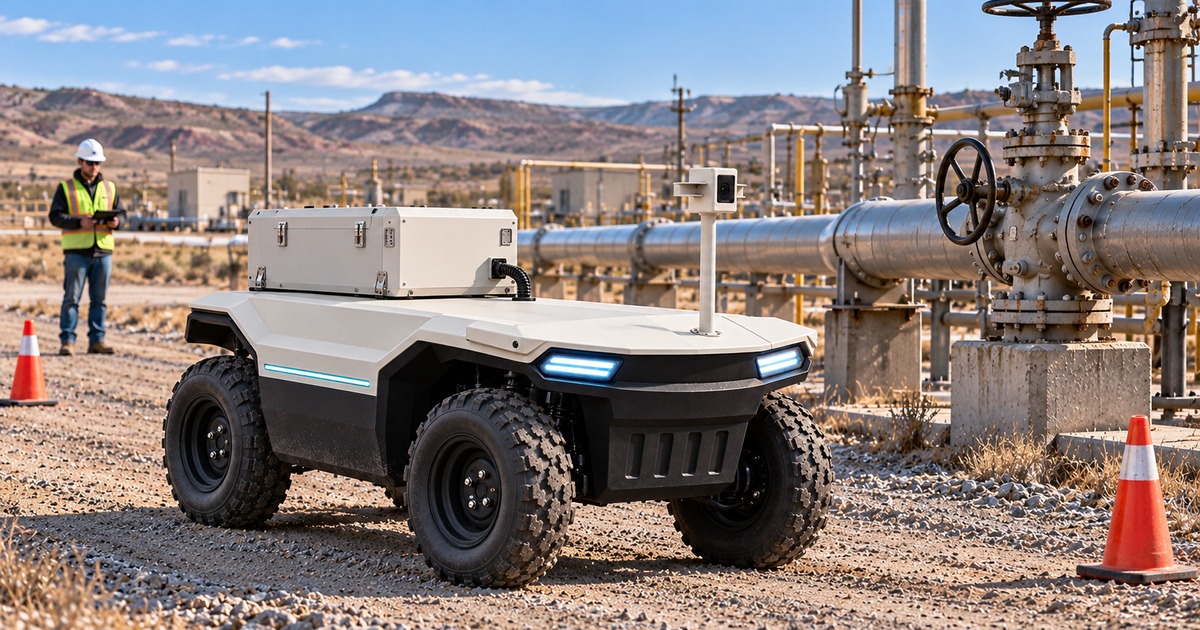 Manufacturer product photograph
Focus 01 · Unmanned inspection
Inspection inside classified areas
Inspect the hazard before sending people.
Remote and semi-autonomous patrol for tank farms, pipe racks and plant perimeters — EO/IR observation, LiDAR and GPS navigation, obstacle avoidance with automatic return and remote takeover.
- EO/IR observation
- LiDAR + GPS
- Obstacle avoidance
- Remote takeover
 Fire-service livery shown — export configuration differs
Focus 02 · Tracked access
Ground that will not carry a wheeled truck
Low ground pressure is a specification, not a slogan.
Tracked carrier for sabkha, dune margins and wet ground — crew, tools and consumables taken to a worksite with no prepared track, on a platform configured for the surface rather than the road.
- Low ground pressure
- Payload deck
- Crew + equipment
- Soft ground
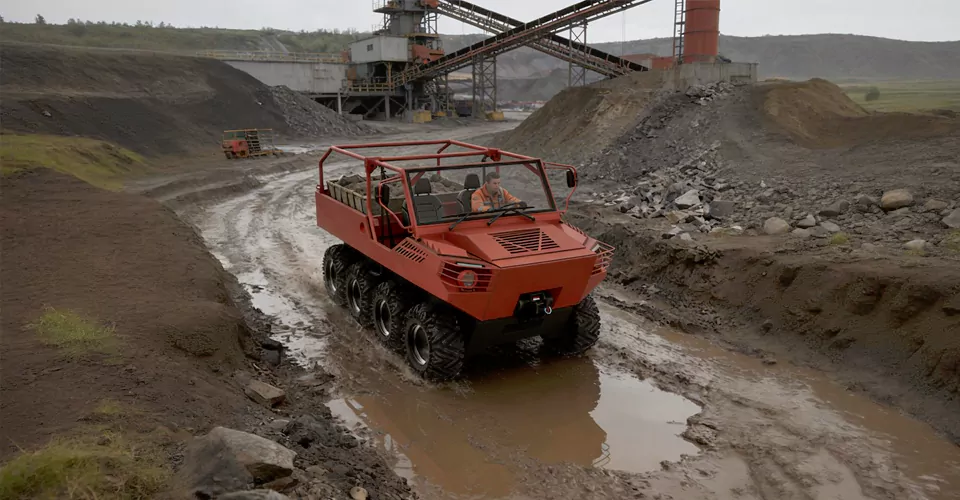 Manufacturer visual — not a project site
Focus 03 · Amphibious crossing
When the road is under water
When the road ends, the rotation does not.
Amphibious all-terrain platform for wadi flooding, submerged access tracks and coastal inundation — six-person mission transport with field power on a range-extended electric architecture.
- Amphibious
- 6 personnel
- Range-extended
- Field power
Illustrative mission configuration. Final vehicle, equipment and system configuration are subject to project-specific engineering, hazardous-area classification and validation.