
Exhibitions & Industry Engagement

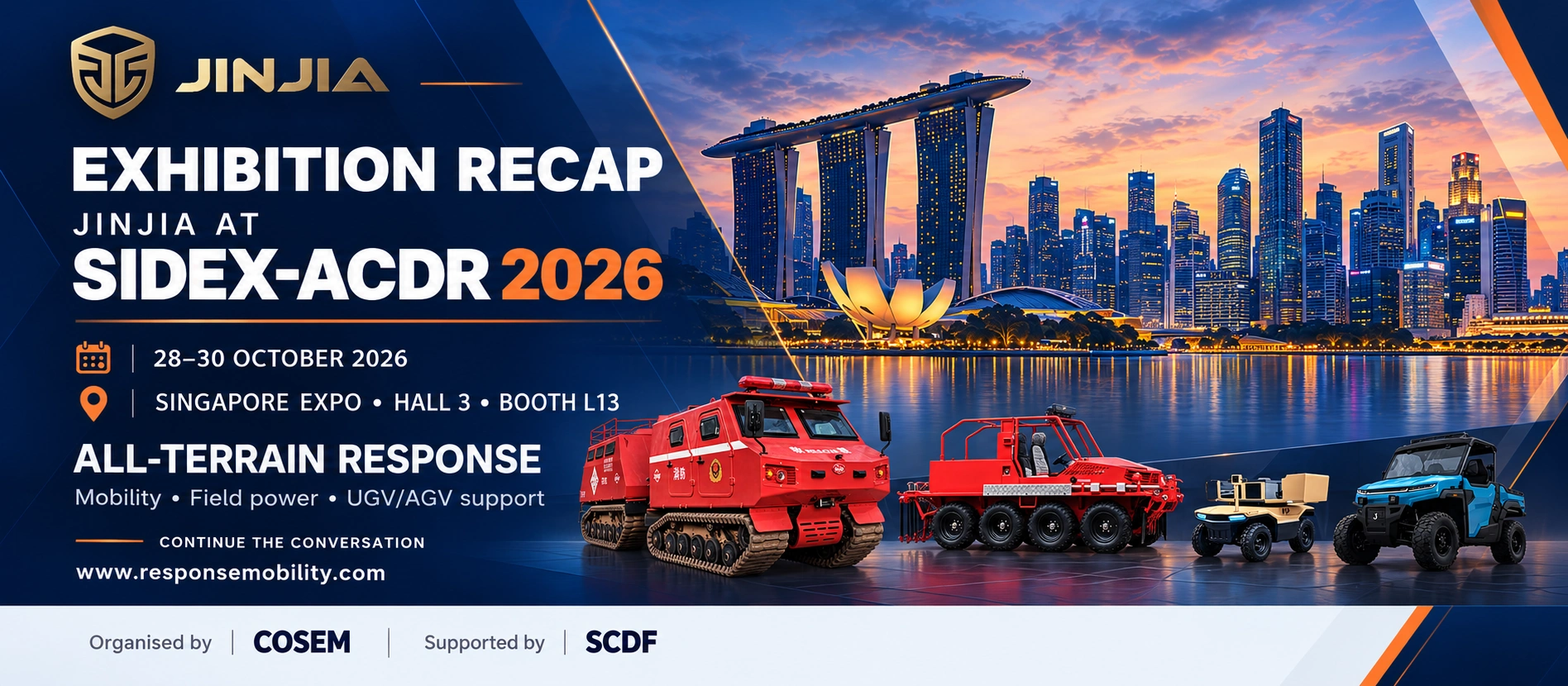
JINJIA at SIDEX-ACDR 2026

Integrated response mobility for Indonesia — nine panels arranged as five zones, from peatland access to multi-platform coordination.

Dates

28–30 Oct 2026

Venue

Singapore EXPO, Hall 3

Stand

L13 & L15

Status

Digital Showroom Open

Explore the Digital Showroom
Overview

The event and why we are there

SIDEX-ACDR 2026, held in conjunction with FiSAC, is the platform for fire, rescue, disaster reduction, management and emergency response professionals in the region.

  • Official nameSIDEX-ACDR 2026, in conjunction with FiSAC
  • Dates28–30 October 2026 · 09:00–17:00
  • VenueSingapore EXPO, Hall 3
  • OrganiserCOSEM Safety & Security Services Pte Ltd
  • SupportSingapore Civil Defence Force (SCDF)
  • FormatExhibition + conference + workshops
  • AudienceFire, rescue, EMS, disaster management, emergency response
  • RegistrationFree visitor pass at sidex.sg
Official organiser theme

“Disaster Resilient Futures: Leadership, Solidarity, Preparedness”

LeadershipDrives strategic influence and regional coordination.
SolidarityFosters collaborative approaches and innovation towards public safety and disaster resilience.
PreparednessEnsures operational readiness, leveraging technology and the community as enablers.
Our Perspective

What we read into the theme

Official organiser theme: SIDEX-ACDR 2026 focuses on fire, rescue, disaster reduction, management and emergency response for a dense urban environment and its regional operating context.
Q1 · What is the organiser saying?

Preparedness is being reframed from “having equipment” to “being able to operate together” — leadership, solidarity and readiness are treated as one problem, not three.

Q2 · Which environments and industries do we focus on?

High-rise and underground built environment; dense urban street networks; petrochemical and industrial installations; flash-flood and coastal inundation; urban search and rescue and hazardous-materials response.

Q3 · Why does it matter?

In most of these incidents the decisive failure point is access and co-ordination — not detection, and not intent. Knowing where the seat of the fire is does not help if nothing can reach it, and reaching it does not help if no one else can see what the crew sees.

Q4 · What position do we bring?

A single vehicle does not solve it. A connected ground system — where robotic, tracked, amphibious, electric and unmanned assets share one picture — is what turns access into command, and command into decisions that survive a degraded network.

Our Response

Four operating problems, four ground configurations

Each configuration is stated as a challenge, the combination we field, and the effect we intend to produce — with the conditions it is engineered for.

Urban Fire · High-Rise & Underground

Challenge
Vertical and below-grade access; interior conditions untenable for personnel
↓
Combination
Firefighting Robot + Fire Rescue UTV + SAE
↓
Effect
Reconnaissance and suppression capability without committing personnel into the hot zone
ConditionsEnclosed space · no public network coverage · high radiant heat · stair and ramp access

Industrial & Petrochemical

Challenge
Plant and facility patrol; thermal anomaly detection; initial response to leaks and fires
↓
Combination
Delta UGV + Firefighting Robot + SAE thermal layer
↓
Effect
Routine inspection with early anomaly identification and a lower cost per patrol
ConditionsHazardous-area classification (ATEX / IECEx pathway) · defined safety regime · defined radio coverage

Flood & Urban Inundation

Challenge
Flash flood, submerged streets, underpass and basement access, evacuation and resupply
↓
Combination
8×8 Amphibious Platform + Articulated Tracked Vehicle + SAE
↓
Effect
Personnel and equipment keep moving when the road network is interrupted
ConditionsWading and water crossing · soft ground and bunds · no fixed infrastructure

USAR & Hazardous Materials

Challenge
Structural collapse, unstable debris, unknown substances, secondary collapse risk
↓
Combination
Tracked Remote Control Vehicle + Delta UGV + EOD robot + SAE
↓
Effect
Reconnaissance and load handling with measurably reduced personnel exposure
ConditionsRubble and narrow voids · degraded communications · indoor and outdoor transition

Configurations shown are illustrative mission configurations. Final vehicle, equipment and system configuration are subject to project-specific engineering, hazardous-area classification and validation.

Showcase

Ten panels, five zones

The stand is arranged as a sequence, not a catalogue: enter the hazard without people → move crew and equipment → cross water and soft ground → inspect unmanned → coordinate everything.

Zone A

Firefighting Robotics

Put distance between the firefighter and the fire.

Put distance between the firefighter and the fire.

Remotely operated tracked robot for structural, industrial and vehicle fire — remote water-monitor operation, thermal imaging for seat-of-fire identification, and sustained operation in conditions not tenable for personnel.

  • Remote water monitor
  • Thermal imaging
  • Tracked chassis
  • Hose drag

Move the load. Not the crew.

Remote-controlled tracked carrier for hose lines, foam concentrate, breathing-air cylinders and rescue equipment across debris, ramps and unstable ground.

  • Remote control
  • Payload deck
  • Debris terrain
  • Equipment forwarding
Zone B

Rapid Intervention & Compact Response

Reach the incident before the heavy apparatus can.

Small enough to get in. Built to work once it is there.

Compact rescue platform sized for narrow streets, basement and loading ramps, industrial walkways and park connectors — carries crew, tools and medical equipment where a full-size appliance cannot enter.

  • Compact footprint
  • Crew + equipment
  • Narrow access
  • Quick deployment

Silent utility. Real work capacity.

500 kg rear cargo-bed payload, zero tailpipe emissions and low noise signature — for tunnels, basements, indoor facilities and prolonged standby duty where exhaust and noise are the limiting factors.

  • 500 kg payload
  • Zero emissions
  • Modular deck
  • Low noise
Zone C

Flood & Amphibious Access

When roads end, response continues.

When roads end, response continues.

Amphibious all-terrain mobility for flash flood, submerged streets, underpasses and coastal inundation — six-person mission transport with field power and communications on a range-extended electric architecture.

  • Amphibious
  • 6 personnel
  • Field power
  • Range-extended EV

Built for soft ground. Ready for real missions.

Low ground pressure and terrain-adaptive articulation for bunds, canal banks, collapse debris and unpaved access — carries personnel, equipment and supplies on a configurable mission platform.

  • Low ground pressure
  • Articulated
  • Modular
  • Configurable deck
Zone D

Unmanned Inspection & Hazardous Areas

Inspect the hazard before sending people.

Inspect the hazard before sending people.

Autonomous and remote inspection for petrochemical facilities, industrial plants, tunnels and post-incident areas — EO/IR observation, LiDAR + GPS navigation, obstacle avoidance with automatic return and remote takeover.

  • EO/IR
  • LiDAR + GPS
  • Obstacle avoidance
  • Remote takeover

Handle the unknown remotely.

Remotely operated manipulation platform for suspected items, unstable loads and post-incident reconnaissance — manipulator arm, multi-camera observation and two-way audio, operating on stairs, gravel and indoor flooring.

  • Manipulator arm
  • Multi-camera
  • Two-way audio
  • Indoor + outdoor
Zone E

Command, Coordination & Programme

The layer that turns separate platforms into one coordinated system.

See. Decide. Coordinate.

Multi-platform command and coordination — common operational picture, live tracking and risk visualization, task dispatch and route coordination, with continuous field feedback and operation without cloud or backbone network.

  • Common picture
  • Live tracking
  • Task dispatch
  • Offline edge

Delivered as a programme, not a product.

Fire, flood, industrial and urban search-and-rescue mobility configured for Singapore and the region — firefighting robots, rescue UTVs, amphibious and tracked platforms, UGVs and SAE, integrated as one system with local support, training and spares planning.

  • Fire
  • Flood
  • Industrial
  • USAR

Illustrative mission configuration. Final vehicle, equipment and system configuration are subject to project-specific engineering and validation.

Book a Meeting

Schedule a 30-minute technical session

Tell us the incident type or access constraint you want to work through. We will confirm a day and time slot at the stand.

Our Perspective

Official organiser theme: ADEXCO 2026 focuses on disaster management, emergency response equipment and civil protection for Indonesia’s multi-hazard environment.

Q1 · What is the organiser saying?

Indonesia faces flood, earthquake and peatland fire events at the same time. Equipment that works in one scenario often fails in another.


Q2 · Which regions and industries do we focus on?

Flood plains and peatland in Sumatra, Kalimantan and Papua; island logistics; mining haul roads in East Kalimantan; oil & gas right-of-way across remote terrain.


Q3 · Why does it matter?

In every one of these events the decisive failure point is access — not detection, and not command intent. Roads that are open are not the same as communities that are reached.


Q4 · What position do we bring?

Vehicles alone do not solve it. A connected ground system — where tracked, wheeled, amphibious, electric and unmanned assets share one picture — is what makes degraded access survivable.

Our Response

Government & Disaster Response

ChallengeFlood, peatland and island access; multi-agency coordination
→
Combination8×8 amphibious + articulated tracked + SAE
→
EffectOne common picture across agencies and terrain types
→
ConditionsSoft ground, water crossing, no fixed infrastructure

Mining

ChallengeHaul-road inspection, evacuation support, tailings access
→
CombinationDelta UGV + electric utility vehicle + SAE
→
EffectHazard assessed without sending people in
→
ConditionsMine sites with defined radio coverage and safety regime

Oil & Gas

ChallengePipeline patrol, wellsite inspection, thermal anomaly checks
→
CombinationDelta UGV + JJ2030A 4×4 + SAE
→
EffectRepeatable inspection at lower cost per patrol
→
ConditionsRight-of-way accessible by 4×4 plus autonomous legs

Remote Industry & Utilities

ChallengeInspection of remote assets without power or coverage
→
CombinationElectric utility vehicle + SAE edge command
→
EffectLow-signature inspection with local decision support
→
ConditionsDisconnected, infrastructure-denied operating conditions
Showcase

ZONE A

Unmanned & Remote Inspection

Inspect the hazard before sending people.

⤢ Enlarge PANEL A-01

Delta UGV · Unmanned Inspection

Inspect the hazard before sending people.

Autonomous and remote inspection for mine sites and hazardous areas. EO/IR observation, LiDAR + GPS navigation, obstacle avoidance with automatic return and remote takeover.

  • EO/IR
  • LiDAR + GPS
  • Obstacle avoidance
  • Remote takeover

ZONE B

Electric & Light High-Mobility

Silent utility with real work capacity — for mine sites, industry and rapid response.

⤢ Enlarge PANEL B-01

Electric Utility Vehicle

Silent utility. Real work capacity.

500 kg rear cargo-bed payload, zero tailpipe emissions and low noise signature, modular rear deck for tools, parts and rescue logistics.

  • 500 kg payload
  • Zero emissions
  • Modular deck
  • Low noise

⤢ Enlarge PANEL B-02

JJ2030A · Light High-Mobility 4×4

One platform. Multiple critical missions.

Right-hand drive for Indonesia, up to six occupants, 600 km road range and 2,500 kg towing capacity on a mission-ready rear platform.

  • Right-hand drive
  • 6 occupants
  • 600 km range
  • 2,500 kg towing

ZONE C

All-Terrain & Amphibious Access

When roads end, response continues — peatland, swamp, mud and flood.

⤢ Enlarge PANEL C-01

8×8 Amphibious Response Platform

When roads end, response continues.

Amphibious all-terrain mobility for flood, mud, swamp and extreme terrain. Six-person mission transport with field power, communications and a range-extended electric architecture.

  • Amphibious
  • 6 personnel
  • Field power
  • Range-extended EV

⤢ Enlarge PANEL C-02

Articulated Tracked Vehicle

Built for soft ground. Ready for real missions.

Low ground pressure and terrain-adaptive articulation for peatland, swamp, mud and flooded areas. Carries personnel, equipment and supplies on a configurable mission platform.

  • Low ground pressure
  • Articulated
  • Modular
  • Local support

ZONE D

Situational Awareness & Multi-Platform Coordination

The layer that turns separate vehicles into one coordinated system.

⤢ Enlarge PANEL D-01

Indonesia Programme Overview

All-terrain response & industrial mobility for Indonesia.

Terrain access across flood, peatland, swamp, mountains and islands — delivered as one coordinated system: 8×8, JJ2030A, Electric UTV, Delta UGV, Articulated Tracked Vehicle and SAE.

  • Flood
  • Peatland
  • Swamp
  • Mountains
  • Islands

⤢ Enlarge PANEL D-02

Situational Awareness Engine

See. Decide. Coordinate.

Multi-platform command and coordination — common operational picture, live tracking and risk visualization, task dispatch and route coordination, with continuous field feedback.

  • Common picture
  • Live tracking
  • Task dispatch
  • Field feedback

ZONE E

Industry Programmes

Oil & gas, mining and national response — configured as programmes, not products.

⤢ Enlarge PANEL E-01

Oil & Gas Operations

Remote inspection for oil & gas operations.

Pipeline and right-of-way patrol, wellsite and facility inspection, visual plus thermal anomaly assessment, and remote site access with emergency support.

  • Pipeline patrol
  • Wellsite
  • Thermal
  • Emergency support

⤢ Enlarge PANEL E-02

Mining Mobility & Safety

Safer mobility for mines & remote sites.

Haul-road and pit-area inspection, mine emergency and evacuation support, tools/parts logistics, tailings and soft-ground access, and remote hazardous-area reconnaissance.

  • Haul-road
  • Evacuation
  • Tailings access
  • Reconnaissance

Illustrative mission configuration. Final vehicle, equipment and system configuration are subject to project-specific engineering and validation.


Panel

Panel

Board artwork is shown as reference only — the full text is available on this page.
Press ESC or click ✕ to close. Focus returns to the panel you opened.


Highlights

STAND · HALL D2 / 964

09 Sep 2026 · Opening day

Stand opened

Five zones opened to institutional visitors; Zone C drew the largest disaster-response delegation.

TECHNICAL EXCHANGE

10 Sep 2026

Peatland configuration clinic

Ground-pressure and water-supply questions answered against real Kalimantan photographs.

DEMONSTRATION

11 Sep 2026

SAE edge command walkthrough

Disconnected-operation demonstration: tracking and task dispatch without cloud or backbone network.

Key Takeaways

Questions visitors actually asked

  • Local maintenance and spare-part availability inside Indonesia, not just delivery.
  • Ground-pressure figures for specific peat classes rather than generic soft-ground claims.
  • Whether UGV inspection can be certified under existing mine safety regimes.
  • Water supply over long distances onpeat rather than short-distance pumping.

Technical understanding gained

  • Confirmed that 8×8 amphibious sizing matches current Kalimantan canal-crossing practice.
  • Revised robustness assumption for Delta UGV occupations after four Site visits.
  • Identified right-hand-drive configuration as a gating requirement, not an option.
  • Open question carried forward: local certification pathway for autonomous patrol.
Resources

Meeting Booking