

Direct answer: when are articulated tracked vehicles useful for pipeline maintenance?
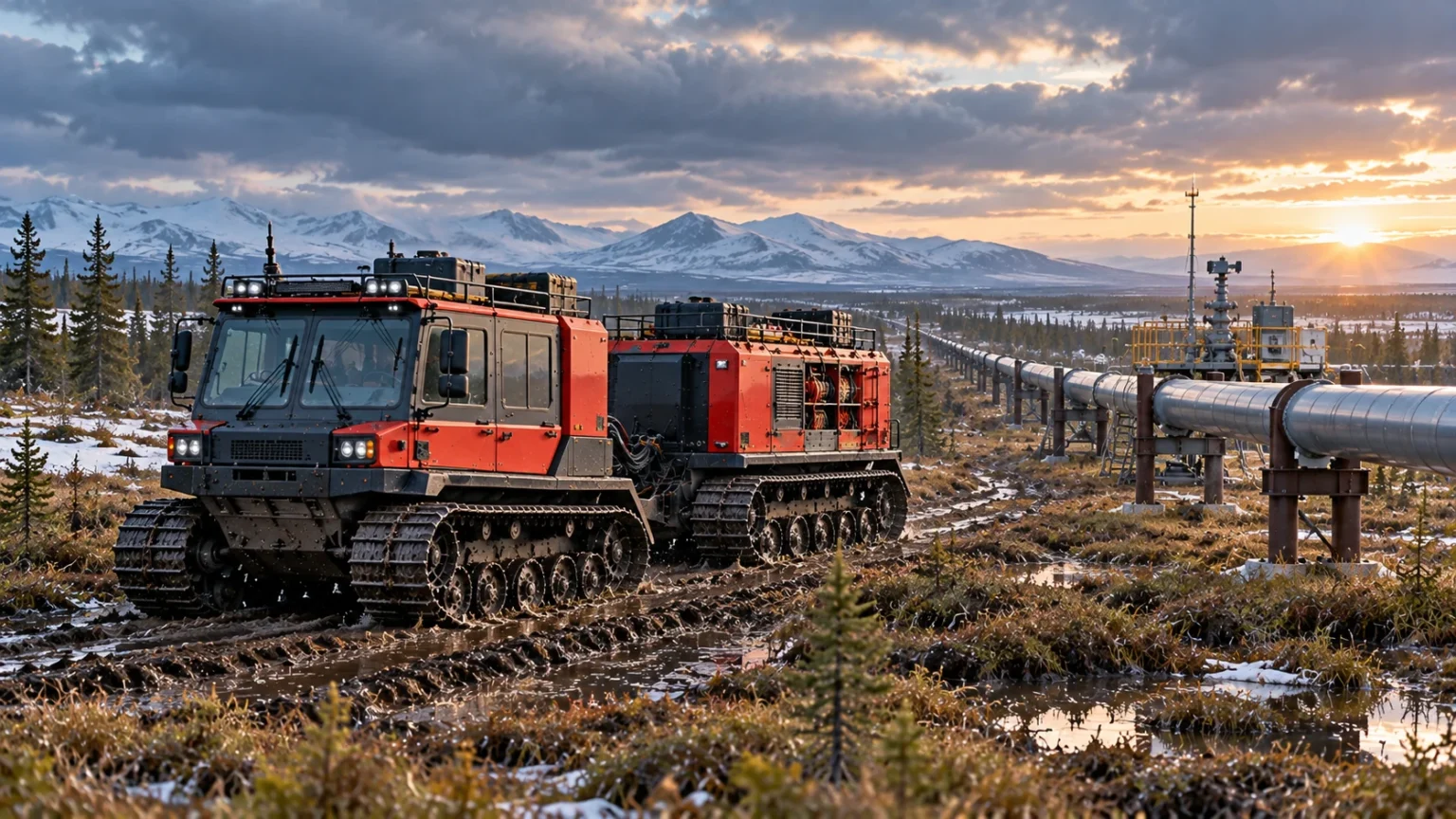
Articulated tracked vehicles can be considered for transporting authorized inspection teams, maintenance tools and emergency supplies to remote oil and gas pipeline facilities when roads are absent, seasonal or unsuitable for standard service trucks. The strongest candidate routes include designated access paths through soft ground, snow-covered service corridors and uneven terrain leading to valve stations and inspection points.
A tracked carrier is a mobility and logistics support platform—not a pipeline integrity inspection instrument, in-line inspection (ILI) tool, excavation permit or authorization to drive over buried pipelines. Route permissions, full operating mass, soil conditions and pipeline-owner restrictions determine whether deployment is appropriate.
The real pipeline challenge: reaching a worksite without creating a new hazard
A right-of-way (ROW) is the controlled corridor associated with pipeline construction, inspection and maintenance. Operators need reliable access to markers, valves, exposed features and possible erosion or third-party interference. Some sections are inspected remotely; others require field teams and equipment at a specific location.
Remote access varies by season and geography. Peatland and marsh soils may shear under traffic, thaw can weaken previously frozen ground, and storm-damaged stream crossings may become impassable. The question is not simply whether a tracked vehicle can traverse a surface, but whether it can reach an approved work point without overloading the ground, damaging the pipeline or disturbing a protected habitat.
Seven practical pipeline-support missions
01 — ROW reconnaissance: carry authorized crews, cameras and survey tools to observe accessible surface conditions, markers, erosion, drainage changes and possible encroachment.
02 — Valve and instrument stations: deliver technicians, hand tools, spare components and test equipment to remote block valves, metering or communications locations.
03 — Cathodic-protection survey support: transport qualified specialists and portable survey equipment; the vehicle does not itself measure or certify cathodic protection.
04 — Maintenance logistics: carry suitable hoses, portable power, tools, temporary lighting and selected replacement parts within verified load limits.
05 — Leak or incident response logistics: support authorized responders from a safe staging point when an operator-approved access route exists; do not enter uncontrolled release or hazardous areas.
06 — Flood, snow and erosion assessments: move inspection teams to locations near damaged approaches after terrain, water depth and recovery plans have been evaluated.
07 — Construction and reinstatement support: deliver appropriate small supplies to permitted work areas, subject to site control and environmental restrictions.
These are application opportunities, not evidence that a JJ117 has performed all listed pipeline missions for named operators.
Why tracked and articulated geometry may help—without guaranteeing access
Tracks can distribute supported mass over an extended ground-contact area, and a two-section articulated configuration may help adapt to irregular approaches. Separate personnel and cargo modules can be assessed for different assignments. Yet nominal ground pressure alone does not predict sinkage, shear failure or repeated-pass rutting.
Engineering selection requires full operating mass, each section’s weight distribution, effective track contact length and width, turning resistance, vegetation sensitivity, gradients and recovery access. An overloaded rear module can immobilize a carrier even if the front section advances. Route verification must cover turns, stopping, starts and repeated passes at the intended payload.
Critical rule: do not drive over a buried pipeline without operator approval
This point deserves explicit attention: low nominal track pressure does not grant permission to cross a buried pipeline. Heavy machines can impose concentrated or dynamic loads through the soil and may damage a pipe or its coating; the likelihood depends on depth of cover, pipe design, ground condition, vehicle mass and route geometry.
U.S. PHMSA guidance illustrates why pipeline ROW access must be coordinated with the operator. A proposed heavy-equipment crossing may require a reviewed crossing point, suitable mats or engineered protection, marked facilities, a spotter and written permission. The precise obligations vary by country, pipeline owner and work scope; U.S. guidance is a safety reference, not a universal legal rule for Kazakhstan, Russia or other markets.
The vehicle should travel only on the approved route. Excavation, trenching, drilling and ground disturbance require separate locating, damage-prevention and permit procedures. A surface pipeline marker does not identify the exact pipe depth or position.
Hazardous areas, oil and gas HSE, and environmental controls
A general tracked carrier must not be advertised as intrinsically safe, explosion-proof, H2S-certified or suitable for entry into a gas-release zone unless the complete configuration is specifically assessed and approved. A pipeline emergency may require exclusion zones, gas monitoring, respiratory protection, ignition-source controls and remote staging under the operator’s emergency plan.
Pipeline rights-of-way also cross sensitive habitats. Repeated tracking through peatlands or wetlands can damage vegetation, hydrology and soil structure. The American Petroleum Institute describes conservation opportunities on ROWs; such habitat considerations should be integrated with route selection, traffic limits and restoration requirements.
JJ117-X1 and JJ117-X2: what JINJIA actually publishes
On the official JINJIA / Response Mobility Tracked Utility Vehicle page, both JJ117-X1 and JJ117-X2 have a manufacturer-published “Weight” field of 17,000 kg, maximum road speed of 65 km/h and stated operating-temperature range of −43°C to +50°C. Published dimensions are 9.1 × 2.45 × 3.6 m for X1 and 9.1 × 2.45 × 2.6 m for X2. These are manufacturer website data, not independently verified field-performance measurements.
The 17,000 kg figure is a weight field, not a rated 17-tonne payload. Road speed does not indicate speed on peat or a pipeline ROW. The page does not publish verified peatland ground pressure, permissible pipeline crossing loads, qualified hazardous-area access, route-specific winter reliability or completed inspection contracts. Any project proposal requires an approved configuration and supporting engineering evidence. Official product information: https://responsemobility.com/tracked-utility-vehicle/
Engineering checklist for a pipeline operator or EPC
1. Mission: routine patrol, valve maintenance, corrosion survey support, emergency logistics or construction support; specify task equipment and number of crew.
2. Route: coordinates, existing access and legal ROW rights, known underground facilities, bridges, slopes, seasonality, wetlands, flood zones and approved crossing points.
3. Loads: gross operating weight, payload, towing requirements, front/rear section mass, ground-contact area and load distribution.
4. Safety: operator approval, route marking, crossing method, HSE zone classification, gas-monitoring requirements, communications, emergency extraction and recovery equipment.
5. Acceptance: define actual loaded field trials, stop/go criteria, ground disturbance limits, maintenance plan, operator training and spare-parts availability.
FAQ for engineering and procurement teams
Q: Can tracked vehicles be used for oil and gas pipeline inspection?
A: They can transport qualified teams and supporting tools on permitted routes. They do not replace specialized ILI systems, leak detection or pipeline integrity assessments.
Q: Is it safe to drive a tracked vehicle directly above an underground pipeline?
A: Not without the pipeline operator’s authorization and an engineering review of cover, loads and protective measures. Low track pressure alone is insufficient.
Q: Are tracked vehicles suitable for swamp or peatland pipeline routes?
A: They may be candidates, but site-specific bearing capacity, sinkage, repeated passes and ecological permissions must be assessed.
Q: Can JJ117 enter gas-hazardous areas?
A: The public product page does not establish whole-vehicle hazardous-area, explosion-proof or H2S certification; do not assume approval.
Q: What information should an RFQ contain?
A: Operating Terrain | Required Payload | Environmental Conditions | Intended Application | Estimated Quantity; add route maps, ROW restrictions, crossing permits, country and schedule.
Request a route-specific mobility assessment from JINJIA
JINJIA / Response Mobility evaluates articulated tracked platform concepts for remote industrial logistics, including pipeline-support assignments on approved access routes. We begin with the mission and site constraints rather than promising a universal all-terrain solution.
Please send five design inputs: Operating Terrain | Required Payload | Environmental Conditions | Intended Application | Estimated Quantity. If available, include ROW maps, access/crossing approvals, seasonal ground surveys, load distribution and HSE requirements.
JJ117 product page: https://responsemobility.com/tracked-utility-vehicle/ | Technical inquiry: https://responsemobility.com/contact/ | Email: info@responsemobility.com
Sources and verification references
JINJIA / Response Mobility — JJ117-X1 and JJ117-X2 official Tracked Utility Vehicle product page (reviewed 2026-10-15) — https://responsemobility.com/tracked-utility-vehicle/
U.S. PHMSA — Briefing: Pipeline Rights-of-Way — https://primis.phmsa.dot.gov/stakeholder-comms/rowbrief/
U.S. PHMSA — PIPA BL15: Enhance Damage Prevention Practices near High-Priority Subsurface Facilities — https://primis.phmsa.dot.gov/stakeholder-comms/pipa/pipa-practice-bl15/
U.S. PHMSA — Excavation Damage and Pipeline Marker Limitations — https://primis.phmsa.dot.gov/stakeholder-comms/factsheets/FSExcavationDamage/
U.S. PHMSA — Phases of Pipeline Construction — https://www.phmsa.dot.gov/technical-resources/pipeline/pipeline-construction/phases-pipeline-construction-overview
American Petroleum Institute — Pipeline Right-of-Way Conservation Guidelines (2022) — https://www.api.org/news-policy-and-issues/news/2022/02/10/api-releases-conservation-guidelines
U.S. PHMSA — Pipeline safety advisory on preventing excavation damage (2026) — https://www.transportation.gov/regulations/federal-register-documents/2026-07752