

Direct answer: can tracked vehicles support oil spill response?
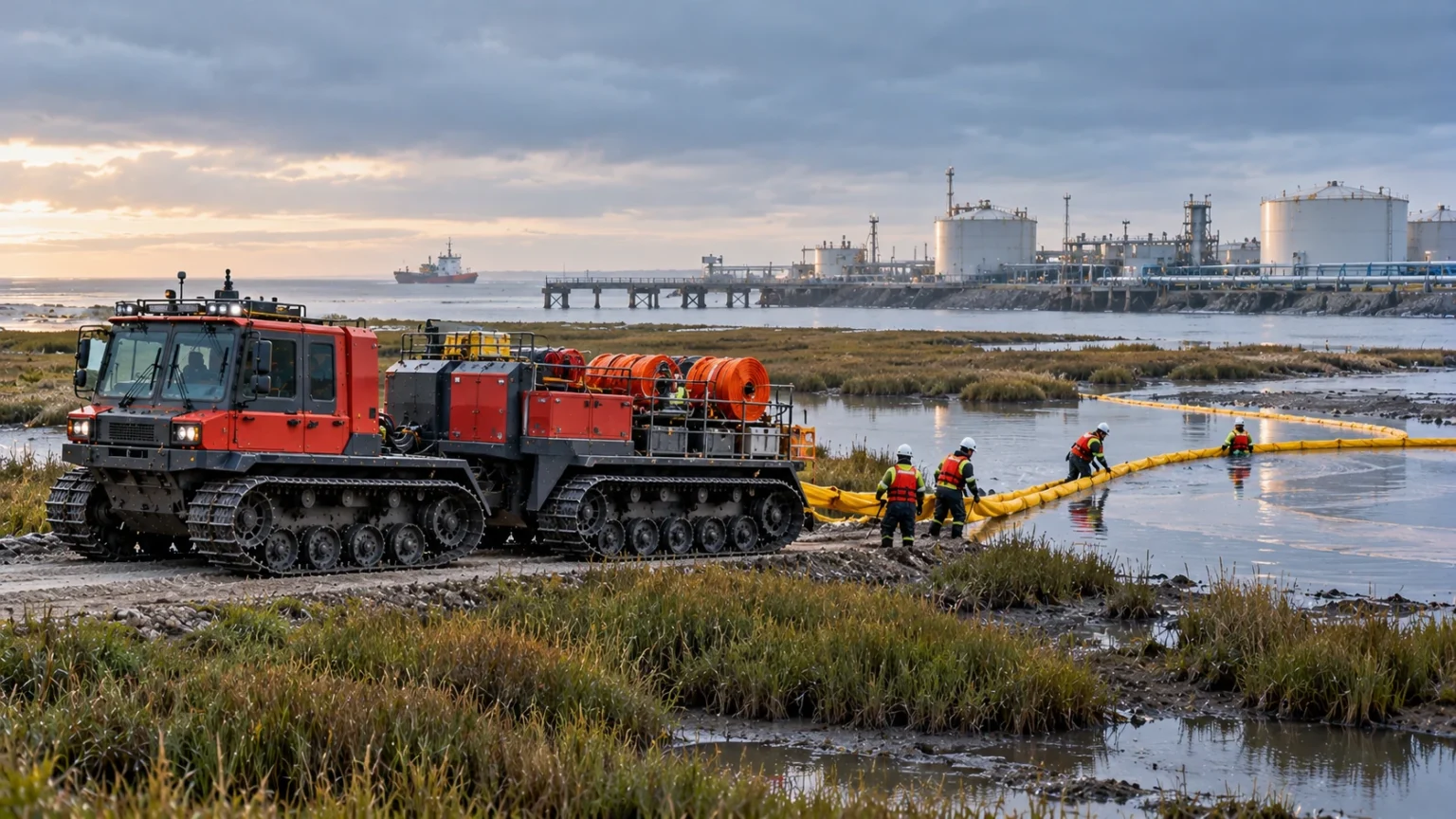
Tracked mobility platforms may support the logistics of an oil spill response by transporting authorized teams, containment boom, absorbents, hoses, portable power, communications equipment and selected recovery-system components to staging points near difficult shorelines. Their role is primarily access and transport; actual containment, oil recovery and disposal require dedicated systems, trained personnel and an approved incident response plan.
A vehicle that can approach a wet shoreline should not automatically enter an oiled marsh. In sensitive habitats, heavy machinery and repeated traffic can damage vegetation, disturb soils and worsen the impact of the spill. The central engineering question is not simply “Can it cross?” but “Can it reach the right work area safely, with a net environmental benefit?”
Why shoreline logistics is often the bottleneck?
A coastal incident may involve mudflats, shallow inlets, saltmarsh, peat, soft embankments and waterlogged service tracks. Standard road trucks may be unable to reach a safe equipment handover point. Work boats can face shallow-draft constraints or have no suitable landing area. Tides, currents and changing ground strength may make a route usable at one time and hazardous later.
The response commander normally needs survey results before allowing traffic. NOAA describes Shoreline Cleanup Assessment Technique (SCAT) as a systematic process for mapping shoreline oiling, identifying sensitive resources and selecting cleanup constraints and endpoints. A proposed tracked access route should be compatible with those findings, not treated as an exception to them.
Seven field tasks where a tracked logistics platform may be assessed
01 — Boom logistics: transport packaged boom, anchors, ropes, tools and deployment accessories to an approved staging site; the boom must be deployed according to the water and shoreline response plan.
02 — Portable equipment transport: move compatible pumps, generators, skimmer components, sorbents and hoses within the confirmed payload envelope.
03 — Personnel shuttle: carry authorized technical staff between approved access points where personnel seating, communications and safe exit are adequately provided.
04 — Shoreline survey support: bring SCAT team instruments, sampling consumables and communications gear to the perimeter of the survey site, without disturbing sensitive habitat.
05 — Remote shoreline support: enable equipment handover where prepared roads stop, provided the operator has approved route geometry and ground-bearing data.
06 — Response base logistics: help establish tool caches, lighting, portable power or mobile communications in a permitted incident staging area.
07 — Demobilization and waste logistics: transport only properly packaged, classified and secured materials under the incident waste plan; contaminated loads require containment and decontamination arrangements.
These are possible mission profiles, not verified contracts or documented oil spill deployments by JINJIA.
Protecting marshes may mean keeping the vehicle outside them
NOAA guidance on oiled marshes explains that active cleanup can cause physical damage from machinery, personnel trampling and the methods employed. In some circumstances monitored natural recovery is preferred. ITOPF likewise notes that inappropriate shoreline cleaning can worsen the ecological harm.
A tracked platform may reduce nominal ground pressure compared with some wheeled alternatives, but nominal ground pressure is not a permit to drive in protected habitats. Site authorities must assess soil shear strength, rutting, vegetation, water flow, repeated passes, spill sensitivity and whether a temporary access mat or a nearby firm staging point would be less harmful.
Any route crossing a sensitive marsh should require an ecological assessment, explicit approval, traffic limits, documented entry/exit procedures and a plan for monitoring and reinstatement. Where the environmental cost is unacceptable, the correct choice is no vehicle entry.
What the carrier does—and what specialist oil spill equipment does
Containment booms are barriers that can redirect or limit the movement of oil when deployed and anchored correctly. Skimmers separate recoverable oil from water and transfer it to appropriate storage. Sorbents, pumps, vacuum systems and temporary tanks each have distinct specifications and limitations.
A carrier can move compatible components to a response location, but carrying a skimmer is not the same as operating a certified recovery system. Oil type, weather, currents, viscosity, storage logistics, waste classification and access determine the actual response technique.
For marine or open-water work, flotation, powered navigation and any flag-state or class requirements are separate from soft-ground driving performance.
Vehicle selection: traction, payload and environmental control
An engineering assessment should begin with full operating mass—including occupants, tools, fuel and any module—and the effective track contact geometry. Ground pressure is only a screening indicator: peat and wet silt can fail in shear, deform under repeated passes or lose support as water levels rise.
Check maximum allowed track width, turning footprint, slope, bank stability, towing and recovery arrangements, decontamination access and whether the site bans internal-combustion engines or other ignition sources. If a module carries liquids or drums, evaluate retention, tie-down, spill prevention and dynamic stability.
Vehicle movement must avoid creating a new release of fuel or oils and should comply with operator HSE and environmental restrictions.
JINJIA JJ117-X1 and JJ117-X2: published facts, not spill-recovery certifications
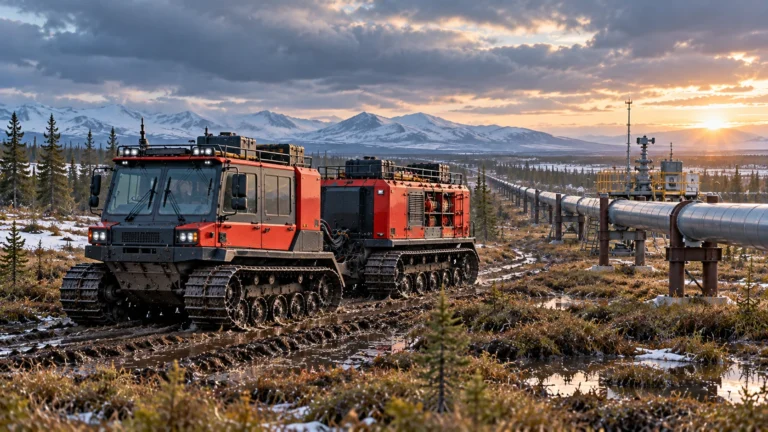
JINJIA’s official JJ117 Tracked Utility Vehicle page lists two configurations, JJ117-X1 and JJ117-X2, each with “Weight” stated as 17,000 kg and maximum road speed of 65 km/h. Published dimensions are 9.1 × 2.45 × 3.6 m for X1 and 9.1 × 2.45 × 2.6 m for X2; the manufacturer lists an operating temperature range of −43°C to +50°C for both. The 17,000 kg field is not a published payload rating.
The X2 page also lists 5 km/h floating speed; X1 separately lists firefighting pump data. These are distinct configurations, not proof that a single unit combines all functions. The public page does not provide measured nominal ground pressure, certified marsh-entry capability, oil-recovery capacity, explosion-proof approval or proof of operating in an actual contaminated shoreline response.
The official JJ117 series is therefore a candidate for project-specific review of permitted logistics missions, not a ready-certified oil skimmer or environmentally harmless wetland vehicle. Product facts: https://responsemobility.com/tracked-utility-vehicle/
Safety, contamination control and the operational boundary
Oil spill operations can involve flammable vapours, oxygen deficiency, toxic gases, unstable banks, contaminated surfaces and moving water. Site safety teams must define exclusion zones, atmospheric monitoring, ignition source restrictions, personal protective equipment, escape routes and emergency recovery methods.
Before entry, identify clean-to-dirty traffic routes and set up suitable wheel/track decontamination, wastewater containment and waste handling procedures. If the vehicle is not qualified for a hazardous location, it must remain outside that zone regardless of its terrain capability.
All containment, pumping, lifting and waste handling should follow applicable local permits and the incident management system. Neither a tracked undercarriage nor a manufacturer brochure replaces those approvals.
A practical seven-stage engineering and deployment workflow
Stage 1 — Define the mission: equipment delivery, personnel, staging, containment support or waste movement; separate transport from actual oil recovery.
Stage 2 — Review the SCAT or equivalent shoreline assessment and the response commander’s environmental constraints.
Stage 3 — Survey access points: soil, slope, tides, water depth, sensitive areas and alternative non-vehicle routes.
Stage 4 — Confirm vehicle and payload: mass, track contact geometry, stability, fuel/energy system and approved accessories.
Stage 5 — Obtain safety and environmental permissions; establish traffic limits, communications and contingency recovery.
Stage 6 — Run a supervised trial on representative, permitted terrain; inspect rutting and route damage before scale-up.
Stage 7 — Operate under the incident plan and document decontamination, equipment handover and final site restoration.
Frequently asked questions
Q: Can a tracked vehicle clean up an oil spill?
A: A carrier mainly provides access and transportation. Cleanup requires approved response methods, specialist equipment and trained teams.
Q: Is low ground pressure enough to operate in marshland?
A: No. Soil strength, repeated traffic, ecological sensitivity and access permissions must be considered.
Q: Can JJ117 carry containment booms and skimmers?
A: Suitable packaged equipment may be considered, but usable payload, fixing, power and safety requirements must be confirmed for the selected configuration.
Q: Does JJ117-X2’s stated floating speed authorize offshore operations?
A: No. It does not establish marine certification, weather limits, navigation approval or oil recovery capability.
Q: Should a vehicle enter every oiled wetland?
A: No. In some marshes the approved response may prioritize non-entry or natural recovery to prevent further harm.
Q: What data should be submitted to JINJIA?
A: Operating terrain, required payload, environmental conditions, intended application and estimated quantity; add oil type, site safety classification, access survey and equipment list.
Discuss a shoreline logistics configuration with JINJIA
JINJIA / Response Mobility can review specialized tracked mobility concepts for remote environmental-response logistics where the route and operating authority permit vehicle access. We begin with mission definitions and environmental constraints rather than promising an untested configuration.
Please share five design inputs: Operating Terrain | Required Payload | Environmental Conditions | Intended Application | Estimated Quantity. For a spill-response project, also provide the approved shoreline access plan, response equipment manifest, contaminated/clean zone layout and applicable HSE and environmental permits.
Official JJ117 platform: https://responsemobility.com/tracked-utility-vehicle/ | Enquiries: https://responsemobility.com/contact/ | Email: info@responsemobility.com
References and evidence
JINJIA official JJ117-X1/X2 Tracked Utility Vehicle specifications — https://responsemobility.com/tracked-utility-vehicle/
NOAA — Shoreline Cleanup Assessment Technique (SCAT) — https://response.restoration.noaa.gov/scat
NOAA — Oil Spills in Marshes: Planning & Response Considerations — https://response.restoration.noaa.gov/sites/default/files/Oil_Spills_in_Marshes.pdf
NOAA — Spill Containment Methods (booms) — https://response.restoration.noaa.gov/oil-and-chemical-spills/oil-spills/spill-containment-methods.html
IPIECA / IOGP — Shoreline response programme guidance — https://www.ipieca.org/resources/shoreline-response-programme-guidance
IOGP — A guide to shoreline clean-up techniques (Report 521) — https://www.iogp.org/bookstore/product/a-guide-to-shoreline-clean-up-techniques/
ITOPF — TIP 07: Clean-up of oil from shorelines — https://www.itopf.org/knowledge-resources/documents-guides/tip-07-clean-up-of-oil-from-shorelines/
ITOPF — TIP 05: Use of skimmers in oil pollution response — https://www.itopf.org/knowledge-resources/documents-guides/tip-05-use-of-skimmers-in-oil-pollution-response/