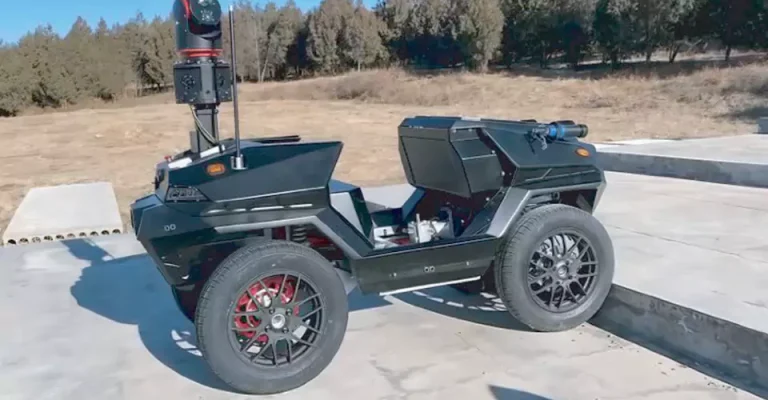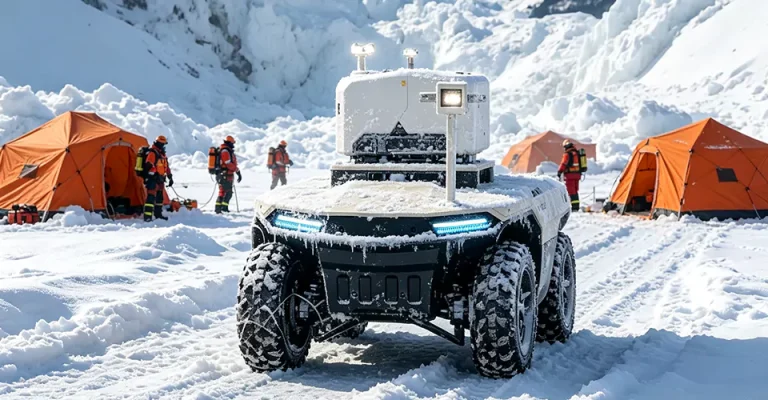











Unmanned Ground Vehicles (UGVs) are robotic systems designed to operate on land without an onboard human driver. They can be remotely controlled, semi-autonomous, or fully autonomous depending on their level of technology and intended application.
As automation and robotics continue to evolve, UGVs are being widely adopted across industries such as agriculture, logistics, construction, mining, and infrastructure inspection. Understanding the different types of UGVs helps businesses choose the right system for their operational needs.
1. Remotely Operated UGVs
Remotely operated UGVs are controlled in real time by a human operator using a remote control system, computer interface, or wireless communication link.
Key Features:
- Full human control from a distance
- Real-time video and sensor feedback
- Simple deployment and operation
- Reliable in hazardous environments
Common Applications:
- Industrial inspection in dangerous areas
- Hazardous material handling
- Emergency response operations
- Infrastructure maintenance in unsafe zones
These vehicles are often used when human presence on-site would be risky or impractical.
2. Semi-Autonomous UGVs
Semi-autonomous UGVs combine human supervision with automated functions. While an operator may still guide the vehicle, certain tasks are handled by onboard systems.
Key Features:
- Assisted navigation and obstacle avoidance
- Automated route following
- Human oversight for decision-making
- Increased operational efficiency
Common Applications:
- Agricultural field operations
- Warehouse logistics and transport
- Construction site material movement
- Mining support operations
Semi-autonomous systems are widely used because they balance automation with human control.
3. Fully Autonomous UGVs
Fully autonomous UGVs operate independently using advanced sensors, artificial intelligence, and mapping technologies. They can navigate and complete tasks without direct human intervention.
Key Features:
- AI-based decision-making
- Advanced navigation systems (LiDAR, GPS, cameras)
- Real-time environment mapping
- Self-learning and adaptive behavior
Common Applications:
- Smart warehouse logistics
- Large-scale agricultural automation
- Industrial transport systems
- Mining and remote operations
These vehicles represent the most advanced category of UGV technology.
4. Wheeled UGVs
Wheeled UGVs are the most common type and are designed for smooth and relatively stable surfaces.
Key Features:
- High speed on flat terrain
- Lower maintenance requirements
- Energy-efficient operation
- Simple mechanical structure
Common Applications:
- Indoor logistics
- Factory automation
- Campus delivery systems
- Urban inspection tasks
Wheeled UGVs are ideal where terrain is predictable and smooth.
5. Tracked UGVs
Tracked UGVs use continuous rubber or steel tracks instead of wheels, making them highly suitable for rough terrain.
Key Features:
- Excellent traction on mud, snow, and sand
- Low ground pressure
- High stability on uneven surfaces
- Strong off-road capability
Common Applications:
- Construction sites
- Forestry operations
- Disaster response areas
- Mining environments
Tracked UGVs are preferred for challenging outdoor conditions where wheeled vehicles may struggle.
6. Hybrid UGVs
Hybrid UGVs combine multiple mobility systems or power sources to improve flexibility and performance.
Key Features:
- Combination of wheels and tracks or multi-mode mobility
- Enhanced adaptability to terrain changes
- Improved energy efficiency (electric + fuel systems)
- Extended operational range
Common Applications:
- Multi-terrain industrial operations
- Research and exploration missions
- Environmental monitoring
- Remote infrastructure projects
Hybrid systems are designed for maximum versatility.
7. Specialized Application UGVs
Some UGVs are designed for very specific tasks or industries, incorporating customized hardware and software.
Key Features:
- Purpose-built designs
- Specialized sensors or tools
- Industry-specific configurations
- High customization capability
Common Applications:
- Agricultural spraying robots
- Security patrol robots
- Surveying and mapping systems
- Payload transport vehicles
These vehicles are tailored to meet precise operational requirements.
Key Factors in Choosing a UGV Type
When selecting a UGV, consider the following:
- Terrain conditions (flat, rough, mixed)
- Level of autonomy required
- Payload capacity
- Operational environment (indoor or outdoor)
- Power system (electric, hybrid, fuel-powered)
- Communication range and connectivity
- Budget and maintenance requirements
Choosing the right type ensures better performance, safety, and cost efficiency.
Conclusion
Unmanned Ground Vehicles come in many forms, including remotely operated, semi-autonomous, and fully autonomous systems, as well as wheeled, tracked, hybrid, and specialized models. Each type is designed to meet specific operational challenges across different industries.
As robotics and AI technologies continue to advance, UGVs are becoming more capable, efficient, and widely used in modern industrial and commercial applications.
For more information about advanced tracked vehicles and unmanned ground vehicle solutions, contact JINJIA Special Equipment at panjun@responsemobility.com. Their team can help you select the right UGV system based on your operational requirements.