










If you have ever looked at an off-road vehicle, truck, or all-terrain vehicle, you have probably seen terms such as 4×4, 4WD, AWD, 6×6, and 8×8. These numbers describe how many wheels a vehicle has and how many of them are driven.
Among these terms, 4×4 is one of the most common. But what exactly does it mean, and why is four-wheel drive useful for off-road vehicles?
What Does 4×4 Mean?
4×4 means that a vehicle has four wheels and power can be delivered to all four wheels.
The first number represents the total number of wheels, while the second number represents the number of driven wheels.
For example:
| Term | Meaning |
|---|---|
| 4×2 | 4 wheels, 2 driven wheels |
| 4×4 | 4 wheels, 4 driven wheels |
| 6×6 | 6 wheels, 6 driven wheels |
| 8×8 | 8 wheels, 8 driven wheels |
Therefore, a typical 4×4 off-road vehicle has four wheels and a drivetrain capable of powering all four.
What Is Four-Wheel Drive?
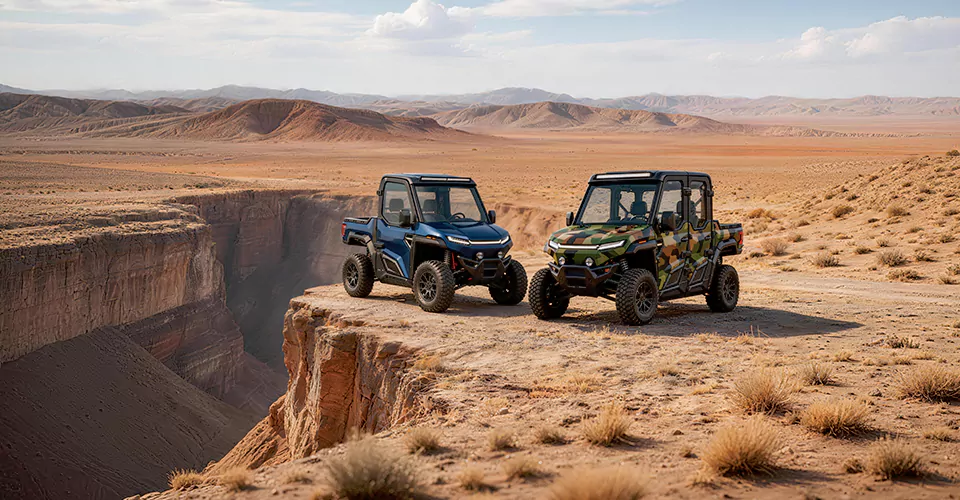
Four-wheel drive (4WD) is a drivetrain system that sends engine power to all four wheels.
When driving on normal roads, a vehicle may not need power going to all four wheels. But on loose, slippery, or uneven terrain, driving all four wheels can improve traction.
For example, if one or two wheels lose traction in mud, the other driven wheels can continue providing forward force.
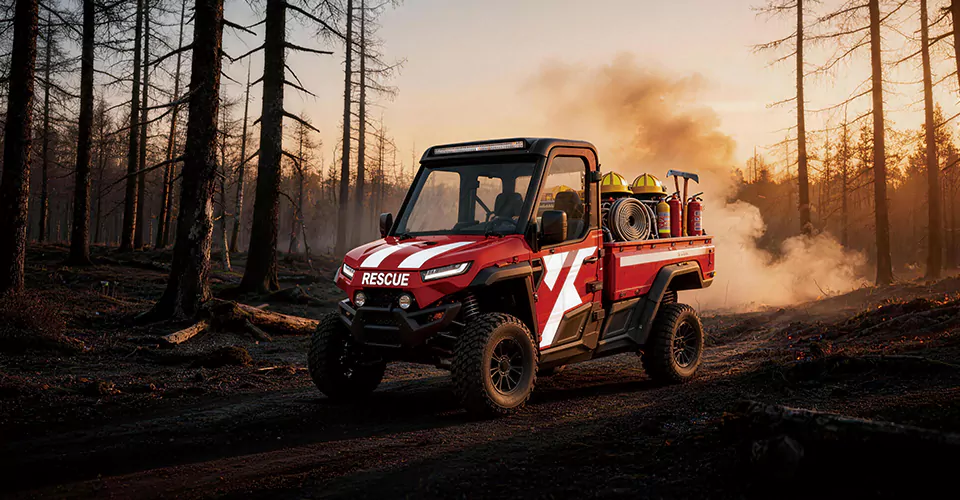
This makes 4WD particularly useful for:
- Mud
- Sand
- Snow
- Gravel
- Rocky trails
- Steep terrain
- Uneven ground
How Does 4WD Improve Off-Road Performance?
Better Traction
The main advantage of four-wheel drive is improved traction.
With power available at all four wheels, the vehicle has more opportunities to transfer engine power to the ground.
Improved Climbing Ability
When driving up steep or uneven terrain, maintaining traction is important. Four-wheel drive can help reduce wheel spin and improve vehicle control.
Better Performance on Loose Surfaces
Sand, mud, snow, and gravel can reduce tire grip. A 4WD system can help the vehicle maintain forward movement when conditions become difficult.
More Control in Challenging Terrain
Four-wheel drive can provide greater confidence and control when driving across uneven surfaces, although the vehicle’s tires, suspension, ground clearance, weight, and driving technique also have a major influence on performance.
4×4 vs. 4WD: Are They the Same?
In everyday automotive language, 4×4 and 4WD are often used to describe the same basic concept: a four-wheeled vehicle capable of driving all four wheels.
However, the terms are not always used in exactly the same way.
- 4×4 describes the vehicle’s wheel and drivetrain configuration.
- 4WD describes the four-wheel-drive system.
For example, a vehicle can be described as a 4×4 because it has four wheels and four driven wheels, while 4WD refers specifically to the system that delivers power to those wheels.
4×4 vs. AWD
Another common term is AWD, or all-wheel drive.
Although both 4WD and AWD can deliver power to all four wheels, they are generally designed with different priorities.
| Feature | 4×4 / 4WD | AWD |
| Main purpose | Off-road and difficult terrain | Road traction and handling |
| Driver control | Often selectable | Often automatic |
| Low-range gearing | Common on some systems | Less common |
| Off-road capability | Often excellent | Varies |
| Typical use | Trucks, SUVs, utility vehicles | Cars and crossovers |
The exact operation depends on the vehicle’s drivetrain design.
What Does 6×6 Mean?
A 6×6 vehicle has six wheels, with power delivered to all six wheels.
Compared with a 4×4, a 6×6 can provide additional traction and weight distribution.
6×6 vehicles are often used for:
- Heavy-duty transportation
- Military applications
- Emergency response
- Industrial operations
- Extreme off-road environments
The additional axle can help support heavier loads and improve mobility on challenging terrain.
What Does 8×8 Mean?
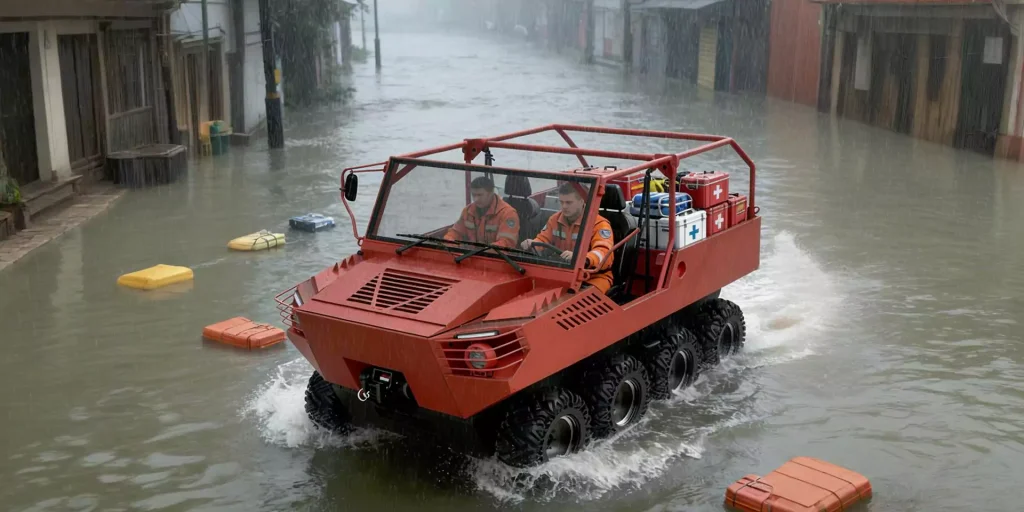
An 8×8 vehicle has eight wheels and power delivered to all eight wheels.
The additional wheels can help distribute the vehicle’s weight and provide multiple points of traction.
This configuration is commonly found in specialized vehicles designed for demanding environments.
An 8×8 amphibious vehicle, for example, can combine eight-wheel-drive mobility with the ability to operate on water.
Why Are 6×6 and 8×8 Useful for Extreme Terrain?
A 4×4 vehicle is highly capable, but some environments require more specialized mobility.
Vehicles with six or eight driven wheels can provide:
More traction: More driven wheels can provide additional contact points for transferring power to the ground.
Better weight distribution: Vehicle weight can be distributed across more wheels.
Greater load capacity: Larger multi-wheel platforms can be designed to carry heavier payloads.
Improved soft-ground mobility: With suitable tires and vehicle design, additional wheels can help reduce the concentration of weight on individual contact points.
This makes 6×6 and 8×8 platforms useful for demanding applications such as emergency response, remote-area transportation, industrial work, and extreme off-road operations.
Common Off-Road Vehicle Terms
Understanding basic terminology makes it easier to compare different vehicles.
4×4
Four wheels with four driven wheels. Common in SUVs, trucks, utility vehicles, and off-road vehicles.
6×6
Six wheels with six driven wheels. Often used for heavy-duty and specialized off-road applications.
8×8
Eight wheels with eight driven wheels. Used for high-mobility and specialized applications requiring additional traction and load distribution.
ATV
All-terrain vehicle designed for off-road mobility. Many conventional ATVs use a four-wheel configuration.
UTV
Utility task vehicle or utility terrain vehicle, typically designed to carry multiple occupants and/or cargo.
Amphibious Vehicle
A vehicle designed to operate on both land and water.
Ground Clearance
The distance between the ground and the lowest part of the vehicle. Higher ground clearance can help a vehicle pass over obstacles.
Payload
The maximum weight of passengers, equipment, cargo, or other loads that a vehicle is designed to carry.
Conclusion
So, what does 4×4 mean? Simply put, it describes a four-wheeled vehicle in which all four wheels can be driven.
Four-wheel drive improves traction and can make a vehicle more capable on mud, snow, sand, rocks, and other challenging surfaces. However, 4×4 is only one part of overall off-road performance.
For more demanding applications, 6×6 and 8×8 vehicles can provide additional traction, weight distribution, and load-carrying capability. When water operation is also required, an amphibious vehicle can extend mobility from land to water.
For specialized all-terrain and amphibious vehicle solutions, contact Jinjia Special Equipment at info@responsemobility.com.