










Articulated tracked vehicle operator training is a documented responsibility, not a collection of driving tips. A civil fleet buyer should agree who provides appropriate instruction, what equipment and roles the records cover, who assesses competence and who decides authorisation. Attendance, competence assessment and permission to use the equipment are separate forms of evidence.
Contents
Assign training responsibilities before the handover
Distinguish personnel roles and qualification evidence
Which documents should accompany vehicle handover?
Acceptance of training records and refresher decisions
Request the documentary training arrangement
Frequently asked questions (FAQ)
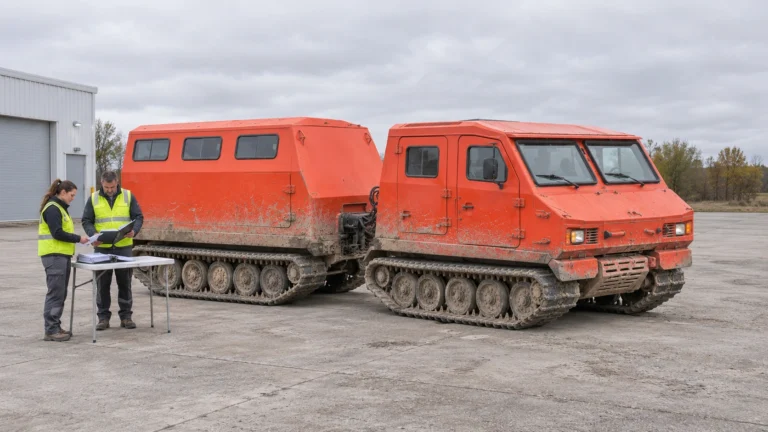
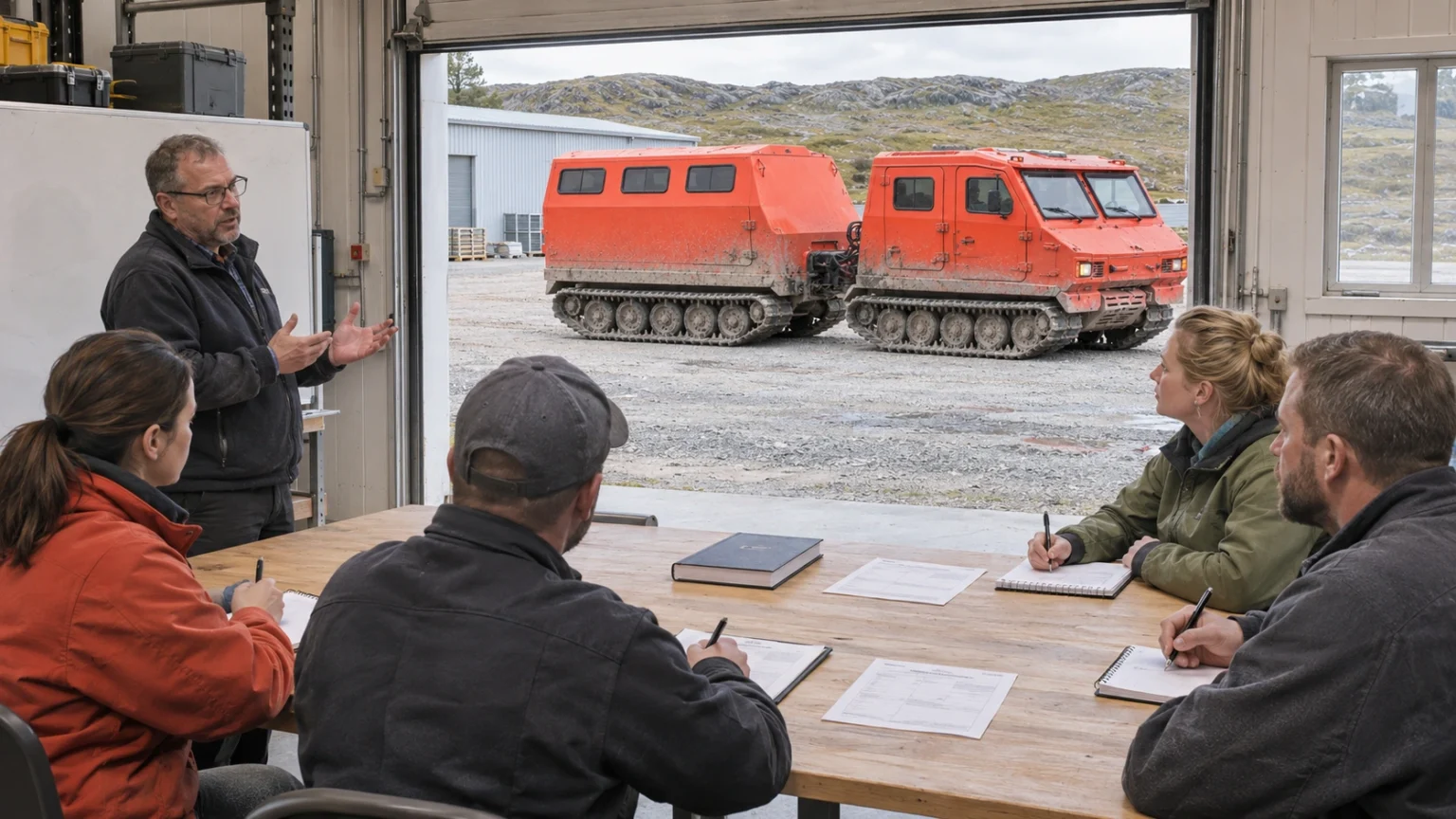
A civilian trainer and adult fleet staff discuss written records at a depot; a parked orange-red two-section carrier is visible outside. AI concept of civilian use; not verified JJ117 equipment, delivery or actual event.
Assign training responsibilities before the handover
Start with the civil employer or receiving organisation and the supplier’s agreed training scope. The employer identifies roles and requirements, while a competent provider delivers the agreed instruction. In turn, the authority or responsible organisation makes the applicable authorisation decision. These roles may overlap by agreement, but do not assume that they do.
Two public historical records illustrate the importance of organisational training: a July 2015 Australian Antarctic Program station report describes an exercise and staff training [S08], and Fire and Rescue NSW reported a multi-agency exercise in September 2024 [S21]. The latter mentions tracked equipment in its fleet. However, neither proves that a JJ117 training programme exists or that every vehicle took part in the exercise.
The UK Health and Safety Executive explains that appropriate training and competence depend on work equipment and tasks [S23]. Its guidance is jurisdiction-specific. Therefore, for another country, verify the actual employer obligations and competent authority rather than assuming a transferable qualification.
Distinguish personnel roles and qualification evidence
A handover can involve a civil equipment operator, a supervisor, maintenance personnel and a record administrator. The supplier should therefore identify which role the offered training addresses. Similarly, a document relating to one role does not establish competence for every other role or configuration.
Ask for the name and authority of the training provider, the language and revision of materials, and the scope described on the resulting record. Meanwhile, keep public examples free of personal identification because actual personnel records belong to the responsible organisation.
An attendance record only indicates participation. In contrast, an assessment record has its stated scope, while authorisation is an independent decision under the applicable process. Consequently, do not label a visitor demonstration, classroom discussion or sales event as an operational qualification.
Which documents should accompany vehicle handover?
Record the civil equipment identity and the applicable issued documents, the training scope, the provider and the record owner. In particular, separate training promised in a contract from training that has taken place. Where a language version remains outstanding, state that explicitly.
The information graphic shows four evidence categories: agreed scope, attendance, competence assessment and authorisation. However, the first two cannot establish the latter two. This matters particularly when a procurement team has not observed the training.
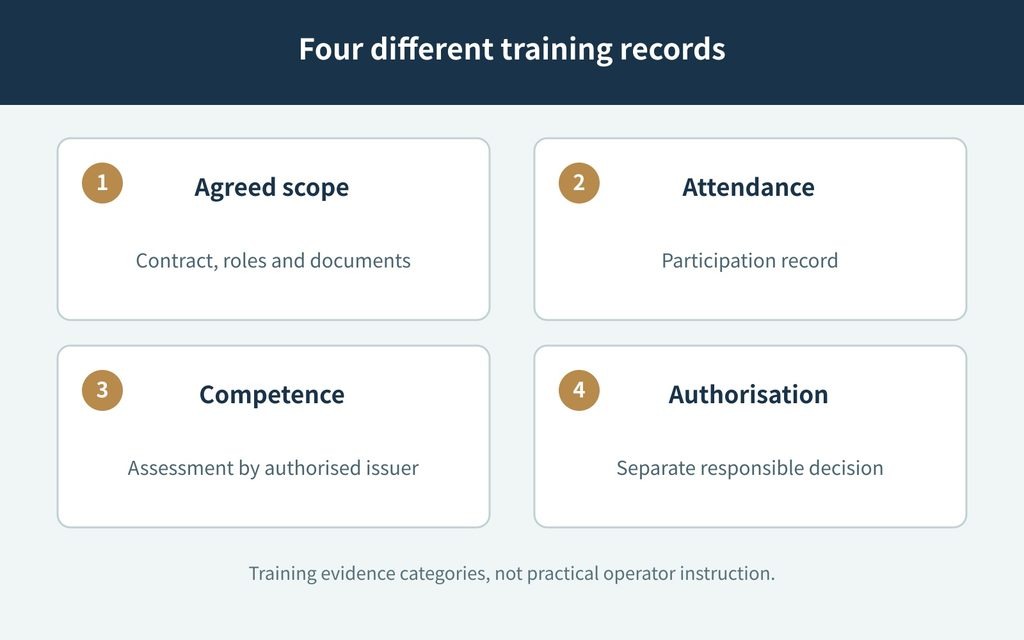
Training evidence categories, not practical operator instruction.
For example, a customer may receive an introductory briefing and a dated attendance list while an assessment remains unscheduled. Record the briefing as delivered, and leave assessment and authorisation pending. No technical driving or maintenance method is implied.
Acceptance of training records and refresher decisions
Acceptance of the training deliverable concerns the agreed documents and the authorised decision-maker. In contrast, technical acceptance concerns the equipment rather than the training deliverable. If the written scope differs from what was delivered, preserve the record and refer it to the contract owner.
HSE guidance recognises that training may need to be refreshed and that changes in equipment or work can affect training needs [S23]. However, a general article cannot set the appropriate interval for a particular fleet. Record who will review the documents and decide whether further assessment is required.
Clear document control helps avoid reusing attendance records beyond their stated scope. Therefore, keep dates, revisions and record status rather than describing the course as a universal licence.
Request the documentary training arrangement
JINJIA publishes its tracked utility vehicle category [S0], not evidence of a confirmed training arrangement for every purchaser. Instead, request the actual civilian offer, applicable documents and written training scope before treating the service as part of the purchase.
The accompanying training handover workbook separates participant roles, provider identity, issued documents, attendance, assessment, authorisation and review responsibilities. Enter only verified records; otherwise, keep the field open.
Finally, use the brand’s public contact page to request general training arrangement information [S0C]. Agree the language, documentary deliverables and ownership of records with the responsible organisation. This provides a clear framework without substituting editorial text for authorised practical instruction.
Request general civilian training arrangement information.
Frequently asked questions (FAQ)
A: Agreed civil training scope, applicable documents, provider identity, attendance, assessment and authorisation records.
Q: Does attendance prove competence?
A: No. Attendance records participation; competence assessment has its own scope and issuer.
Q: Can a demonstration qualify an operator?
A: No. A demonstration is not automatically a qualification or permission.
Q: Who determines whether training is adequate?
A: The responsible employer, qualified provider and applicable authority under the actual requirements.
Q: How often should training be refreshed?
A: The responsible organisation determines this using applicable rules, issued documents and actual needs. No universal interval is claimed.
Q: Do the cited exercises prove JJ117 certification?
A: No. They are third-party historical training reports.
References and evidence scope
S08: Australian Antarctic Program — This week at Davis, 3 July 2015 — Station report describes an exercise and training, not a real incident or a certificate for another vehicle.
S21: Fire and Rescue NSW — Alpine emergency exercise, 19 September 2024 — Public exercise report; tracked vehicle category mentioned among fleet, not evidence of every training activity.
S23: UK Health and Safety Executive — Training and competence — UK workplace-equipment guidance, illustrative of competence documentation; local applicability requires verification.
S0: JINJIA / Response Mobility — Tracked Utility Vehicle — Manufacturer page; verified public product literature, not proof of the delivered civil configuration.
S0C: JINJIA / Response Mobility — Contact — Public brand contact page.