

Assign the 8×8 a specific leg
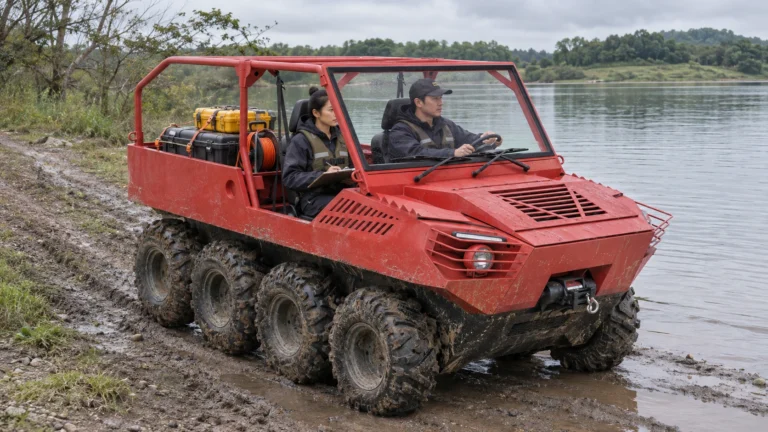
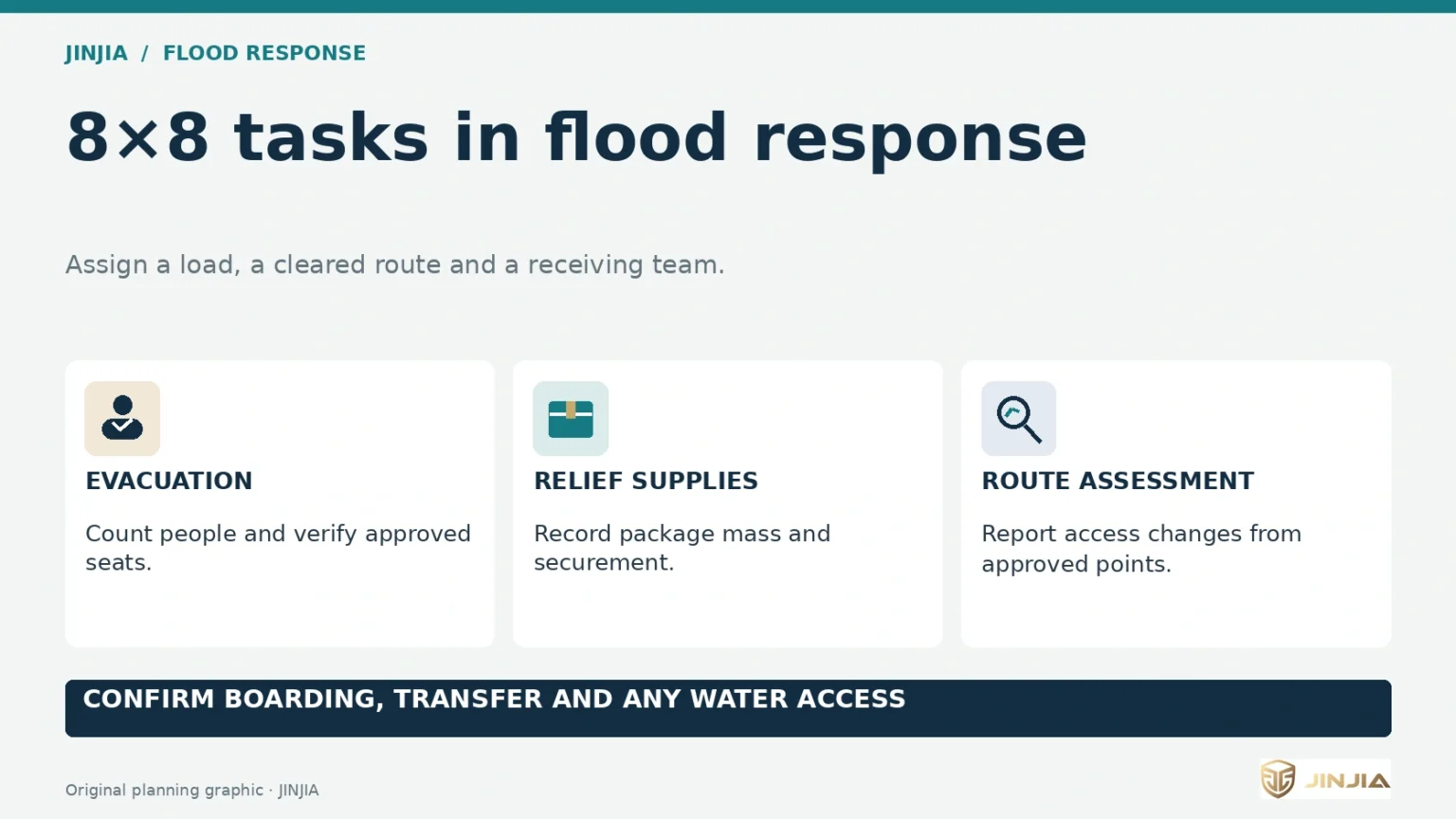
An amphibious 8×8 can support flood evacuation, relief delivery and route assessment where the incident plan has an approved last-mile route. Give the vehicle a specific leg, a defined load and a receiving team. A conventional truck can bring larger loads to a dry staging site. The 8×8 can take an approved transfer leg where its size and mobility suit the route. A specialist water team can take a leg that requires boat-based rescue.
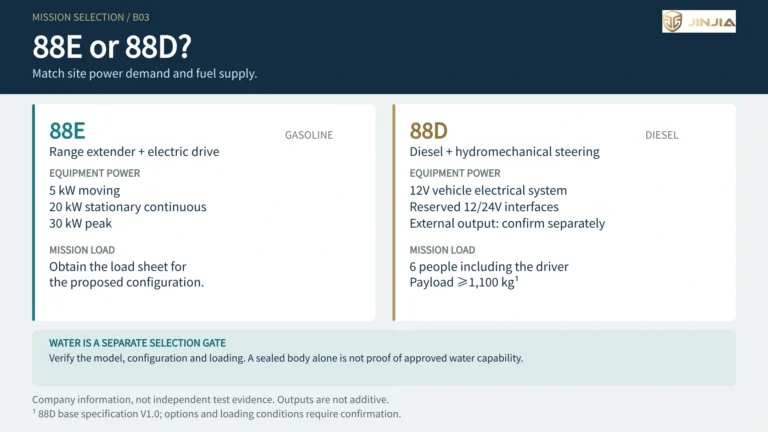
For JINJIA buyers, identify whether the submission is for the 88E range-extended electric configuration or the 88D diesel configuration. Confirm seats, restraints, installed equipment and the allowed load for each proposed mode on that exact build. Any water segment calls for its own engineering evidence and approval by the responsible incident team.
What the Sandomierz account establishes
In a field report dated 18 June 2010, Polish equipment supplier and participant Intervent describes four ARGO Avenger 750 EFI vehicles working in Sandomierz and nearby flooded communities. It attributes the operation to a flood-command assignment and names its own staff and OSP Ożarów Mazowiecki volunteer firefighters among the operators. Its account reports evacuation of people and small animals, food and drinking-water deliveries, and reconnaissance. [S01]
Poland’s Supreme Audit Office separately documents the 2010 flooding and evacuation in Sandomierz. Its municipal audit establishes the incident context. The ARGO fleet count and tasks come from Intervent. Its account gives no measured current, loaded weight, freeboard or entry and exit limits for the individual trips. For a JINJIA proposal, request evidence from the exact vehicle, load and conditions proposed. [B13-E1]
Calculate evacuation and relief loads separately
For evacuation, state the number of evacuees, operator and attendants for each trip. Record the approved seat and restraint arrangement, mobility assistance and permitted hand-carried items. Include any proposed patient-transfer equipment in the configuration and load review. Name who checks the manifest at pickup and who accepts the people at reception. A transfer that requires a medical team or specialist carrier should be scoped as its own leg.
For relief delivery, list packages by quantity, mass and dimensions. Record the actual restraint arrangement, weather protection, loading method, unloading capacity and receiving contact. Assess the loaded outbound leg and the return leg independently. If plans change and people need to ride on the return, reassess the seating and all remaining cargo before dispatch.
Reconnaissance needs a third task brief. Identify the crew, radios or mapping equipment, permitted observation points and the information the incident team needs back. An access report can contain a closed junction, a usable dry approach, a blocked transfer point or a time-stamped change in conditions. The observing crew reports what it can verify from approved locations.
Confirm boarding, transfer and water access points
Name the pickup and discharge locations and show them on the same route map. Record vehicle approach, waiting space, accessible boarding arrangements, the person responsible for passenger accounting and the receiving contact. If a boat team takes over, record the land-side handoff and the planned alternative if the receiving point closes.
For any proposed water leg, ask the incident team to confirm the assigned asset, both approved access points, current site assessment and an alternate route or handoff. Include bank condition, unknown obstructions and changing water levels in the assessment record. The U.S. National Weather Service warns the public against entering floodwater or bypassing closure barriers because conditions can hide damaged roads and other hazards. Use cleared approaches and the responsible team’s route decision. [B13-E2]
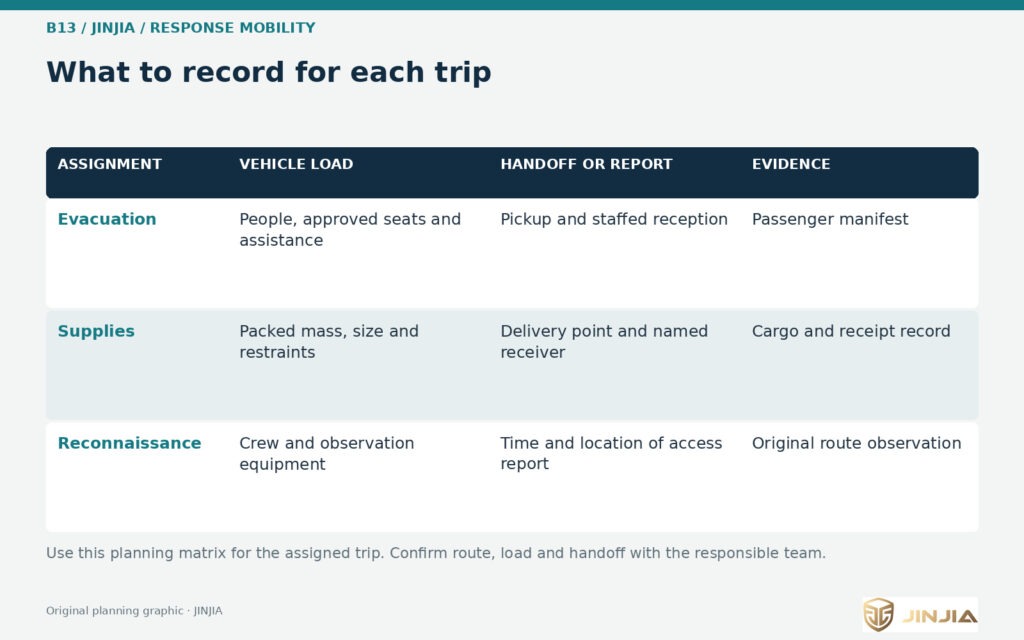
Record the vehicle load, transfer or reporting point and evidence separately for each task.
Keep the sources tied to the same operation
Use one record per claim. Retain the event, location, date or reporting period, publisher, participant role, vehicle model and task shown or stated. Link the original account. Mark what comes from an official incident record, a participant’s report, a photo or a measured trial. An image may confirm a vehicle’s presence at a named location when the attribution is clear. The same image rarely establishes the load or the complete route.
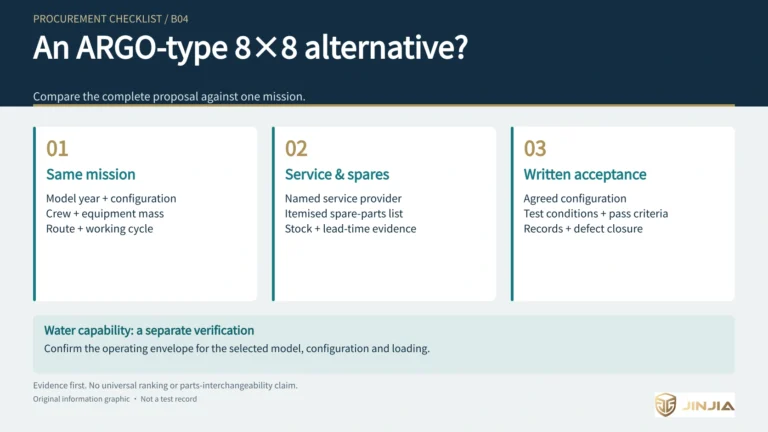
Check that reports, photos and clips describe the same event and trip before combining them. A repost of the same account adds reach and has the same underlying source. Ask for a mission log or signed test sheet when purchase decisions depend on route completion or approved transport capacity. Keep any unresolved claim in the evidence register.
Decide when another asset should take the leg
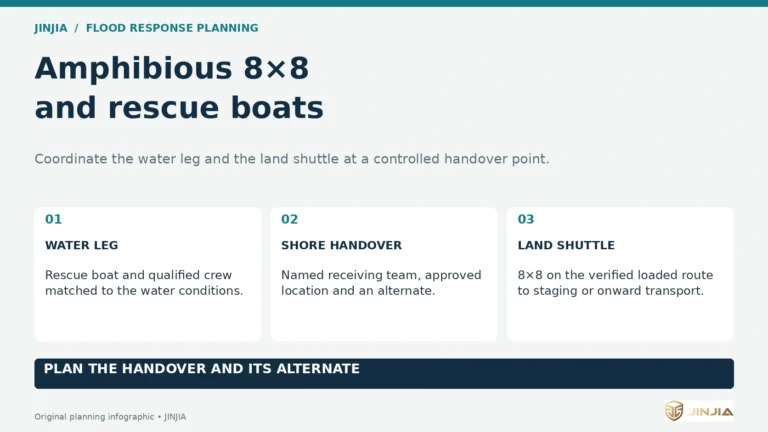
Use a truck or other suitable road vehicle on cleared roads when it can handle the required people or freight. Consider the 8×8 for the approved connection where conventional access ends and configuration evidence covers the load. Where water rescue is needed, assign a qualified team and the rescue craft it specifies. FEMA’s flood search-and-rescue resource definition provides an example of how boat, high-clearance vehicle and other resources can be coordinated. [B13-E3]
Treat aquatic payload and stability, entry and exit, and passenger or equipment retention as separate acceptance questions. Changing water or an unavailable handoff can invalidate the route plan. A useful acceptance trial reproduces the proposed build, representative load and defined conditions in a controlled setting and records the result for each claimed leg.
Give the buyer and incident team a one-page brief
• Purpose and ownership. Identify evacuation, relief delivery or route assessment. Name the dispatch, route and receiving leads.
• Legs and transfer points. Mark cleared approaches, boarding and discharge points, any separately approved water leg and an alternate handoff.
• People and equipment. Record approved seats and restraints, assistance needs, package and module loads, securement and separate outbound and return configurations.
• Evidence. Attach the named incident or trial record, its date, vehicle model, conditions and what it substantiates.
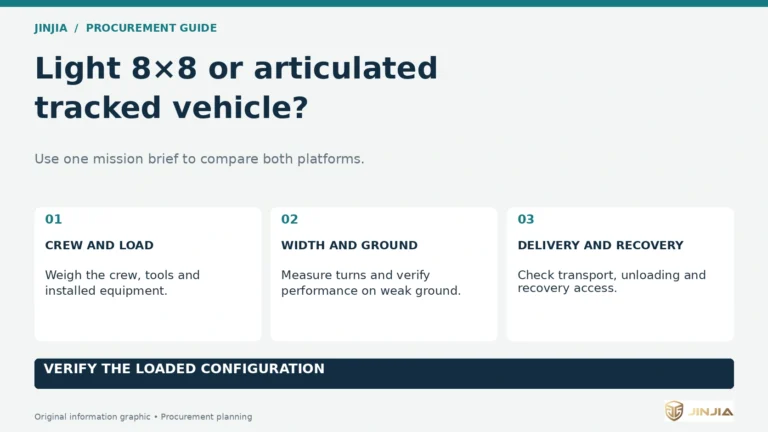
• Acceptance. Set the checks for the proposed 88E or 88D build. Confirm which load and route are supported and who can suspend or reassign the leg.
The amphibious 8×8 and rescue boat guide explains the handoff in more detail. Send JINJIA the route, mission load and working conditions for a configuration discussion.
Frequently asked questions (FAQ)
A: List people by approved seat, including the operator and attendants. List freight by packed mass, size and securement. Recheck each leg if the return load changes.
Q: What should the boarding and water access record contain?
A: Mark pickup, discharge and transfer points, their responsible teams and a fallback. For a proposed water leg, record the incident team’s approved asset, both access points and the current assessment.
Q: What evidence belongs to a single flood operation?
A: Keep the original source, location, date, participant role, model and task. Where route or load limits affect purchase, request a trip log or measured test for those conditions.
Sources and further information
[S01] Intervent · Sandomierz flood field report, 18 June 2010
[B13-E1] Poland’s Supreme Audit Office · Sandomierz municipal flood audit (Polish)
[B13-E2] U.S. National Weather Service · Flood safety