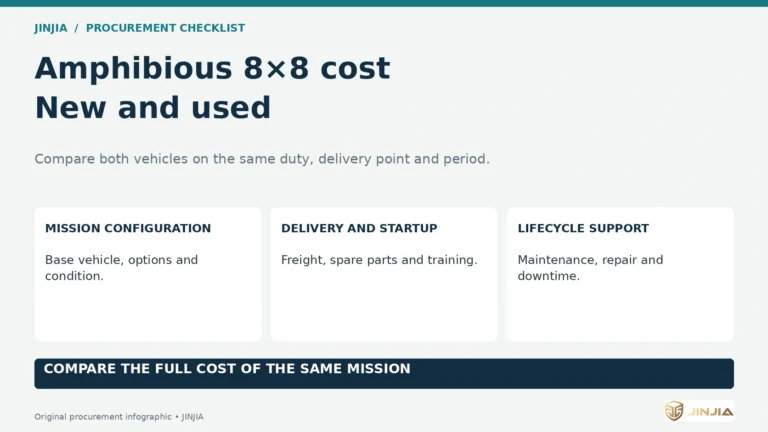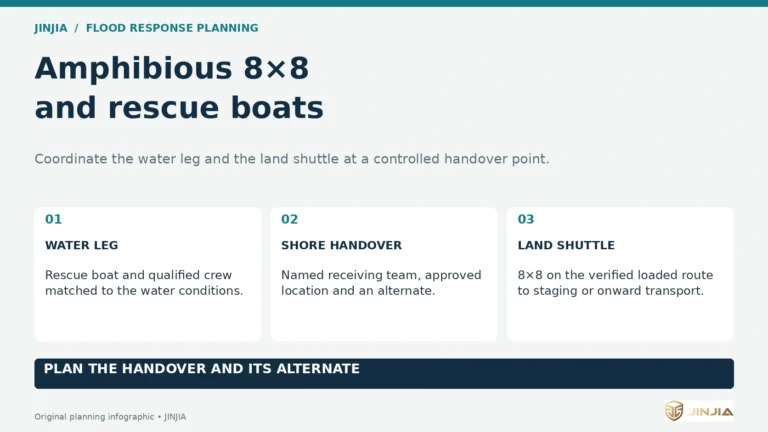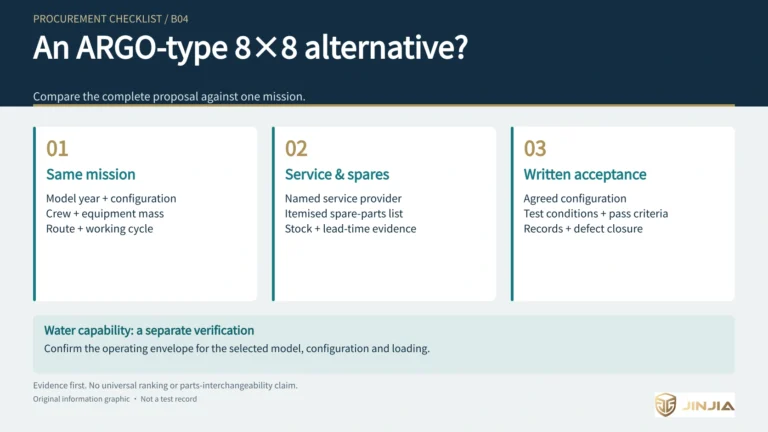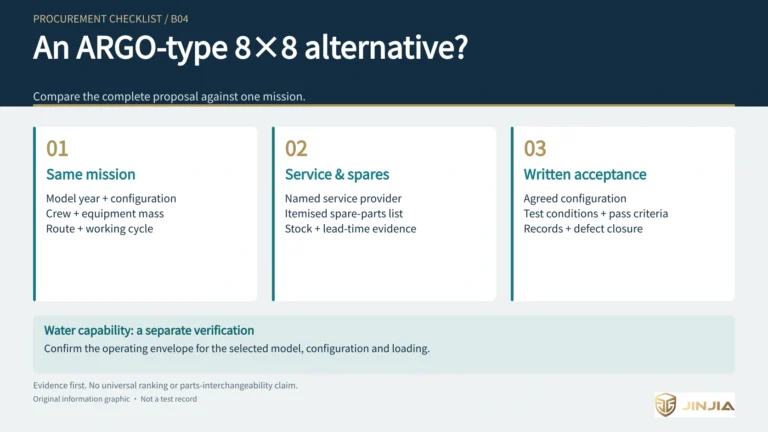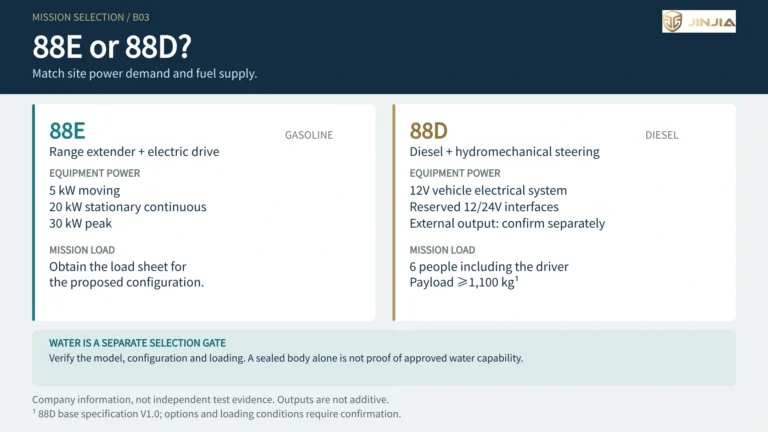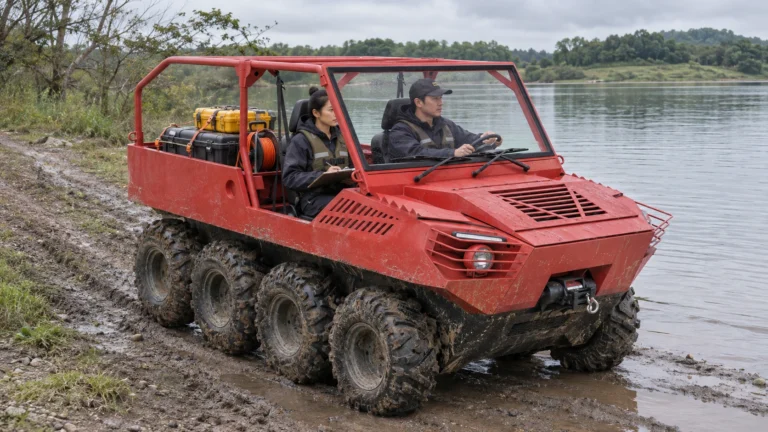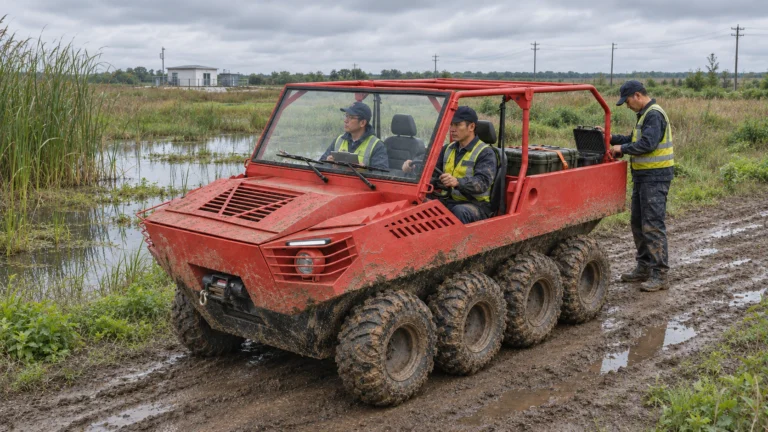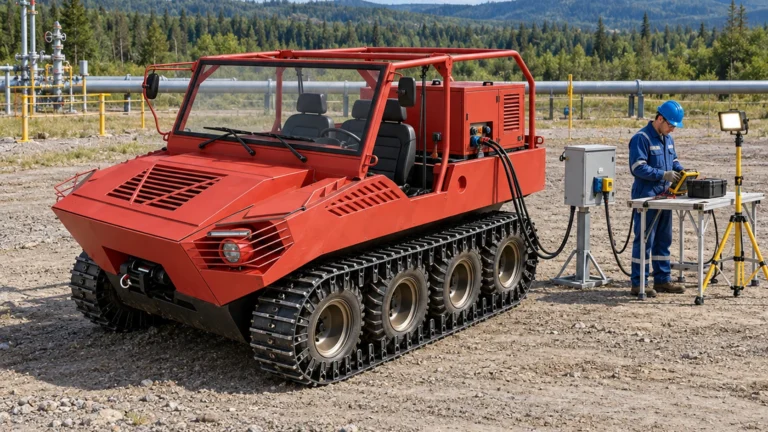


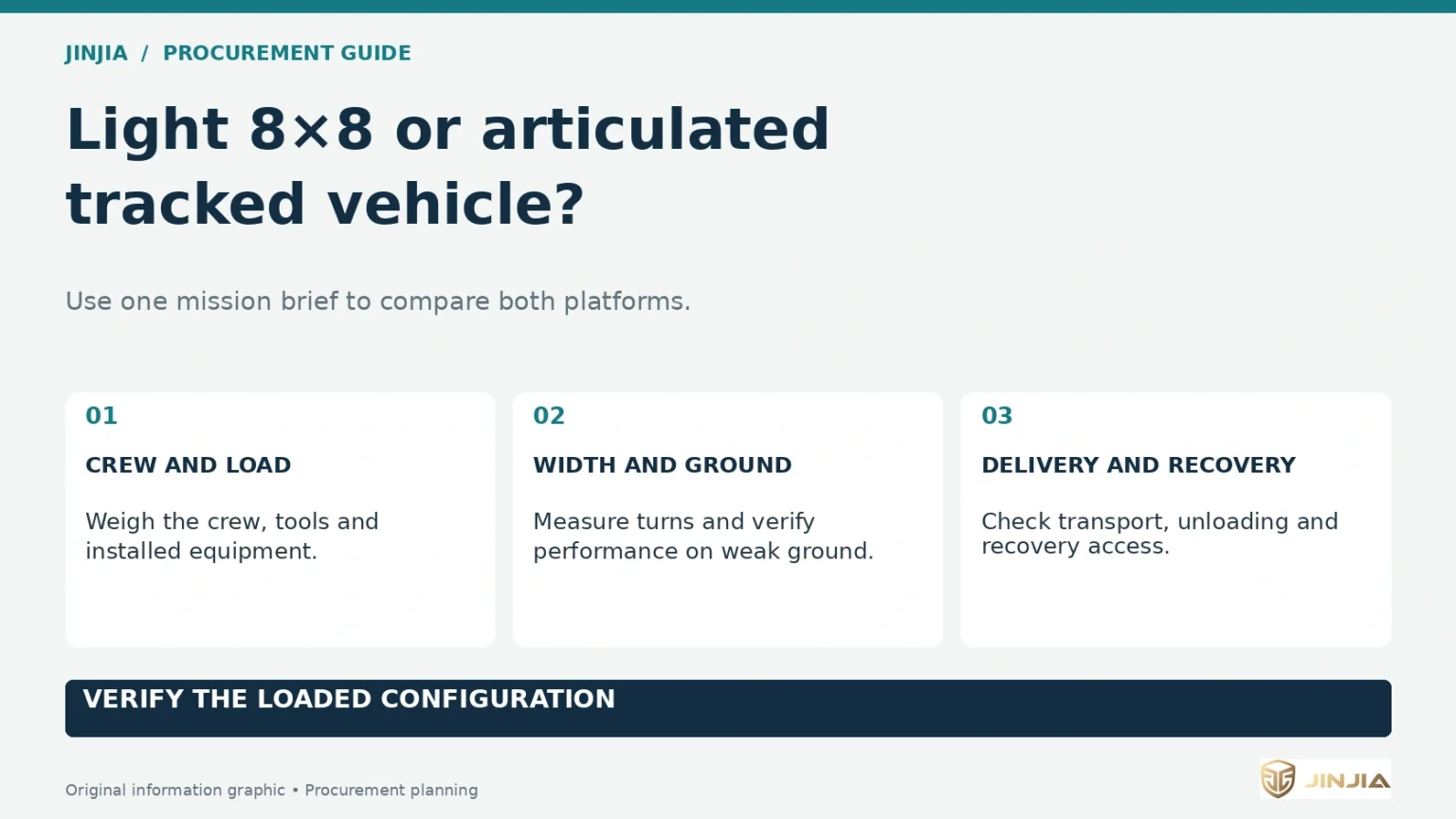
Original procurement infographic. Compare crew and load, route width and soft ground, and transport and recovery.
Which platform fits the mission?
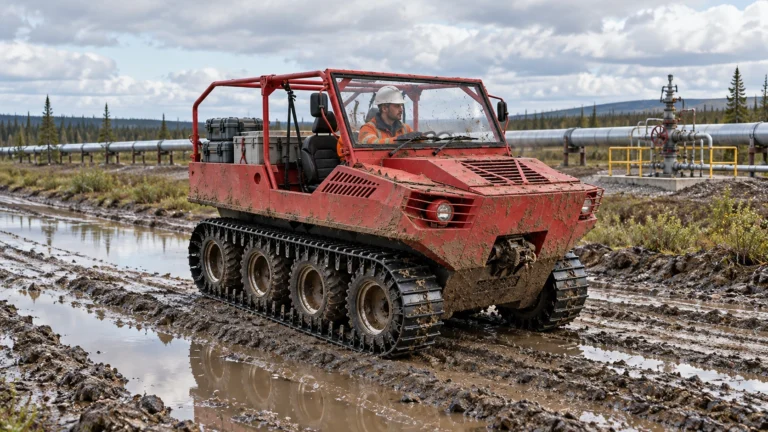
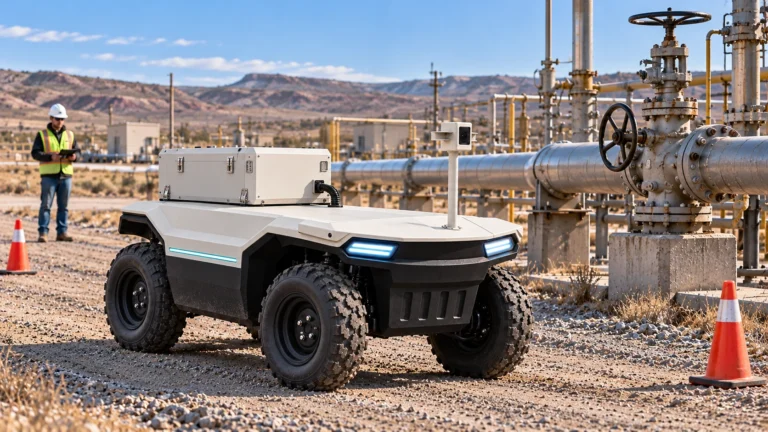
Shortlist a light 8×8 when a small crew, tools and consumables can reach the worksite within the vehicle’s verified loaded limits. Evaluate a two-section articulated tracked vehicle when a larger crew or a multi-tonne load needs to travel together, or when a long section of weak ground makes repeated trips impractical. Confirm that the larger vehicle can reach the staging area, negotiate the narrowest turn and be recovered if it stops on the route.
A light 8×8 uses eight driven wheels in its base wheeled configuration. Over-tyre tracks may be specified as an option on a compatible build. A two-section articulated tracked carrier steers through a joint between its front and rear units and is evaluated as a complete vehicle, including the equipment on each section. A track option on a light vehicle changes its running gear and loaded geometry. The capacity of a two-section platform must be checked separately.
What the available evidence establishes
JINJIA’s 88D diesel 8×8 specification V1.0 lists six seats including the driver, a manufacturer-listed loading mass of at least 1,100 kg and a reference width of up to 1,800 mm. These are specification figures. Obtain the signed limits and actual width for the delivered build, including any tracks and installed equipment. The specification leaves rated wading depth, flotation load, freeboard, stability and water speed to separate verification.
JINJIA’s 88E uses a gasoline range extender and electric drive. The 88D figures apply to the diesel model. The JJ117 is a JINJIA two-section articulated tracked platform. For a JJ117 proposal, request the project specification, front and rear load allocation and the conditions of the supporting tests. The examples below are planning scenarios.
Payload scale and passengers
Write the load in kilograms before choosing a platform. Include each person with PPE, tools, consumables, recovery equipment, mounts and any module carried during travel. Identify the base vehicle condition used for the calculation, including which fluids and installed items are already counted. Check approved seating and restraints, usable cargo space, load distribution and the fully loaded vehicle mass.
For example, three people budgeted at 100 kg each with PPE plus 120 kg of tools and recovery gear create a 420 kg mission load before additional equipment. A light 8×8 is a candidate if its signed configuration, restraints and load distribution support the task. A single 2,400 kg mission load including personnel and a module calls for screening a multi-tonne carrier. For an articulated platform, ask which section can take each item and what the loaded centre of gravity must be. If the job can be split, compare the total time for multiple light trips with one larger trip, including loading and return travel.
Route width and soft ground
Measure gates, bridge decks, switchbacks, side clearances and the room needed to turn around. Obtain a swept-path check at the tightest bends. An 8×8 with optional tracks may need more clearance than the wheeled configuration. On a two-section vehicle, the rear unit follows its own path through the turn. Check the required clearance with the real load and mounted equipment.
Mark where the ground becomes weak, how long those sections are and how rain, thaw or repeated passes change the surface. Compare the vehicles in the intended loaded condition. A ground-pressure figure helps screening when the load and contact-area assumptions are known. It cannot establish passability on its own. Ask for evidence on a comparable surface and assess both the outbound and return route. A short soft stretch may be avoidable; a sustained peat or snow segment may justify evaluating an articulated tracked carrier if the corridor and staging area can take it.
Deployment and recovery logistics
Plan the trip from depot to worksite and back. Request transport dimensions and loaded mass, confirm suitable carrier or trailer capacity and tie-down provisions, and identify a place to unload, turn and reload. A vehicle that fits the worksite can still be delayed by a staging access constraint. Check transport time and resources for both candidate configurations.
For recovery, identify the responsible crew, rated recovery points and compatible equipment. Assess whether the support vehicle can reach the likely stopping point and whether there is enough room to work. Compare spare parts, service access and how long a disabled vehicle would block the route. Use the manufacturer’s recovery procedure and the site plan for the actual operation.
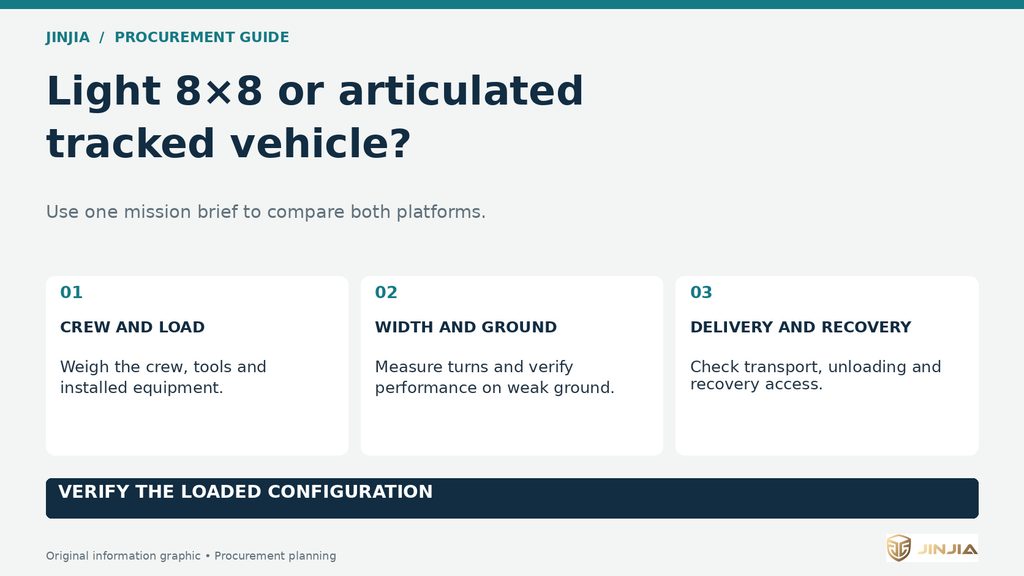
Original procurement infographic. Compare crew and load, route width and soft ground, and transport and recovery.
Limits and alternatives
A track-equipped light 8×8 is a configuration to assess when load stays within the light platform’s limits and ground conditions warrant it. A larger articulated carrier may suit a single consolidated load if the route and transport chain support it. Where the final approach is narrow, consider staging the heavy load at a transfer point and using a smaller vehicle for the final leg. Treat water segments separately and obtain written operating limits for the exact configuration.
One-page mission brief for procurement
Use one page to record the same six inputs for each candidate.
• People and PPE — headcount, positions and loaded mass.
• Equipment — each item’s mass, dimensions, mounting position and whether it must travel together.
• Route — narrowest gate, tightest bend, bridge limits and turning areas.
• Soft ground — surface type, length, seasonal condition and number of passes.
• Deployment — carrier, loaded dimensions, unloading location and available time.
• Recovery — responsible crew, rated points, available equipment and access route.
Ask both suppliers to return a configuration sheet and a test plan against the same mission brief.
For vehicle categories, see Amphibious 8×8 vs ATV. For the broader running-gear comparison, see Tracked vs Wheeled Vehicles. Send your route, mission load and working conditions to JINJIA / Response Mobility for an 8×8 configuration discussion.
Frequently asked questions (FAQ)
Q: What should a buyer check about payload scale and passengers?
A: Obtain the approved seating and restraint layout, then weigh people with PPE, tools, recovery gear, mounts and installed modules. Compare the total with the signed limits and check distribution by section on a two-section carrier.
Q: How should route width and soft ground be documented?
A: Measure the narrowest clearances and record tight turns, turnarounds and bridge limits. Map the length and condition of weak ground. Request a loaded swept-path check and evidence from comparable ground conditions.
Q: What evidence is needed for deployment and recovery logistics?
A: Request verified transport dimensions and mass, tie-down details, and a loading and unloading plan. Confirm rated recovery points, the support equipment and who can reach the vehicle if it stops on the route.
Sources and further information
[S91] JINJIA 88D Diesel 8×8 Technical Specification V1.0, 2026-09-08
Manufacturer specification / company input; not independent test evidence.
[S92] JINJIA confirmed 88E/88D product distinctions
Manufacturer specification / company input; not independent test evidence.
[S93] JINJIA tracked utility vehicle platform
[S94] JINJIA amphibious utility vehicle platform