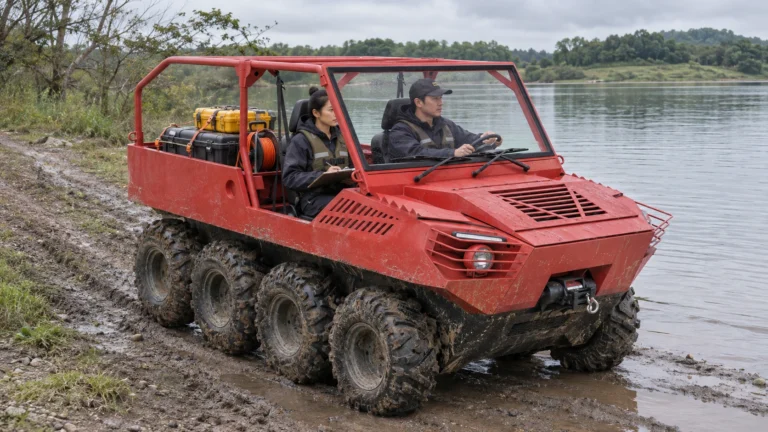


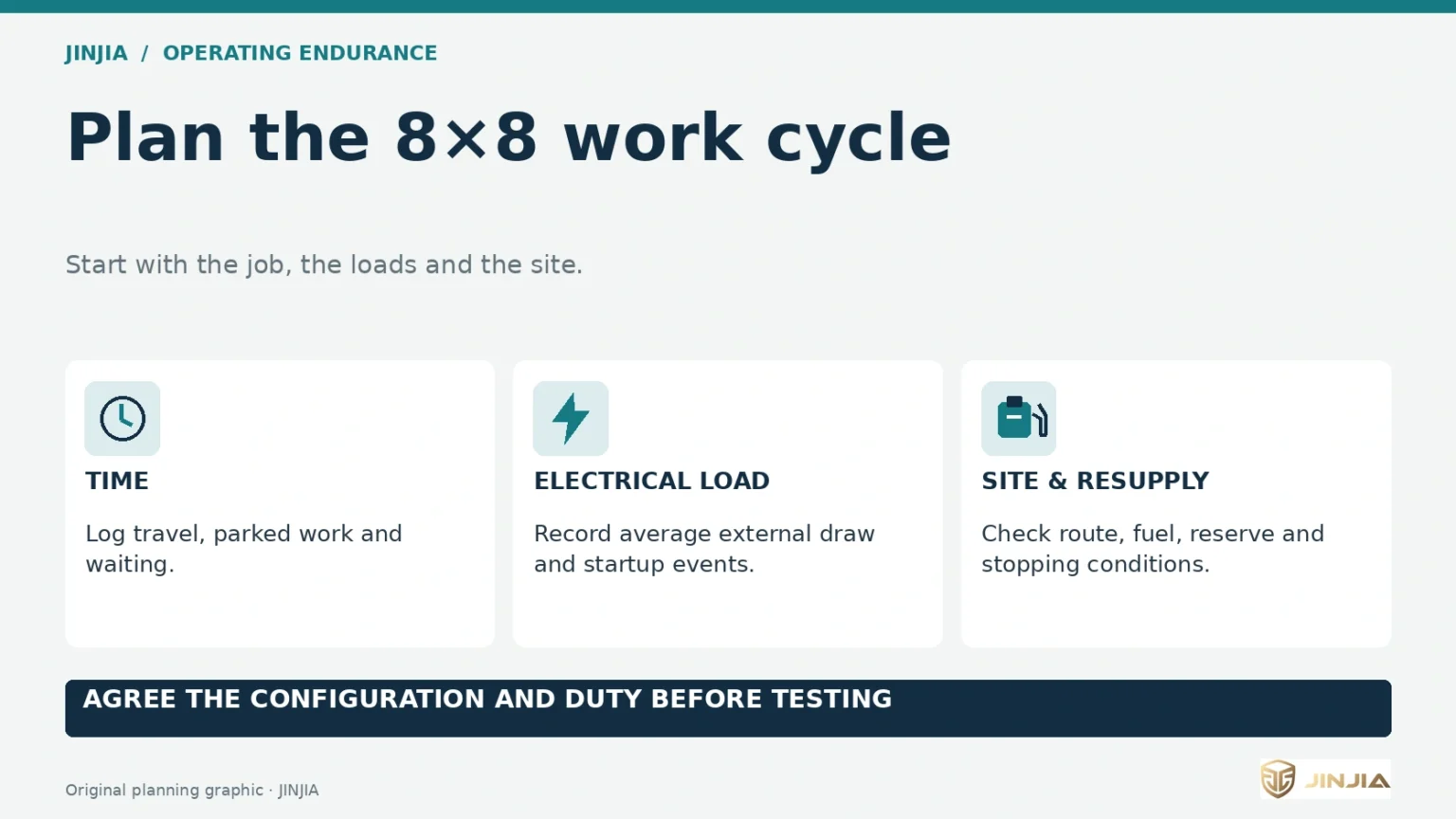
Record the route and elapsed time, equipment draw, and site and resupply conditions before evaluating operating endurance.
Start with the required shift
Assess the operating time of a range-extended 8×8 from the work it must complete between departure and return. List the travel legs, the time spent working while parked and any waiting or resupply stops. Then describe the equipment that will draw power and the conditions on the route. This gives the supplier a cycle it can reproduce in a trial.
Keep three results separate. Driving Range is the distance covered in a defined driving test. All-electric Range is the distance covered with the range extender inactive, under a defined load and battery state-of-charge window. Operating Endurance is the elapsed time demonstrated for an agreed work cycle and end condition. Identify which of these results the project needs and describe how it will be measured.
What the 88E and 88D figures establish
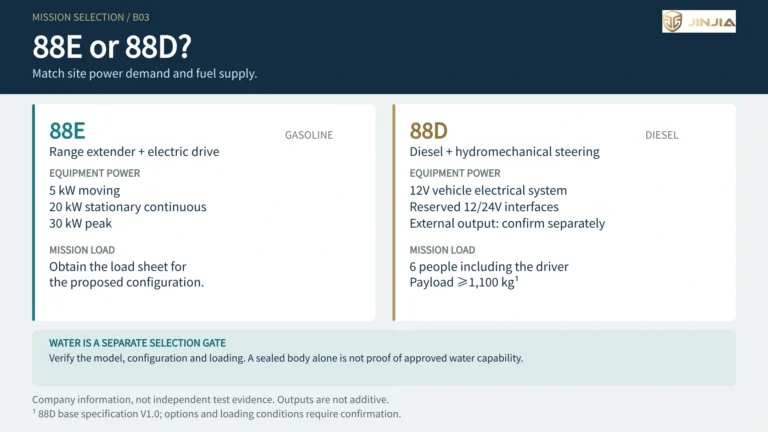
JINJIA identifies the 88E as a gasoline range-extended electric 8×8 with approximately 2 kWh of nominal battery capacity. Use the stated capacity to identify the battery configuration. Assess electric-only performance from usable energy or a measured run with the range extender inactive, along with the starting and ending battery state of charge and the test conditions.
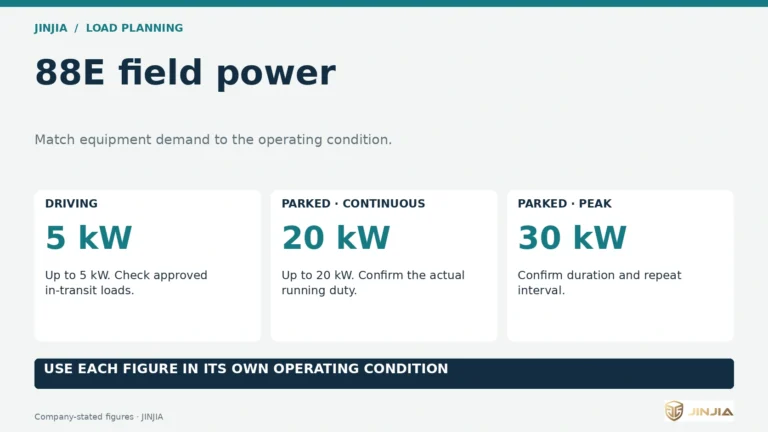
The company states up to 5 kW of external output while driving and up to 20 kW continuous while parked, with 30 kW parked peak. These are power ratings for separate modes. Confirm the peak duration, applicable interfaces and operating conditions with the supplier. The diesel 88D requires its own fuel and operating records. Its technical specification leaves fuel consumption to be confirmed. Compare both builds against the same job and record which outputs and test results apply to each.
Separate driving, stationary work and waiting
Lay out the mission in order. For each land leg, record distance, elapsed time, terrain and stop frequency. If the route includes water travel, list it separately with the agreed operating conditions. For each stop, distinguish time spent running equipment from time spent waiting, preparing the site or resupplying. Record traction time and stationary time even if the vehicle powers equipment in both modes.
For illustration, an inspection shift might include 120 minutes driving on land, 90 minutes of stationary work and 30 minutes of waiting. That adds up to 240 minutes, or four hours of scheduled work and waiting. A radio powered during the drive belongs in the electrical record for those same 120 minutes. Adding a second time entry for the radio would count those minutes twice.
Record what the equipment actually draws
Record concurrent equipment, average external draw in kW over each interval and startup demand with its units and duration. Where metering is available, use measured interval energy in kWh or its equivalent interval average. Verify the outlet, protection and load sequence for the proposed build. Startup demand matters to acceptance even when it adds little to the total energy.
In the illustrative shift, suppose the external loads average 1.2 kW while driving and 3.0 kW during stationary work, with no external draw during the wait. Multiplying each interval average by its hours gives 2.4 kWh plus 4.5 kWh, or 6.9 kWh of external energy demand. The calculation describes the equipment’s demand for the scenario. Fuel consumption, battery energy and traction still require separate measurements.
If the next job runs a pump intermittently, log its on and off periods or measure the average over the whole interval. Keep the largest start and the equipment already running in the acceptance notes. Ask whether the installed interface can supply the agreed loads in their actual order.
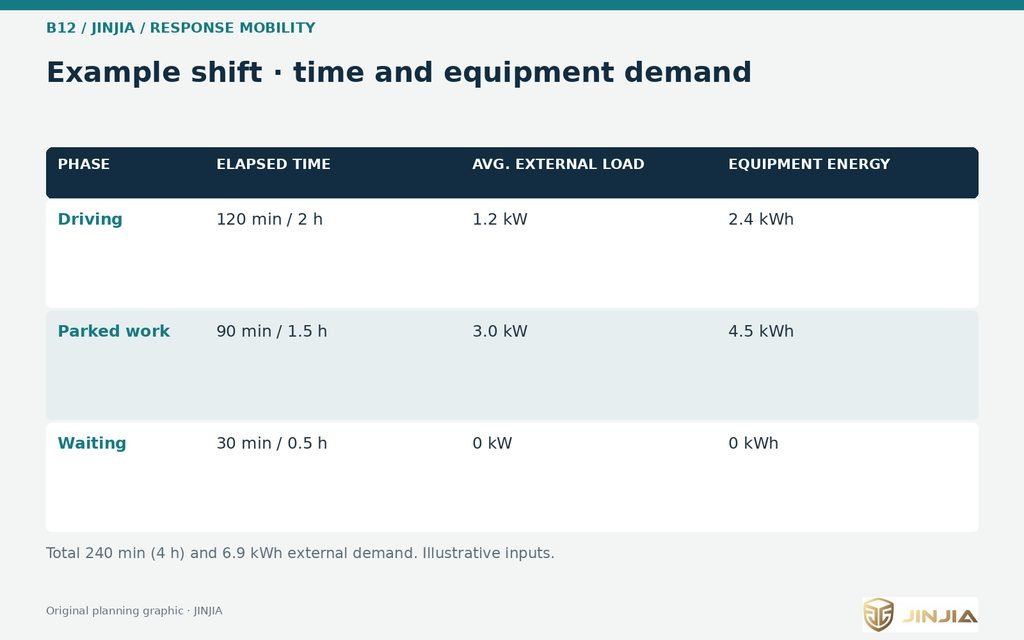
Hypothetical shift. Average external kW multiplied by each interval’s hours gives equipment demand. The calculated hours and kWh describe the scenario.
Match the environment and resupply plan
Identify the surface, grades, expected water segments, tire or optional track configuration, temperature and altitude. Record the load and how it is carried. Compare trials made under documented conditions. A dry-road log is useful for that road. A route that adds soft ground, a climb or a water leg needs its own evidence.
Record starting fuel, battery state of charge if applicable, planned resupply points, time at those stops and the required return reserve. For a trial, ask how fuel used and energy delivered were measured. Record ending fuel and battery state, interruptions and any load reduction. Compare runs with similar energy boundaries, or keep the differences visible in the test report. A trial ending with a substantially lower battery state has used part of the starting stored energy.
Decide what needs a test or an alternative
Use fuel consumption data from the same configuration and a relevant duty before committing to endurance. Where the data are missing, write down the scheduled time and equipment demand, then ask for a logged trial. A published tank volume and a power headline answer different questions from a measured mission. Ask the supplier to define the permitted duty, reserve and stopping criteria.
If parked equipment must stay powered while the vehicle travels elsewhere, compare a separate power source on that duty. If the route cannot support the proposed refuelling or return plan, compare a shorter schedule, a suitable staging point or a different vehicle. Evaluate each option against the same required work and record the remaining uncertainty.
A one-page checklist for buyers
• Route and clock. List land and water legs, stationary work, waits and stops in order.
• Configuration and payload. Record the model, crew, cargo, fitted equipment and tires or tracks.
• Equipment demand. Give average external draw, startup events and electrical interfaces for each interval.
• Conditions and resupply. Record the site, fuel and battery starting states, resupply and return reserve.
• Verification. Agree how to log time, distance, fuel, external energy and ending states, along with the test owner and acceptance conditions.
Download the 8×8 work-cycle worksheet (06_downloads/JINJIA_B12_8x8_Work_Cycle_Worksheet_EN_RU_CN.xlsx). For background, see the range-extended 8×8 introduction and the 8×8 field power planning guide. Send JINJIA the route, mission load and working conditions to discuss the proposed build and its acceptance trial.
Frequently asked questions (FAQ)
A: List land and water travel, parked work and waiting or resupply in order. Use the same clock for equipment that runs during a travel leg. Specify Driving Range, All-electric Range or Operating Endurance as separate trial results.
Q: How should actual electrical load be documented?
A: Record average external kW or measured kWh for each interval. Log startup demand, duration, units and concurrent equipment separately. Confirm the applicable connector and limits for the supplied vehicle.
Q: What evidence is needed for environment and resupply?
A: Document terrain, grade, temperature, altitude, loaded configuration and refuelling plan. Request measured fuel used, external energy and battery start and end states from a relevant duty before committing to operating endurance.
Sources and further information
[S89] JINJIA amphibious utility vehicle overview
[S91] JINJIA 88D Diesel 8×8 Technical Specification V1.0 · company source
[S92] JINJIA 88E configuration and external output · company source
[B12-E1] National Laboratory of the Rockies · DriveCAT
[B12-E2] Cummins · Liquid Cooled Generator Set Application Manual T-030