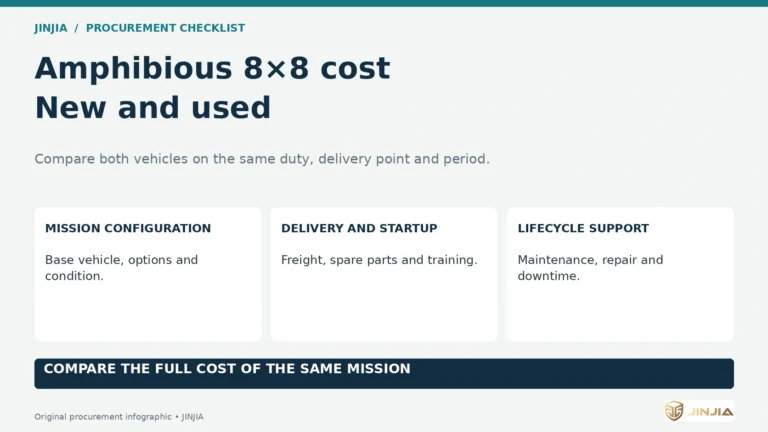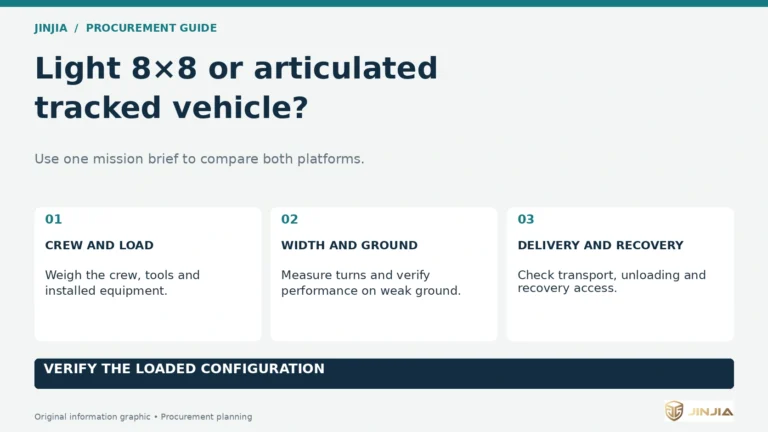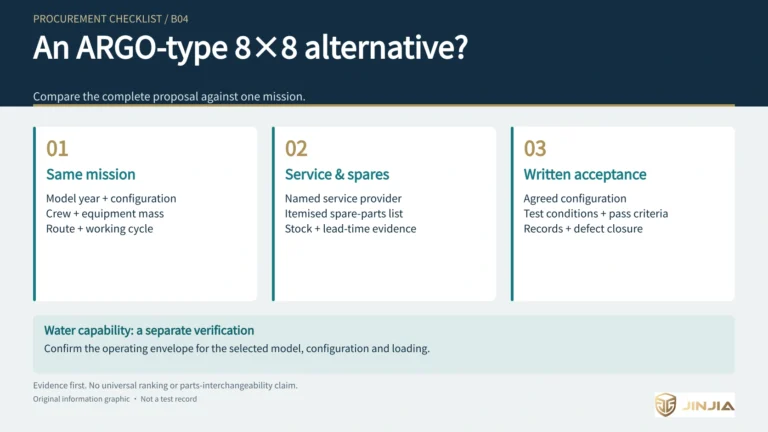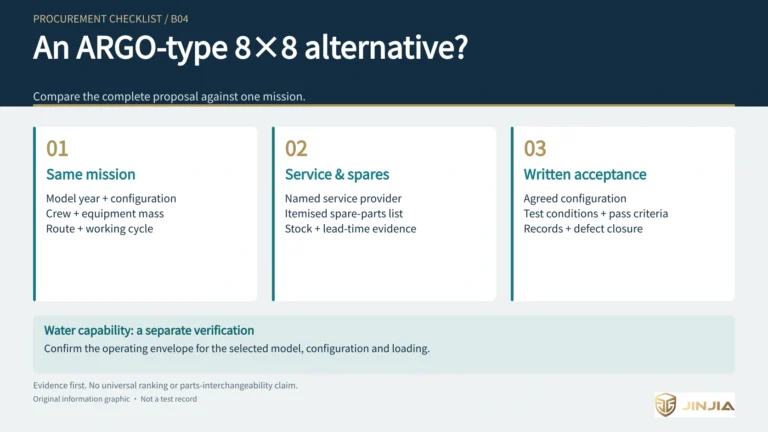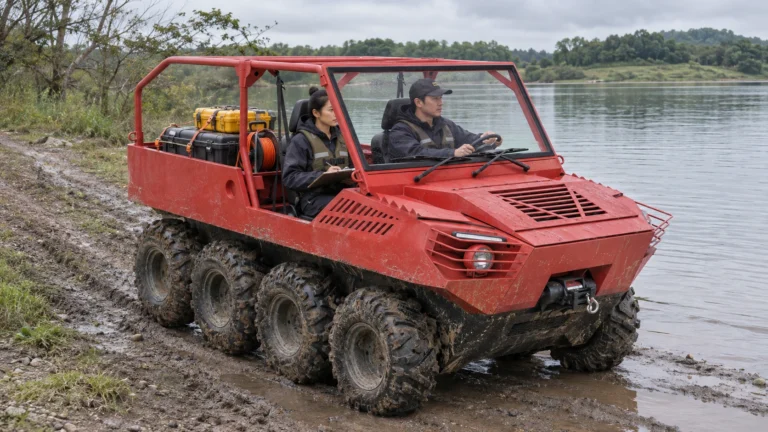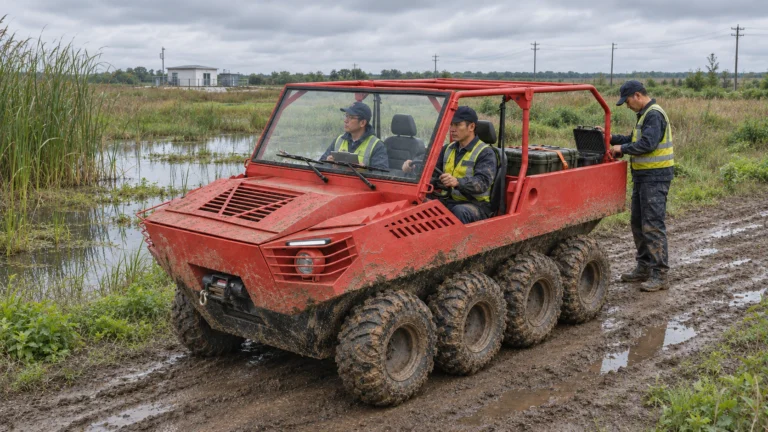


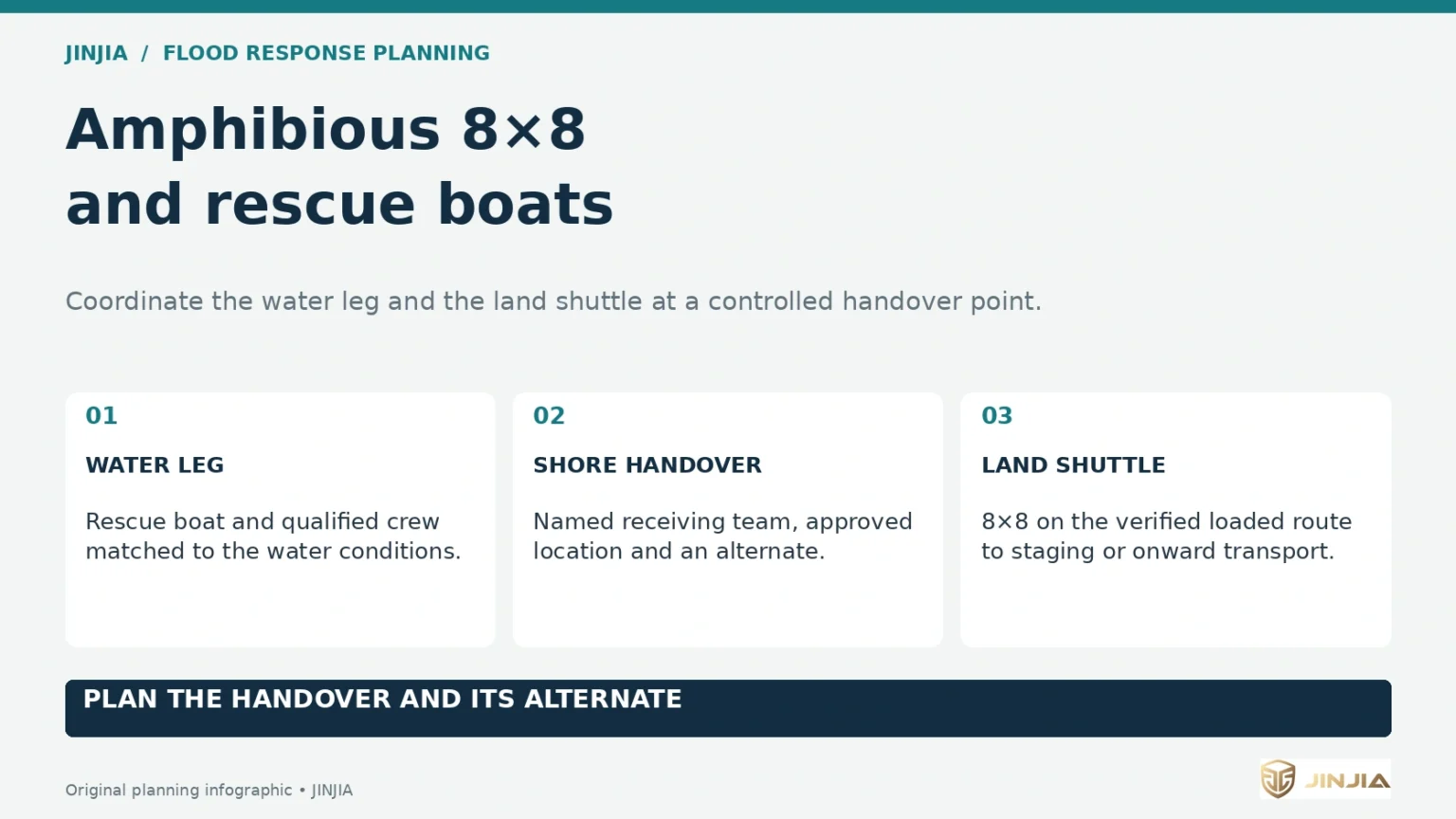
Original planning infographic for coordinating a rescue boat, a controlled shore handover and an 8×8 land shuttle.
How should an amphibious 8×8 work with a rescue boat?
Assign the boat to the water leg and the 8×8 to the land connection when both platforms are needed. The boat works within its approved water and crew limits. The 8×8 can move a team, secured equipment or eligible passengers between a staging area and a controlled shore handover point, provided the route and the loaded vehicle configuration are suitable. Name the receiving team and the alternative handover site before planning the combined mission.
For this comparison, a rescue boat is a craft selected for a specific water environment and operated by a trained team. An amphibious 8×8 is a wheeled all-terrain vehicle with configuration-dependent water capability. A vehicle operating in contact with the ground and one moving afloat have different limits. Even a verified floating configuration requires a separate decision for each proposed water task.
What the available evidence establishes
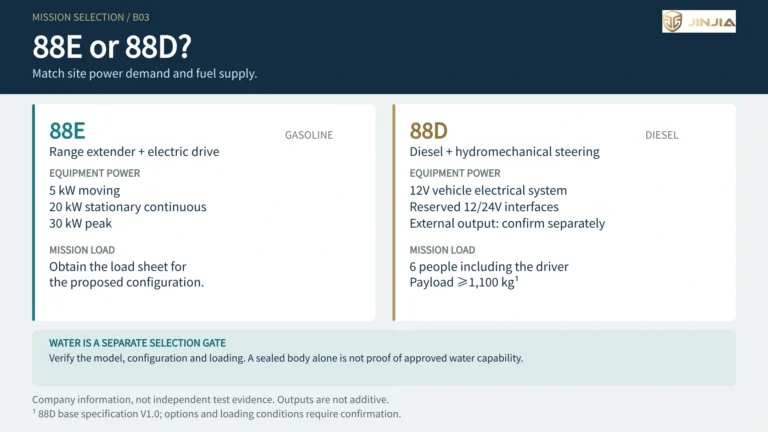
JINJIA’s 88D diesel 8×8 specification V1.0 lists a standard six-seat layout including the driver. It leaves rated wading depth, flotation load, freeboard, stability and water speed to separate verification. Seat count therefore gives a starting point for a land seating plan. Water operation needs written evidence for the precise build, loaded mass, distribution and operating conditions. JINJIA’s 88E is a gasoline range-extended electric platform and must be assessed using its own configuration documents.
The UK Department for Environment, Food & Rural Affairs’ flood rescue asset register guidance illustrates the distinction between buying a vehicle and assessing a deployable rescue capability. Its register assesses defined teams and equipment together and includes equipment and record review. Use the approach as a procurement reference. The applicable service and local authority determine the requirements for the project.
Water conditions and access
Have the water team identify the intended water leg, how conditions can change and whether the selected craft is suitable. Record flow, debris, visibility, submerged hazards, water-level change and the exposure of the entry and exit points. Establish which team verifies the site, who can close it and what alternate location can serve the route. Specify wading or afloat travel separately if any 8×8 water operation is proposed.
Check both approaches to the handover point. A boat needs an approved arrival and departure point for the water side. The land team needs a usable approach, space to turn and a route back to staging. Record shore surface, grade, obstructions and how rising water could cut off the approach. Agree the acceptance conditions with the responsible team and the relevant manufacturers. If one side cannot use the site, reassess the handover location before committing either asset.
Distance of the land connection
Measure the actual one-way and return routes between shore and the staging area, ambulance access or shelter. Capture gates, soft ground, turning space, road closures and alternate access. Build a time estimate that includes loading, travel, queuing, unloading and return. Record the number and mass of people or equipment expected per trip and verify those values against the actual vehicle configuration.
Consider a planning example in which a support truck stops 800 m from the approved shore point because the final access is unpaved. Screen a loaded 8×8 for that connection if the site assessment supports it. The 800 m is a scenario input. Compare the complete cycle with moving the handover to a reachable ramp, walking where the responsible team approves it, or using an available vehicle suited to the shore route. A closer site can also be a poor choice if people and cargo must queue beside the water.
Transfer of people and equipment
Define the handover as a task in its own right. Assign an accountable lead on the water side and a receiving lead on shore. List who or what is coming ashore, the destination and the means of confirming receipt. Keep a common record for people, essential equipment and delays. For equipment, specify mass, dimensions and how it is secured in each transport configuration. Identify the waiting area so the next transfer can proceed without blocking the approach.
For a casualty, have the responsible medical and rescue teams approve the receiving vehicle, restraints or stretcher interface and care arrangements. A general passenger seat count does not establish suitability for a particular patient. Test communications, load tracking and the handover interface in a controlled exercise before relying on the combined route.
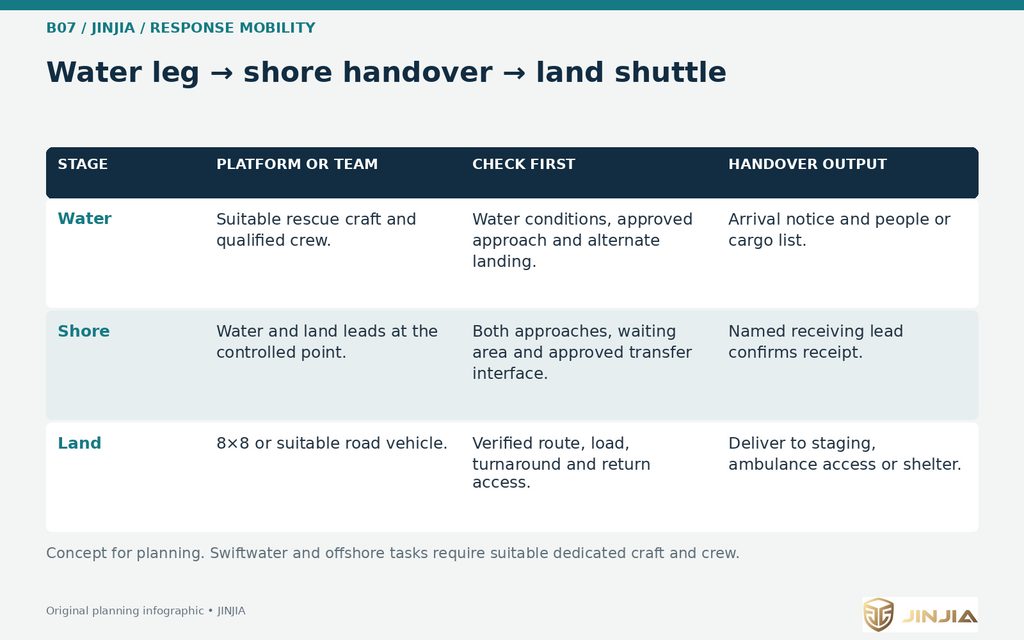
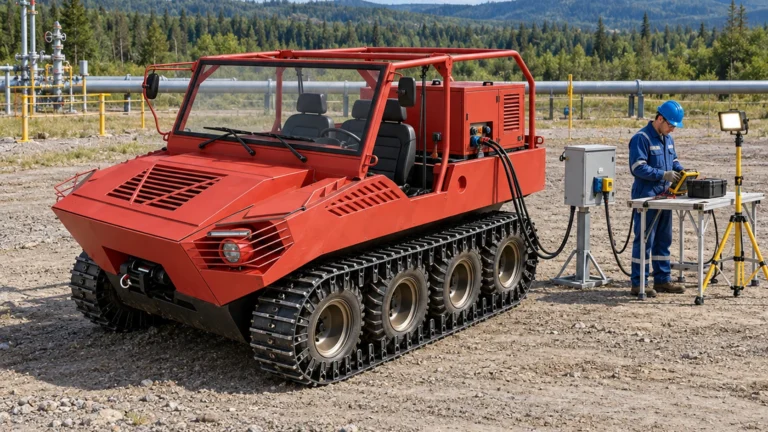
Original planning infographic for coordinating a rescue boat, a controlled shore handover and an 8×8 land shuttle.
Limits and alternatives
Use a suitable dedicated rescue craft and qualified team for swiftwater or offshore rescue under the responsible authority’s procedures. Restrict any proposed afloat 8×8 role to the conditions documented for that exact vehicle and accepted for the mission. Where the bank is unsuitable, consider another landing point. Where a road vehicle can reach the landing, it may serve the entire land connection. Evaluate the benefit of adding an 8×8 against the extra handover, crew and recovery requirements.
One-page procurement brief
Use one route sketch and record the following items for each candidate combination.
• Water leg — conditions, approved craft and crew, site reviewer and closure authority.
• Entry, exit and handover — primary and alternate points, both approaches, staging and access.
• Land connection — outbound and return distances, measured travel time, turnaround and backup route.
• People and equipment — counts, loaded masses, receiving team and securing or restraint requirements.
• Evidence — configuration-specific limits and the proposed controlled handover exercise.
• Fallback — who pauses the route, where the mission transfers, and what resources are available.
See the JINJIA amphibious utility vehicle overview for platform context. Send your route, mission load and working conditions to JINJIA / Response Mobility for an 8×8 configuration discussion.
Frequently asked questions (FAQ)
A: Record flow, debris, visibility and water-level changes. Have the responsible teams verify the craft, both approaches to the primary and alternate handover sites, and who can pause access. Request separate written limits for any proposed 8×8 water use.
Q: How should distance of the land connection be documented?
A: Measure the actual shore-to-staging distance and return route. Record restrictions and a fallback route. Include waiting, loading, unloading and return in the trip cycle and check the loaded configuration.
Q: What evidence is needed for transfer of people and equipment?
A: Request a handover plan naming the two leads, receiving location, counts and equipment masses, and the securing or restraint requirements. For casualty transfer, obtain the responsible medical and rescue teams’ approval. Verify the interface in a controlled exercise.
Sources and further information
[S91] JINJIA 88D Diesel 8×8 Technical Specification V1.0, 2026-09-08
Manufacturer specification / company input; not independent test evidence.
[S92] JINJIA confirmed 88E/88D product distinctions
Manufacturer specification / company input; not independent test evidence.
[S93] Defra Flood Rescue National Asset Register guidance
https://www.gov.uk/guidance/applying-to-join-the-defra-flood-rescue-national-asset-register
[S94] JINJIA amphibious utility vehicle platform