










A light 8×8 and an articulated tracked vehicle are different civilian utility vehicle categories. One is a compact wheeled utility platform; the other comprises two connected tracked vehicle sections. Both may be considered for civilian staff and ordinary goods transport. Start with the work to be performed, the intended passenger or cargo arrangement and the manufacturer’s confirmed documents. A category name alone does not establish that a vehicle is appropriate for a particular site.
Contents
Which platform fits the civilian transport task?
Personnel and ordinary goods: clarify the requirement
What procurement documentation should be requested?
Shared decision table: compare the same questions
Related product entries and the next step
Frequently asked questions (FAQ)
References and further reading
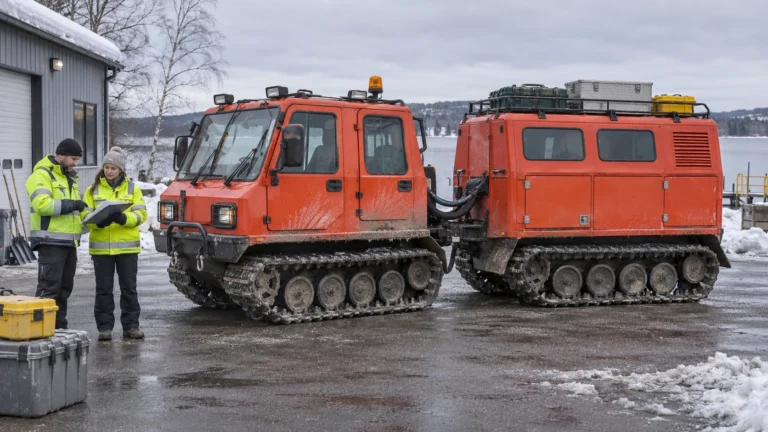
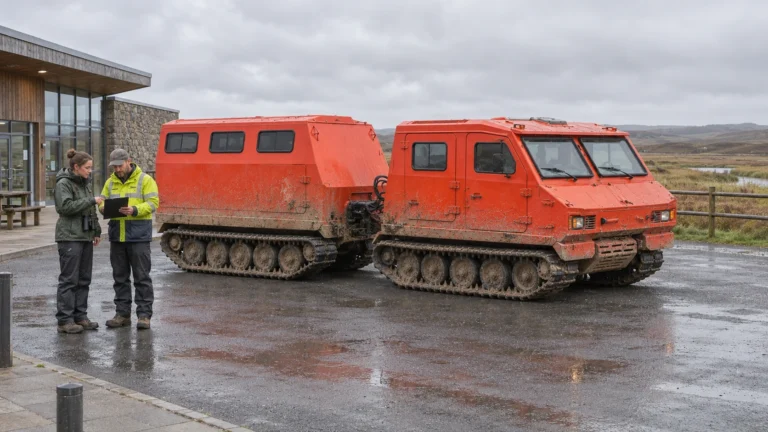
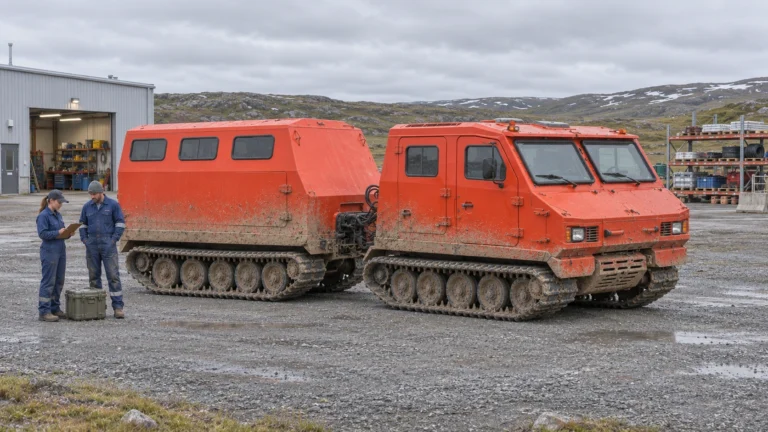
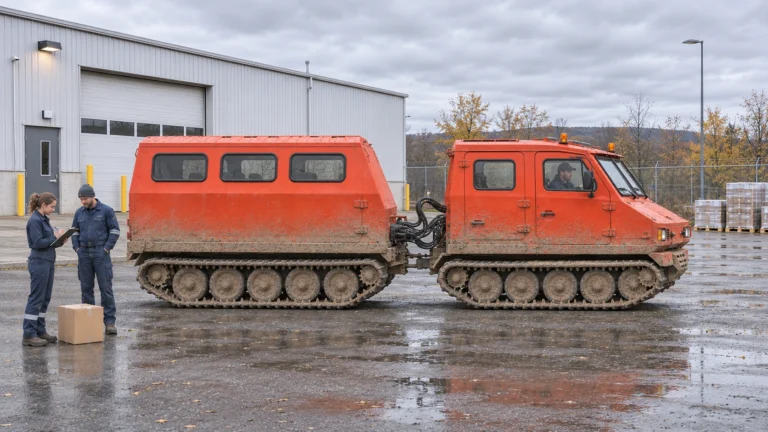
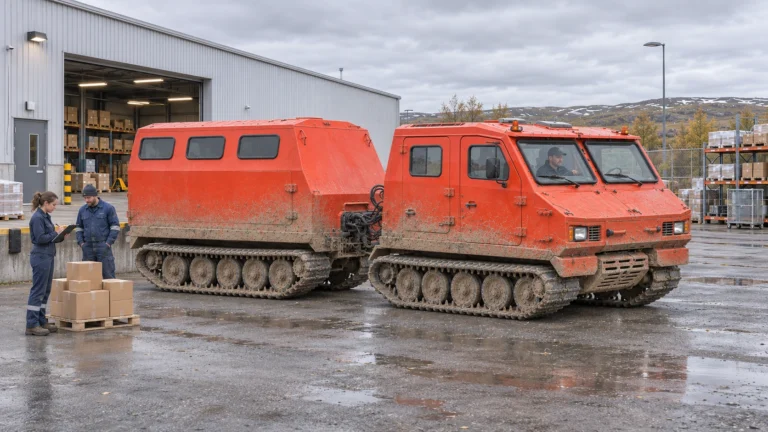
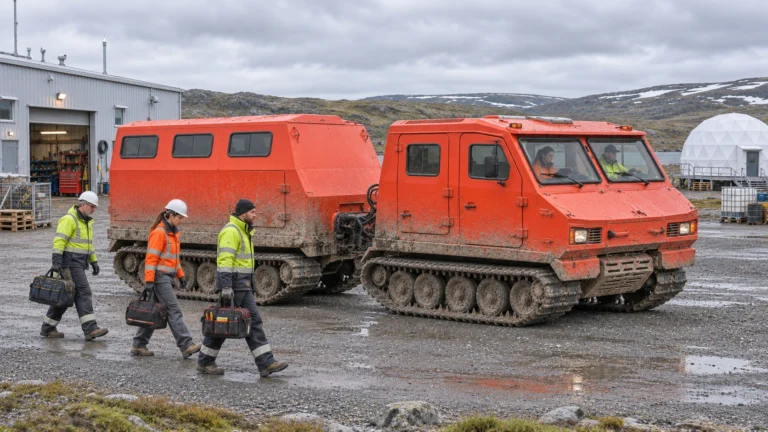
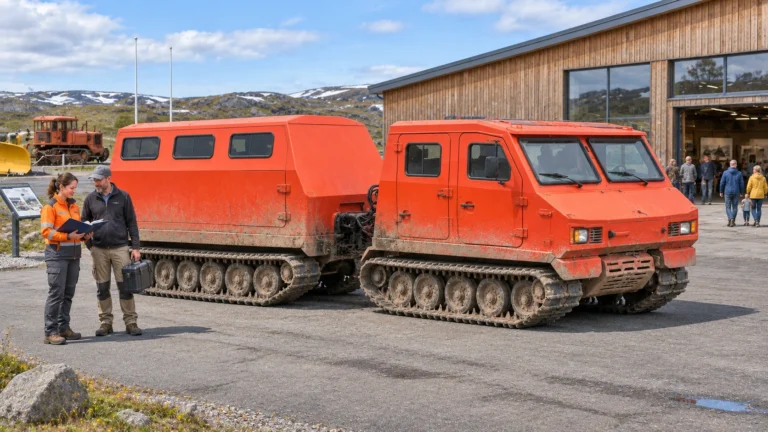
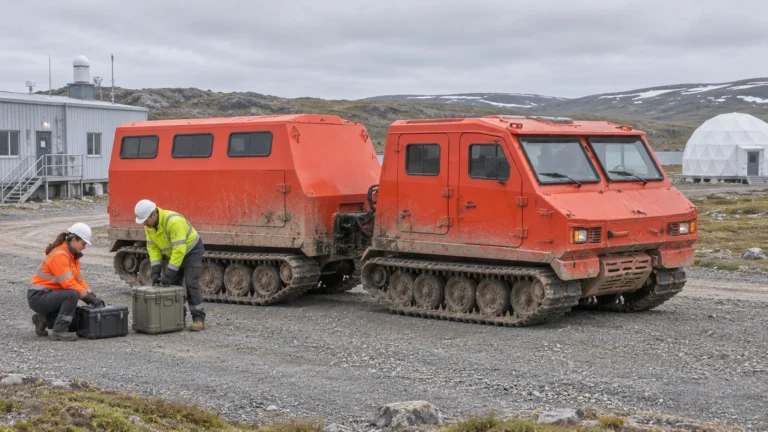
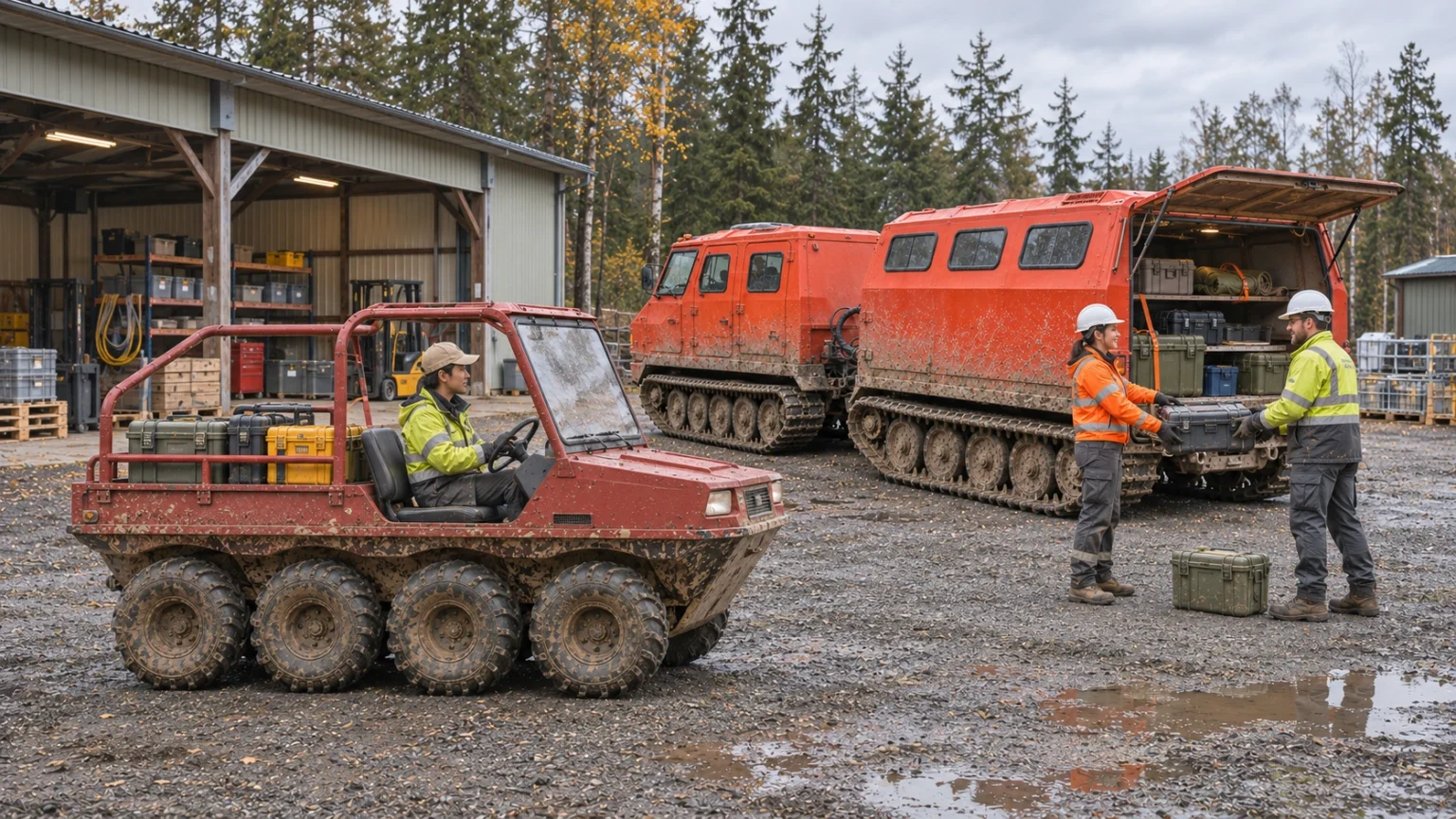
AI concept: two different civilian vehicle categories parked at an ordinary goods handover point. Not actual JINJIA products or a side-by-side performance test.
Which platform fits the civilian transport task?
The 8×8 vs articulated tracked vehicle comparison begins with a civilian transport requirement, not a winner. A small utility vehicle and a two-section transport vehicle are different product families. The question is whether a documented configuration matches the organisation’s ordinary transport need.
A light 8×8 is identified by its eight-wheel base configuration. The JINJIA amphibious utility vehicle page presents the 88E range-extended platform [S1]. A two-section tracked carrier is a separate category; the JINJIA tracked utility vehicle page presents the JJ117 family with alternative bodies [S2]. Neither product description is an independent performance test.
For example, a forestry maintenance organisation may need people to attend a scheduled service activity, or ordinary spare parts to reach a store. These are separate transport requirements even if they share a reception point. The broader terminology article [S3] explains the distinction between wheels and tracks, and the category article [S5] provides further context.
Personnel and ordinary goods: clarify the requirement
First, distinguish passenger transport from the transfer of tools, replacement parts and ordinary supplies. Passenger accommodation must be confirmed for the exact body. For ordinary goods, confirm what the supplier means by the payload definition rather than using body volume or a picture as a substitute.
The two-section JJ117 family has distinct personnel and cargo body options. A rear body is part of the configuration, and its weight may be counted within the applicable rating. A personnel body, a cargo body and a specialised functional body are therefore not interchangeable claims.
Similarly, the light 8×8’s advertised utility role does not establish that every version offers the same seating, loading or water-use approval. Ask for the correct product name and current configuration sheet. Do not transfer a published value from one model or module to another.
As a civilian example, Canadian operator Hydrus Innovations describes providing crew and cargo forwarding services using its Hägglunds fleet [S4]. This is useful evidence of the difference between transport jobs, not evidence of JINJIA deliveries or equivalence between products.
What procurement documentation should be requested?
Record the same civil transport purpose on both inquiries. Ask each supplier to identify the quoted configuration and its current product sheet. Separate manufacturer descriptions, stated options and independent or otherwise documented approval evidence.
The buyer should also request the relevant passenger or cargo-body documentation and applicable local approvals. Ask which equipment is actually included in the offer, what service documentation will accompany delivery and whether training is provided for the chosen civilian application.
Keep cost, delivery and warranty information on the same commercial basis. For example, an equipment-only quotation may exclude items included in another offer. Record the differences before making a commercial comparison. The shared screening card supplied with this article provides editable fields for this information.
Shared decision table: compare the same questions
Use the questions below to structure the conversation. The table is an administrative requirement checklist, not a capability ranking. A blank or unconfirmed answer remains open for supplier confirmation.
| Common inquiry | Light 8×8 | Two-section tracked |
| Intended transport | Describe passenger or goods task | Describe passenger or goods task |
| Quoted body | Request exact utility configuration | Request exact rear-body option |
| Configuration evidence | Current applicable product sheet | Current applicable configuration sheet |
| Commercial scope | Included items, warranty, support | Included body, warranty, support |
| Decision record | Confirmed / open questions | Confirmed / open questions |
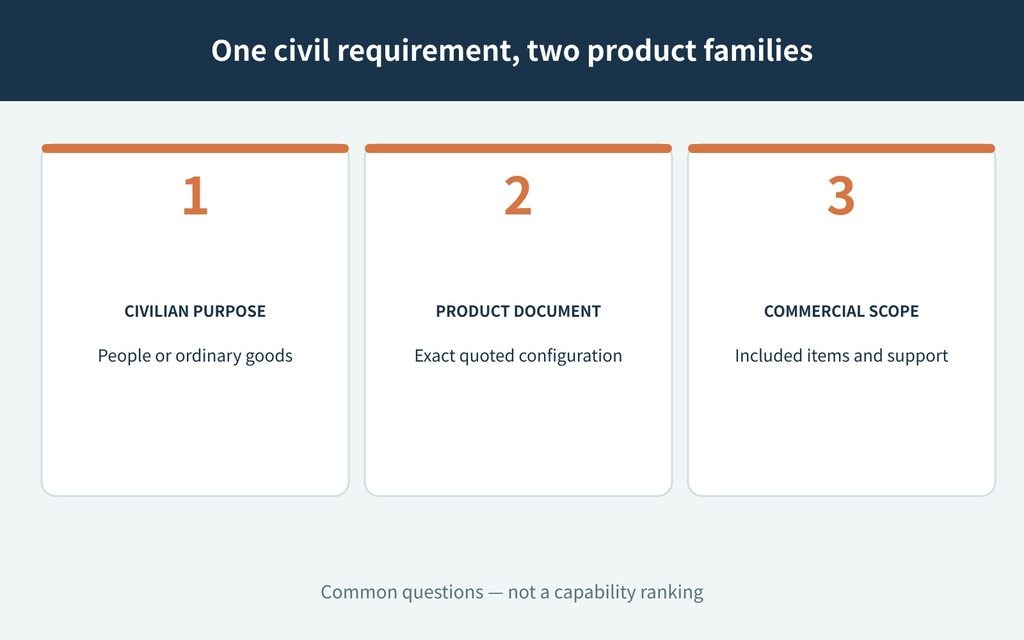
Common inquiry questions, not a capability ranking or operating approval.
Each platform has its own current product documentation. A label such as 8×8, articulated or amphibious is not a statement of approved use for a specific activity. Where a particular operating approval is required, obtain the applicable confirmation rather than deriving it from the category.
Related product entries and the next step
For the light utility platform, refer to the JINJIA Amphibious Utility Vehicle page [S1]. For the two-section tracked platform, refer to Tracked Utility Vehicle [S2]. Both pages are product introductions; the applicable agreed configuration document governs the delivered vehicle.
Use the contact page to submit a civilian transport description [S6]. Identify whether the requirement is people, ordinary goods or a separately reviewed functional body. The comparison is a starting point for discussing the two product families, not a promise of their suitability for an unspecified operation.
Describe your civilian transport requirement to JINJIA.
Frequently asked questions (FAQ)
A: A light 8×8 has an eight-wheel base platform; an articulated tracked vehicle consists of connected tracked sections. They are separate product categories.
Q: Does an eight-wheel vehicle with optional tracks become a two-section articulated vehicle?
A: No. A running-gear option does not change a single-body platform into a two-section product family.
Q: Is a rear module rating identical to the weight of usable goods?
A: Not necessarily. Confirm the supplier’s definition and whether the body itself is included.
Q: Can both categories be discussed for ordinary civilian transport?
A: Yes, provided the exact intended configuration and relevant site approvals are checked.
Q: Are product-page specifications independent field-test evidence?
A: No. They are manufacturer information; applicable evidence should be verified separately.
Q: What should a buyer send first?
A: A civilian task description, the passenger or ordinary cargo requirement, requested body options and questions about the product documentation.
References and further reading
S1: JINJIA — Amphibious Utility Vehicle — Manufacturer’s light utility platform entry.
S2: JINJIA — Tracked Utility Vehicle — Manufacturer’s two-section product family and body options.
S3: JINJIA — Tracked vs Wheeled Vehicles: What’s the Difference? — Existing broad running-gear terminology page; not model-specific test evidence.
S4: Hydrus Innovations — Hagglunds fleet — Third-party civilian transport services; no JINJIA delivery claim.
S5: JINJIA — What Is a Tracked Utility Vehicle? — General tracked utility vehicle terminology.
S6: JINJIA — Contact — Manufacturer contact entry.