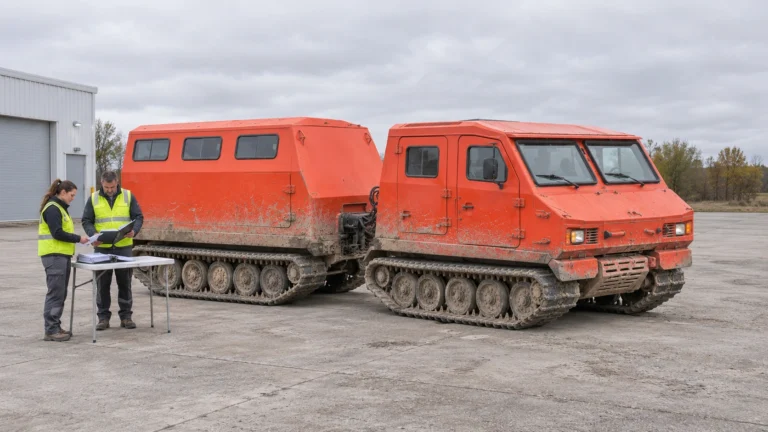











Articulated tracked vehicle delivery documents connect an agreed purchase with the item received. For a civilian carrier, procurement should request an identification document, a controlled contract annex, lawful delivery responsibilities, a receipt record and the applicable support paperwork. Delivery acknowledgement does not by itself establish technical acceptance or permission to use the vehicle.
Contents
Link the contract to the actual supplied item
Clarify lawful delivery and who owns each document
What should the receiving file contain?
Record visible damage or a discrepancy without changing the evidence
Handover to the service and contract teams
Frequently asked questions (FAQ)
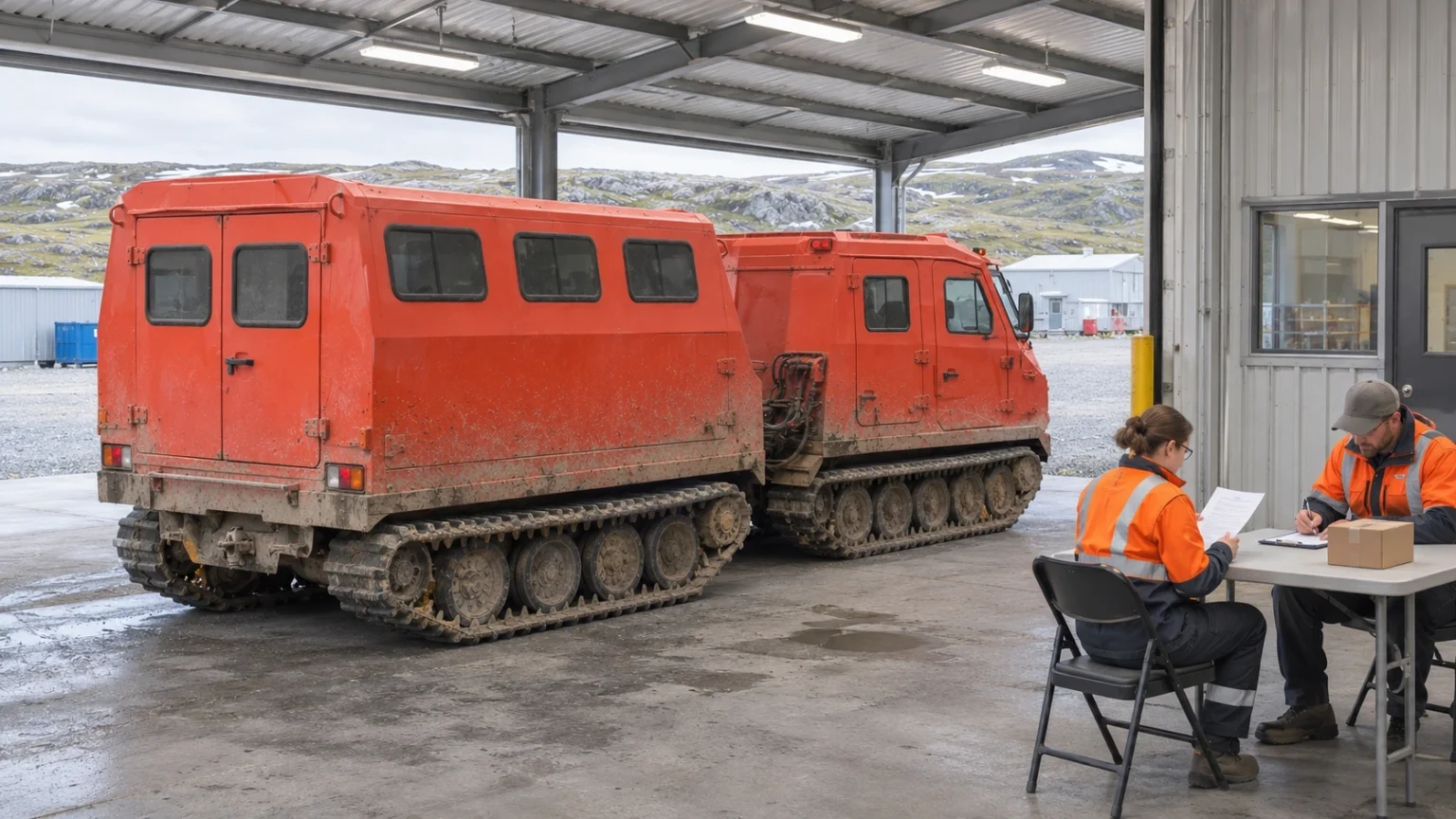
Civilian receiving clerks review paperwork at a covered warehouse beside a stationary orange-red two-section tracked carrier. AI concept of civilian use; not verified JJ117 equipment, delivery or actual event.
Link the contract to the actual supplied item
Start with the signed commercial agreement and the document that identifies the offered civil configuration. If a quotation refers to a model family rather than one revision, ask the supplier which issued document describes the item being purchased. In particular, keep the reference number from the agreed annex in the receiving file.
An ordinary two-section tracked transport vehicle may be described with different civil body arrangements. Consequently, illustrations and brochure descriptions should not replace the configuration document accepted by both parties. JINJIA publishes its tracked utility vehicle category [S0], but the actual offer remains a separate commercial record.
Use the contract register to record the current revision, applicable annexes, included documents and the authorised people who approve changes. If a newer quotation changes the scope, retain the old revision and identify the superseding record instead of replacing it silently.
Clarify lawful delivery and who owns each document
Procurement and the contracted transport provider have different roles. The buyer should know who is responsible for confirming applicable permissions, insurance and the contractual delivery point. However, the required documents depend on the actual transaction and jurisdiction. Obtain those answers from the responsible provider and relevant authority rather than treating an online article as regulatory or transport advice.
The World Bank’s goods-contract management guidance distinguishes logistics arrangements, acceptance checks and warranty information [S24]. Thus, it offers a useful framework for document categories rather than a list of requirements for every transaction.
For example, an order may identify a delivery obligation while a receiving organisation has its own internal asset-record requirements. Record both document owners and any missing approvals. Do not infer that a transport receipt settles every contractual or regulatory question.
What should the receiving file contain?
Organise the file into four groups. First, identify the contract and revision in the commercial record. Next, describe the agreed civilian item and included documents. The receipt, in contrast, records what the recipient actually acknowledged. Finally, list missing information and assigned responsibilities.
The accompanying information graphic illustrates those four documentary categories. For each one, record the document title, issuer, revision or date and confirmation status. If a document is unavailable, however, leave it explicitly pending rather than filling the gap with a photo or a similar model’s report.
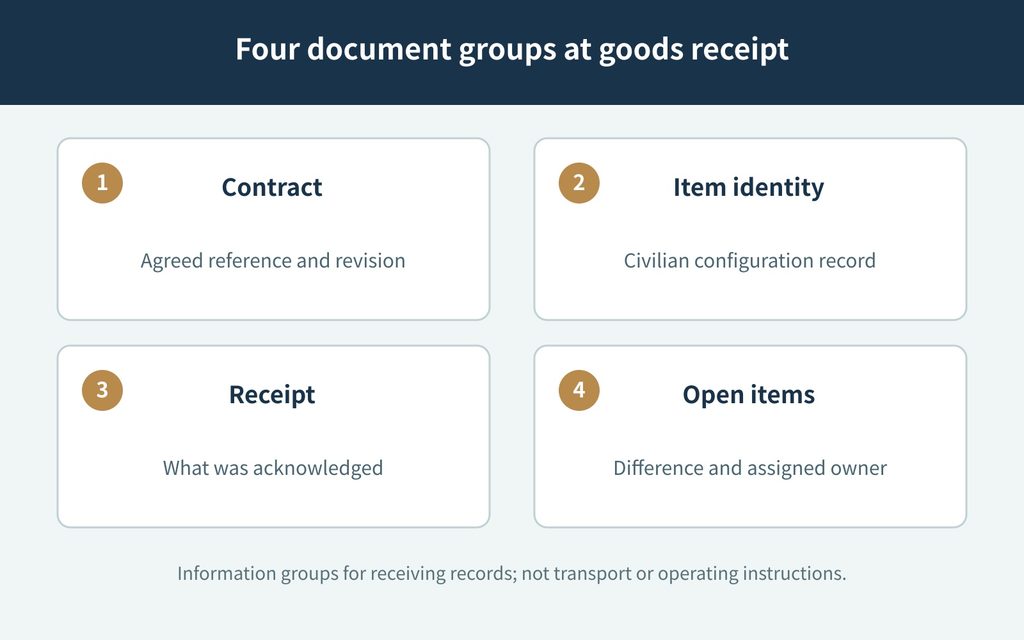
Information groups for receiving records; not transport or operating instructions.
A receipt can be an important commercial record. Nevertheless, formal acceptance and any permission for use belong to separately agreed or competent processes. For this reason, a receiving employee should not describe a delivery signature as independent evidence of vehicle capability.
Record visible damage or a discrepancy without changing the evidence
A receiving organisation may record an externally apparent difference, missing paperwork or an item that does not match the agreed description. Therefore, preserve dated evidence and identify which document and item it concerns. For safety-sensitive conditions, refer the matter to appropriately qualified staff rather than attempting a technical judgement from a photograph.
For example, suppose a sealed pack of agreed documents is missing from a civilian equipment delivery. In that case, the receiving officer can record the missing document reference and notify the contract contact. However, the agreed procedure and authorised reviewer determine the effect on acceptance.
Separate a reported difference, a supplier response and the final documented disposition. In addition, distinguish an observation from an allegation of cause. Closing a document issue requires evidence that the authorised parties recognise, not merely an informal message.
Handover to the service and contract teams
After receipt, the buyer needs a consistent record for the service team: the accepted item reference, operating and maintenance documentation as contracted, training agreement if applicable, and written warranty and service contacts. Therefore, identify in the delivery file which documents have actually arrived.
The included worksheet uses blank records so that a receiving organisation can enter its own documents and statuses. It focuses on records rather than transport arrangements. Those matters do not belong in this generic document checklist.
Finally, request the relevant civilian product and delivery documentation from JINJIA [S0C]. Agree the documentary scope before purchase, preserve the original references at receipt and leave unresolved issues visible until properly closed.
Request general civilian product and delivery documentation.
Frequently asked questions (FAQ)
A: The agreed contract and configuration reference, responsible delivery and approval records, receiving acknowledgement, discrepancy register and applicable service literature.
Q: Does a delivery receipt count as formal acceptance?
A: Not necessarily. Receipt, contractual acceptance and permission for use are distinct records.
Q: Should the buyer assume that all pictured equipment is included?
A: No. The accepted configuration document and contract annex define the supplied scope.
Q: What should be recorded when paperwork is missing?
A: The document identity, observation date, responsible party and unresolved status.
Q: Does the World Bank guidance determine our local transport rules?
A: No. It is general procurement guidance. Applicable obligations must be confirmed for the actual transaction.
Q: Does the product page prove a guaranteed delivery schedule?
A: No. Delivery timing and scope require the actual written commercial agreement.
References and evidence scope
S24: World Bank — Contract Management: Procurement Guidance (June 2024), goods contracts — General public procurement guidance on contract administration, receipt/acceptance and warranty information; not model certification or a requirement for every contract.
S0: JINJIA / Response Mobility — Tracked Utility Vehicle — Manufacturer page; verified public product literature, not proof of the delivered civil configuration.
S0C: JINJIA / Response Mobility — Contact — Public brand contact page.