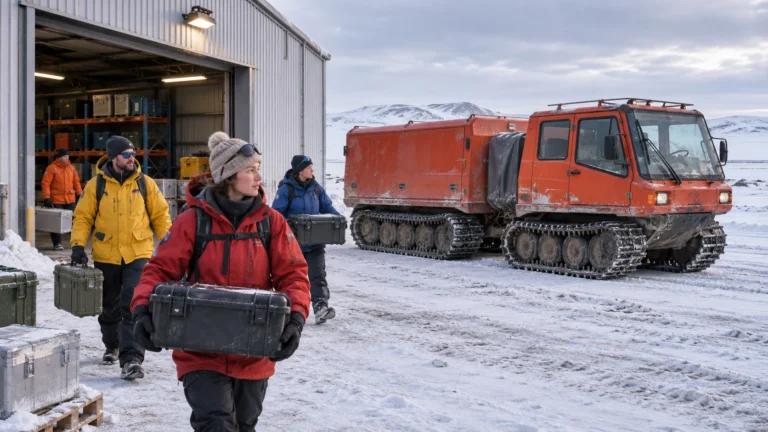












Credible articulated tracked vehicle service support depends on a documented relationship between the civilian customer, the supplier and any authorised service organisation. A delivery record anchors that relationship to the actual supplied item. Written warranty terms and named responsibilities define its commercial scope. A photograph of a workshop or a historical fleet story cannot prove a support commitment.
Contents
Begin with the delivery and identity record
Distinguish supplier support and local service responsibilities
Read the warranty as a written commercial document
Separate the history of other fleets from local service evidence
Keep unresolved commitments visible
Frequently asked questions (FAQ)
Civilian service staff review a service folder at a reception counter in a workshop, with a parked weathered red two-section tracked utility concept behind them. AI concept of civilian use; not verified JJ117 equipment, delivery or actual event.
Begin with the delivery and identity record
Quality discussions are easier when the customer and supplier refer to the same supplied item and document revision. Therefore, retain the agreed delivery description, identified documentation and any unresolved commercial matters from the handover.
For example, a retained purchase document can show which civilian configuration the transaction concerns. In contrast, a later brochure describes current marketing material. Therefore, do not silently substitute one for the other.
B34 explains the role of delivery and receipt documents. B35 considers maintenance-related documentation, while B36 addresses training records. Here, by contrast, the focus is commercial responsibility and evidence of after-sales support.
Distinguish supplier support and local service responsibilities
A customer may hear terms such as manufacturer support, dealer assistance and local service. However, those expressions alone do not establish who accepts a request, who contracts to provide a service or who bears a particular expense. Therefore, identify the actual parties in the written agreement.
In addition, a proposed service partner is not necessarily an authorised service partner for the supplied item. The customer’s own contact, the supplier contact and any documented local organisation should each have a clearly labelled role.
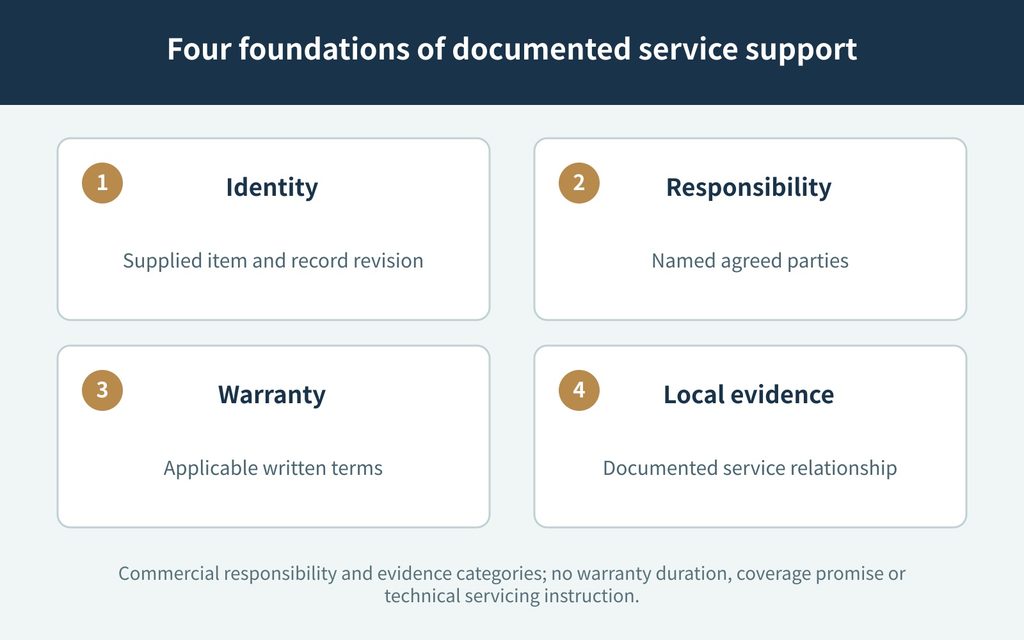
Commercial responsibility and evidence categories; no warranty duration, coverage promise or technical servicing instruction.
The information graphic separates four elements: the supplied-item record, the agreed support relationship, written warranty terms and evidence of local service. It makes the commercial discussion traceable rather than specifying maintenance or promising a service network.
Read the warranty as a written commercial document
A useful warranty reference identifies the document, date, covered item and agreed terms. For example, a general warranty advertisement may leave out exclusions or the circumstances that require further commercial approval. Instead, refer to the actual agreement.
World Bank guidance for goods contracts discusses warranty information in the context of contract administration [S24]. However, general procurement guidance cannot determine a particular JJ117 warranty period, scope or reimbursement obligation.
Compare the actual written terms with the delivered commercial scope. However, keep any matter open if the parties have not agreed on it. Moreover, avoid replacing a warranty record with an assumed response time, availability figure or a promise drawn from another product line.
Separate the history of other fleets from local service evidence
An Australian Antarctic Program account from 2015 describes work on vehicles in its own fleet [S09]. Similarly, the International Antarctic Centre explains the work of its own mechanics [S15]. Taken together, the examples illustrate the personnel and records that accompany equipment ownership.
Neither example, however, establishes a JINJIA workshop, technician network, parts stock or warranty in a particular country. Thus, third-party case studies and offered support for a new civilian customer are different sources of evidence.
If a supplier names a local organisation, retain the written evidence concerning its identity and authorised scope. For instance, the address of a general workshop does not itself confirm an agreed support responsibility. The workbook therefore leaves local service evidence and terms empty until actual documents exist.
Keep unresolved commitments visible
A support register is most useful when it makes uncertainty visible. Instead of labelling every row as confirmed, record the relevant agreement, a dated response, the issue still open and its commercial reviewer.
The JINJIA tracked utility vehicle page [S0] offers general product context. However, it does not replace the written commercial terms applicable to a specific transaction. No local service availability, fixed service level or warranty duration is assumed in this article.
Finally, the public contact page [S0C] provides an entrance for general civilian product and commercial documentation. Ask for the written terms relevant to the actual relationship. Then keep the records alongside B37, because only agreed or evidenced costs belong in that comparison.
Request general civilian service documentation and relevant written commercial terms.
Frequently asked questions (FAQ)
A: An identifiable delivered item, written terms, assigned parties and evidence for any claimed local service.
Q: Is a proposed partner automatically an authorised service centre?
A: No. The responsible parties must verify the written scope and relationship.
Q: Does a general product page set the warranty period?
A: No. Use the applicable agreed warranty document.
Q: Can an Antarctic operator’s historical maintenance work prove JINJIA service coverage?
A: No. That evidence concerns a different organisation and fleet.
Q: Should a service register assume stock or response time?
A: No. Record only the applicable written terms or actual evidence.
Q: Does the included worksheet replace a support agreement?
A: No. It is a generic civilian record for tracking agreed and unresolved commercial topics.
References and evidence scope
S09: Australian Antarctic Program — New heart for an old faithful (2015) — Historical account of work on its own Antarctic vehicles; no JJ117 maintenance or cost evidence.
S15: International Antarctic Centre — The mighty mechanics at the heart of the Hägglund — Tourist attraction describes its own maintenance programme; not JINJIA services or network evidence.
S24: World Bank — Contract Management: Procurement Guidance (June 2024), goods contracts — General public procurement guidance on contract administration, receipt/acceptance and warranty information; not model certification or a requirement for every contract.
S0: JINJIA / Response Mobility — Tracked Utility Vehicle — Manufacturer page; verified public product literature, not proof of the delivered civil configuration.
S0C: JINJIA / Response Mobility — Contact — Public brand contact page.