

Quick answer: What should an oil and gas buyer evaluate first?
Sound tracked vehicle selection begins with the duty, not the datasheet. The right machine must perform a precisely defined task safely at its true operating mass, over the site’s actual terrain, within the project’s regulatory and environmental boundaries. Start with the mission, route and load—not the top speed or a generic “all-terrain” claim.
For remote oil and gas projects, procurement teams should verify five essentials: operating terrain; required payload; environmental conditions; intended application; and estimated quantity. Those inputs lead to a configuration review, a site-specific risk assessment and a measurable acceptance test. An articulated tracked platform is one candidate, not the automatic winner of every comparison.
TL;DR
- Tracked vehicle selection starts with duty, route and true operating mass — not top speed or an “all-terrain” claim.
- Operational gross mass = base vehicle + mission module + personnel + fuel/fluids + cargo; the 17,000 kg “Weight” field is not payload.
- Nominal ground pressure (p = mg/A) is a screening number only; soil shear, repeated passes and season decide sinkage.
- Fording, flotation, powered swimming and icebreaking are four separate capabilities requiring separate acceptance tests.
- Ask for every RFQ clause answered as Complies / Complies with modification / Does not comply / Engineering confirmation required.
1. Define the task before choosing the platform
Write down whether the equipment will move staff, spares, survey instruments, generators, temporary pumps or mission modules. Establish the duty cycle: distance each shift, number of trips, expected utilization, turnaround time, stationary power needs and recovery constraints. Separate cargo mass from operating mass and check any tow or trailer requirement independently.
Then classify every task as routine logistics, inspection support, construction support or emergency response. Transporting firefighting equipment does not itself make a carrier a certified firefighting vehicle; delivering a skimmer does not establish an oil-recovery rating.
2. Survey the full route—not merely its most visible obstacle
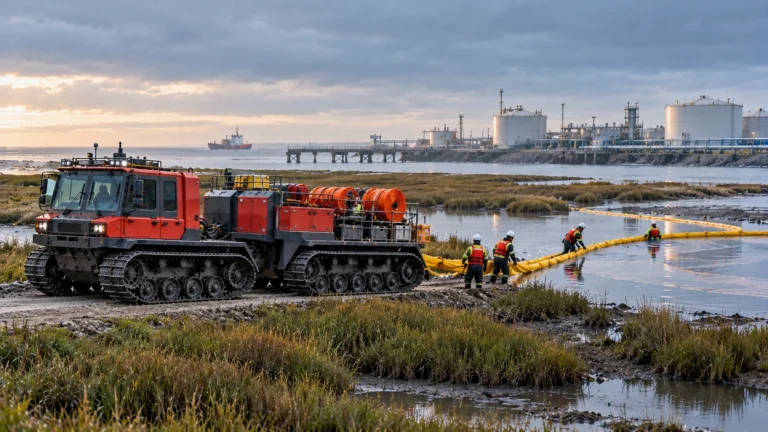
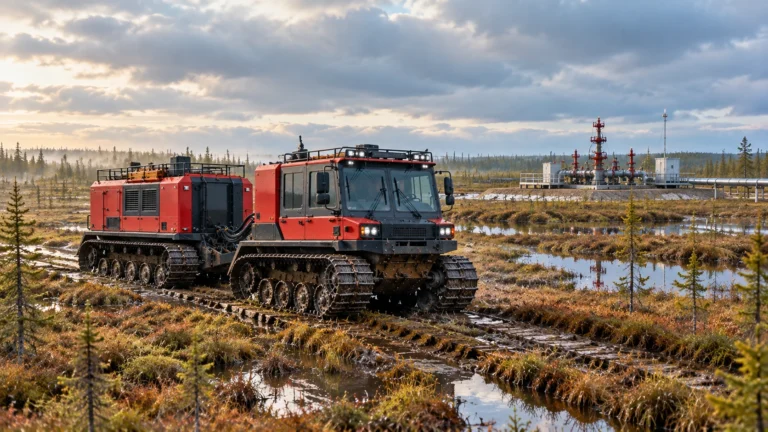
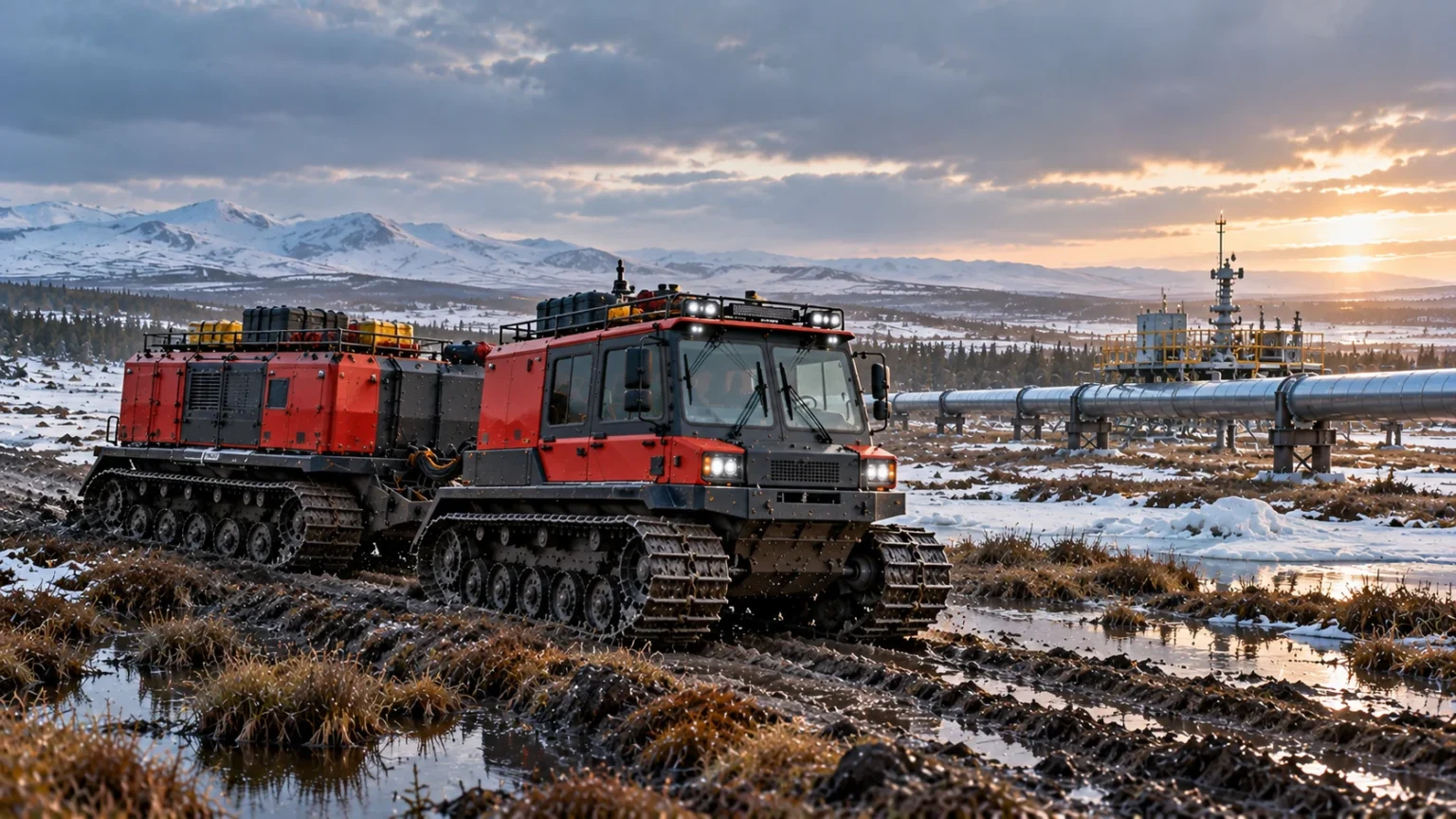
Next, build a route profile for soft clay, peat, muskeg, wetlands, rocky gradients, snow, thawing tundra, river approaches, mudflats and unprepared shorelines. Record turning spaces, obstacles, side slopes, seasonal changes, permitted corridors and available rescue routes.
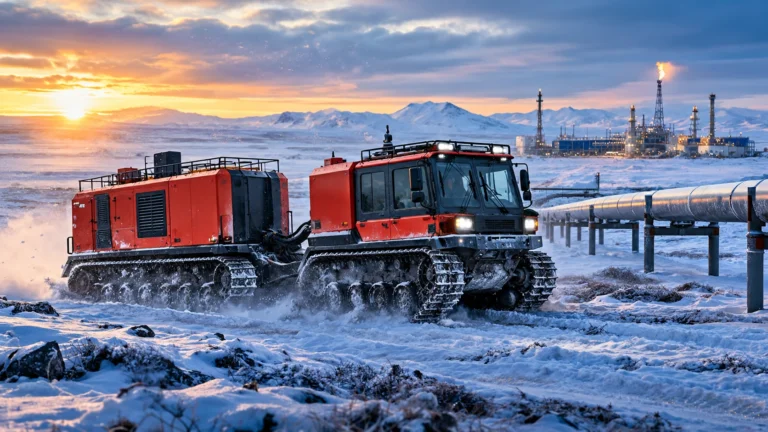
Soil bearing capacity and shear behavior are often as important as a vehicle’s nominal ground pressure. An Arctic winter route may become unserviceable during spring thaw. A snow-rated machine is not automatically safe on natural ice; safe load limits, local approval and a recovery plan require independent assessment.
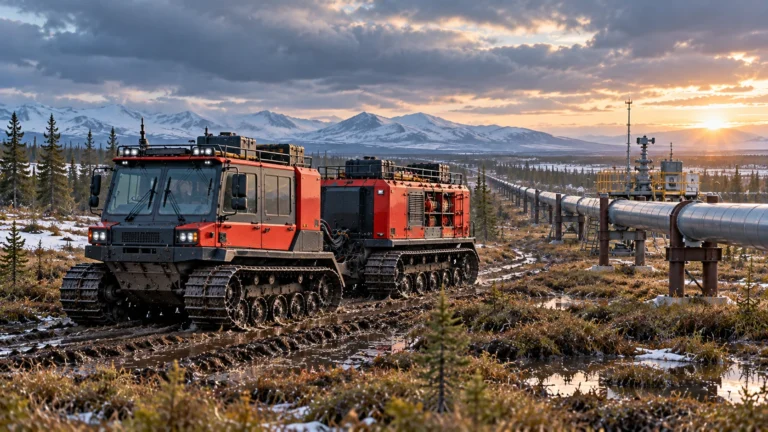
Crossing an active buried pipeline, or operating inside its right-of-way, requires the operator’s approval. Above all, do not infer crossing permission from broad tracks or low ground pressure. PHMSA materials are useful safety background for U.S. projects, not a universal rule for every country.
3. Calculate true loaded mass and useful payload
Use the following RFQ relationship: operational gross mass = base vehicle + mission module + personnel + fuel and fluids + tools and cargo. Useful payload is not interchangeable with the manufacturer’s “Weight” field. Confirm curb/empty mass, gross vehicle mass limit and axle or tracked-section load distribution for the exact build.
Also check the centre of gravity, securement points, permissible floor loading, module interfaces, towing limits (if any), loading/unloading procedure and transport envelope. Reserve capacity for instruments, safety equipment and modifications agreed during engineering review.
4. Understand ground pressure, traction and sinkage
Engineers sometimes estimate nominal average contact pressure as p = mg/A. Here m is the relevant supported mass, g is gravitational acceleration and A is effective track-ground contact area. However, it is only a screening parameter: track loading varies, and soil shear failure or repeated passages can create serious rutting even at apparently low nominal pressure.
In addition, request the manufacturer’s measured or calculated contact geometry at specified load, track dimensions, test mass, slip rate, gradeability evidence and representative soft-ground trials. Ask for ground disturbance limits when crossing peat or wetland habitats. The IUCN UK Peatland Programme has documented persistent ecological and hydrological effects from tracks and roads on peatlands.
An articulated configuration can help accommodate uneven terrain and distribute vehicle modules. Yet articulation alone proves nothing about a particular ground pressure or marsh crossing performance.
5. Separate fording, flotation, water propulsion and icebreaking
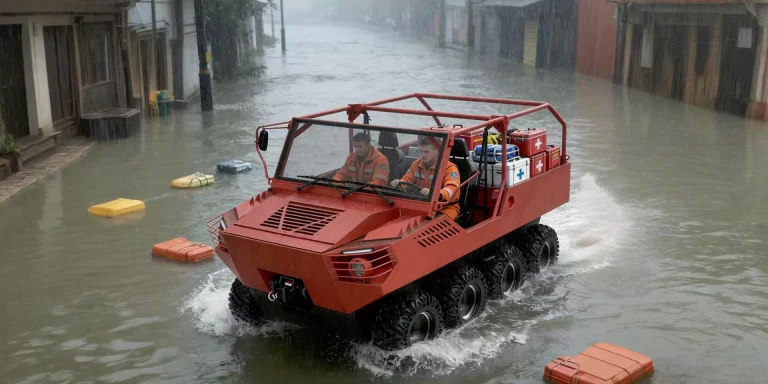
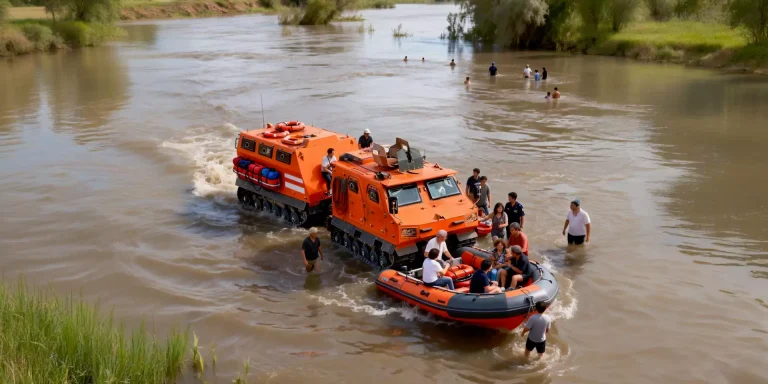
Fording means crossing water while relying largely on ground contact. Flotation means the vehicle can support itself in water; powered swimming requires propulsion and steering. Water-to-shore exit adds a new traction and stability problem, especially on an unprepared bank. Marine service introduces yet another layer of certification and safe-operations requirements.
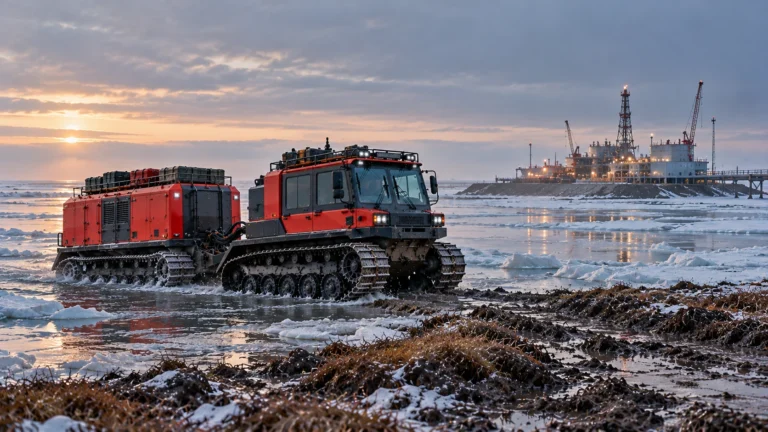
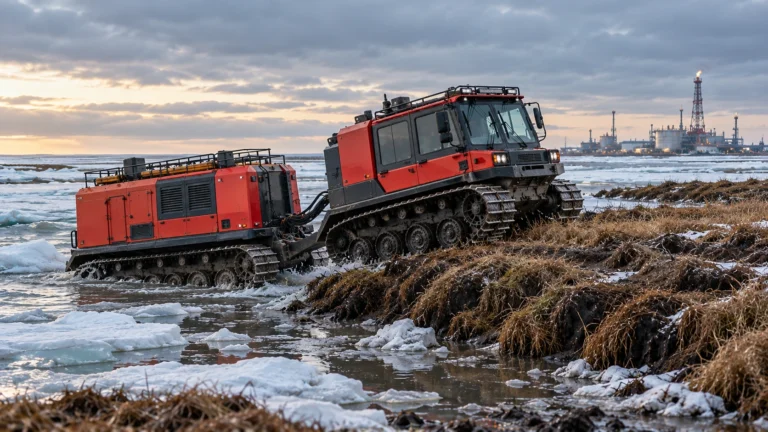
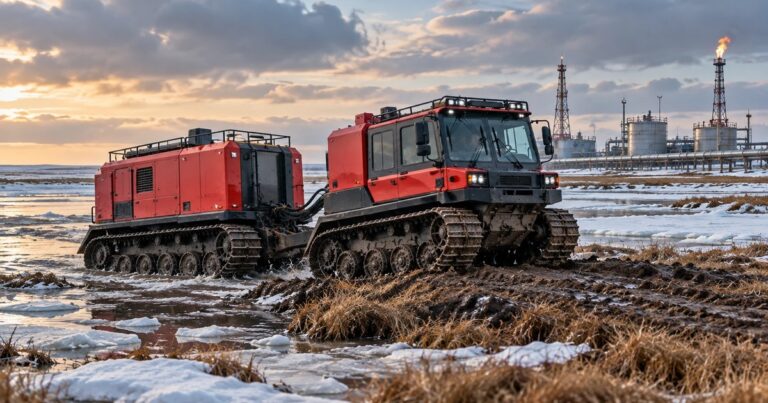
The same distinction applies to winter operations. Traction on snow, travel on sufficiently assessed ice, movement in broken ice and active icebreaking are four different capabilities. Do not write them into one “amphibious/Arctic” purchase specification without separate acceptance criteria.
6. Assess oilfield HSE and approvals before specifying optional equipment
First, confirm hazardous-area zoning, combustible atmosphere restrictions, H₂S exposure, gas monitoring, communication coverage, recovery and evacuation plans, personnel protection, lifting points and operator training. Vehicle entry to a classified hazardous area must depend on the installation’s rules and verified equipment suitability, not general off-road performance.
OSHA lists vehicle and equipment transport, struck-by hazards, fire/explosion exposure and other hazards as important oil-and-gas field risks. Applicable local standards and operator requirements govern each project. We cite OSHA guidance as a safety reference, not as a claim of universal jurisdiction.
For pipelines, add right-of-way and buried-crossing approvals. In wetland areas, add ecological permits and repeat-pass limits. Offshore or ice-water missions also need classification, stability, flotation and rescue requirements where applicable.
7. Evaluate whole-life cost instead of buying only on price
Tracked vehicle selection should weigh whole-life cost rather than purchase price alone. A useful cost comparison includes acquisition and customization, shipping and local registration, training, fuel or energy, maintenance hours, spare parts and tracked undercarriage wear. Add planned downtime, emergency recovery, service-network coverage and residual value. Compare alternatives at a specified annual duty cycle and service life.
Then use an operating case that matters: total cost per delivered tonne-kilometre, per accessible worksite or per productive shift. Do not claim a universal saving versus wheeled vehicles without comparative field data.
8. The supplier technical acceptance checklist
01 — Obtain a configuration-controlled technical datasheet including serial/build reference and documented mass definitions.
02 — Verify gross mass, usable payload, crew capacity and permitted accessory load in the exact configuration.
03 — Obtain track width, actual contact length, effective area, ground pressure basis and route soil data.
04 — Check slopes, turning radius, obstacles, climate range and any required towing/transport permissions.
05 — Separate fording from powered swimming and ice travel from icebreaking; specify practical tests for each.
06 — Review HSE, H₂S, explosive atmosphere, environmental and pipeline crossing restrictions.
07 — Require delivery inspection, operator training, spare-parts support and warranty terms.
08 — Define representative field-acceptance trials, measured pass/fail criteria, recovery procedures and the owner of each approval.
9. What JINJIA publicly states about JJ117-X1 and JJ117-X2
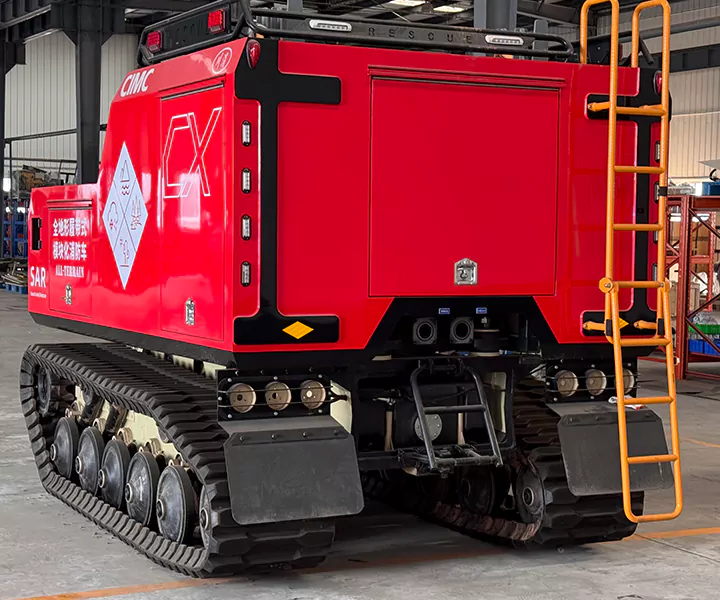
JINJIA’s official product page lists JJ117-X1 and JJ117-X2 with a “Weight” value of 17,000 kg for each configuration, and a maximum road speed of 65 km/h. Listed dimensions are 9.1 × 2.45 × 3.6 m (X1) and 9.1 × 2.45 × 2.6 m (X2). The manufacturer-stated operating temperature range is −43°C to +50°C.
On the X2 listing, JINJIA separately includes a 5 km/h floating speed. The X1 listing contains firefighting equipment specifications. These are distinct configurations: no buyer should combine individual figures into an unverified single vehicle. The 17,000 kg field does not mean 17 tonnes of payload. No published page supplies independently verified loaded-ground-pressure, marsh performance, icebreaking or hazardous-area certification for the specific projects discussed here.
JJ117 can therefore be treated as an initial design candidate for selected mobility studies, subject to engineering confirmation. Official source: https://responsemobility.com/tracked-utility-vehicle/
10. An effective RFQ: five core inputs plus supporting evidence
Tracked vehicle selection succeeds or fails on this submission: Operating Terrain | Required Payload | Environmental Conditions | Intended Application | Estimated Quantity. To accelerate selection, also provide destination country, route photographs or topographic data, soil/ice/water information, personnel capacity, duty cycle, accessories and local HSE requirements.
Ask suppliers to answer each RFQ clause as Complies / Complies with modification / Does not comply / Engineering confirmation required, supported by test evidence where relevant. Never turn a conditional statement into a guaranteed catalogue specification.
Frequently asked questions
A: No. They can be appropriate in certain low-bearing-capacity or uneven terrains, but life-cycle cost and route conditions can favor wheels, mats, other tracked configurations or alternative logistics.
Q: Does “Weight 17,000 kg” mean a 17-tonne payload?
A: No. It is the manufacturer’s weight field. Ask for empty mass, gross vehicle weight limit and verified payload for the chosen configuration.
Q: Does low ground pressure prevent sinking?
A: No. Soil shear strength, sinkage, slip, repeated passes and environmental limitations all matter.
Q: Can the JJ117-X2 be used as a certified offshore rescue craft?
A: Its public floating-speed figure is not evidence of marine class, rescue certification or an approved offshore operating envelope.
Q: Can a tracked vehicle cross a buried pipeline safely?
A: Only after the pipeline operator approves the route and any required crossing protection.
Q: What should buyers request before a binding quotation?
A: A complete duty definition, engineering data, destination and permits, validation requirements, support terms and an agreed configuration.
Request a project-specific mobility review
JINJIA / Response Mobility can review difficult terrain and modular transport requirements as a tracked vehicle selection exercise. Share the five basic design inputs and, if available, a route map and equipment list. We will distinguish existing published parameters from options that require new validation.
Operating Terrain | Required Payload | Environmental Conditions | Intended Application | Estimated Quantity.
Official JJ117 page: https://responsemobility.com/tracked-utility-vehicle/ | Contact: https://responsemobility.com/contact/ | Email: info@responsemobility.com
Related JINJIA technical guides
Explore the seven related articles in this oil and gas series: all-terrain applications, unprepared banks, peatlands, Arctic transport, pipeline maintenance, offshore emergency support and coastal oil-spill logistics. The CMS team should link only to verified published pages.
Sources and technical references
JINJIA — JJ117-X1/X2 official tracked utility vehicle specifications — https://responsemobility.com/tracked-utility-vehicle/
OSHA — Oil and Gas Well Drilling and Servicing: Transportation — https://www.osha.gov/etools/oil-and-gas/transportation
Transporting equipment in oil and gas operations — OSHA — https://www.osha.gov/etools/oil-and-gas/transportation/transporting-equipment
Health hazards and H₂S in oil and gas extraction — OSHA — https://www.osha.gov/oil-and-gas-extraction/health-hazards
PHMSA — Phases of Pipeline Construction — https://www.phmsa.dot.gov/technical-resources/pipeline/pipeline-construction/phases-pipeline-construction-overview
IUCN UK Peatland Programme — Tracks and Roads on Peatlands (2025) — https://www.iucn-uk-peatlandprogramme.org/sites/default/files/2025-03/Tracks%20and%20roads%20on%20peatlands%20-%20March%202025.pdf
Google Search Central — Article / BlogPosting structured data — https://developers.google.com/search/docs/appearance/structured-data/article