

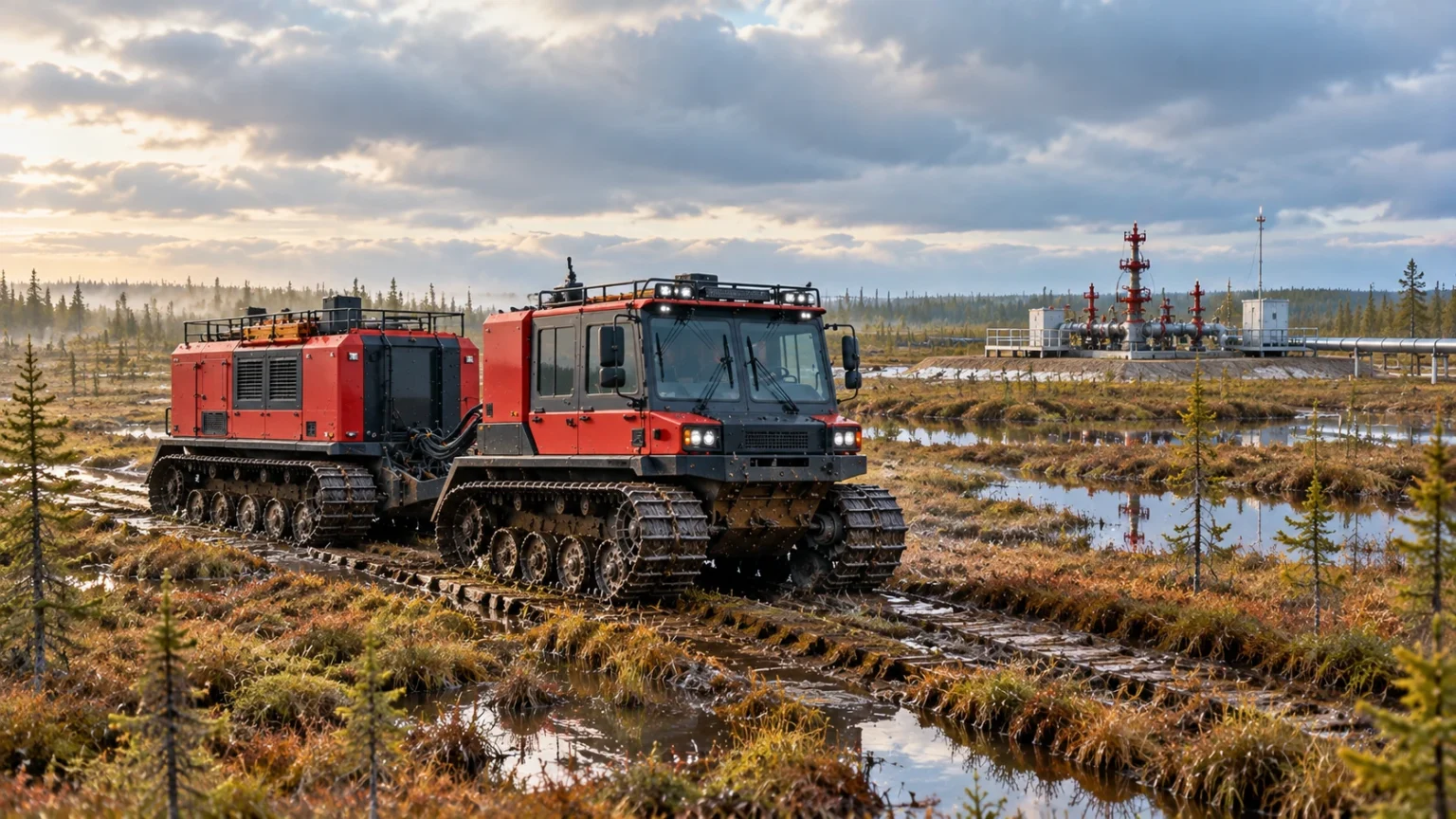
Quick answer: when is a low-ground-pressure tracked vehicle useful?
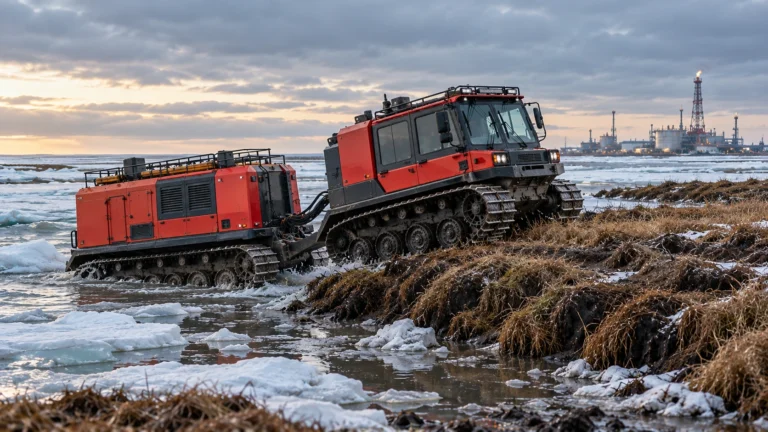
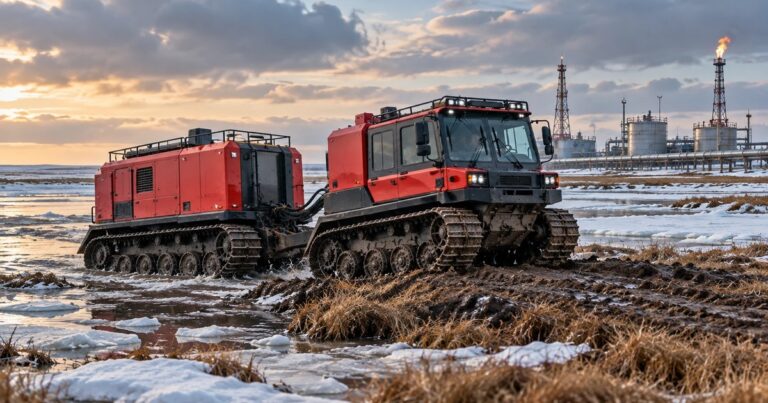
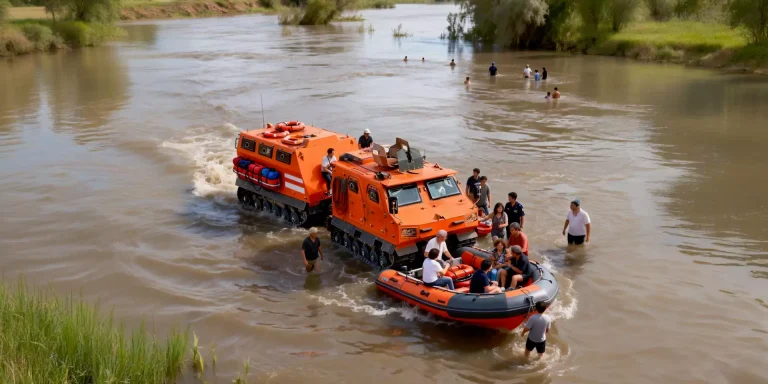
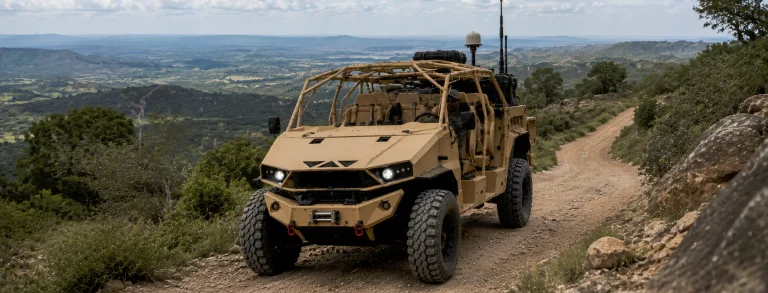
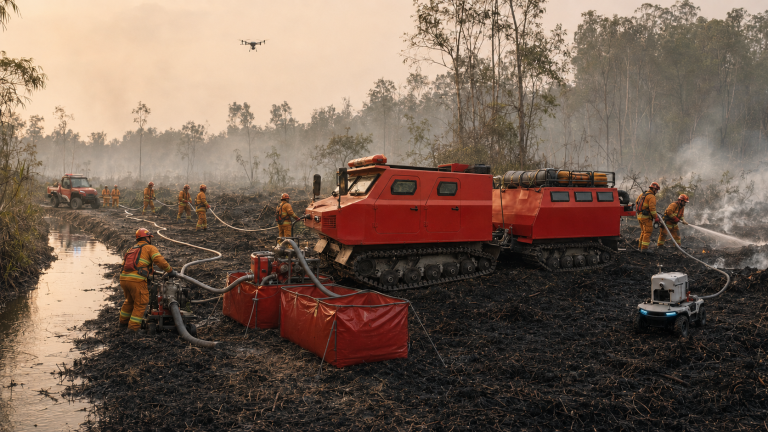
A low-ground-pressure tracked vehicle may be a candidate for carrying people, tools or suitable cargo across peatland, muskeg, marsh and waterlogged oilfield terrain where conventional road access is limited. Tracks distribute supported weight over an extended contact area; a two-section articulated design may also accommodate uneven ground and modular equipment layouts.
However, “low ground pressure” is not a guarantee of flotation, zero rutting or environmental safety. Real trafficability depends on fully loaded mass, effective track contact, soil bearing and shear resistance, water table, maneuvering, repetition and recovery provisions. Engineering evidence must be established before the vehicle enters a protected or high-risk wetland.
Peatland, marsh, swamp and muskeg are not one soil condition
Peat is an organic soil whose structure and moisture content can vary greatly with depth. A seemingly firm vegetation mat may overlie very weak, saturated material. Marshes may contain mineral sediment, while a swamp can combine standing water, roots, peat and submerged obstacles. “Muskeg” is commonly used in northern regions for boggy, often peat-rich ground.
Treat these as site-specific soil and hydrology problems—not a single terrain category on a brochure. Before committing to a vehicle, identify peat thickness, water level, surface mat integrity, soil strength, crossing distance and the expected number of journeys.
What nominal ground pressure measures—and what it does not
As a preliminary comparison, average nominal ground pressure can be estimated as p = m × g / A, where m is the supported operating mass, g is gravitational acceleration, and A is the combined effective ground-contact area. If the mass is entered in kilograms and area in square metres, the result is in pascals (Pa). 1 kPa = 1,000 Pa.
The formula is a screening tool. Track pressure is not uniform along the contact patch; dynamic load transfer, undercarriage geometry, turning and slope can generate higher local stresses. Soil can still fail in shear even when average nominal pressure appears moderate. Wider tracks do not automatically compensate for excessive total mass.
For a 17,000 kg configuration, it is not possible to publish a verified JJ117 ground-pressure figure without the correct loaded mass distribution and effective contact area. JINJIA’s current public JJ117 page does not disclose these input dimensions or a certified kPa result. No numeric ground-pressure claim is made here.
Four mechanisms that can stop a tracked carrier
Bearing failure and sinkage: the peat or mineral sublayer cannot support the imposed load, causing the vehicle to settle and lose ground clearance.
Traction loss and shear failure: the track demands more shear resistance than the surface can provide. Spinning or aggressive turning may tear the vegetation mat.
Cumulative rutting: repeated passes deform the same corridor. A route that works on the first trip may become impassable after several loaded trips.
Hidden water and obstacles: drainage ditches, open water, stumps, buried debris or weak shore edges can create abrupt support loss. A shallow-looking pool is not proof of safe fording or flotation.
The USDA Forest Service describes soil trafficability as the ability of soil to support moving vehicles and emphasizes field assessment of soil conditions. This is a stronger selection method than relying on an unqualified “swamp-ready” label.
Why articulated tracked layouts deserve evaluation
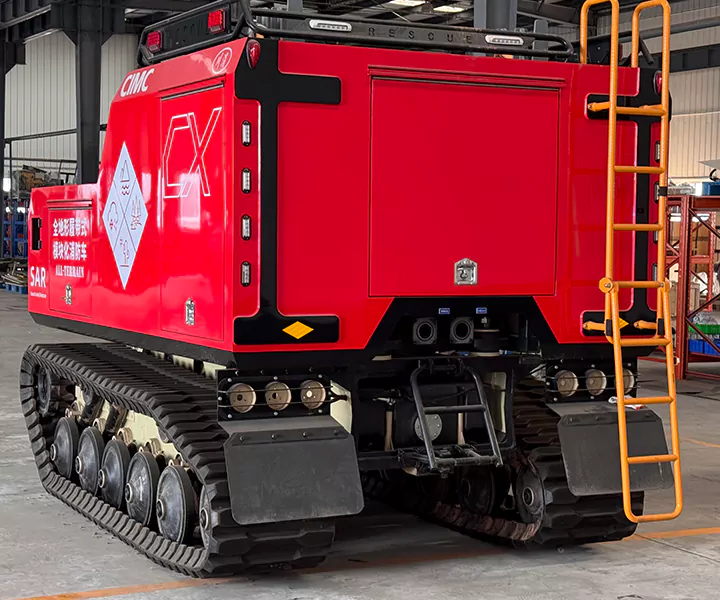
A two-section tracked carrier may be useful where a crew compartment and a separate utility module are desirable. Depending on articulation geometry, the sections can follow changing terrain profiles, while several track-contact regions share the total mass. The arrangement also lends itself to configurable emergency or inspection modules.
These are engineering opportunities, not automatic performance guarantees. Payload, articulated joint forces, turning radius, track slip, stability and soil deformation must be verified in the specific loaded configuration. An articulated vehicle can still become immobilized in deep peat or damage the vegetation surface.
Six oil and gas use cases with clear buyer value
1. Peatland pipeline inspection: move maintenance personnel, portable inspection instruments, hoses and communications equipment along authorized sections of remote pipeline rights-of-way.
2. Remote wellsite logistics: deliver suitable spare parts, tools and compact mission modules where permanent road construction may be expensive or seasonally impractical.
3. Seismic survey support: transport approved survey instruments and crews on carefully planned access routes; repeated traffic and site rehabilitation must be considered.
4. Wetland valve stations and monitoring: reach remote above-ground facilities for planned inspection, sensor replacement and communications maintenance.
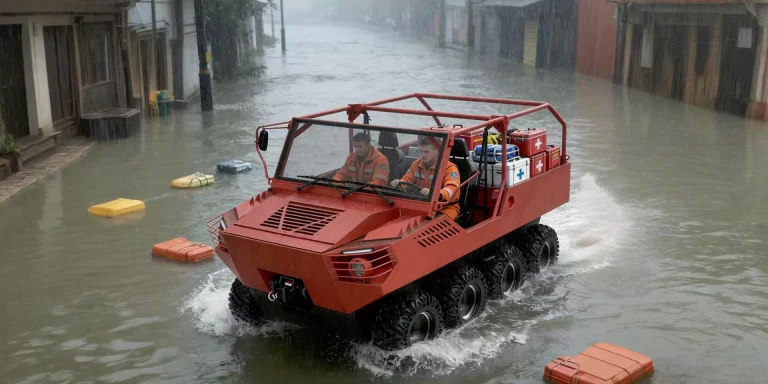
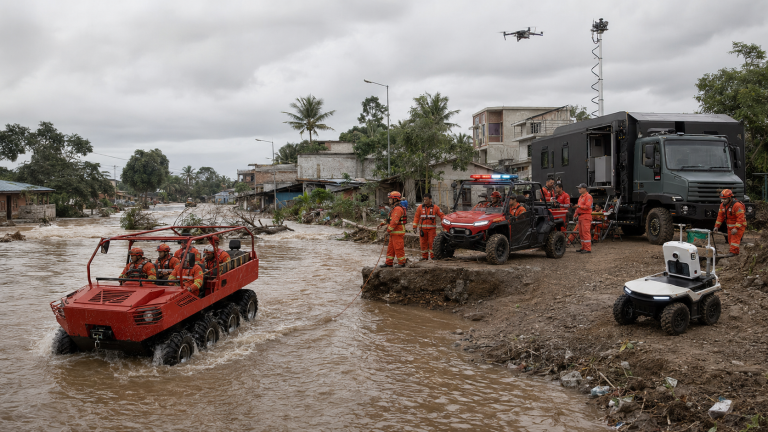
5. Flood and incident-response logistics: deploy permitted supplies and trained responders through selected soft-ground corridors after a site-specific safety assessment.
6. Environmental monitoring and remediation support: carry approved lightweight sampling and response equipment, subject to habitat protection and contamination-control procedures.
All six are potential applications for engineering assessment, not claims that an existing JJ117 configuration has already completed those operations.
Environmental protection belongs in the specification
Peatlands are valuable habitats and carbon stores. Vehicle access can cause vegetation loss, deep ruts, altered water flow and long-lived surface change. IUCN’s 2025 briefing discusses the environmental consequences of tracks and roads across peatlands; NatureScot recommends route planning, avoiding sensitive areas, limiting track spin and tight turns, and considering temporary mats or crossing points.
A project should therefore define access permission, route selection, season, load limits, maximum acceptable rut depth, restricted-turn areas, number of passes, recovery and restoration responsibilities. In fragile ecosystems, “do not drive” may be the correct recommendation even when a machine is physically capable of crossing.
What the official JINJIA JJ117 product page confirms
The public JINJIA / Response Mobility Tracked Utility Vehicle page lists JJ117-X1 and JJ117-X2. Both specifications carry a “Weight” entry of 17,000 kg, maximum road speed of 65 km/h and stated operating temperature range from −43°C to +50°C. JJ117-X1 dimensions are 9.1 × 2.45 × 3.6 m; JJ117-X2 dimensions are 9.1 × 2.45 × 2.6 m.
The published “Weight” field is not a 17-tonne payload rating. The road-speed and temperature entries are manufacturer-published specifications, not proof of peatland performance or independent certification. Track contact area, validated ground pressure, permissible peat strength, repeated-pass rut depth and wetland field-test reports are not publicly established.
For wetland projects, JINJIA would first evaluate mission load, terrain and the applicable environmental restrictions before suggesting a specific platform or possible engineering adaptation. Full specifications: https://responsemobility.com/tracked-utility-vehicle/
Procurement checklist: request evidence, not slogans
Terrain: site coordinates, peat thickness, standing-water depth, vegetation mat condition, soil bearing/shear measurements, slope and access constraints.
Mission: total operational weight, required payload, crew count, trip frequency, route length, towing or mission modules, and required return/recovery strategy.
Environment: season, operating temperature, precipitation, thaw, water table and any contamination or hazardous-area restrictions.
Acceptance: allowable sinkage/rut depth, repeated-pass performance, turning trials, loading condition, ground disturbance rules, evidence/certificates and testing authority.
Commercial: expected quantity, delivery country, lead time, equipment versus service scope, and maintenance/spares requirements.
Frequently asked questions
Q: Does a tracked vehicle always have low ground pressure?
A: No. The result depends on actual operating mass and effective contact area; a heavy tracked vehicle may still exert substantial pressure.
Q: Does low ground pressure guarantee a vehicle will not sink in peat?
A: No. Soil shear strength, sinkage, dynamic loading and repeated trips also determine trafficability.
Q: Are tracked vehicles environmentally harmless in wetlands?
A: No. Even a low-ground-pressure design can rut, tear vegetation or alter hydrology; permissions and controlled routes are essential.
Q: Is JINJIA JJ117 certified for a specific kPa ground pressure?
A: No public verified kPa figure has been identified on the current JJ117 product page. Request configuration-specific evidence.
Q: Which industrial tasks are promising?
A: Selected pipeline inspection, remote wellsite support, surveys and emergency logistics—subject to engineering and environmental approval.
Q: What should a buyer send first?
A: Operating Terrain | Required Payload | Environmental Conditions | Intended Application | Estimated Quantity; attach soil and route information where available.
Discuss a peatland or wetland mobility project
Send JINJIA five initial engineering inputs: Operating Terrain | Required Payload | Environmental Conditions | Intended Application | Estimated Quantity. Where possible, include peat depth, basic soil tests, route photos, load configuration, seasonal constraints and required operating country.
Our engineering team can assess whether an existing configuration, customized tracked carrier or separate feasibility study deserves further evaluation. Product: https://responsemobility.com/tracked-utility-vehicle/ | Contact: https://responsemobility.com/contact/ | Email: info@responsemobility.com
References
JINJIA / Response Mobility, Tracked Utility Vehicle (JJ117-X1 and JJ117-X2), accessed 2026-10-15 — https://responsemobility.com/tracked-utility-vehicle/
USDA Forest Service, Identifying Soils Trafficability: Soils Operability Conditions for Machine Traffic (2022) — https://research.fs.usda.gov/treesearch/65976
IUCN UK Peatland Programme, Tracks and Roads on Peatlands: Technical Briefing (2025) — https://www.iucn-uk-peatlandprogramme.org/news/new-publication-tracks-and-roads-peatlands
NatureScot, Peatland ACTION—Tracks: Creation, Use and Reinstatement (updated 2024) — https://www.nature.scot/doc/peatland-action-technical-compendium-restoration-10-track-removal-or-reinstatement
US Forest Service, Minimizing Soil Impacts from Forest Operations (2011) — https://research.fs.usda.gov/treesearch/41849