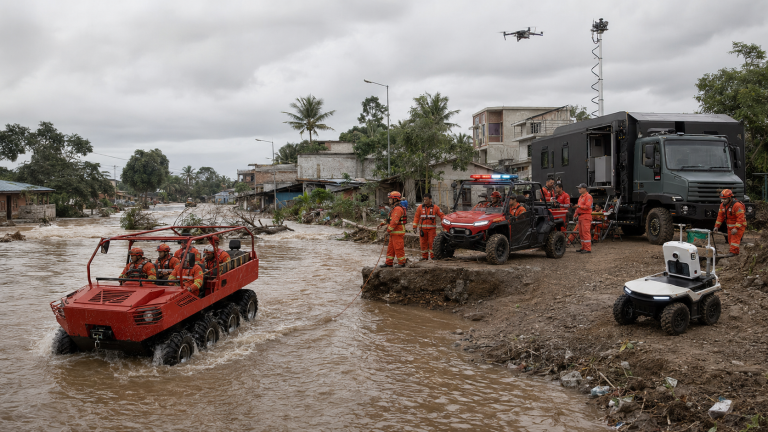


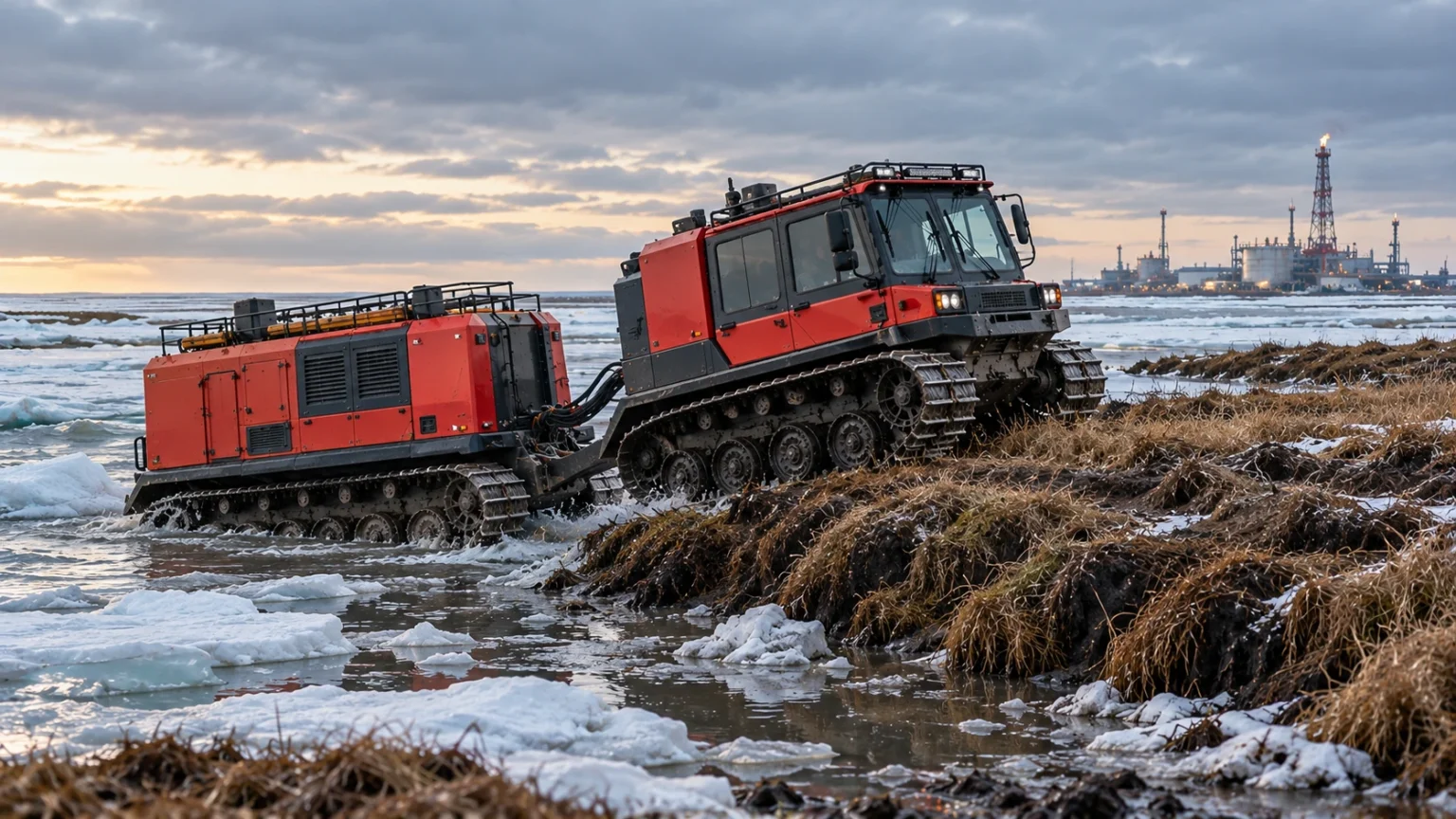
Why the last few metres of an amphibious route can determine the entire mission
Quick answer: what makes a water-to-shore crossing difficult?
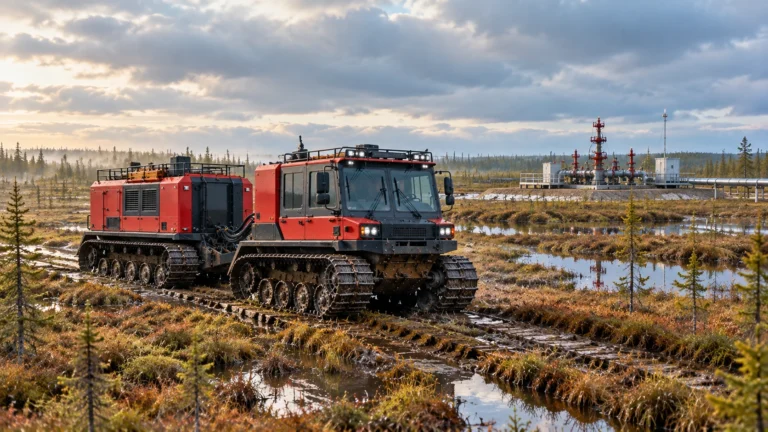
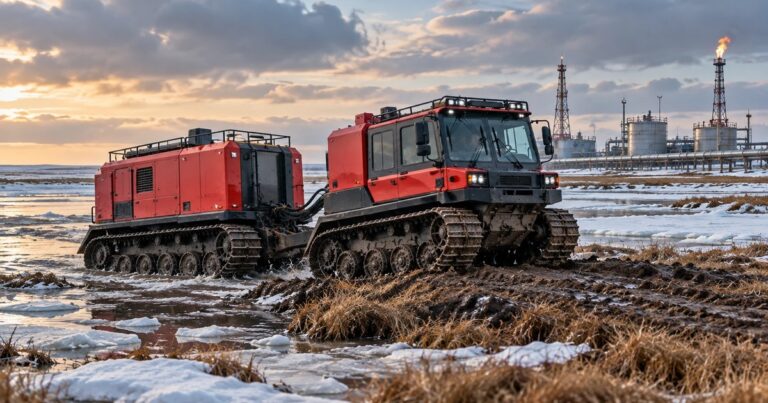
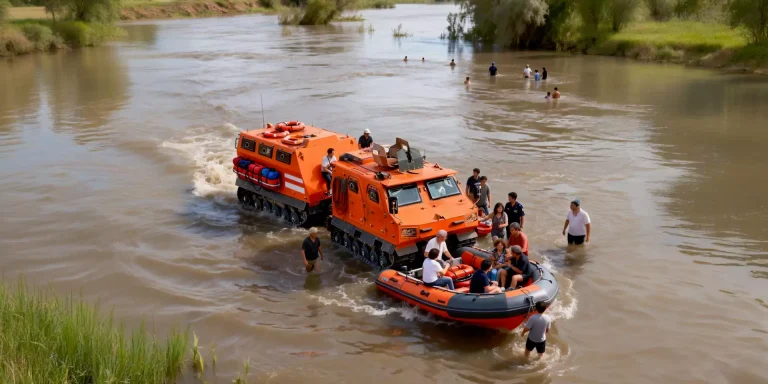
The critical point of a water-to-land mission is often the shoreline—not the water crossing itself. A vehicle must maintain traction while buoyancy decreases, tracks begin carrying more load, the bank deforms and the rear section is still partly afloat. On ice edges and peat, the supporting surface may fail before the vehicle completes the transition.
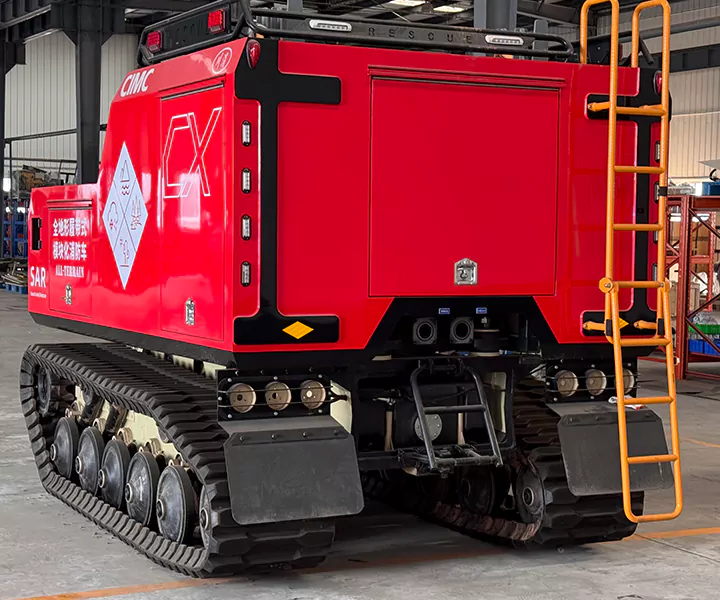
Articulated tracked platforms are worth evaluating because their two-section layout may help manage changes in terrain geometry. But articulation alone does not prove amphibious operation, unprepared-bank climbing, safe ice travel or low environmental impact. All four require site-specific evidence.
Five phases of leaving water onto a natural bank
1 Approach and reconnaissance. Determine actual water depth, underwater obstacles, current, bank angle, submerged soil strength and a safe alternative recovery route. A visually gentle shoreline can hide a steep underwater break or weak peat below vegetation.
2 First track contact. At initial contact, only part of the running gear may produce useful traction; a soft bank may shear or slump. Approach speed and the relation between track grip and water propulsion (if fitted) matter.
3 Progressive load transfer. As the bow and front tracks emerge, buoyancy decreases and vehicle weight transfers to the tracks. Resistance can rise precisely when available ground support remains uncertain. Pitch angle, track slip and articulation geometry need to be monitored.
4 Rear-section breakout. On an articulated carrier, the rear unit may remain buoyant or partly grounded while the leading unit climbs. Joint angles, drawbar forces and rear-track traction become critical; a successful front climb does not guarantee the rear section can follow.
5 Departure onto soft ground. Clearing the waterline is not mission success if the adjacent peat or marsh cannot support repeated movements. Check sinkage, wheel/track rut depth, the return route and ecological restrictions.
In engineering terms, available track traction must exceed the combined slope, terrain deformation and other resistances with a suitable safety allowance. That relationship is a conceptual selection check—not a substitute for a coupled water–vehicle–soil model or full-scale testing.
Unprepared banks: the real variables
An unprepared bank is a shoreline without a constructed ramp, graded hardstand or engineered landing surface. It may be sand, cohesive mud, peat, gravel or an eroding vegetated edge. Each behaves differently under a concentrated moving load.
Key variables are bank slope and breakover geometry; soil bearing and shear strength; submerged-to-dry traction change; fully loaded vehicle mass and its distribution; track width, lug geometry and contact length; articulation degrees of freedom; water level and wave action.
A manufacturer’s maximum gradeability figure should never be interpreted as a certified water-to-unprepared-bank exit angle. Testing on firm, dry slopes cannot establish performance on submerged mud or peat.
Ice is not one condition: four distinct engineering tasks
Snow-covered firm ground involves track flotation and traction. Driving on floating or supported ice additionally requires an approved ice-load assessment that includes actual gross mass, route, thickness, ice quality and local hydrology. Crossing an ice edge introduces localized fracture and changing support. Active icebreaking is yet another engineering problem involving structural loads and propulsion.
For Arctic and Northern Caspian operations, do not infer that a published operating temperature or on-snow capability establishes safe travel on sea ice. The Government of Canada specifically warns that operating a vehicle on ice-covered water requires measured ice conditions and a load-based safety assessment.
Ice up to 0.6 m thick has been raised as a potential project condition in industry discussions, but it is not an established performance claim for the BN117 family. It must not be advertised as a certified icebreaking specification.
Peat and marsh: why “low ground pressure” is not enough
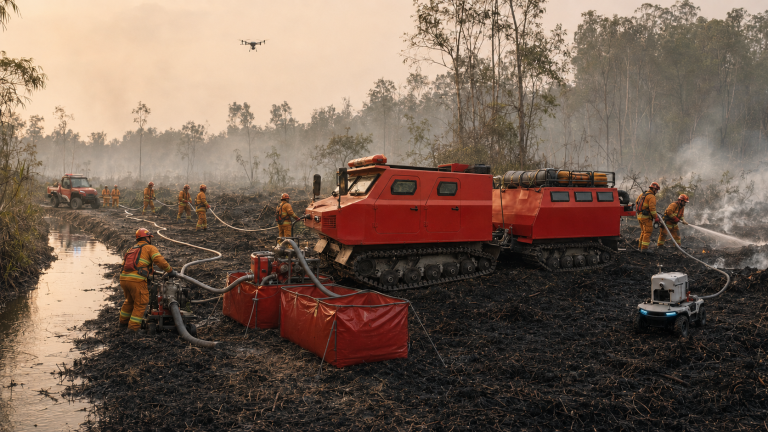
Peat may contain a relatively intact surface mat over material with poor load-bearing and shear capacity. A low nominal contact pressure can be helpful in certain soft-ground conditions, but it cannot eliminate sinkage, rutting or terrain damage. Dynamic loads, turning maneuvers and repeated passes may govern actual outcomes.
A preliminary nominal ground-pressure estimate divides supported vehicle weight by effective contact area. For procurement, however, engineers need the real loaded configuration, contact geometry, soil testing, traction analysis and acceptable ground-disturbance limits—not a generic “swamp-ready” statement.
IUCN’s peatland guidance documents potentially long-lasting damage from access tracks and repeated ground disturbance. Permission, route planning, seasonal timing and recovery arrangements are essential even where tracked mobility is technically possible.
Where oil and gas operators may need this capability
Northern Caspian shallow-water facilities and artificial islands: evaluate controlled movement between designated shallow approaches and shoreline operating points. The separate marine, ice and HSE requirements remain decisive.
Coastal oil and gas maintenance: bring inspection personnel and suitable tools beyond the end of prepared access routes; do not assume personnel evacuation or marine status without approval.
Peatland pipeline corridors: assess transport of maintenance crews, portable equipment, hoses and field communications across low-bearing-capacity ground under environmental controls.
Arctic and sub-Arctic facilities: study snow, thawing ground and shore approaches as different seasonal cases instead of claiming one year-round terrain rating.
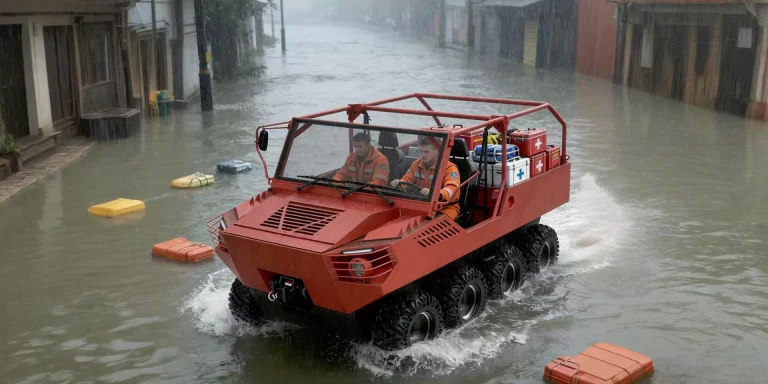
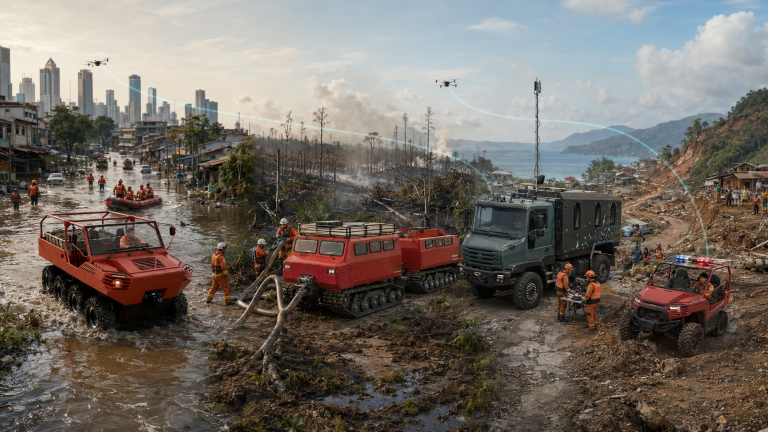
Flooded onshore assets and emergency logistics: deploy approved supplies on suitable routes after verifying water depth, submerged hazards, recovery and electrical safety.
Environmental response: support selected shoreline inspection and oil-spill logistics operations where access is authorized and terrain disturbance is acceptable.
What JINJIA publishes about the JJ117 tracked platform
JINJIA’s current public tracked-utility-vehicle page lists JJ117-X1 and JJ117-X2 configurations. Both show a 17,000 kg “Weight” field, which is vehicle weight—not a claim of 17,000 kg payload. The page also lists a maximum road speed of 65 km/h and an operating-temperature range of −43°C to +50°C for the described configurations.
The JJ117-X2 listing gives a 5 km/h “Floating Speed (Water)” figure for that variant. It should be read strictly as a published model specification: it does not certify sea-state limits, seaworthiness, ice operation, shoreline-exit performance or a passenger carrying allowance for any water route.
The public specifications do not establish track contact pressure, verified peatland trafficability, water-to-unprepared-bank angle, ice-edge climb capability, 0.6 m icebreaking, or marine-class certification. These require technical confirmation and evidence before becoming project commitments.
| Field / source label | JJ117-X1 | JJ117-X2 |
| Weight | 17,000 kg | 17,000 kg |
| Maximum Road Speed | 65 km/h | 65 km/h |
| Temperature range | −43 to +50°C | −43 to +50°C |
| Floating Speed (Water) | Not stated | 5 km/h (published listing) |
Source: https://responsemobility.com/tracked-utility-vehicle/
Site survey and RFQ checklist
Terrain: bank profile above and below water; peat depth and shear strength; bottom type; obstacles, currents and water level variation.
Operation: distance on land and water; maximum loaded mass; payload and crew; intended frequency; maximum slope and allowable rutting.
Ice and climate: seasonal ice observations, edge conditions, measured ice quality, temperature range and weather operating limits.
Safety: operating authority and permits, emergency recovery, flotation/propulsion requirements, environmental restrictions, H₂S and site HSE rules where relevant.
Verification: proposed test site, acceptance conditions, witnesses, certification/classification needs and responsible contracting entity.
Frequently asked questions
Q: Can an amphibious tracked vehicle climb out of water without a prepared ramp?
A: Some purpose-designed vehicles may do so within a defined envelope. For JJ117, a guaranteed natural-bank exit capability is not established by the currently published specifications; bank-specific testing is required.
Q: Does articulation guarantee traction on an unprepared bank?
A: No. It may help with geometry and load distribution, but track-soil interaction, mass, joint limits and available traction determine whether the complete vehicle can exit.
Q: Does the JJ117-X2 published 5 km/h water speed mean it can operate offshore?
A: No. A water-speed entry does not define sea-state limits, marine certification, survival stability or suitability for a particular route.
Q: Can a tracked vehicle drive on ice or break 0.6 m ice?
A: These are separate problems. Ice travel requires a site-specific ice safety assessment. No JJ117 0.6 m icebreaking performance should be claimed without independent verification.
Q: Are tracked vehicles harmless to peatlands?
A: No. A tracked vehicle can still damage vegetation and peat. Soil testing, environmental permits, route management and disturbance limits are necessary.
Q: What information should I send JINJIA first?
A: Operating Terrain | Required Payload | Environmental Conditions | Intended Application | Estimated Quantity. Add bank profile, water/ice conditions, destination and certification needs if available.
Discuss a water-to-shore mobility project
If your energy, engineering or emergency-response team faces a transition between water, natural banks, ice and peat, send JINJIA the five initial design inputs below. We will review whether an existing configuration, a modified platform or a dedicated feasibility study is the appropriate next step.
Operating Terrain | Required Payload | Environmental Conditions | Intended Application | Estimated Quantity
Official JJ117 product page: https://responsemobility.com/tracked-utility-vehicle/
General inquiry: https://responsemobility.com/contact/
Email: info@responsemobility.com
Technical sources and further reading
JINJIA JJ117 official product specifications — https://responsemobility.com/tracked-utility-vehicle/
2025 Ocean Engineering research: water–ground transition — https://doi.org/10.1016/j.oceaneng.2025.123181
Government of Canada: working and driving on ice-covered water — https://www.canada.ca/en/employment-social-development/services/health-safety/prevention/ice.html
IUCN UK Peatland Programme: Tracks and roads on peatlands (2025) — https://www.iucn-uk-peatlandprogramme.org/news/new-publication-tracks-and-roads-peatlands
FHWA: ice roads establishment and management — https://highways.dot.gov/federal-lands/innovation-research/ice-road-management
Mandatory pre-publish checks
☐ Verify all JJ117 fields against the current official page before launch.
☐ Do not assert a tested bank-exit grade, marine approval, peat trafficability or icebreaking.
☐ Use the conceptual-illustration caption under the image.
☐ Check the EN target page, canonical, OG image, internal links, sitemap and mobile layout.
☐ Replace all placeholders only after the pages are live.