

1. Choose for the mission, then define the vehicle
For government and industrial teams, the right choice is the vehicle that completes the required route with the approved people and equipment aboard. A narrow access task may favour a conventional ATV; a work route with a crew and cargo may suit a UTV. An amphibious 8×8 deserves evaluation when the mission combines difficult ground with a justified need for floating operation. None of these categories is a universal winner.
Here, ATV means a conventional quad with handlebars and a straddle seat. UTV means a work-oriented side-by-side with steering-wheel controls and designated seats. Amphibious 8×8 means an eight-wheel platform designed for land travel and floating movement. “All-terrain” is also used more broadly, so confirm the exact model rather than relying on the label. [S01–S02]
• Match the vehicle to the route
• Count people and task equipment
• Separate land and water capability
2. What the evidence actually establishes
A named example prevents a common mistake: the 2025 Polaris RANGER 570 Full-Size manual permits water operation within a specified floorboard-level limit. That is model-specific wading guidance, not evidence of controlled amphibious navigation. It does not justify saying that every UTV is unable to enter water. [S03]
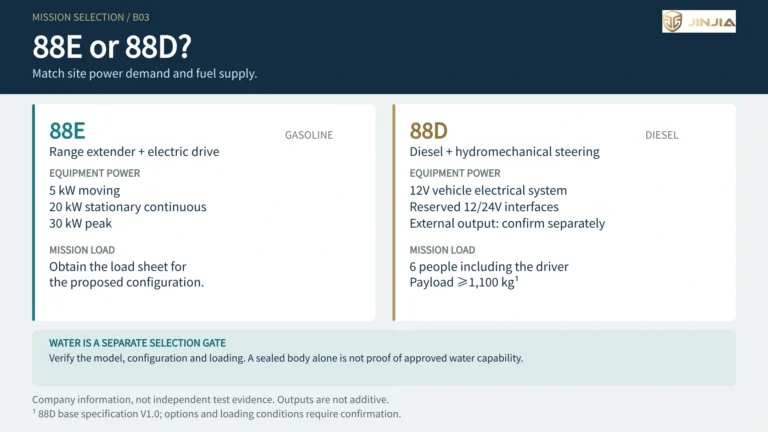
JINJIA’s 88D technical specification lists six seats including the driver. This is a manufacturer specification, not an independent mission trial. It does not establish a six-person floating operating limit. Keep the diesel 88D separate from the gasoline range-extender/electric 88E; equipment or power claims for one are not automatically transferable to the other. [S91–S92]
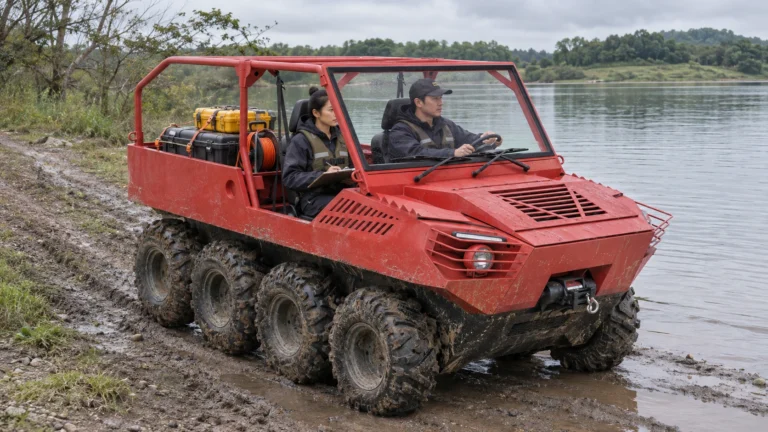
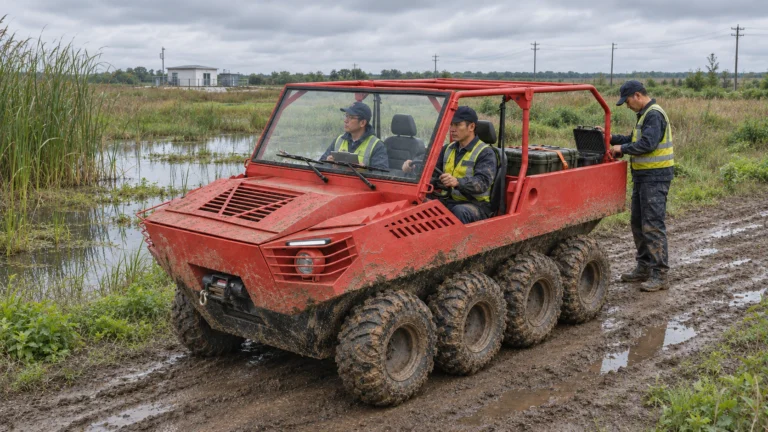
For a purchase decision, distinguish definitions, model documentation, company-confirmed configuration and witnessed acceptance evidence. A photograph illustrates a scene; it cannot prove payload, stability or water performance.
3. Match the vehicle to the route
Map the complete journey: transport to site, access width, firm tracks, soft sections, gradients, turning areas and the return route after weather changes. Identify whether water is a shallow crossing with a supported bottom or a section requiring the vehicle to float. Include the places where entry or exit could be blocked.
| Candidate | Mission question | Evidence to request |
| Conventional ATV | Does a compact vehicle meet the people and tool requirement? | Exact dimensions, approved occupants and load limits. |
| Work UTV | Can the selected seating and cargo layout complete the access route? | Loaded clearance, route trial and model water guidance. |
| Amphibious 8×8 | Is mixed ground and floating travel necessary and supportable? | Configured land performance and separate water evidence. |
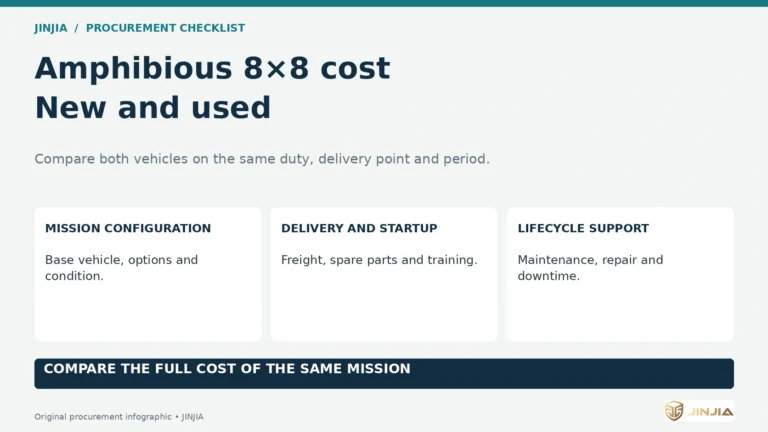
Compare candidates on the same route and seasonal conditions. Include unloading, transfers, recovery access and maintenance time in the duty cycle. Do not assume eight wheels make a vehicle faster, cheaper or better on every surface. A maintained-road task may favour a conventional road vehicle.
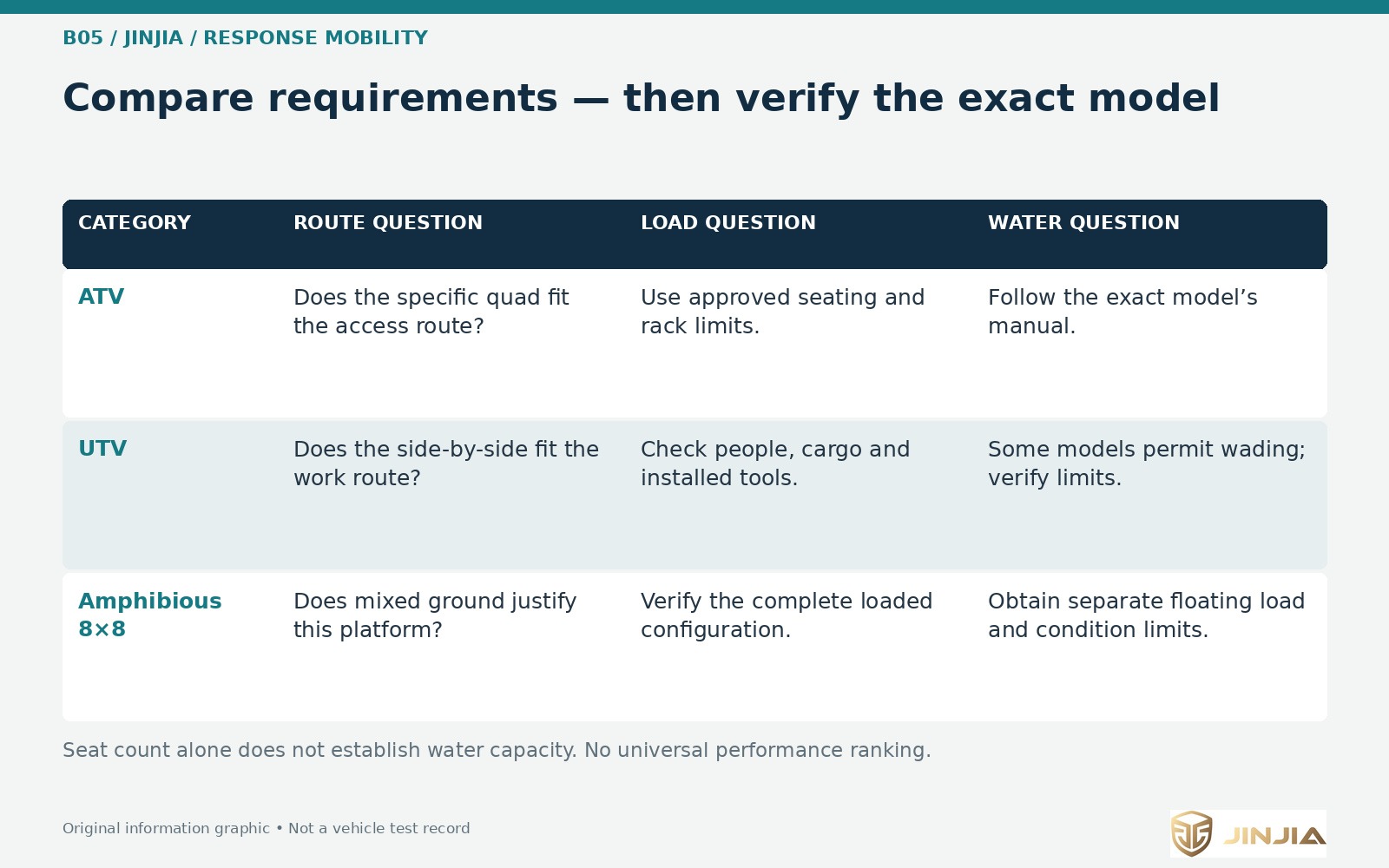
Original selection infographic: assess the route, people and equipment, then verify land travel, wading and floating operation separately. This is not a test record.
4. Count people and task equipment
List every occupant, personal protective equipment, tools, consumables and installed module. Ask how the manufacturer defines payload and whether fuel or permanently installed accessories are already included in the stated mass. Avoid counting them twice. Approved seats, usable cargo space and permitted mass are three different checks.
As a planning example, two technicians with test instruments and cable reels have a different requirement from six responders with rescue equipment. This is an illustrative comparison, not a customer deployment or a claim that either load is approved on a particular vehicle.
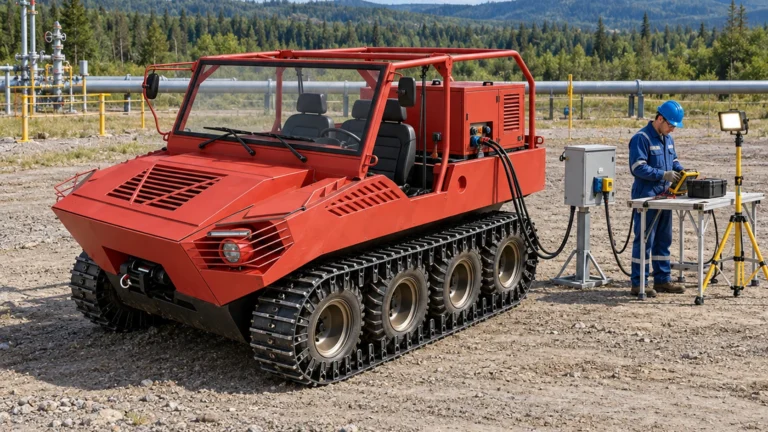
Record each item’s mass, dimensions, mounting position, restraint and electrical demand. Check access to seats and exits after installation. A cargo box is not an extra passenger seat; free floor area is not a stretcher approval. Ask for a configuration drawing and a loaded acceptance plan before comparing quotations. A generator, mast or rescue module also changes weight distribution and service access.
5. Separate land and water capability
Use three separate questions. Land travel concerns traction, clearance, braking and stability on the specified route. Wading concerns the depth and conditions allowed by the exact vehicle’s instructions while it remains supported by the ground. Floating operation additionally needs verified buoyancy, freeboard, stability, propulsion, steering and an agreed operating envelope.
A land payload figure cannot establish a water payload. Large tyres, a sealed-looking body or a snorkel cannot substitute for documented floating capability. Likewise, the word “amphibious” does not establish suitability for fast current, waves, debris or every bank profile.
For any proposed water task, request the permitted configuration, total loaded mass, load distribution, water conditions and entry/exit limits, with supporting records. If these remain unverified, the water task remains unresolved. Keep it out of the accepted operating scope until the required evidence and procedures are agreed.
6. State limits and consider alternatives
This comparison is a selection framework, not a class-wide performance ranking. No comparative speed, purchase-price or lifecycle-cost advantage is claimed. The supplied 88D baseline does not settle water payload, freeboard, stability or water speed for the buyer’s final configuration.
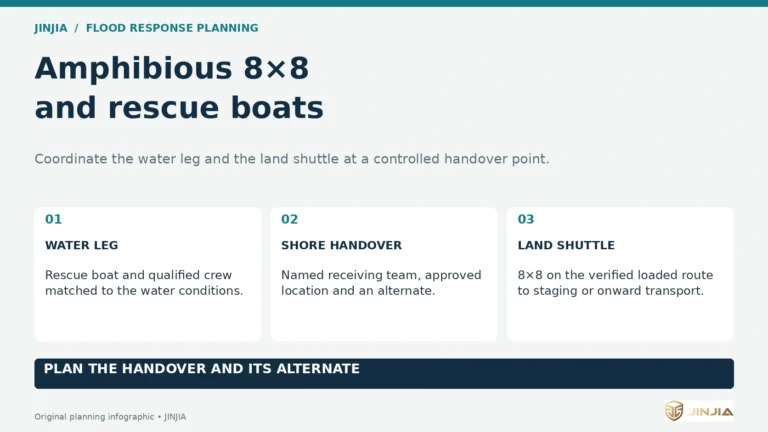
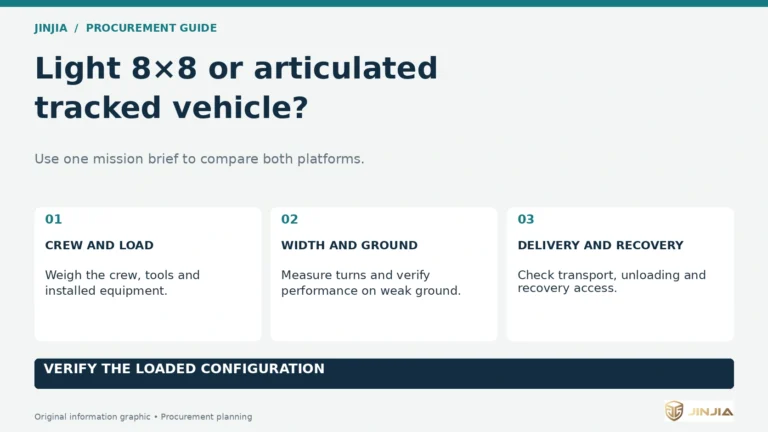
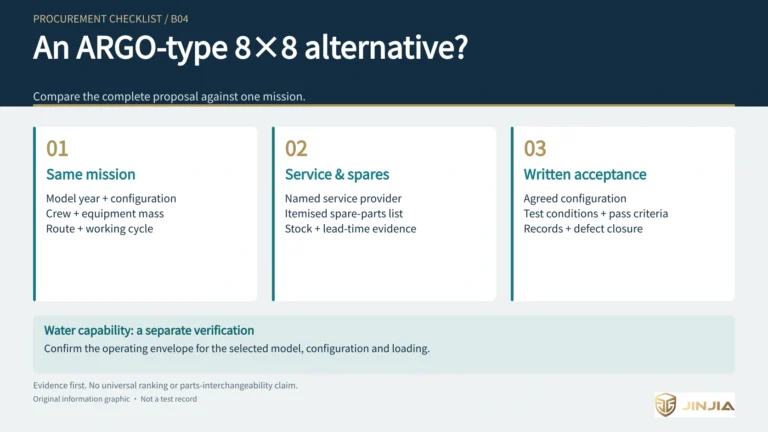
Where the route is mostly water, assess a suitable boat and shore-transfer arrangement. Where ground conditions dominate and dimensions allow, compare a tracked platform. For routine service roads, evaluate a work UTV or road vehicle. A mixed fleet may be preferable when one platform would require unacceptable compromises. Compare local service, transport and recovery arrangements alongside the vehicle itself.
7. Send a one-page mission brief
| Record | Information to provide |
| Route | Map, distance, widths, slopes, surfaces and seasonal changes. |
| People | Driver plus passengers, designated seats, protective equipment. |
| Equipment | Itemised mass, dimensions, mounting and power demand. |
| Water | Wading or floating; depths, current, banks and evidence gaps. |
| Duty cycle | Hours, transfers, refuelling/charging, transport and support. |
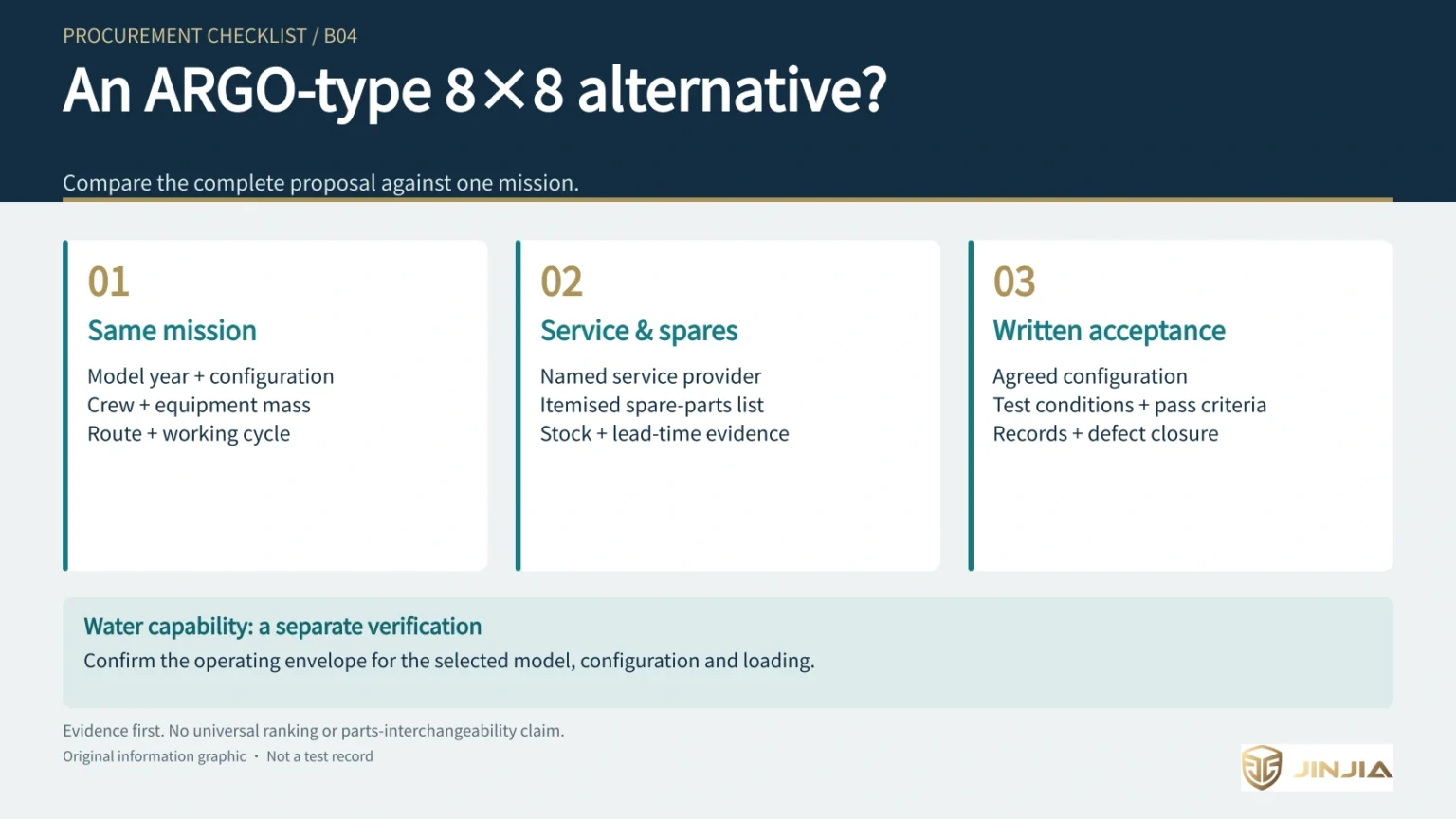
| Acceptance | Exact configuration, test conditions, criteria and responsible parties. |
Start with what an 8×8 amphibious vehicle is and review the JINJIA amphibious utility platform. Related selection questions include 8×8 versus articulated tracked vehicles, 8×8 versus rescue boats, and amphibious payload planning. Use the same mission brief for each comparison.
Send your route, mission load and working conditions for an 8×8 configuration discussion. Contact JINJIA.
Frequently asked questions (FAQ)
A: Identify the route section that determines success: access width, soft ground, crew transport or a genuine floating requirement. Then compare exact models on the same loaded route and seasonal conditions.
Q: How should people and task equipment be documented?
A: Use a seating plan and an itemised load register covering people, protective equipment, tools and modules. Confirm the manufacturer’s mass definitions, attachment positions and electrical requirements, then agree the loaded acceptance configuration.
Q: What evidence separates wading from floating capability?
A: Wading needs model-specific depth and operating instructions. Floating operation needs additional evidence for the configured loaded mass, buoyancy, freeboard, stability, propulsion and control under stated water conditions. One capability does not prove the other.
Sources and further information
[S01] SVIA — What is an ATV?
[S02] ROHVA — What is an ROV?
[S03] Polaris 2025 RANGER 570 Full-Size Owner’s Manual, P/N 9941859, §4.4.15.8
https://publications.polaris.com/owner/owners-manuals/9941859/0000976677.xml?onepage=true
[S91] JINJIA 88D Diesel 8×8 Technical Specification V1.0, 2026-09-08
Manufacturer specification / company input; not independent test evidence.
[S92] JINJIA confirmed 88E/88D product distinctions
Manufacturer specification / company input; not independent test evidence.