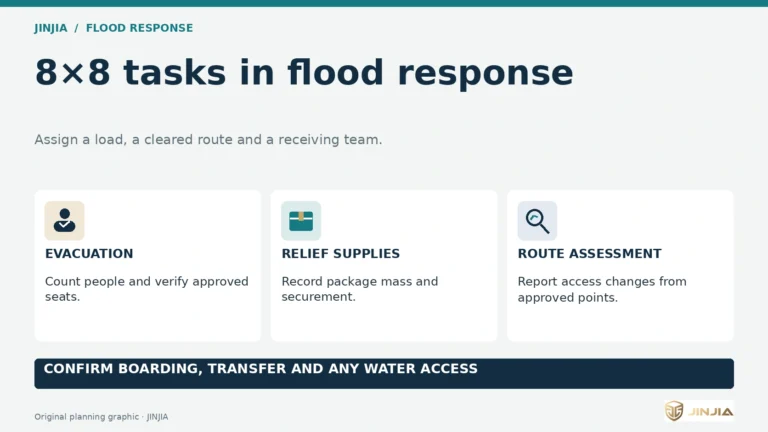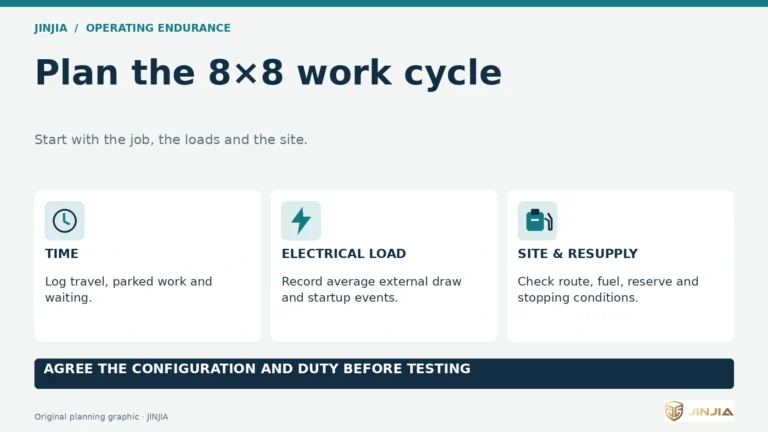


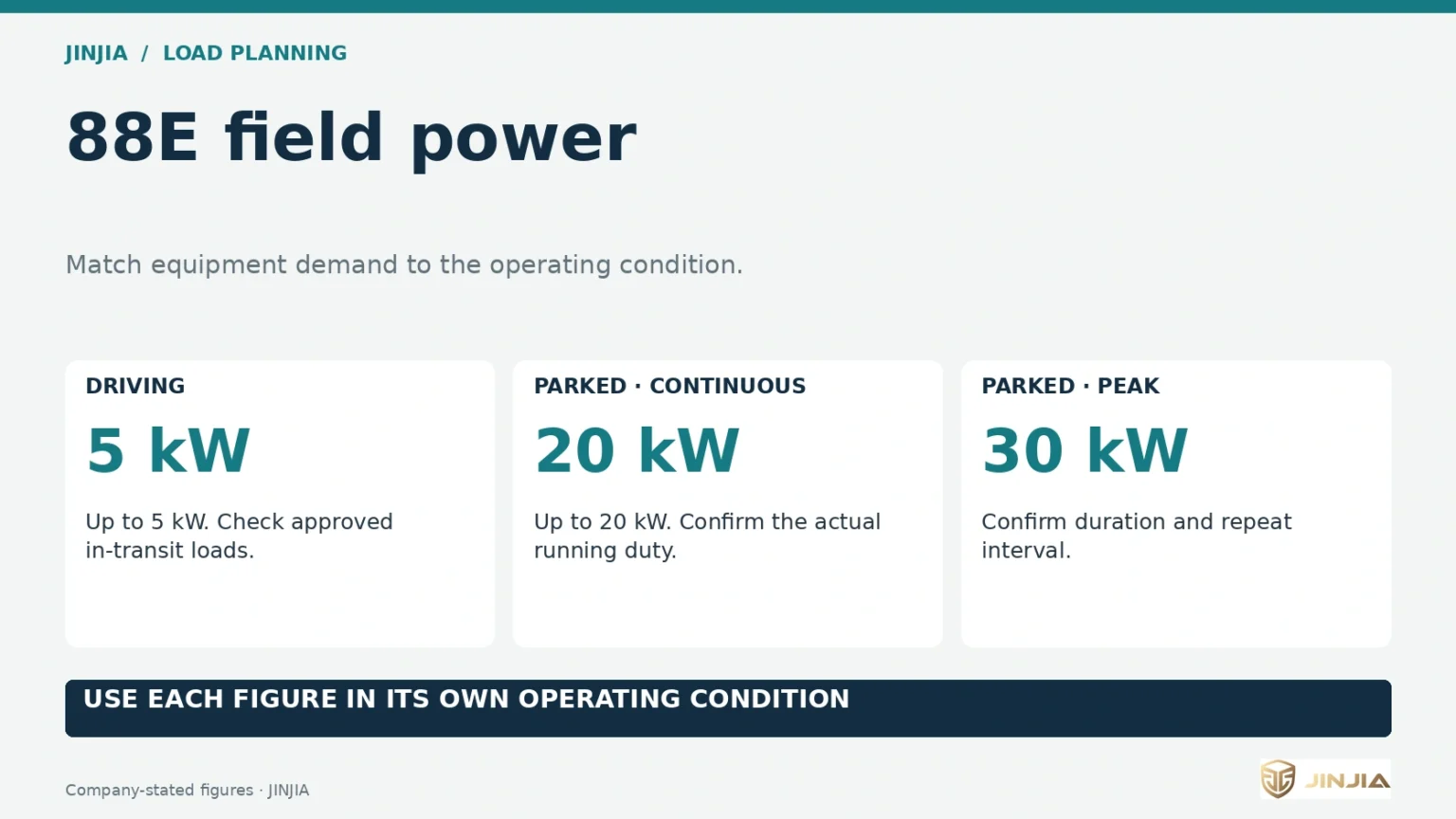
Company-stated 88E outputs by operating condition. Confirm the duration of the 30 kW parked peak for the chosen configuration.
Start with the job the 88E must power
For 8×8 mobile field power, start with the equipment that runs during travel, the equipment that runs after parking, and the largest short demand during startup. Then match each group to the intended operating mode.
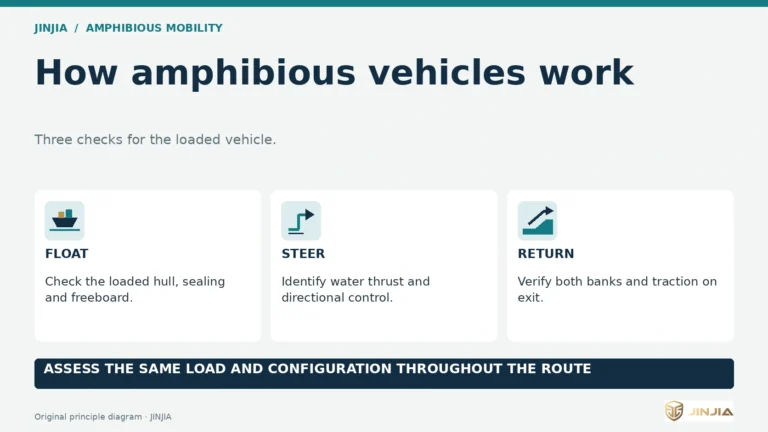
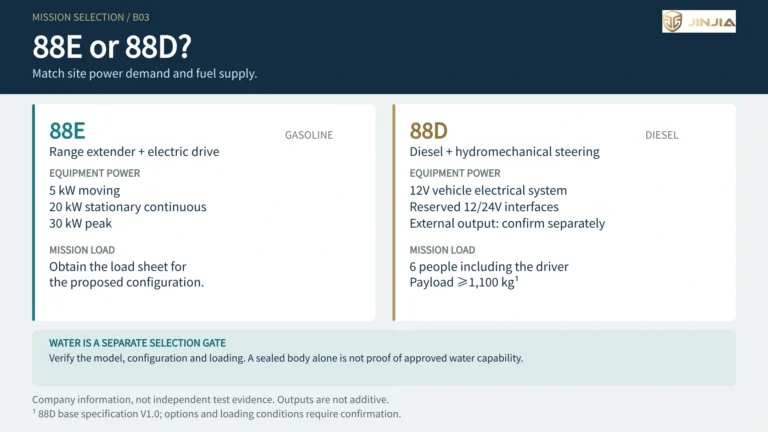
The JINJIA 88E is a gasoline range-extended electric amphibious 8×8. Two motors drive the vehicle and a separate motor provides water propulsion. External power for mission equipment is a separate requirement. For a remote maintenance team, define the route, what must stay powered in transit, what is done at the worksite and how the team continues if the vehicle must leave.
Evidence behind the three figures
JINJIA states up to 5 kW while driving, up to 20 kW continuous while parked, and 30 kW peak while parked. These are company-stated output figures for the 88E. The public platform page describes the same output split. For a specific vehicle, ask for the configuration, the operating limits and a load-test record before specifying a duty. The three figures apply to different operating conditions and cannot be added.
Use equipment data for the actual working load. Record voltage, frequency, phase, running kW and current, and starting kW, kVA or inrush current as available. kW is real power. kVA is apparent power and can matter to the source and connection during startup. Avoid treating the two as interchangeable. The worked numbers below are hypothetical equipment demands. The confirmed capability comes from the agreed test on the supplied build.
5 kW while driving
List the equipment that must operate on the move. Examples are an approved communications system, onboard data collection and a task module designed for use in transit. Sum only the loads expected to run together. For example, three hypothetical demands of 1.2, 1.6 and 0.7 kW total 3.5 kW at the point of use. Add other concurrent devices to the same group. Record every switching or starting event that could change the demand.
Ask the supplier to define the approved moving interfaces, permissible speed and traction conditions, any restrictions on phase or outlet, and how the vehicle prioritizes power if drive demand rises. Record the expected response if equipment power is reduced or interrupted. Match the approved installed module and route to the acceptance test. Run the worksite tools in a separately planned stationary duty.
20 kW continuous while parked
Create a second list for the worksite. Identify the simultaneous steady load, the hours it will run and any cycling equipment. A hypothetical group with 3 kW of lighting, 2 kW of support equipment and an 8 kW pump running together draws 13 kW while all three are operating. Two hours at that steady load represent 26 kWh of equipment demand. Actual energy changes with the duty cycle. Fuel use and available runtime require separate evidence for the tested setup.
Verify the working duration, ambient temperature, altitude, cooling conditions and any output derating. Confirm interface ratings for the whole supply and for each connector or circuit the job uses. Include the receiving equipment, protections and the site authority in the acceptance plan. A group that appears to fit in kW can still exceed a phase-current or connector limit.
30 kW peak while parked: confirm duration
Record the event that creates the peak, which equipment is already operating and how long the event lasts. In the stationary example, assume the pump needs 17 kW during startup, with the other 5 kW still running. The illustrative starting total is 22 kW. The pump’s 17 kW starting demand replaces its 8 kW running demand for that event. The example leaves starting kVA, current, voltage dip and recovery time to be established.
Request the allowable peak duration and repetition, recovery interval and starting response at the expected temperature and initial vehicle state. Confirm the transient limits of the load and supply together. Keep engineering sign-off pending if those data or supporting test measurements are missing. A qualified team can compare a different start sequence, a different equipment configuration or a separately rated source under the same mission requirements.
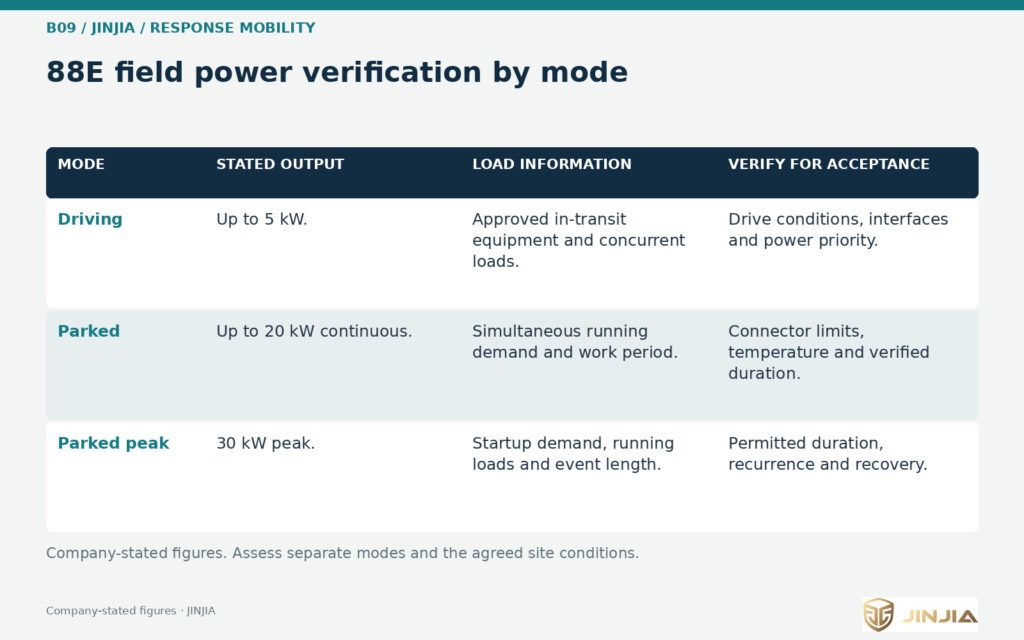
Planning matrix for the actual work package. Record running and starting loads separately and verify the configuration, interfaces and peak duration.
When a separate generator is the better fit
Compare the 88E and a separate or towable generator on the same route, worksite, load steps and duration. The vehicle-mounted supply may simplify a mobile maintenance task when one team needs access and electricity together. A separately sized source may fit a long stationary job, a task that needs the 88E to leave during work, or a peak the proposed vehicle configuration cannot support. Compare transport access, setup, maintenance, interruption tolerance and standby arrangements.
Plan external power in an approved dry area. Where a job involves fixed wiring, hazardous areas or a critical uninterrupted load, have the responsible electrical and site teams specify the permitted system, isolation and backup. Water mobility and the power headline alone cannot establish those approvals. Request the supplier’s instructions for the chosen configuration and the applicable site sign-off.
Download the load worksheet and prepare acceptance
• Route and mode. Identify the intended moving segments, parking location, surface and environmental conditions.
• Loads and interfaces. Enter each device, quantity, running power, concurrent group, voltage, frequency, phase and rated current.
• Startup event. List the affected device, demand and units, duration, repeat interval and equipment that remains on.
• Work period. Record duty cycle, target hours, supply continuity and any standby source.
• Acceptance owner. Name the team that will confirm the configuration, approved test conditions, measured outputs and the response to interruption.
Download the 88E field power load worksheet (06_downloads/JINJIA_B09_88E_Field_Power_Load_Worksheet_EN_RU_CN.xlsx). The three tabs cover the same procurement inputs in English, Russian and Chinese. The moving and parked running totals are calculated separately. Use the worksheet with the range-extended 8×8 introduction and the 8×8 platform overview. Send your route, load list and working conditions to discuss configuration and acceptance with JINJIA.
Frequently asked questions (FAQ)
A: The concurrent group of equipment approved for use in transit. Confirm the connector and phase limits, drivetrain conditions and load-priority rules for the ordered configuration.
Q: What evidence is needed for continuous 20 kW while parked?
A: Ask for a documented load test of the configured unit covering the required duration, site conditions, interface and circuit limits and actual simultaneous load.
Q: How long can the 88E provide 30 kW peak?
A: The allowable duration has to be confirmed for the proposed build. Ask for duration, recurrence, recovery and evidence of the response to the actual startup demand including current and kVA where applicable.
Sources and further information
[S92] JINJIA 88E configuration and output figures · company-stated figures
[S89] JINJIA public amphibious platform overview