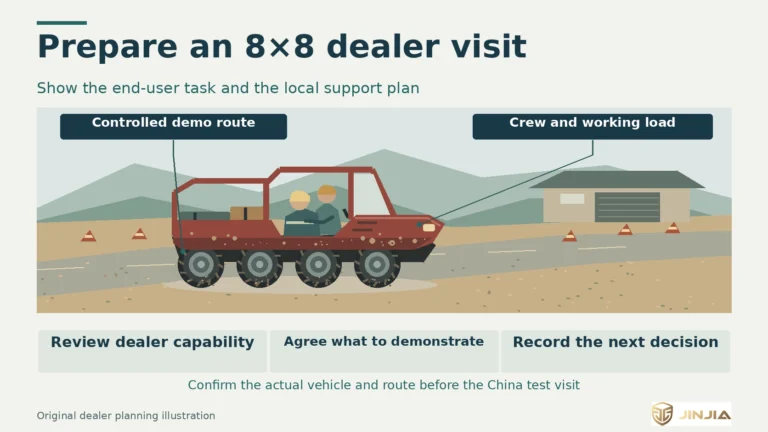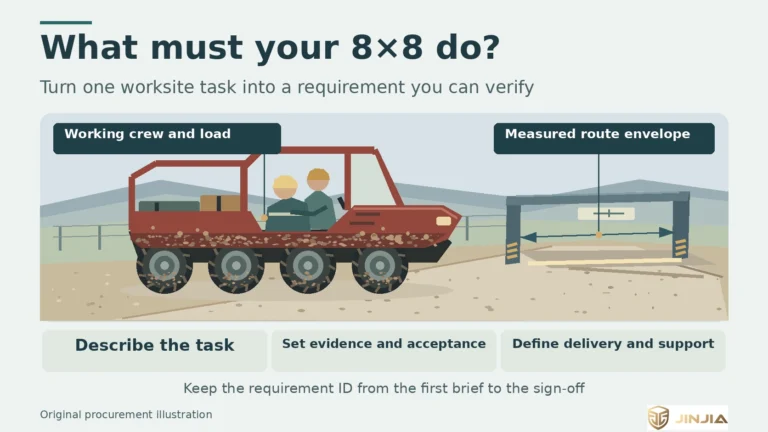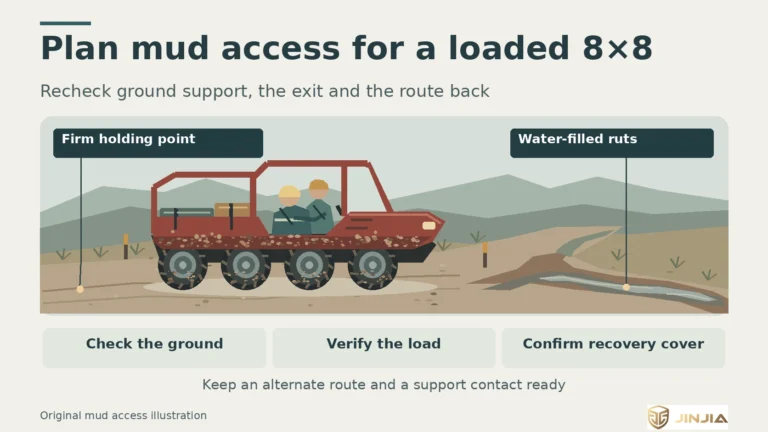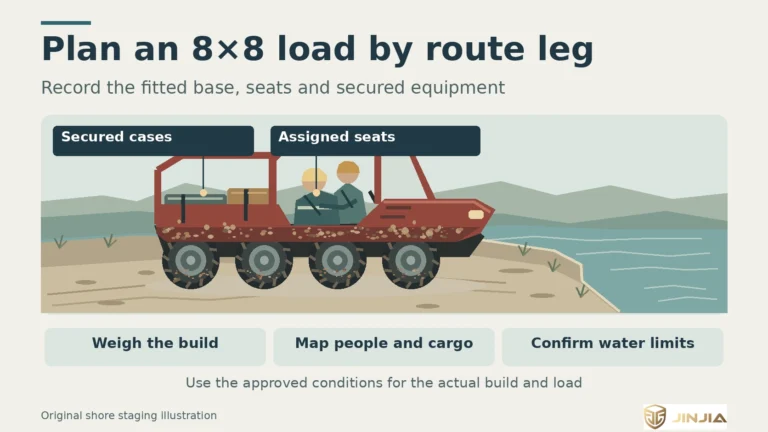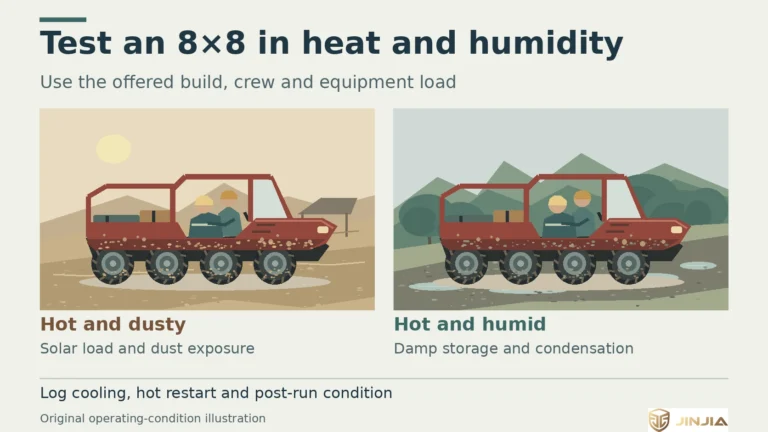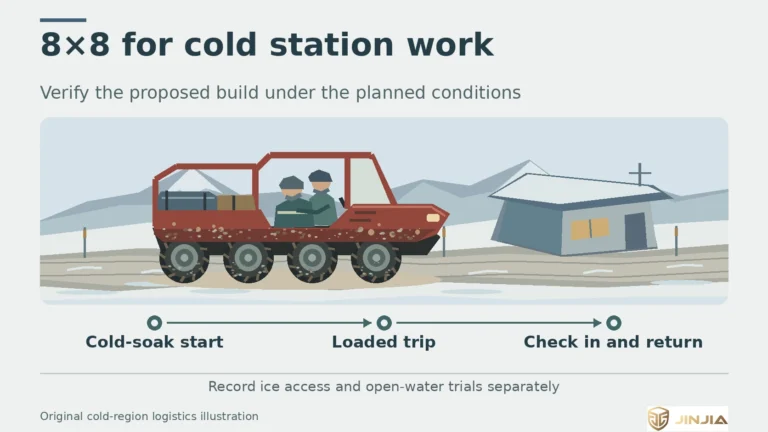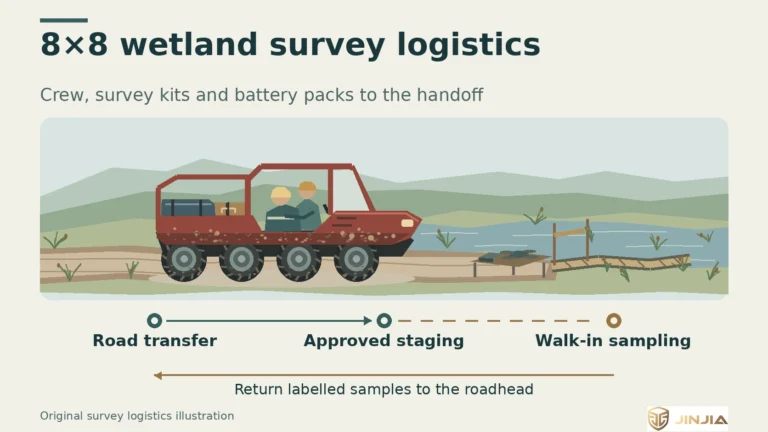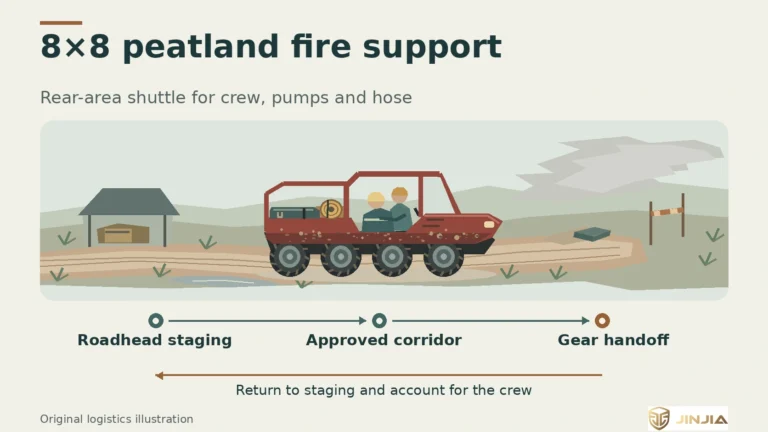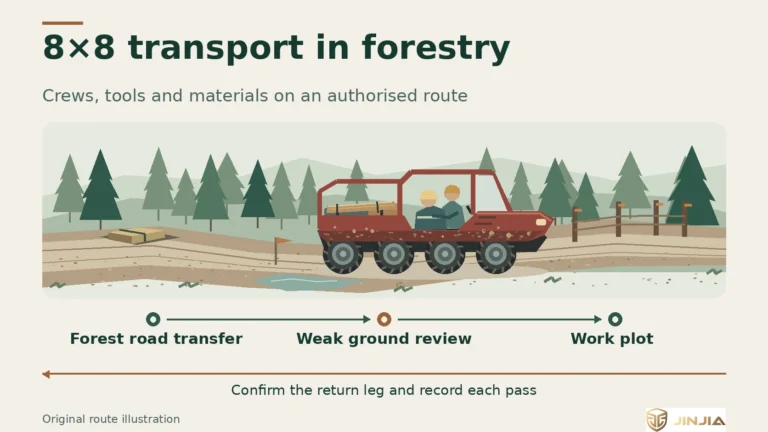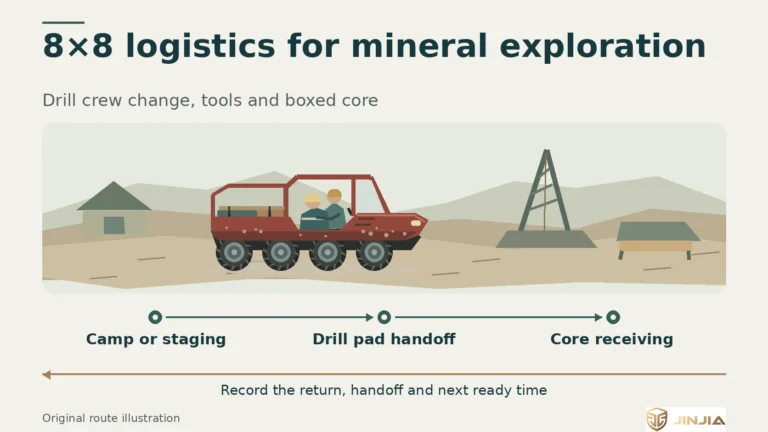


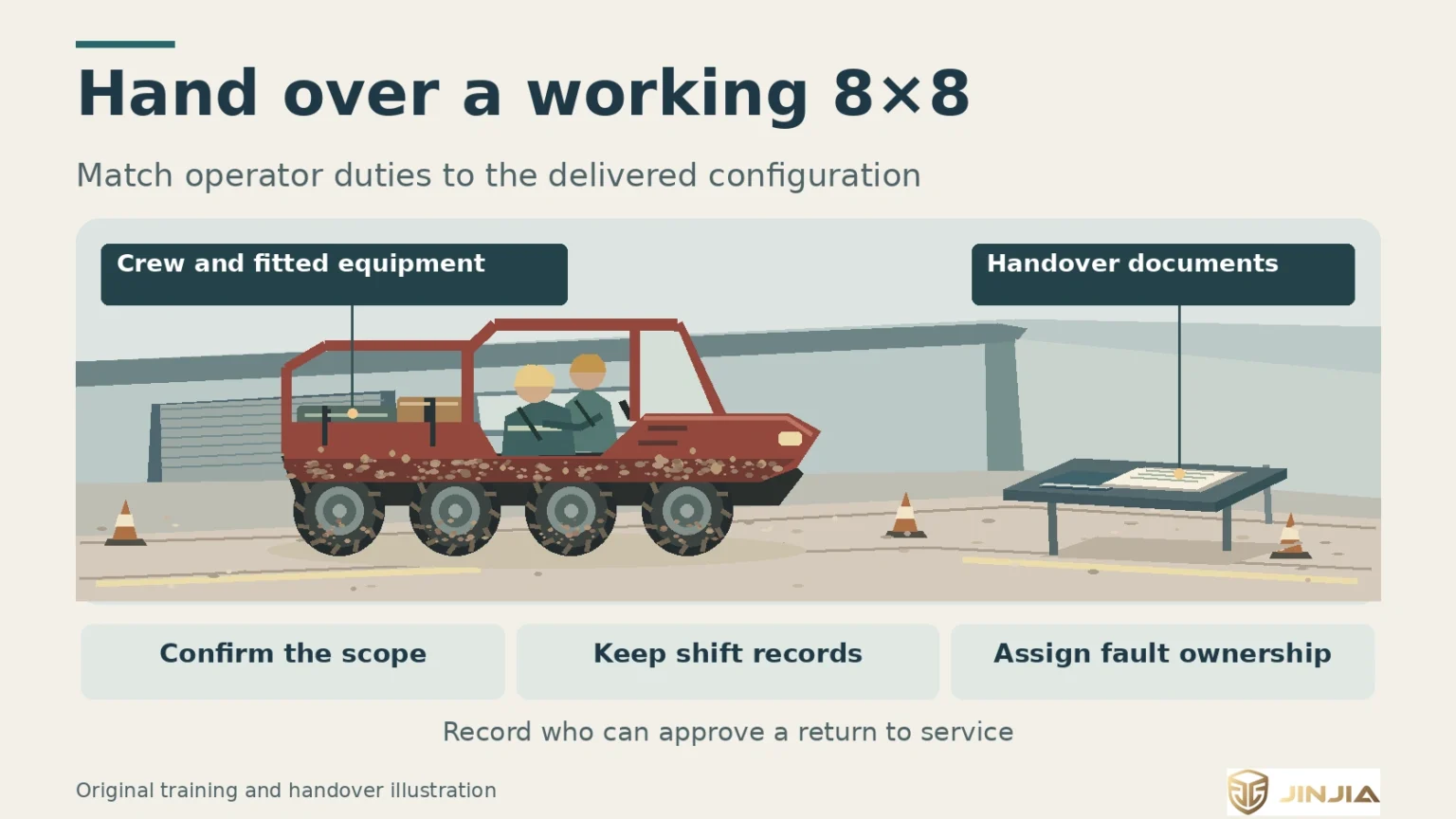
At handover, match the as-delivered 8×8 and its fitted equipment to the documents and the crew’s authorised duties.
What should be in an 8×8 handover?
Amphibious vehicle operator training starts with the vehicle as delivered. A buyer needs the manuals for that unit, named responsibilities, evidence of supervised training and a record of the duties each operator may take on. The handover should tell the next shift how to check the vehicle, where to report a fault and who decides when it can return to work.
An 8×8 may carry people and equipment over rough ground or on a route with wet segments. Set the initial release by task and site. Record land travel, wheel-supported wading and operation afloat separately where they apply. Site procedures, applicable qualifications and the manufacturer’s instructions govern the work.
Use the documents for the delivered vehicle
The JINJIA product page identifies the 88E as a range-extended electric-drive platform. The manufacturer comparison distinguishes the diesel 88D. The 88D civil and industrial specification calls for final confirmation of the seating, restraints and emergency egress arrangement. Water-use limits and fitted options also need confirmation against the delivered configuration. Use these sources to identify the equipment and request the applicable manuals and approvals. (S91 · S92)
Start the receiving record with the model, serial number, configuration revision, fitted options, attachments and manual revisions. Document discrepancies with the order and obtain the supplier’s written disposition. Public product media can orient the training team. Record the actual instructor, assessed tasks and authority separately for the delivered unit.
Match training to configuration and responsibility
The fleet owner controls the document set and operating scope. The instructor conducts supervised training and records what the operator demonstrated. The shift supervisor assigns people within the site’s authorisations and checks readiness. The operator performs assigned checks and reports faults. Name who can diagnose or repair equipment and who approves return to service. Confirm the backup contact for each role.
Plan training modules on configuration recognition, vehicle and attachment limits, pre-use and return checks, carriage of people and secured equipment, and fault reporting. For an external power option on the 88E, specify who is trained for the supplied interface and which equipment documentation applies. On the 88D, assign the diesel service and fault-reporting responsibilities for that unit. Record each module, assessed task, instructor, date and scope. Keep attendance and the site decision on independent work in separate fields. The UK HSE training guidance gives a general example of matching competence to the equipment and the task. (B26-E1)
Record checks and maintenance by shift
Use the checklists and maintenance schedule for the delivered build, fitted attachments and actual environment. Agree who reviews the log and where the next shift can find it. Include the vehicle ID, date, operator, checklist revision, operating meter where applicable, finding, action and unresolved issue ID.
| Stage | Record to keep | Who uses it |
| Before use | Approved checklist and status of items relevant to the shift, such as tyres, restraints, required guards and the fitted load | Operator records findings. Supervisor reviews restrictions before assigning work. |
| Return from duty | Hours or distance, unusual conditions, damage, warnings and outstanding issues | Outgoing shift records exceptions. Incoming shift checks open actions and vehicle status. |
| Scheduled maintenance | Applicable schedule revision, completed work, due items and service evidence | Maintainer updates the service record. Fleet owner assigns follow-up and retains evidence. |
Adjust the inspection plan with the responsible team when the equipment, duty or environment changes. The UK HSE inspection guidance uses risk assessment and manufacturer recommendations to determine scope and frequency. (B26-E2)
Escalate faults and document the handover
Agree the reporting chain before work starts. If an issue affects safe use, follow the site’s stop and reporting procedure and keep the unit out of service until the responsible person reviews it. Record the unit ID, time, task and operating conditions, warning or symptom, actions taken and current restrictions. Share incident evidence collected under the site procedure. The supervisor assigns a case owner and contacts the agreed service provider.
Record which repair or inspection was performed, its evidence, the remaining restrictions and who approved return to service. Hand unresolved cases to the incoming shift with the current vehicle status and the next named action. The HSE maintenance guidance describes the role of competent personnel and planned maintenance. Service for a delivered 8×8 follows its manufacturer’s and site instructions. (B26-E3)
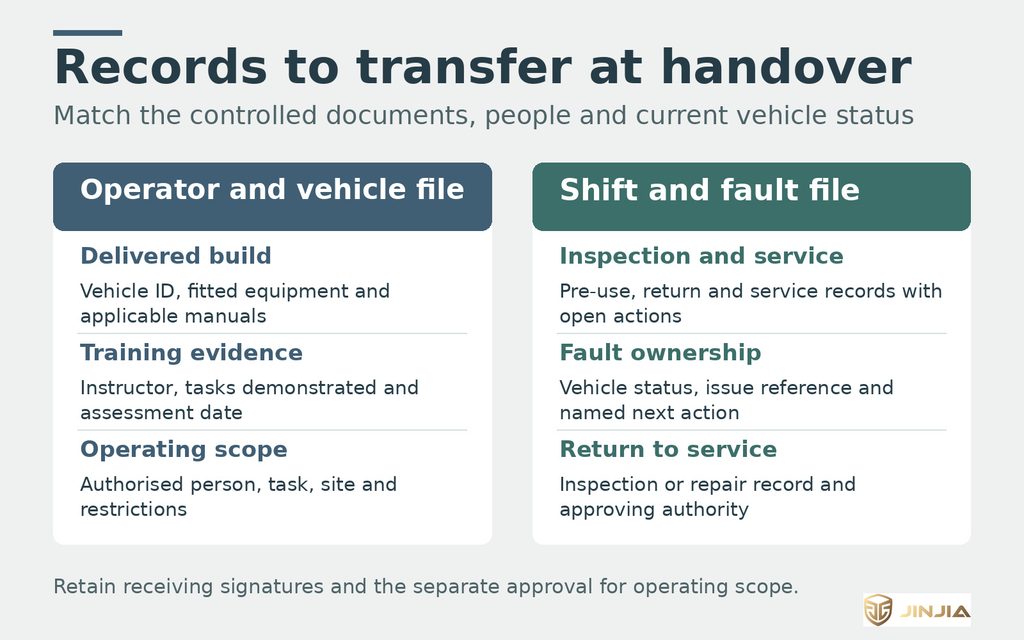
Keep operator assessment and site authorisation with the vehicle records. Transfer open defects with the shift and the release decision.
Set the limits of the initial release
A delivery signature records receipt. The operating scope comes from the separate site decision, relevant training evidence and any required qualifications. Before releasing work afloat, obtain the approved limits and documentation for the loaded configuration, the site’s approval and training appropriate to that task. If the approvals or operator coverage are pending, use a released land-only scope or arrange a transfer by a separately authorised team.
Review the records after a configuration change, change in duty, significant incident or change in assigned personnel. Assign new sign-off only for the scope the team has verified.
Give procurement a one-page handover checklist
• Vehicle and documents. Reconcile the unit ID, fitted equipment, order and controlled manuals.
• People and duties. Name the instructor, supervisor, operators, service contact and return-to-service authority.
• Training and access. Attach attendance, tasks demonstrated, assessment evidence and the approved scope.
• Shift and service records. File the checklists, opening meter reading, planned maintenance and outstanding actions.
• Fault escalation. Record the site procedure, service route, open issue IDs and release authority.
• Receiving sign-off. Record who handed over and who received the unit, the date, any restrictions and when they will be reviewed.
Send your route, mission load and working conditions to discuss the configuration and the handover scope. Review the 88E and 88D comparison for the two builds. Contact JINJIA