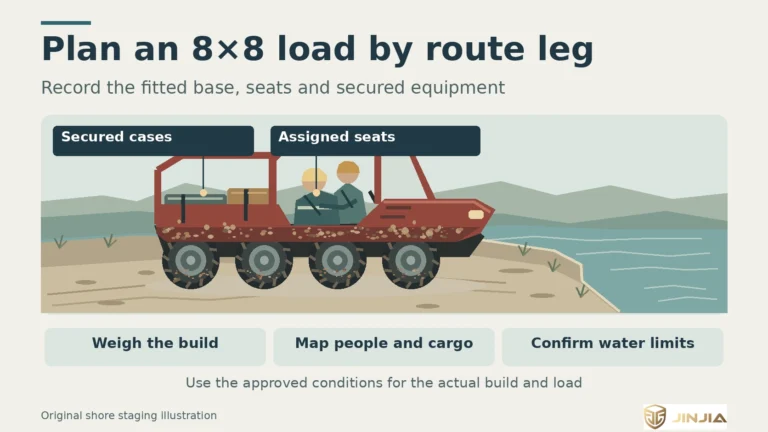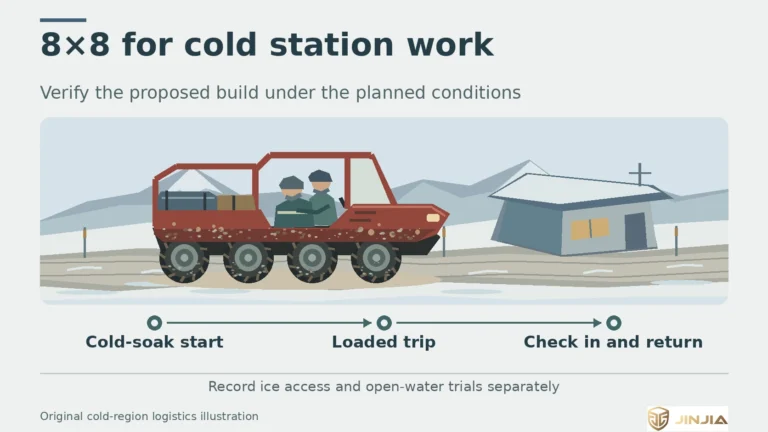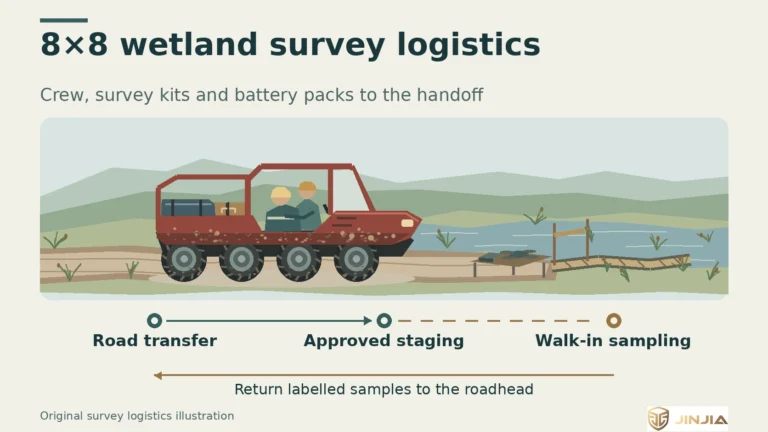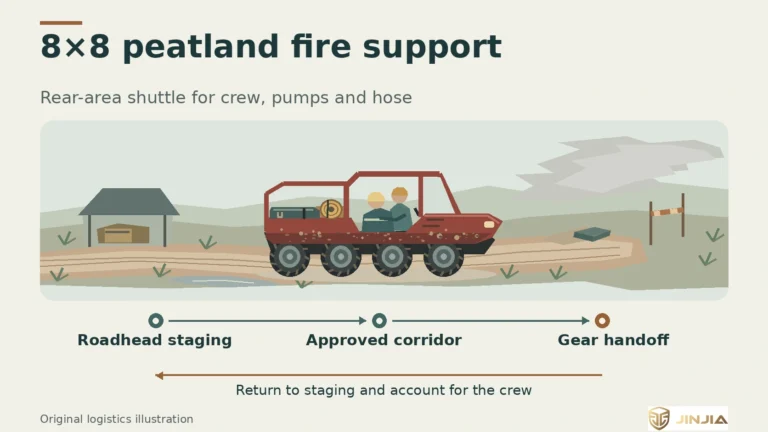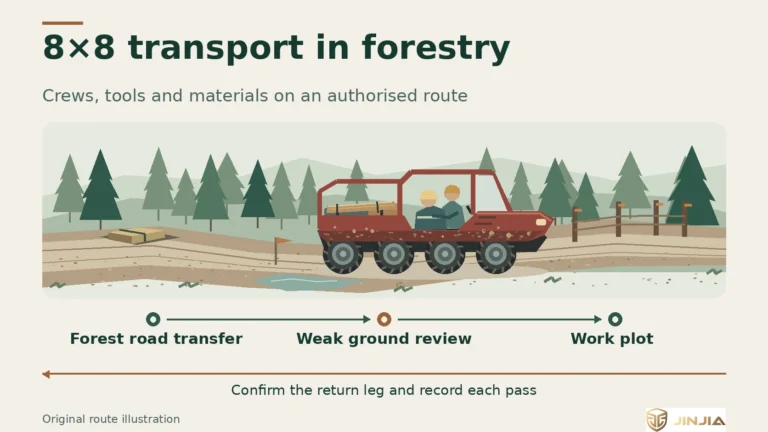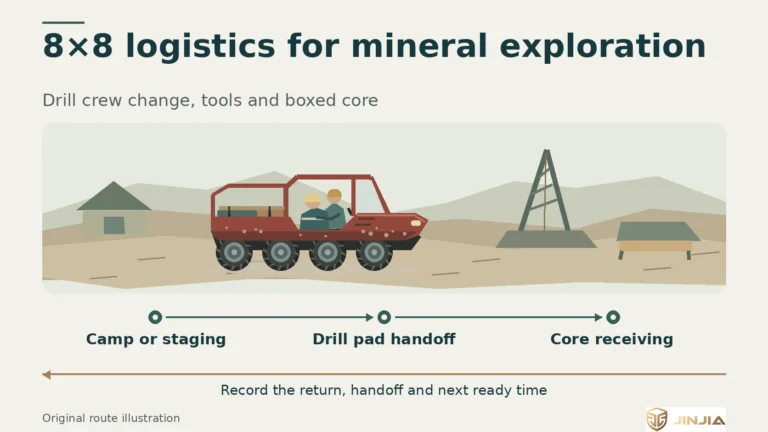


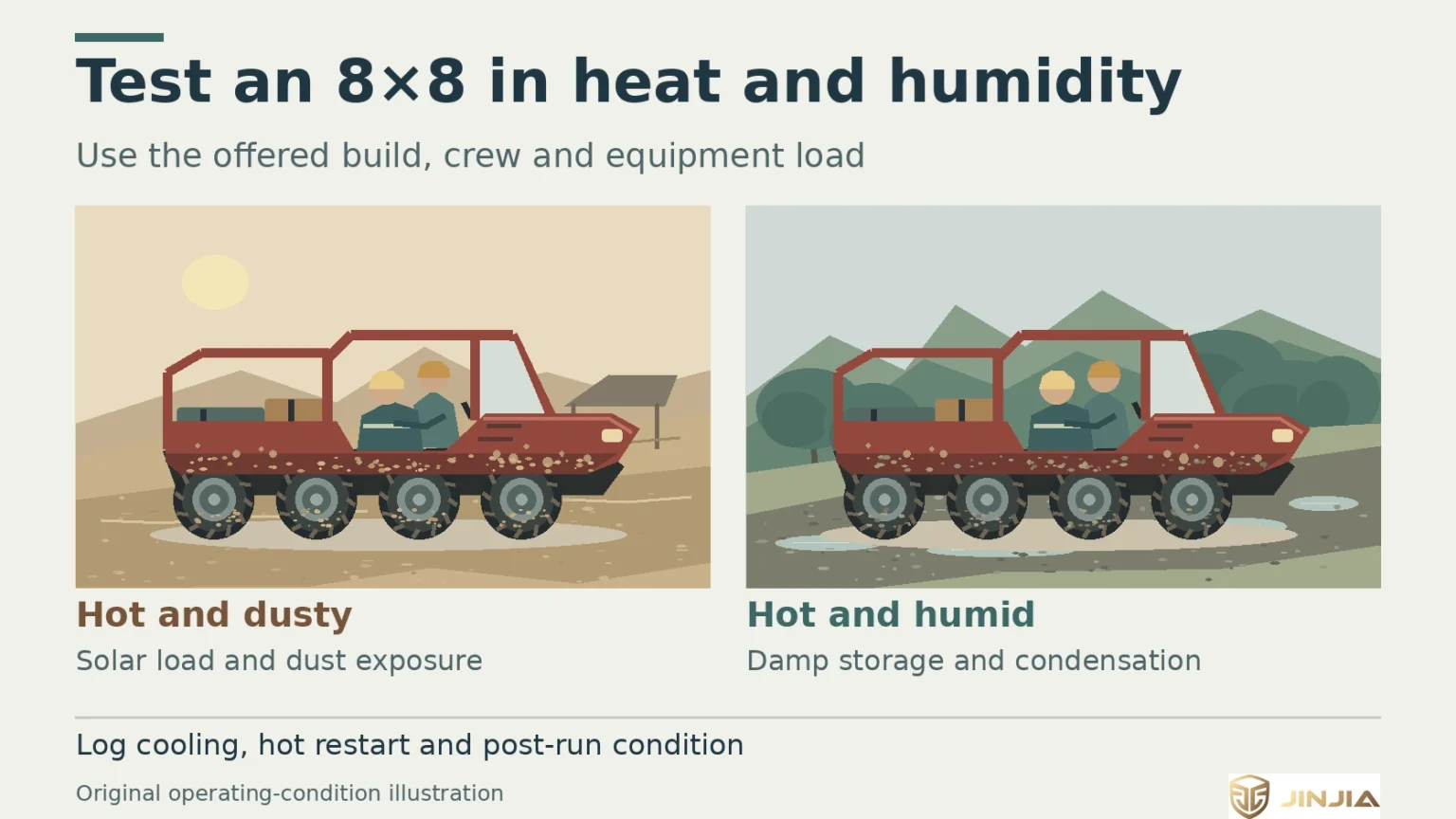
Set separate hot-dust and humid-heat verification profiles for the same working 8×8 configuration.
Define the 8×8 task and its climate profiles
Tropical amphibious vehicle maintenance starts with knowing what the vehicle must do between service stops. Specify the route, payload, travel speed, stopped work and storage. Use a heat-and-dust profile for a Gulf Cooperation Council (GCC) site where exposure calls for it. Use a heat, humidity and condensation profile for a Southeast Asian site with wet operations and overnight storage. Obtain the conditions from the actual site and season.
Identify each offered 8×8 by its build record. List the tyres, cooling package, sealing hardware, canopy and the installed equipment that draws power or restricts airflow. Use that build and its actual service load for the vehicle acceptance run. The two climate profiles may use the same mission cycle, with exposure and inspection records kept for each.
Establish what the configuration records cover
The JINJIA civil and industrial 88D specification gives +55 °C as the upper ambient operating temperature. Its UAE note calls for configuration-specific checks of cooling margin, hot-soak starting, fuel-system suitability, electrical derating and occupant heat protection. Request the corresponding reports for the diesel vehicle offered and the intended duty cycle. (S91)
The 88E combines a gasoline range extender with electric drive. Two motors drive it on land. A third provides water propulsion. For the 88E offer, request its own operating and storage limits, thermal protection behaviour and auxiliary power limits. Match the records to the installed components and the offered build. (S92)
Specify temperature, humidity and dust
For dry heat, record ambient air temperature, solar exposure, airflow and soak duration. Specify the dust source, exposure period and documented service condition of the air filters and cooling screens. Record the vehicle condition at the start and end of the run. IEC 60068-2-2 and IEC 60068-2-68 give references for applicable dry-heat and dust or sand tests. Identify the item each report covers. (B22-E1 · B22-E2)
For hot and humid work, specify temperature and relative humidity together. Include wet return, storage ventilation and the temperature changes that can produce condensation. IEC 60068-2-78 addresses steady damp heat without condensation. IEC 60068-2-30 covers cyclic damp heat where condensation is generally expected. Choose evidence that represents the expected exposure and record the restart after storage. (B22-E3 · B22-E4)
Verify cooling under sustained load
Use a loaded cycle that reflects slow travel, repeated stops and parked work. Run the equipment that will be used on the mission. Include an agreed shutdown period and hot restart. Time-align ambient conditions, payload, speed, available coolant and drive temperatures, equipment load, warnings, any output reduction and the time to recover. Ask whether temperature stabilised within the planned work period. A brief climb leaves the sustained-load question open.
For 88E, record the range extender’s operating state, battery state of charge and actual electrical demand in travel and when parked. For 88D, check the diesel cooling and fuel-system response and hot restart on the offered build. Agree the required task duration, acceptable output and termination criteria with the supplier and site test lead. Run crew heat exposure controls separately, taking account of the work, clothing and environment. (B22-E6)
Check cleaning, corrosion and maintenance
Inspect and photograph the filters, cooling screens and air paths at the end of the dusty run. Use the approved cleaning method and record the access, tools, service time and parts needed. Confirm the same duty can be resumed after the regular service. At the humid site, check drain paths, connector seals and caps, cable entries, fasteners and coating damage after wet return and storage. Record condensation, corrosion, diagnostics and any corrective work.
Request the inspection interval, approved washing and drying method, connector service instructions and replacement parts for the delivered build. If an IP designation is claimed, identify the tested enclosure, its fitted conditions and scope. IEC 60529 classifies enclosure protection. Obtain separate evidence for any proposed pressure washing or salt exposure. (B22-E5)
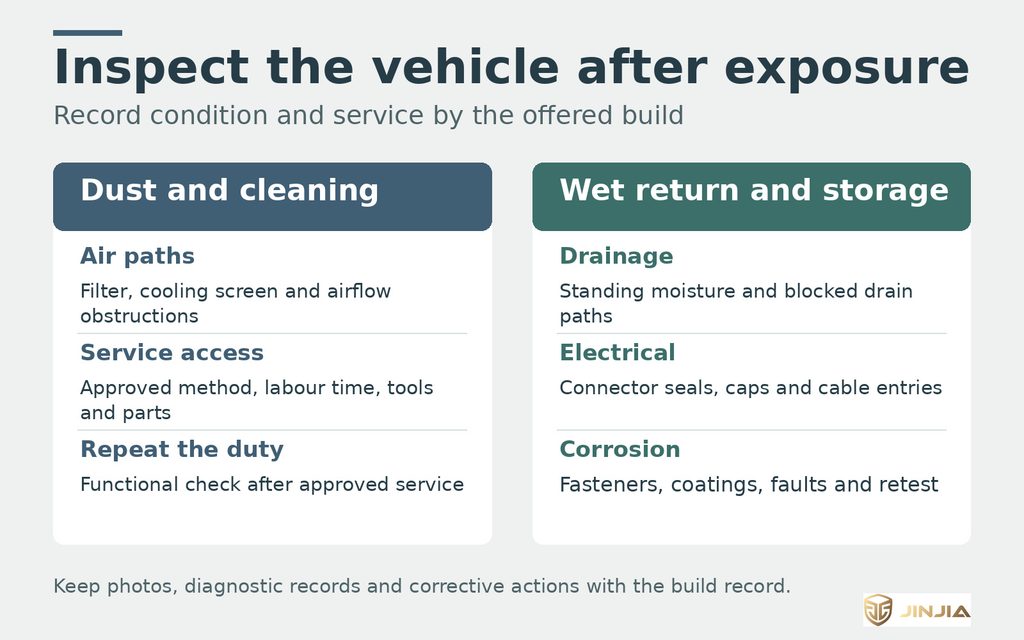
Record cleaning, moisture and corrosion findings for the offered configuration after exposure and storage.
Review limits and alternatives
Carry the measured conditions into the acceptance record. General 88D ambient data and component tests each have a defined scope. Require the 88E or 88D build to complete the specified task at the selected conditions before accepting a specific heat or damp-storage capability. Confirm any offered cooling, sealing or corrosion treatment on the configuration sheet.
If sustained duty remains outside the evidence, compare a shorter duty cycle, a service stop or a different vehicle. For prolonged stationary equipment use, compare a separate power source. Check the impact on crew exposure, response time and field maintenance before changing the operating plan.
Give procurement a one-page verification brief
• Build and mission. Record the offered build, crew, cargo, installed equipment and loaded work cycle.
• Exposure. Enter site, season, temperature, humidity, dust, airflow, soak and storage conditions by profile.
• Sustained duty. Set time, required speed or output, acceptable reduction, stop criteria and the restart check.
• Post-run service. Define inspection points, cleaning and drying, spares, service time and the functional recheck.
• Acceptance. Obtain time-stamped traces, photos, faults, repair and retest records, plus the approver and date.
Send your route, mission load and working conditions to JINJIA before agreeing the test. Use the work-cycle guide for travel and parked work and the oilfield guide if the route includes access after flooding. Contact JINJIA · 8×8 work-cycle assessment · Remote oilfield access after flooding
Frequently asked questions (FAQ)
A: Record air temperature, sunlight, airflow and exposure time for dry heat and dust. Specify temperature, relative humidity, wet return and storage transitions for damp heat.
Q: How should cooling under sustained load be documented?
A: Use a time-stamped log of the loaded work cycle. Capture ambient conditions, temperatures, equipment demand, warnings, output reduction, time to recover and hot restart.
Q: What should the post-run cleaning and corrosion record include?
A: Identify the inspected filters, air paths, drains, connectors and coatings. Include before and after photos, the approved service method, parts and a functional recheck.
Q: What does the published +55 °C value cover?
A: It is the 88D civil and industrial configuration’s upper ambient operating specification. Request a separate hot-duty report for the ordered build and a model-specific report for 88E.
Q: How are steady damp heat and cyclic damp heat different?
A: Steady testing uses high humidity at a constant temperature without condensation. Cyclic testing varies the temperature and generally produces surface condensation. Select the evidence appropriate to the intended exposure.
Q: What does an IP designation substantiate?
A: It describes the specified electrical enclosure’s tested protection under the stated conditions. Request separate records for the proposed vehicle, connector installation, cleaning method or salt exposure.
Sources and further information
[S91] JINJIA | 88D Civil / Industrial Technical Specification, v1.0, 8 September 2026, pp. 6 and 9 · company source
[S92] JINJIA | 88E Amphibious Utility Vehicle specifications
[B22-E1] IEC 60068-2-2:2025 | Dry heat
[B22-E2] IEC 60068-2-68:1994 | Dust and sand
[B22-E3] IEC 60068-2-78:2025 | Damp heat, steady state
[B22-E4] IEC 60068-2-30:2025 | Damp heat, cyclic
[B22-E5] IEC 60529 | Degrees of protection provided by enclosures (IP Code)[B22-E6] NIOSH | Workplace recommendations for heat stress