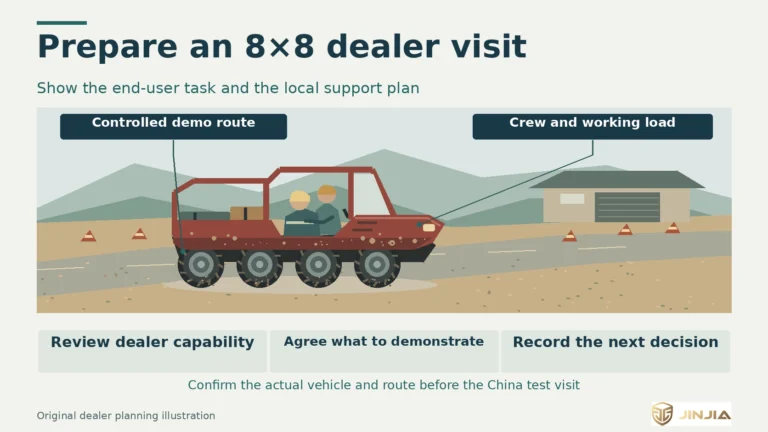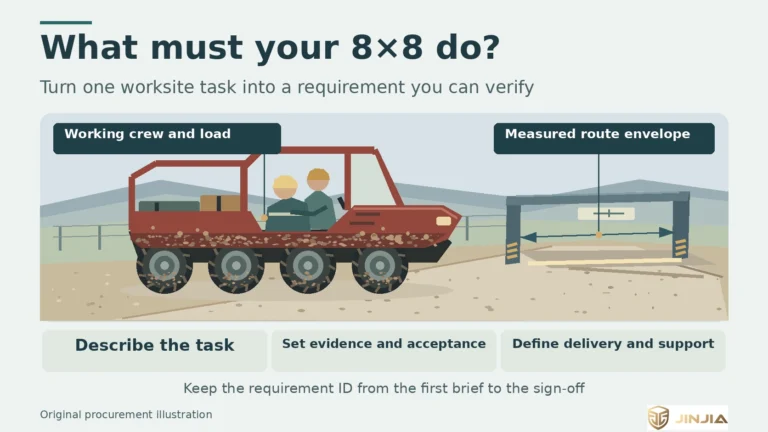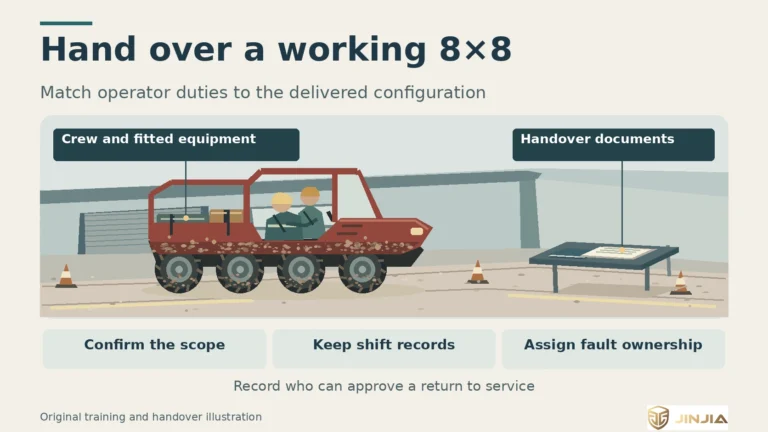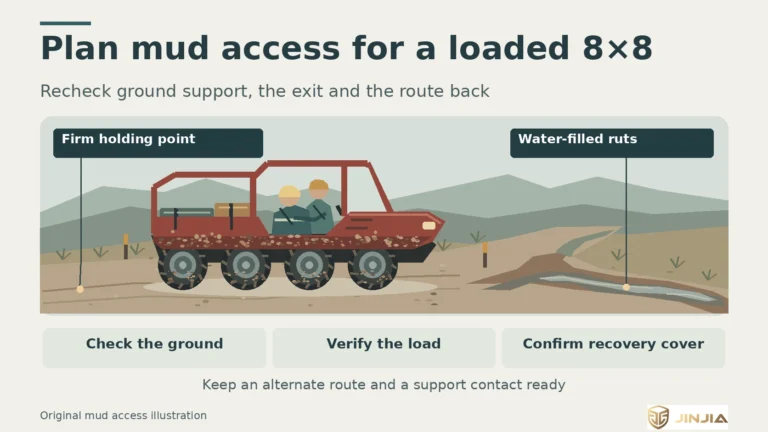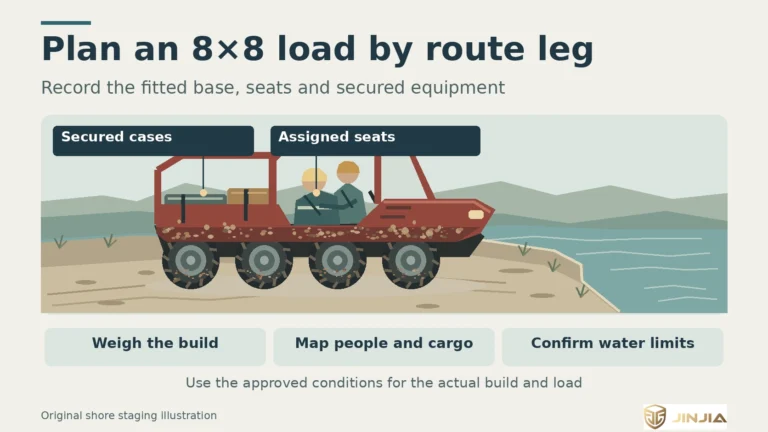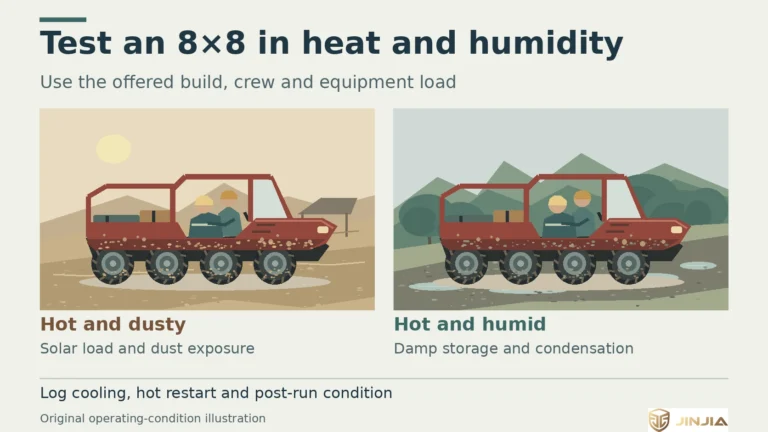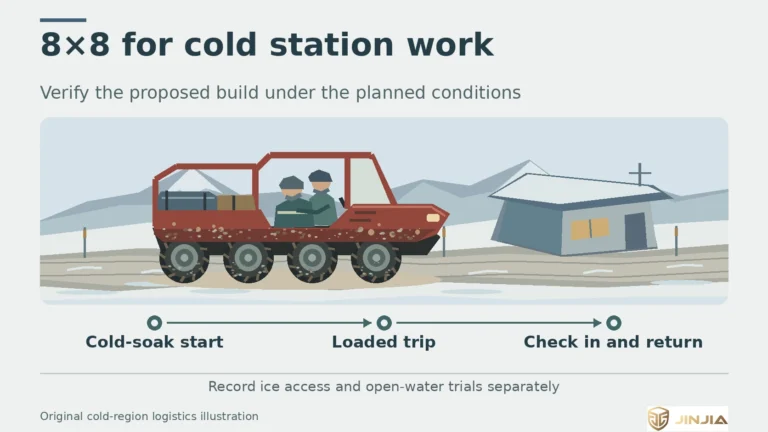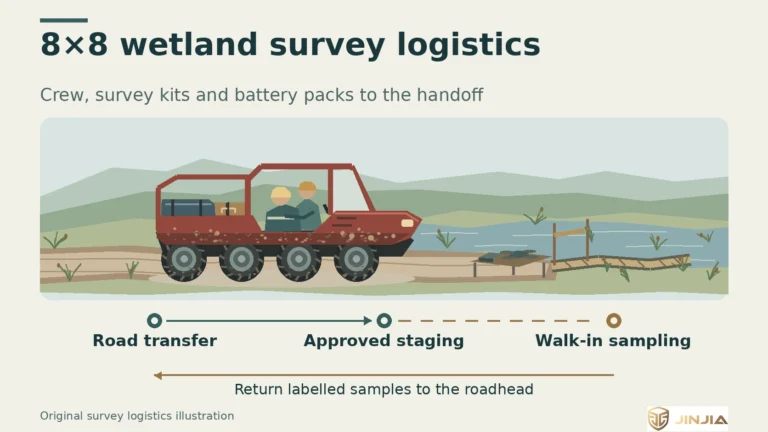


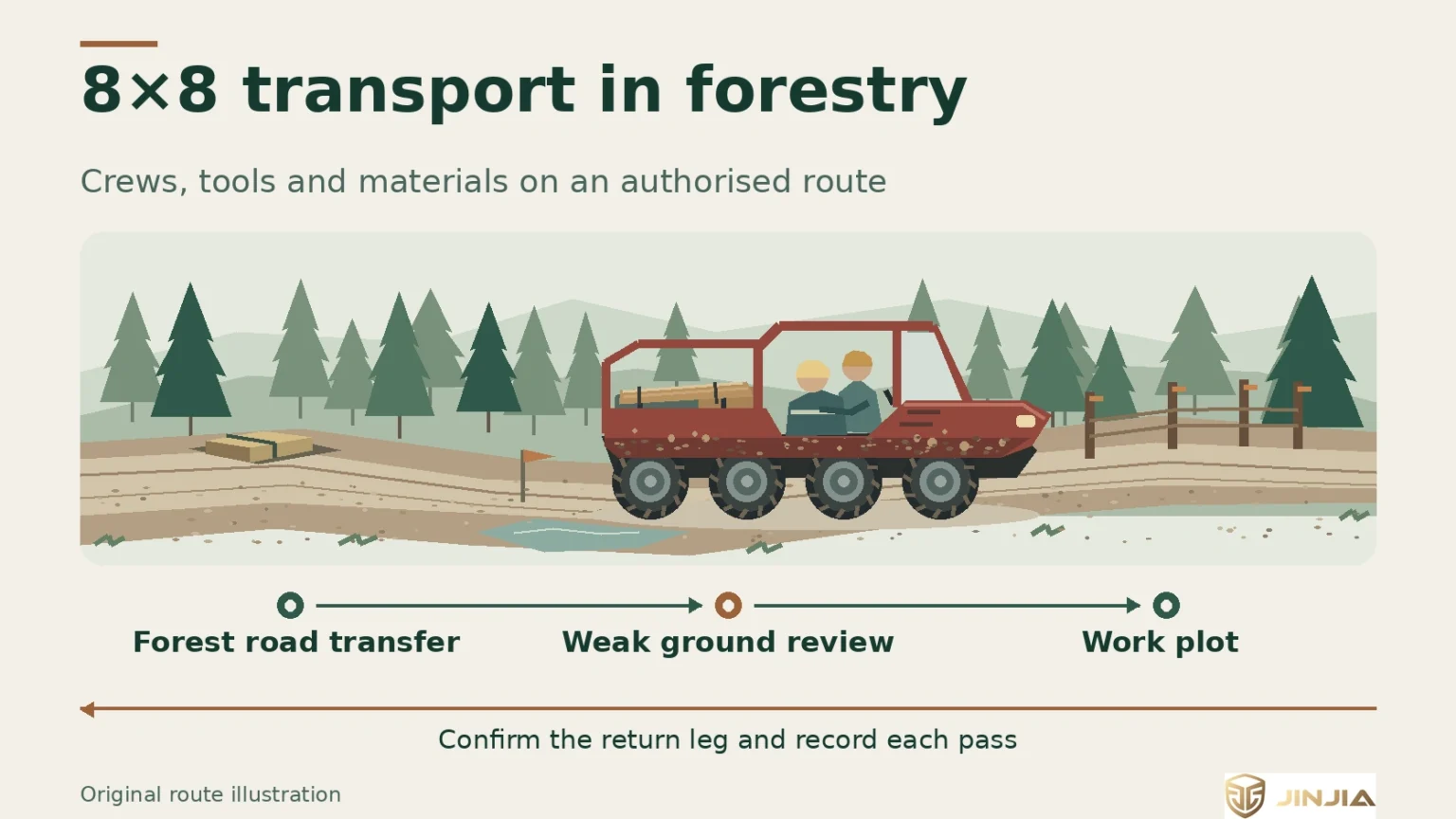
Stage the crew and secured tools at the forest road. Review wet ground before sending the vehicle to the work plot.
Define the forestry transport job
A forestry patrol amphibious vehicle is a candidate for the last part of an authorised route between a forest road and a remote work plot. Specify the work, such as inspecting boundary markers or moving fencing materials. A two-person patrol and a materials run to several plots need different load plans.
The JINJIA 88E is range-extended electric drive and the 88D is diesel. For either build, start with the required seats, usable cargo area and expected number of trips. A route that crosses open water adds a separate review of the vehicle configuration, permitted crossing, load limits and entry and exit conditions.
What the forestry references establish
CE Horsford Forestry and Environmental describes using its amphibious Argocat 8×8 to carry crew and some equipment to remote worksites on wet or soft ground. The same fleet description assigns timber skidding to an Alpine tractor. Horsford’s account establishes how that operator divided the work. Measured ground pressure and route performance would need separate data for the proposed JINJIA build. (S24)
Ron’s Rentals lists crew and equipment transport as forestry uses for its rental fleet. Its Avenger ST listing identifies an amphibious 8×8 offered for forestry among other uses. ARGO’s 2013 commercial brochure lists log pulling and trailer hauling in its woodlot section. Its 2015 brochure differentiates the wading Centaur from amphibious models. Request route and configuration evidence for the offered build. (S33 · S30 · S39 · S40)
Allocate people, tools and materials
List the driver and crew going to each plot and returning from it. Use the seating and restraint layout approved for the offered build. Check how the team boards, unloads and keeps tools and materials out of the seating space. The UK HSE guidance for forestry vehicles addresses operator training, protection for occupants and weather-related terrain changes. (B17-E2)
Make a load list in both directions. Record packed dimensions and weights for survey cases, hand tools, stakes and fencing supplies. Include people, personal kits, fitted equipment and towbar load where applicable in the load review. Confirm usable tie-down points, a low and stable stowage layout, and clear access for unloading. Include removed fencing, empty cases and wet gear on the return list. If long materials interfere with seating or overhang the agreed load envelope, stage them closer to the work or use a dedicated materials trip.
Assess forest routes and soil
Walk or survey the intended route with the person responsible for site access. Mark the transfer point, route width and turns, side slopes, ruts, drainage crossings, soft patches and areas closed to vehicles. Check how incoming and outgoing traffic will pass, where the vehicle can turn with its intended load, and who can close or reopen a segment after rain. Compare the outward and return legs. A usable approach may have an unsuitable exit or too little turning room.
Agree with the land manager on which surface changes require a hold, a reroute or postponement. Repeated passes, rising moisture, wheel slip and tight turns can change a route that was usable on the first trip. Use before-and-after pictures at the same points, including the turns and weak ground. Record weather, actual load, tyre or optional track configuration and the number of passes. The UK Forestry Standard recommends monitoring soil damage and adapting, postponing or stopping operations as conditions change. Set the actual access rules with the site. (B17-E1)
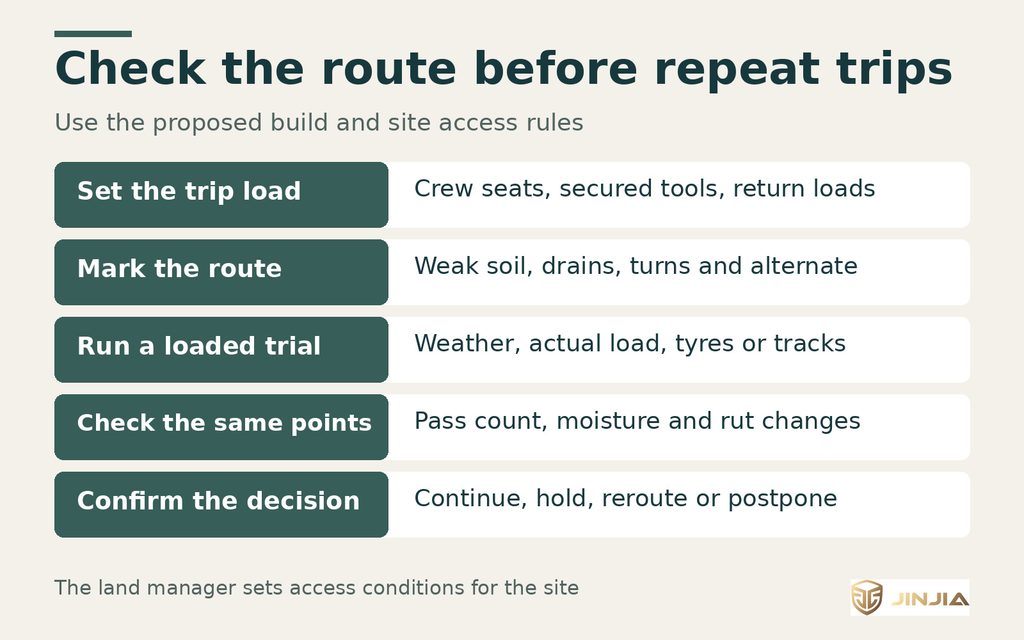
Record the ground at the same points over successive trips and confirm when the site lead will hold or reroute traffic.
Check towing and specialist-tool limits
For a materials trailer, ask for written confirmation of the approved coupling, loaded trailer mass, vertical load on the hitch and braking requirements for the offered vehicle. Assess the combination on the intended gradients, turns and stopping areas. Loading the trailer, attaching a tool and extracting timber each require their own equipment review. HSE guidance on ATVs and trailed equipment is a reference for identifying what to verify with the vehicle provider and site team. (B17-E3)
Put specialist attachments such as a sprayer, winch or powered tool mount on a separate list. Confirm how it is attached, its installed mass and load distribution, guards, any power or hydraulic requirements, and operator training. The 2014 ARGO public works release describes a sprayer package on specific ARGO builds. Treat it as a supplier example when defining an integration brief. For any water leg, ask the provider and site lead to confirm the proposed configuration independently, including whether a trailer or attachment is allowed. (S42)
Set the operating boundary and compare alternatives
Consider a road vehicle or utility vehicle where the existing forest road carries the load. Where motorised access is closed, compare staging and foot access for small kits. Use a task-specific carrier if the work includes heavy tools, bulk loads or timber extraction. Optional tracks may be considered on the offered 8×8 build. Compare actual results with the intended loads and number of passes before making any soil-impact claim.
Record the route rules, likely seasonal closures, who can halt a trip and the alternate route or vehicle. Check communications, roadside unloading and recovery access as part of the trial plan. Use representative loads under site-approved conditions. Include measured loading, travel and unloading time to see whether the daily plan fits inside the available access window.
Give procurement a one-page forestry task brief
• People. Enter the driver, crew counts by direction and destination, approved seats and restraints, and the person responsible for each handover.
• Cargo. List outward and return items, packed sizes and weights, mounting or restraint requirements, and the unloading point for each load.
• Route. Attach a marked route and alternate, identify soft soil, turning and drainage points, and name who clears the route after rain.
• Frequency. State trips per shift, the access window and the permitted number of passes or inspection interval. Record the loaded trial and any change in the ground.
• Tools and decision. Identify trailers, attachments, approvals and evidence required for the offered build. Compare the feasible alternatives and agree when to hold the trip.
Send the route, load list and operating conditions to JINJIA to discuss the 8×8 platform. For further planning, see the guides on getting stuck in mud and land and water operation. (Links · Contact · 8×8 platform · Mud and bogging · Land and water operation)
Frequently asked questions (FAQ)
A: List the driver, people and gear for each direction. Confirm approved seats, restraints and usable cargo area on the build offered. Give weights and packed sizes for the material and return loads.
Q: How should forest routes and soil be documented?
A: Mark the transfer, turnaround, weak soil and drainage points on both route legs. Take photos from matched positions, record moisture, actual load, running gear and pass count, and agree the hold or reroute rules with the land manager.
Q: What evidence is needed for towing or a specialist tool?
A: For a trailer, verify the approved hitch, gross loaded weight, vertical hitch load and braking. For a mounted tool, verify mounting, loaded balance, guards, power needs and operator training on the exact build.
Q: Do optional tracks make a sensitive route usable?
A: Consider only the option approved for the offered build. Assess the route, soil and pass frequency with the land manager and document the result at representative load. Site access decisions apply to that configuration and condition.
Q: Can the same 8×8 move timber?
A: Define the job first. A materials trailer and timber extraction require different handling and equipment checks. Match timber extraction to dedicated forestry equipment and the site plan.
Q: What if the approved route includes water?
A: Verify the water leg, permitted loads, entry and exit points, and plan for return and recovery with the site and vehicle provider. Confirm any trailer or mounted tool specifically for that water configuration.
Sources and further information
[S24] CE Horsford Forestry and Environmental | Equipment
[S30] Ron’s Rentals | ARGO Avenger ST 8×8 Open Cab
[S33] Ron’s Rentals | Forestry Equipment Rentals
[S39] ARGO | Commercial Vehicles, 2013
[S40] ARGO | Commercial Vehicles, 2015
[S42] ARGO | Public Works Solutions, 2014
[B17-E1] Forestry Commission | UK Forestry Standard, fifth edition
[B17-E2] HSE | Quad bikes and all-terrain vehicles in forestry
[B17-E3] HSE | Safe use of ATVs in agriculture and forestry (AIS33)