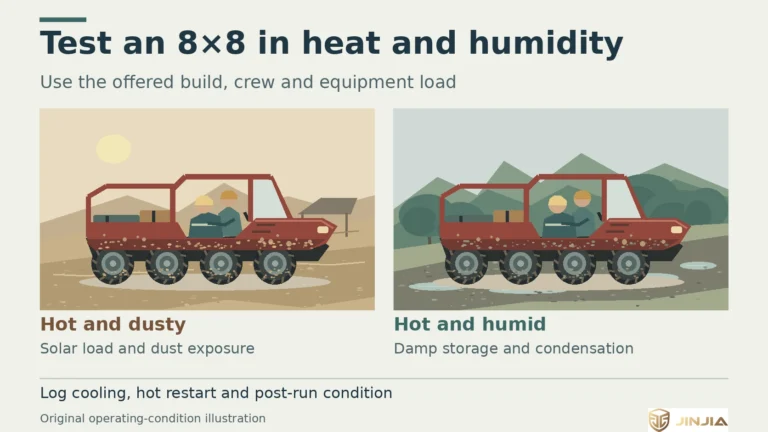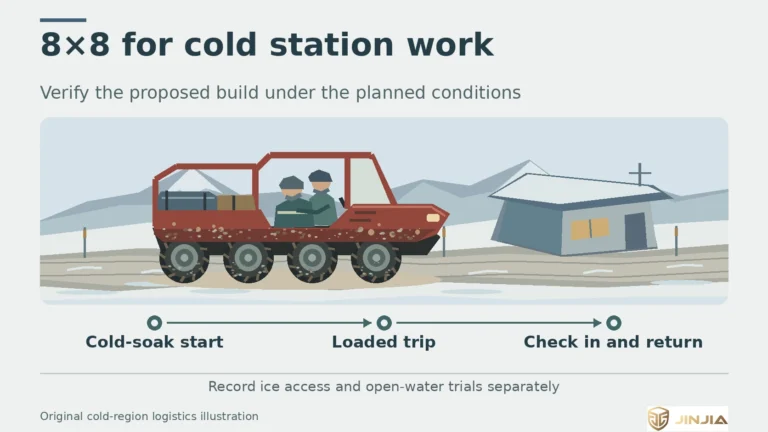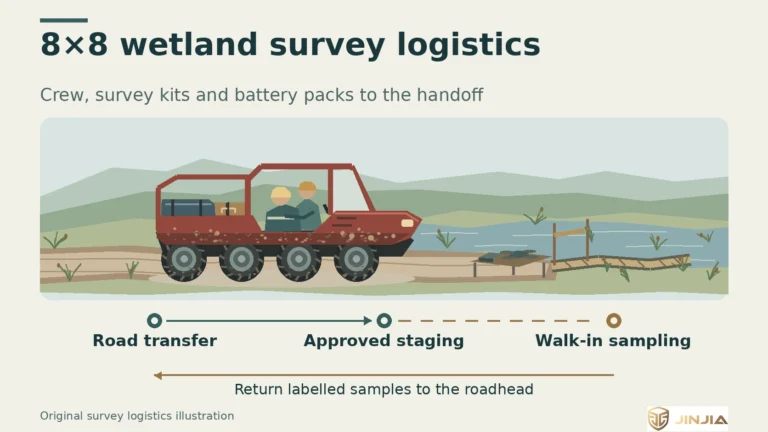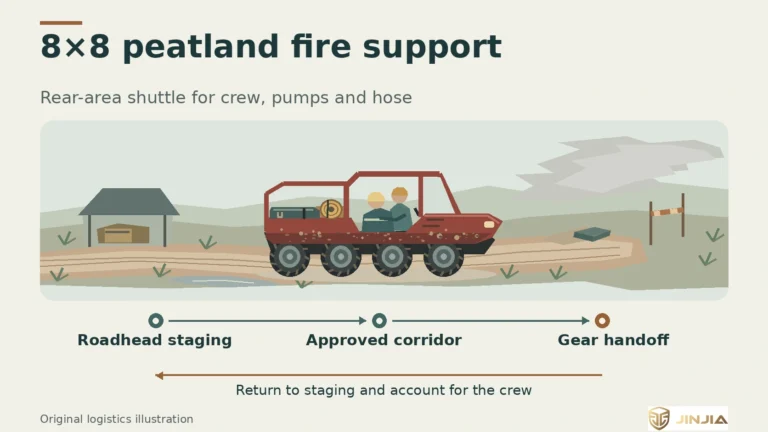


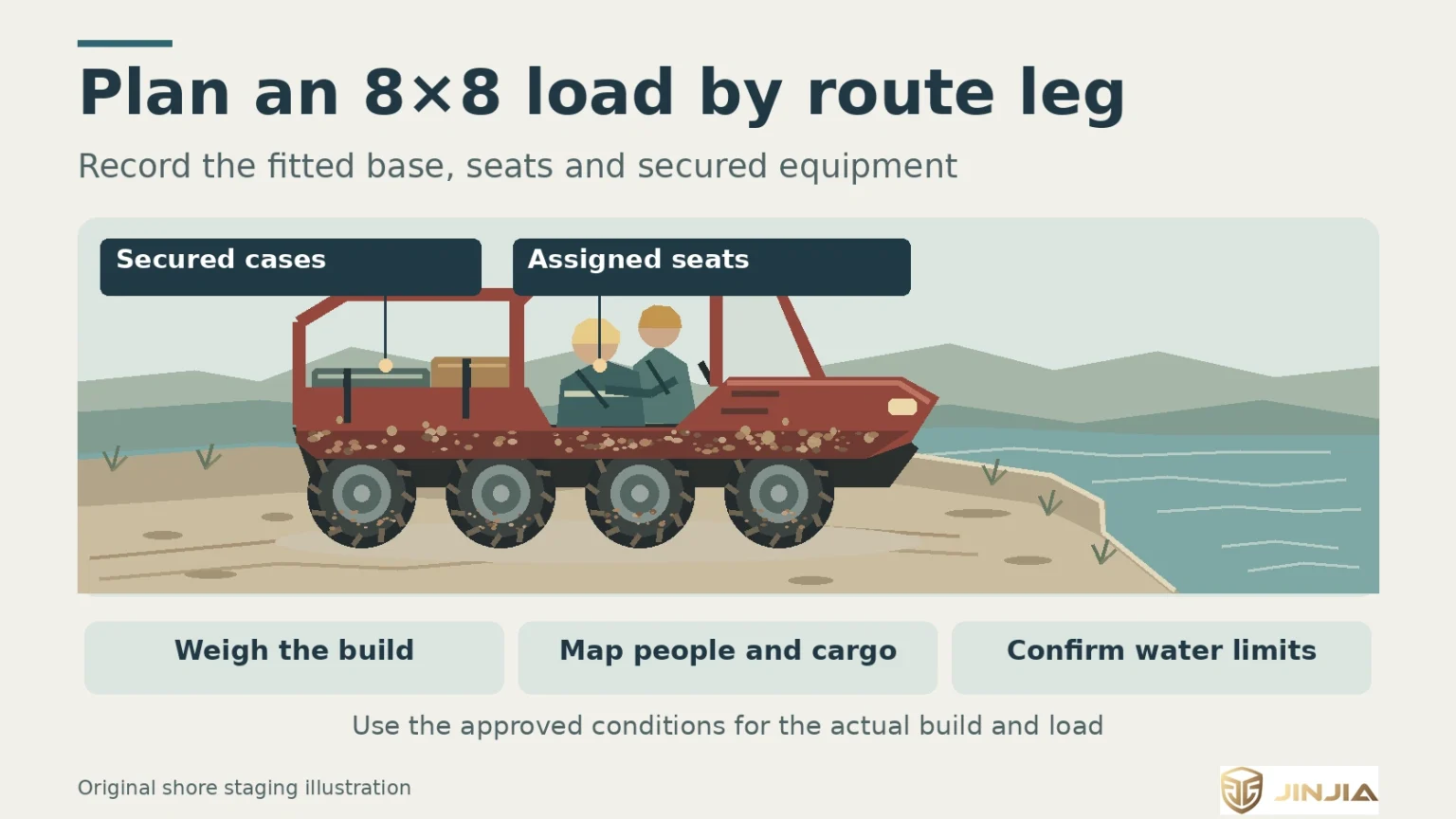
Weigh the fitted 8×8, assign people and cargo for each leg, and confirm the water limits.
Define the route and the vehicle’s job
Start an 8×8 amphibious vehicle payload review with a manifest for each route leg. A crew may bring supplies to a bank, unload part of the cargo, then continue with a different load and seating plan. Record the driver, passengers, personal protective equipment, cargo and fittings for both legs. Treat wheel-supported wading and operation afloat as separate conditions. Request the limits and evidence for whichever the route requires.
Read the 88E and 88D figures by model
The current JINJIA 88E product page lists a curb mass of 1,650 kg and maximum loads of 1,000 kg on land and 800 kg on water. These are manufacturer-published figures for the range-extended model. Request the precise mass definition, seating arrangement, fitted options and water conditions that apply to the offered build. Use those records for the actual mission. (S89 · S92)
The civil and industrial diesel 88D specification lists curb mass ≤1,750 kg excluding options, loading mass ≥1,100 kg and six occupants including the driver, arranged 2+4. An eight-person layout is an engineering option for separate assessment. For either seating layout, request build-specific limits for wading and water use, including water payload, approved occupancy, freeboard, stability and water speed. The 88D specification leaves these water performance limits to project confirmation. (S91 · S92)
Weigh the fitted vehicle and account for options
Obtain a weigh ticket for the offered vehicle as fitted. Record the fuel and fluids as weighed, along with any hardtop, winch, tyre or track option, rack and fixed equipment included in that mass. For each leg, include any loose kit and fuel carried above the weighed condition. If the fitted setup or baseline fuel changes, update the weighed reference or document an agreed correction. Keep a clear inclusion record for each item to avoid double-counting.
Compare the loaded mass with the permitted total for the build and conditions. If the supplier quotes a payload allowance, ask which people, equipment and fluids it includes. Use the approved gross mass, local load limits and seating layout from the supplier’s configuration documents. Carry any exposed or high-mounted equipment into the distribution review.
Map people and cargo before comparing totals
Assign a seat and restraint to each occupant. Record each load’s mounting or tie-down point, height and position from front to rear and side to side. Confirm local rack and floor limits. Total mass can be within a quoted allowance while a local load or a vehicle attitude falls outside the agreed envelope. Record transfers and changed seating before the next leg.
The table illustrates the arithmetic for a site support trip with three occupants. It uses a hypothetical configured vehicle and an unchanged weighed baseline. A supply package is handed over ashore. Enter the actual position and restraint for every load with the real manifest.
| Load entry | Land leg kg | Water leg kg | Placement or inventory reference |
| Configured vehicle as weighed | 1,800 | 1,800 | Build and scale record including fitted options and stated fuel |
| Driver and PPE | 90 | 90 | Driver seat and restraint |
| Two crew and PPE | 170 | 170 | Two assigned seats and restraints |
| Two secured equipment cases | 80 | 80 | Assigned floor positions and tie-downs |
| Site consumables package | 35 | 0 | Handed over ashore before the water leg |
| Safety and recovery kit | 25 | 25 | Secured, accessible stowage |
| Mission additions | 400 | 365 | People, PPE, cargo and loose equipment above the weighed base |
| Total loaded mass | 2,200 | 2,165 | Compare each total with its own approved envelope |
Request the rated conditions for operation afloat
Ask the responsible supplier or test operator for the signed water-use record for the selected build, seats, load and distribution. It should identify the approved number of people and load, measured freeboard at the relevant points, fore-and-aft trim, stability evidence and propulsion limits. Check the tested water conditions, banks, entry and exit, equipment recovery and the procedure for cancelling a leg. Agree any required trial and its stop criteria with the qualified team before operation.
Transport Canada’s small-boat guidance illustrates why the amount and position of load matter for stability. Use that principle to ask for the vehicle’s own approval record. For wheel-supported wading, request a separate boundary covering depth, ground, current and loaded configuration. (B23-E1)
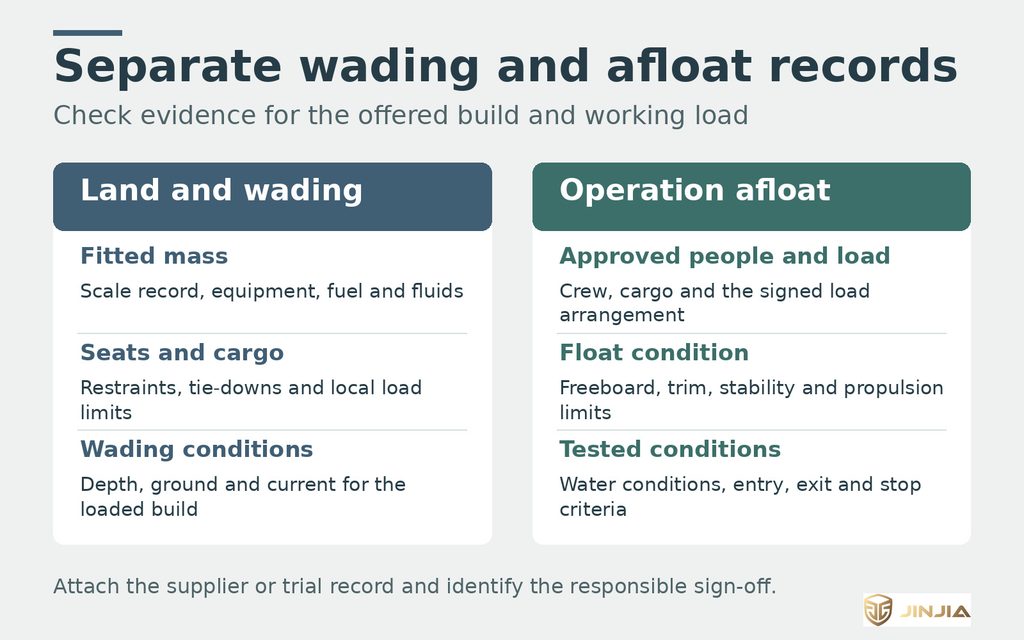
Use separate records for wheel-supported wading and for the actual build, crew and load afloat.
Review boundaries and alternatives
When a leg exceeds its evidenced limits, compare splitting the shipment, moving the handover point or using a suitable boat for the water leg. Any revised layout needs its own declared seating and distribution. Evaluate the transfer site and what the crew can actually unload and secure there. For a changed top, track setup or equipment module, obtain confirmation for that build before relying on earlier records.
Give procurement a one-page load and acceptance brief
• Build and weighed base. Identify model, build, scale record, fuel state and fitted options.
• Manifest by leg. Record crew, equipment, cargo, loose fuel and calculated total mass.
• Seats and placement. Attach seat assignments, restraint and tie-down locations, and distribution limits.
• Water and wading approvals. Record authorised conditions, people and load, measured evidence and the responsible sign-off.
• Transfer plan. Confirm what moves ashore, entry and exit points, recovery arrangements and alternatives.
Send your route, mission load and conditions to JINJIA. See the 88E and 88D comparison, rescue boat task boundaries and flood-response roles. Contact JINJIA
Frequently asked questions (FAQ)
A: Request a weigh ticket for the offered build. Record options, fuel and fluids included in the measurement. Count people and all kit added after weighing against the relevant limit.
Q: How should distribution of people and cargo be documented?
A: List seat and restraint assignments, mass and position for each item, and its anchorage. Record any unloading or seat changes before the next leg and verify local load limits.
Q: What evidence is needed for rated conditions for water use?
A: Request the signed record identifying the build and loaded arrangement, approved occupancy and load, freeboard, trim, stability, propulsion limits, entry, exit and tested conditions. Obtain separate evidence for wheel-supported wading.
Q: What loads does JINJIA publish for the 88E?
A: The current product page lists a maximum of 1,000 kg on land and 800 kg on water. The supplier should confirm the mass definition and permissible load and seating for the selected build and operating conditions.
Q: What seating does the 88D specification describe?
A: The civil and industrial specification lists six occupants including the driver, arranged 2+4. Eight is a custom layout for separate assessment. Obtain the approved water occupancy and load for the actual build.
Q: What do the two totals in the example represent?
A: The land total is 2,200 kg and the water total is 2,165 kg after a 35 kg package is handed over ashore. Both illustrate arithmetic on a hypothetical fitted vehicle. Use the approved limits for any actual build.
Sources and further information
[S89] JINJIA | 88E Amphibious Utility Vehicle specifications
[S91] JINJIA | 88D Civil / Industrial Technical Specification, v1.0, 8 September 2026, pp. 2, 7, 9 · company source
[S92] JINJIA | Company-confirmed 88E and 88D configuration notes · company source