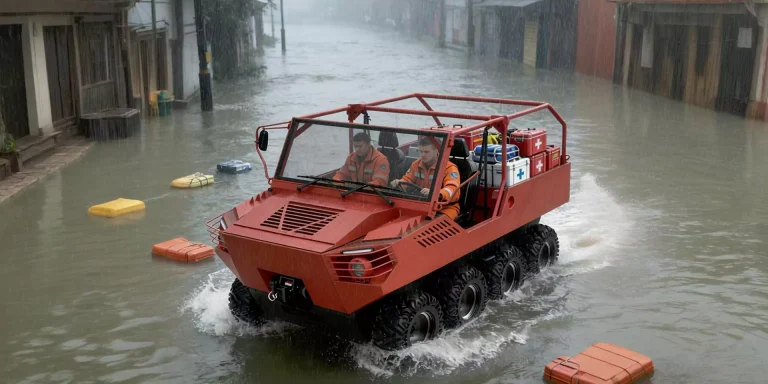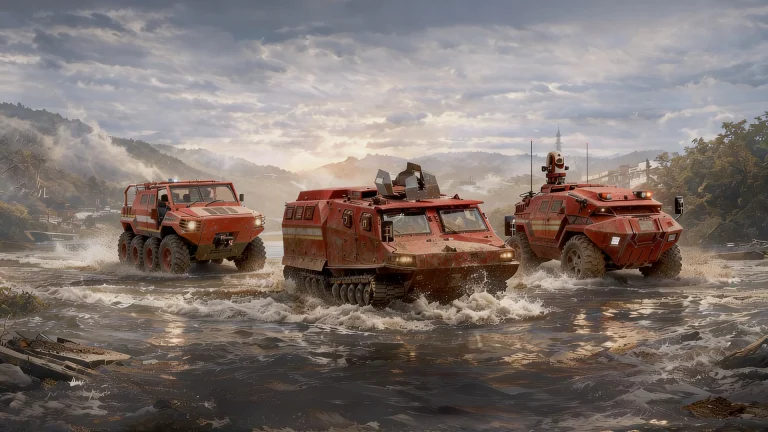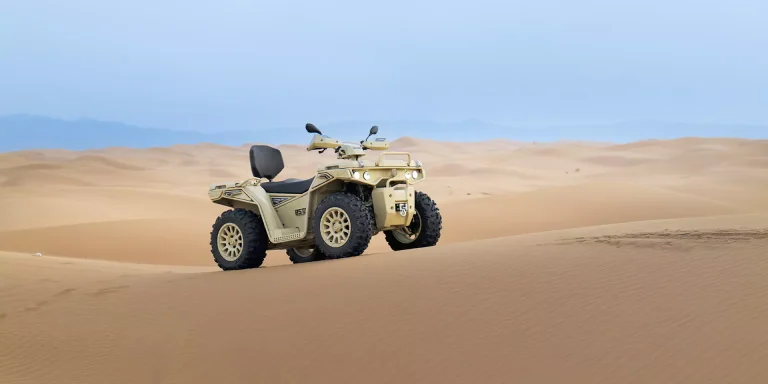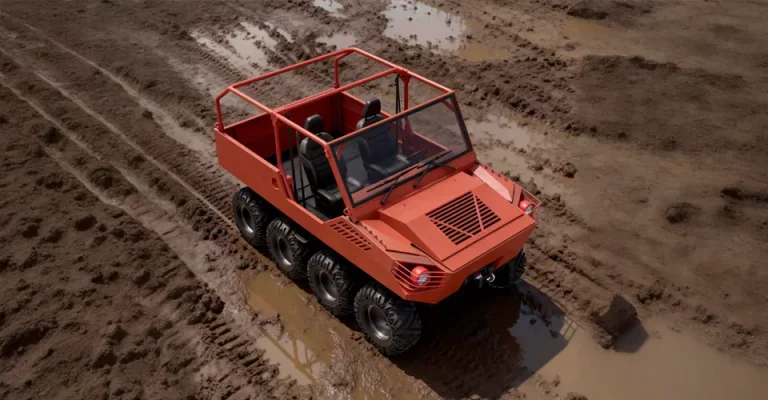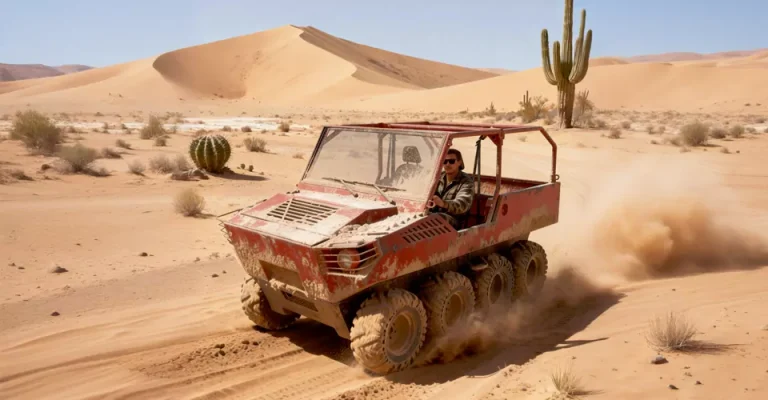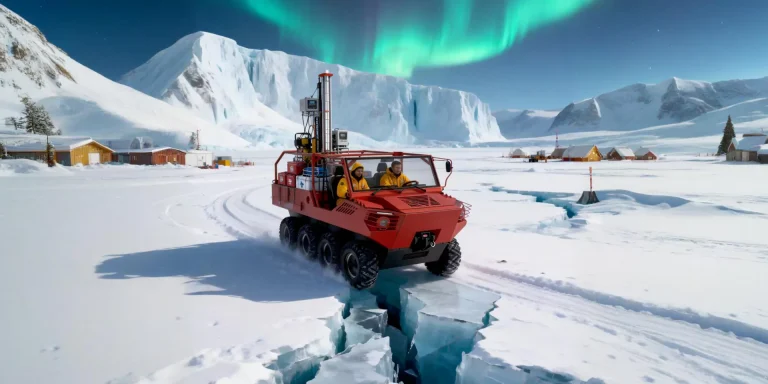











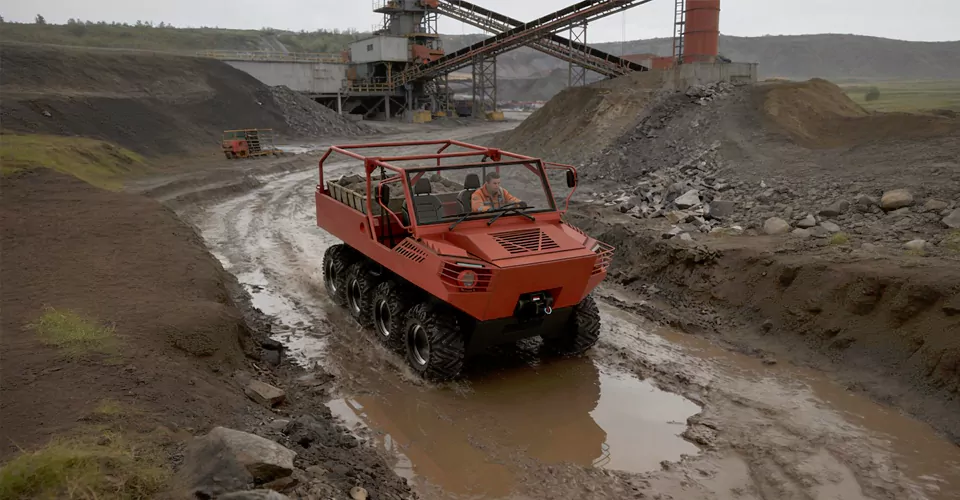
An 8×8 amphibious vehicle is a specialized all-terrain vehicle designed to travel on both land and water. The “8×8” designation means that the vehicle has eight wheels, with power delivered to all eight wheels. This configuration provides high traction, stability, and mobility across challenging terrain.
Unlike conventional off-road vehicles, amphibious 8×8 vehicles can transition from land to water without requiring a separate boat or transport system. They are commonly used for rescue operations, emergency response, transportation, environmental work, and other applications where access to difficult terrain is essential.
What Is an 8×8 Amphibious Vehicle?
An 8×8 amphibious vehicle combines the functions of an off-road utility vehicle and a water-capable transport vehicle.
On land, its eight-wheel drive system helps distribute traction across multiple wheels, allowing it to travel through mud, sand, snow, rocks, and uneven ground. In water, its buoyant body and propulsion system allow it to float and move across rivers, lakes, flooded areas, and other waterways.
This combination makes an 8×8 amphibious vehicle particularly useful in environments where roads are limited or completely unavailable.
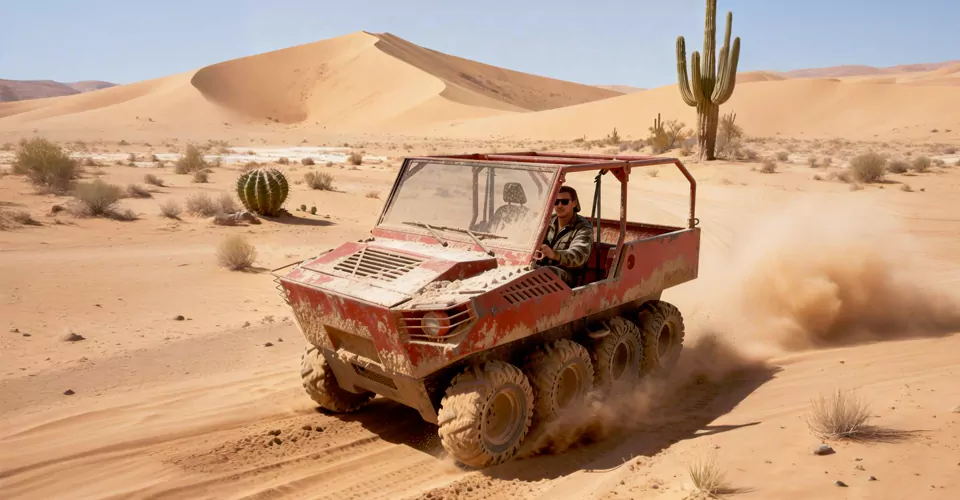
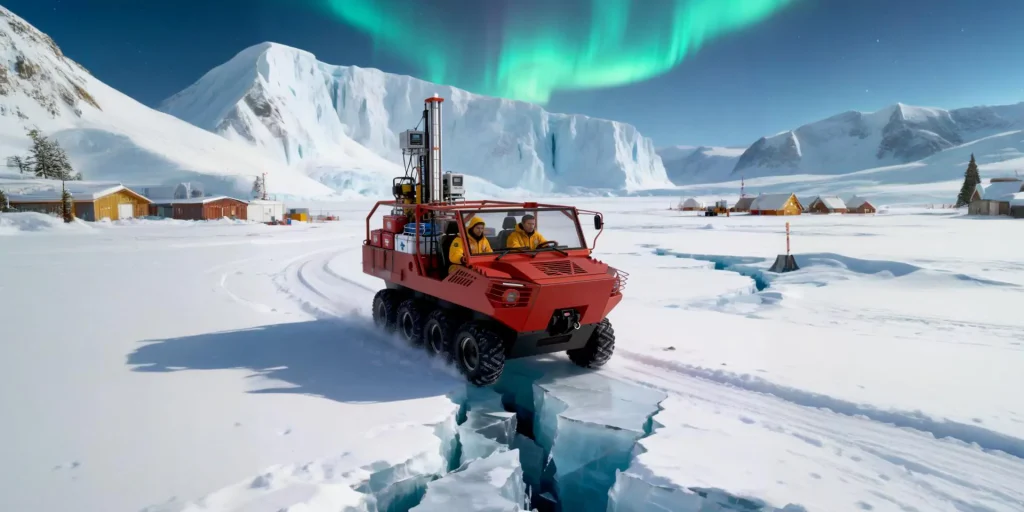
Key Features of an 8×8 Amphibious Vehicle
1. Eight-Wheel Drive
The 8×8 drivetrain provides power to all eight wheels. Compared with conventional 4×4 vehicles, this configuration can provide better traction and weight distribution on soft or uneven surfaces.
It is especially useful when operating on:
- Mud and wetlands
- Sand and beaches
- Snow and ice
- Rocky terrain
- Forest trails
- Flooded ground
2. Amphibious Capability
The most important feature is the ability to operate on both land and water.
A properly designed amphibious vehicle can enter and exit water directly, reducing the need for trailers, boats, or specialized transport equipment.
3. High Ground Clearance
Many amphibious 8×8 vehicles are designed with substantial ground clearance. This helps the vehicle pass over rocks, roots, ditches, and other obstacles while reducing the risk of the chassis contacting the ground.
4. Low Ground Pressure
Multiple wheels help distribute the vehicle’s weight over a larger contact area. This can reduce ground pressure and improve mobility on soft surfaces such as mud, snow, and sand.
5. Strong Load-Carrying Capacity
Depending on the vehicle design, an 8×8 amphibious vehicle can transport operators, passengers, equipment, supplies, or rescue materials.
This makes it useful not only as a transportation platform but also as a mobile work vehicle.
6. All-Terrain Mobility
An amphibious 8×8 vehicle is built for environments where conventional vehicles may struggle. Its drivetrain, suspension, tires, and body design work together to provide mobility across different types of terrain.
Advantages of an 8×8 Amphibious Vehicle
Excellent Mobility in Difficult Terrain
One of the biggest advantages is its ability to access areas that are difficult or impossible to reach with standard vehicles.
An 8×8 platform can travel across soft ground, steep trails, muddy areas, and shallow waterways, making it suitable for remote operations.
Seamless Land-to-Water Operation
Traditional transportation may require one vehicle for land and another for water. An amphibious vehicle can perform both roles.
This can simplify logistics and reduce the time required to move personnel and equipment between different environments.
Improved Traction and Stability
Eight driven wheels provide multiple points of contact with the ground. This helps improve traction and vehicle stability, particularly when operating on loose or uneven terrain.
Flexible for Different Applications
The vehicle can be configured for different purposes, including passenger transportation, cargo transportation, rescue missions, utility work, and emergency response.
Useful in Remote Areas
In remote locations without developed road networks, an amphibious 8×8 vehicle can provide an important transportation solution.
It can be especially valuable in wetlands, forests, coastal areas, mountainous regions, and areas affected by flooding.
Applications of 8×8 Amphibious Vehicles
1. Search and Rescue
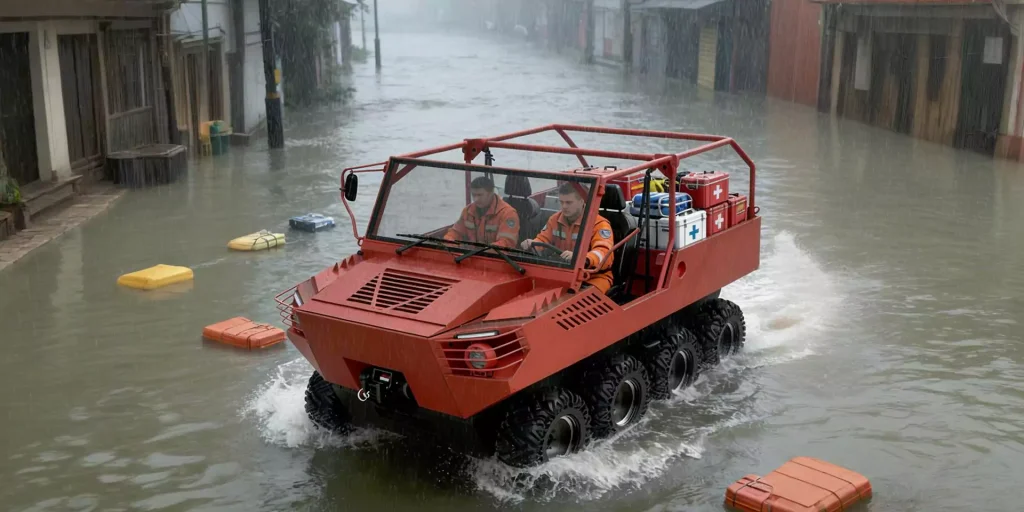
8×8 amphibious vehicles are well suited to search-and-rescue operations.
During floods, storms, and other emergencies, roads may become inaccessible. An amphibious vehicle can help rescue teams reach stranded people and transport emergency supplies.
Typical uses include:
- Flood rescue
- Emergency evacuation
- Transporting rescue personnel
- Carrying medical supplies
- Delivering food and water
2. Flood Response
Flooded roads can prevent conventional emergency vehicles from reaching affected communities.
An amphibious vehicle can travel through flooded streets, muddy terrain, and shallow water, making it a useful tool for disaster response teams.
3. Forestry and Environmental Operations
Forestry and environmental teams often work in remote areas with limited road access.
An amphibious 8×8 vehicle can transport personnel, tools, and equipment through forests, wetlands, and other challenging environments.
4. Agriculture and Wetland Operations
Soft agricultural land, marshes, and wetlands can be difficult for conventional vehicles.
The combination of eight-wheel drive and low ground pressure makes amphibious vehicles suitable for certain agricultural, drainage, surveying, and wetland applications.
5. Utility and Infrastructure Maintenance
Utility companies and infrastructure teams may need to access areas without conventional roads.
An amphibious vehicle can transport workers and equipment to remote locations for inspection, maintenance, and repair work.
6. Outdoor Recreation and Tourism
Some amphibious 8×8 vehicles are also used for outdoor recreation and tourism.
They can provide access to lakes, rivers, beaches, forests, and other natural environments while offering passengers a unique off-road experience.
8×8 Amphibious Vehicle vs. Conventional 4×4
| Feature | 8×8 Amphibious Vehicle | Conventional 4×4 |
|---|---|---|
| Wheels | 8 | 4 |
| Drive | All 8 wheels | Usually all 4 wheels |
| Water Operation | Designed for amphibious use | Generally not suitable |
| Soft Terrain | Excellent | Moderate to good |
| Load Distribution | More evenly distributed | More concentrated |
| Remote Access | Excellent | Good |
| Typical Applications | Rescue, utility, wetland, emergency response | Transportation, construction, recreation |
The right choice depends on the operating environment. A conventional 4×4 may be sufficient for normal off-road driving, while an amphibious 8×8 is more suitable when both difficult land terrain and water crossings are expected.
How to Choose an 8×8 Amphibious Vehicle?
Before selecting an amphibious vehicle, consider the following factors:
Terrain: Identify whether the vehicle will operate mainly on mud, sand, snow, rocks, wetlands, or mixed terrain.
Water Conditions: Consider the expected water depth, current, waves, and frequency of water operation.
Payload: Determine how many passengers and how much equipment the vehicle needs to carry.
Range: Consider the required operating range on both land and water.
Vehicle Dimensions: Check whether the vehicle can access the intended roads, trails, work sites, or storage areas.
Customization: Depending on the application, you may need special seating, cargo areas, rescue equipment, lighting, communication systems, or other accessories.
Conclusion
An 8×8 amphibious vehicle combines eight-wheel-drive mobility with water-crossing capability, providing a flexible transportation solution for challenging environments.
Its main advantages include excellent off-road traction, low ground pressure, amphibious operation, high mobility, and versatile carrying capacity. These characteristics make 8×8 amphibious vehicles useful for search and rescue, flood response, forestry, environmental operations, utility maintenance, agriculture, and outdoor recreation.
If you are looking for an amphibious vehicle for a specific application, Jinjia Special Equipment can provide more information about suitable vehicle configurations and solutions. Contact info@responsemobility.com to discuss your requirements.