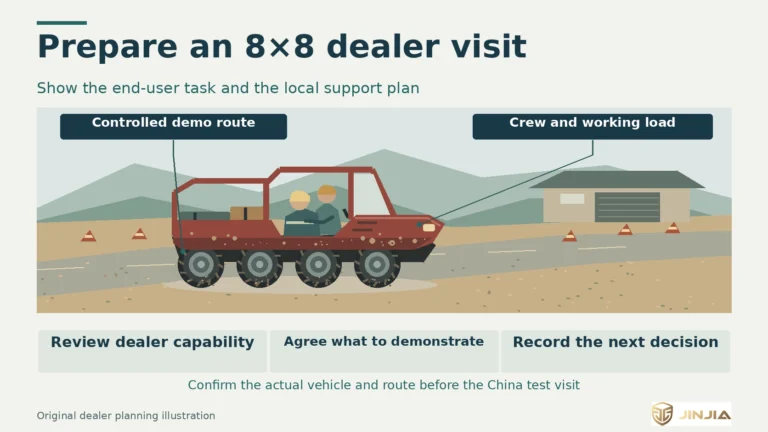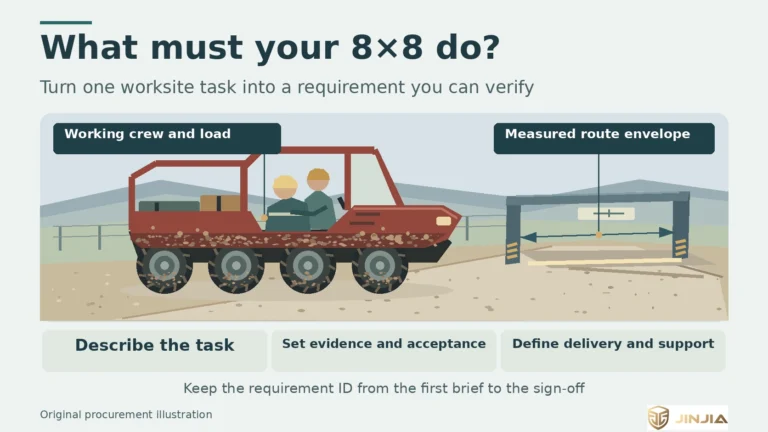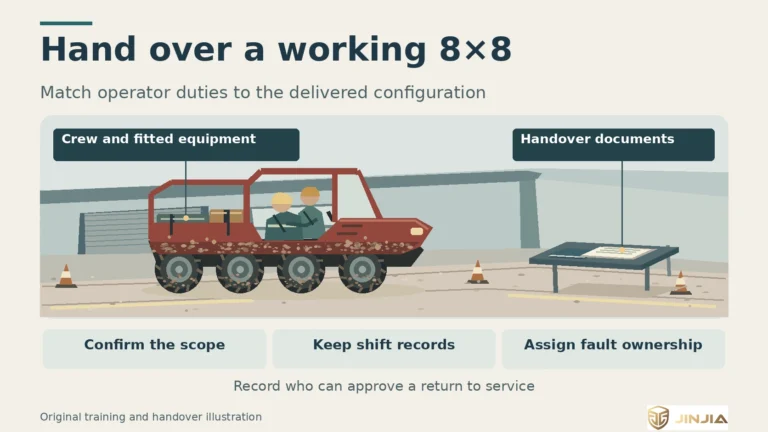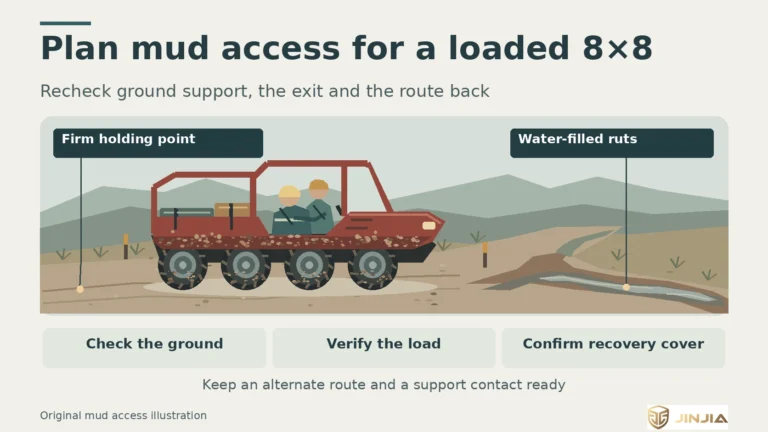


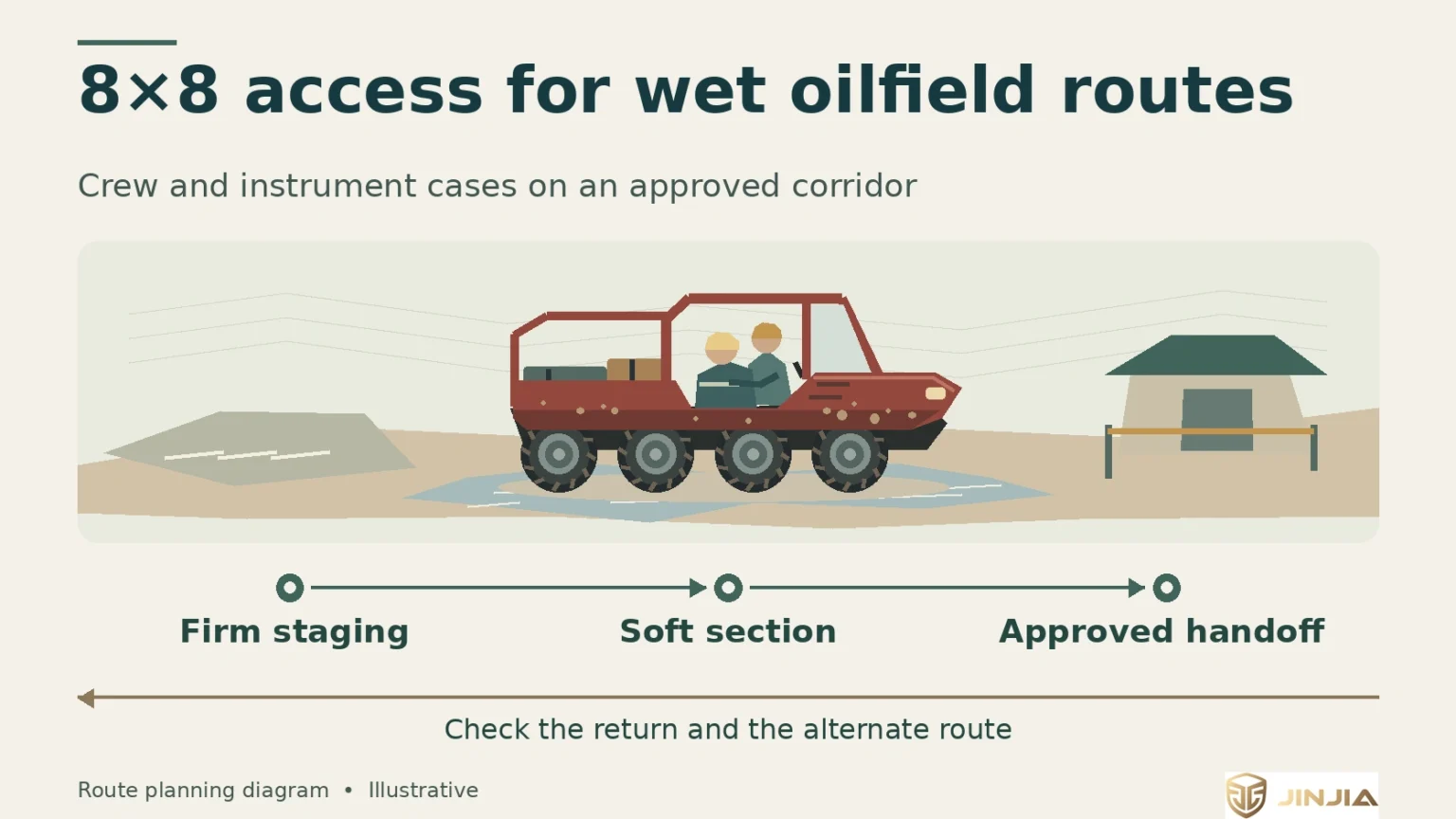
Plan both legs of the wet oilfield route around the crew, instrument cases and an approved handoff.
Assess the 8×8 for the whole return trip
An 8×8 oilfield access vehicle can be evaluated for a defined job such as taking technicians, instrument cases or packaged spares from firm staging to an approved handoff point after rain. JINJIA 88E is the range-extended electric-drive platform. 88D is the diesel platform. Ask for the build proposed for your route, including seating, cargo restraint and the operating limits for each leg.
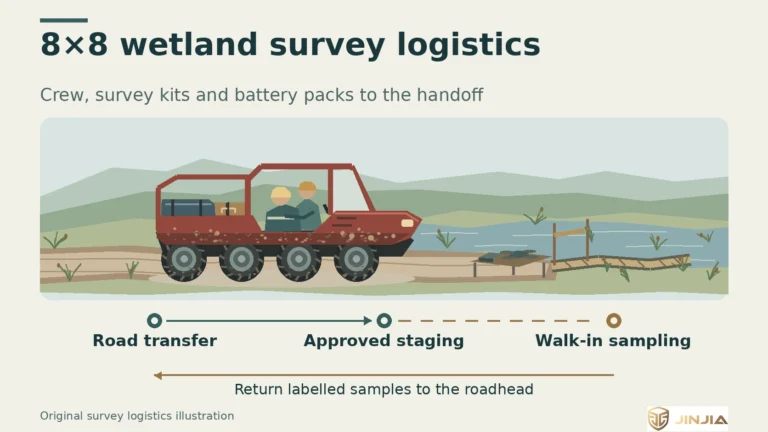
Map the outward and return legs before choosing a configuration. Mark the firm surface, soft shoulders, waterlogged low points, loading and unloading areas, turnarounds and the backup route. If an approved route includes a move from land to water, assess entry, water conditions, exit and return separately. A hard approach and an unusable return bank can belong to the same trip.
What the oilfield evidence establishes
Ron’s Rentals lists the ARGO Avenger ST 8×8 open cab as an amphibious rental model and describes an oilfield fleet for remote access. These pages identify a commercial rental offering and its intended use. They give no completed-trip record for a named operator or a measured route.
In its company history, Mudd-Ox reports Canadian rental orders for 8×8 vehicles fitted with tracks and links 2009 demand to the Fort McMurray oilfield area. That is a manufacturer account without a named end user or mission acceptance data. The accounts support including small off-road carriers in a shortlist. JINJIA configurations still require their own route and load evidence.
Separate routine access and response
For routine work, define the recurring trip. A maintenance crew may need to take a technician and a calibration kit from a gravel staging point to a permitted transfer location, then return with used tools and the instrument. Put the expected trip frequency, inspection window, receiving contact, operator cover and maintenance support in the operating plan. Assess road reopening or a shared vehicle against the same trip.
For contingency work, define who requests, clears and receives a trip after heavy rain or an access closure. Record the time window, priority items, alternative access and the point where the dispatcher will hold the trip. The vehicle can bring approved personnel and supplies to the handoff. The site incident plan assigns specialist repair, spill response or medical transport.
Check site access requirements
Have the site operator identify the permitted corridor, staging and exchange points, and the boundaries of any classified or environmentally restricted area. Confirm access on both legs and specify who rechecks it after rain, erosion or a change in ground conditions. Get the operator’s requirements for vehicle configuration, driver approval, communications, recovery and any seasonal restrictions.
If the assignment touches a classified area, the operator’s competent safety team must review the specific vehicle, installed equipment and intended use against the applicable requirements. Confirm the scope of any required ATEX or IECEx documentation with the site. Keep standard or unverified equipment outside the restricted boundary and agree an approved handoff. Electric drive and amphibious construction provide no basis for an explosion-protection claim. HSE’s guidance on explosive atmospheres and the IECEx equipment-scheme rules explain the distinction between the area and the documentation for equipment.
Plan people, instruments and supplies
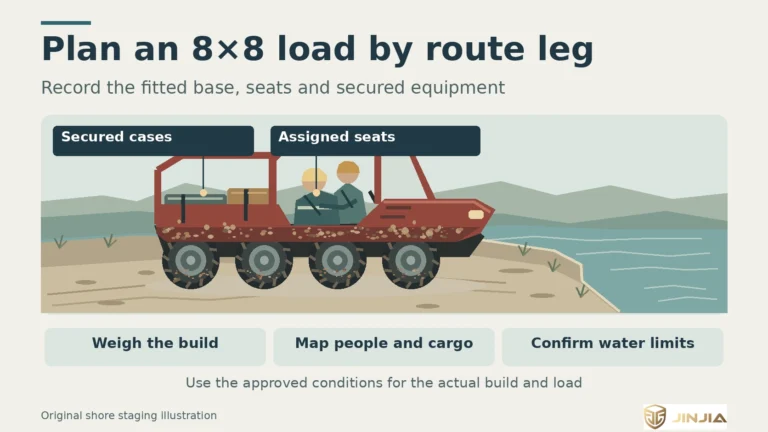
Prepare two manifests, one for each direction. Match people to approved seats and restraints. Count occupant and cargo mass, including instrument cases, tools, consumables, spares and PPE. Account for fuel and fitted modules using the supplier’s mass basis. Record packing dimensions, restraint points and who handles the load at each stop. Specify what comes back, including removed components or used materials, and the site procedures that apply to them.
As a planning example, a crew might take one sealed calibration case and a replacement component out, then pick up the removed component for return. The return load can change even when the crew count stays the same. Obtain configuration-specific loading limits and distribution instructions. For any approved water leg, verify the water load, propulsion arrangement and exit with the proposed build. Assess optional over-tyre tracks with their added mass and configuration limits.
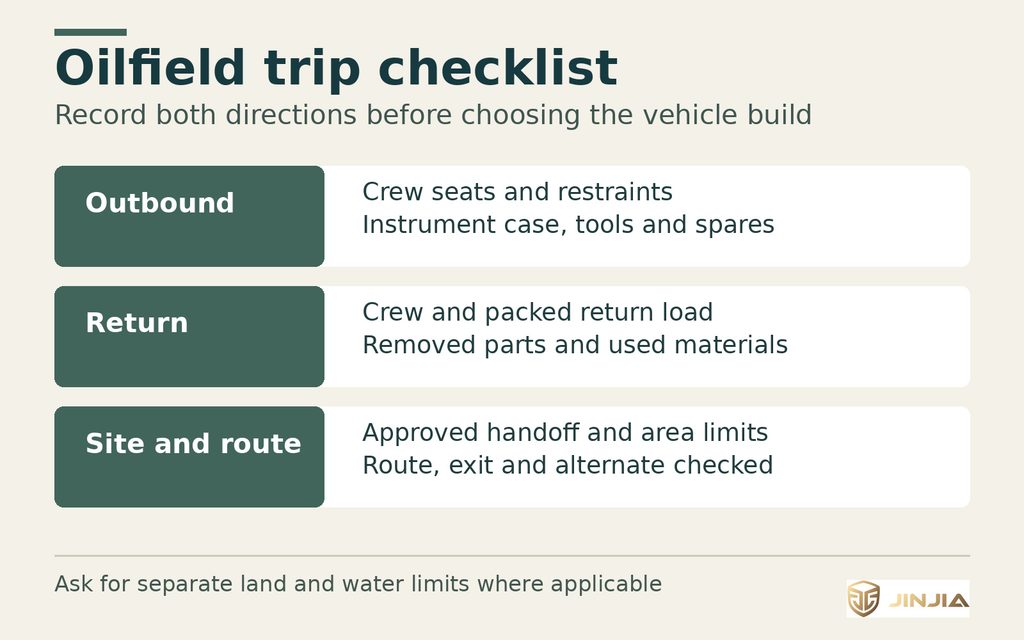
List the people and cargo in each direction. Confirm access and operating limits for the actual configuration.
Set limits, compare options and define the trial
An 8×8 is a candidate for a small load and an approved leg. If the restored road can support the trip, compare a conventional utility vehicle. Where demand is larger or repeated shuttle trips are impractical, compare heavier tracked logistics. A boat can be assessed where the operator permits water access and both landings work. Compare the same delivered task, including handling, support, number of trips and recovery.
Unknown water, suspected washouts, an unreliable exit or a closed route are reasons to hold the trip and reassess with the site. An enclosed non-floating build gives no evidence of flotation for a proposed vehicle. HSE’s workplace driving-surface guidance is a useful reference for assessing surface suitability and drainage.
Agree a controlled demonstration with the selected configuration and representative load. Record ground conditions, passage in both directions, transfer points, recovery arrangements and any route or load limitations. Include operator training, local maintenance and post-trip cleaning or inspection in the handover.
Give the buyer a one-page mission brief
• Route. Provide a map and recent photos for both legs. Mark staging, soft sections, any approved water leg, exits, turnaround and the alternate route.
• Task. Give the normal trip frequency and the contingency request and clearance contacts. Name the receiving team and the criteria for holding the trip.
• Access. Record corridor and handoff approvals, area classification, environmental restrictions and any required equipment documents.
• Load. List seats, masses, dimensions, restraints and handling at each end. Record what returns and ask for separate land and water limits where applicable.
• Acceptance. Agree trial conditions, logs, communications, recovery and shortfalls that require another means of access. Assign training and local support.
Send the brief to JINJIA for a configuration discussion and see the 8×8 amphibious utility platform for product context. If the instruments also need an external source, use the 8×8 field-power guide to specify that requirement.
Frequently asked questions (FAQ)
A: A routine brief specifies planned frequency, operator cover, receiving team and maintenance. A contingency brief also identifies triggers, the person who clears the trip, the hold point and an alternative when the route closes.
Q: How should site access requirements be documented?
A: Record the approved corridors and transfer points, applicable area classifications and restrictions, the exact configuration and supporting documents, and the person responsible for clearance. Arrange an approved handoff outside any restricted area the equipment cannot enter.
Q: What evidence is needed for people, instruments and supplies?
A: Provide seat and restraint information and two cargo lists with masses, packed dimensions, restraint and loading points. Include occupants, PPE, returned parts, and fuel or modules as required by the supplier’s mass basis.
Q: Can the land loading limit be used for a water leg?
A: Ask for separate configuration-specific limits and loading instructions for land and water. The water leg also needs a suitable exit and return option.
Q: Are over-tyre tracks part of the standard configuration?
A: Treat tracks as an option to verify against the exact build. Ask for added mass, compatibility, and changes to land and water limits and procedures.
Q: When should a trip be put on hold?
A: Hold the trip when the site closes the corridor or water conditions, ground, exit or return are unverified. Reassess the route with the operator and use the approved alternative when needed.
Sources and further information
[S30] Ron’s Rentals · ARGO Avenger ST 8×8 open cab
[S34] Ron’s Rentals · Oilfield Equipment Rentals
[S36] Mudd-Ox · Our History
[B15-E1] UK HSE · Driving surfaces
[B15-E2] UK HSE · ATEX and explosive atmospheres