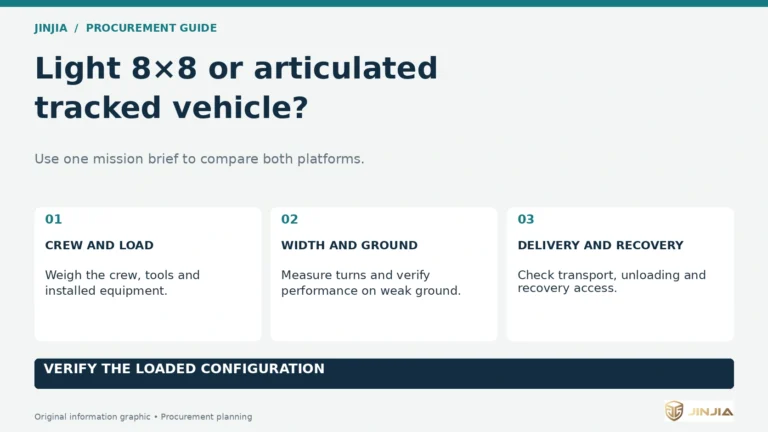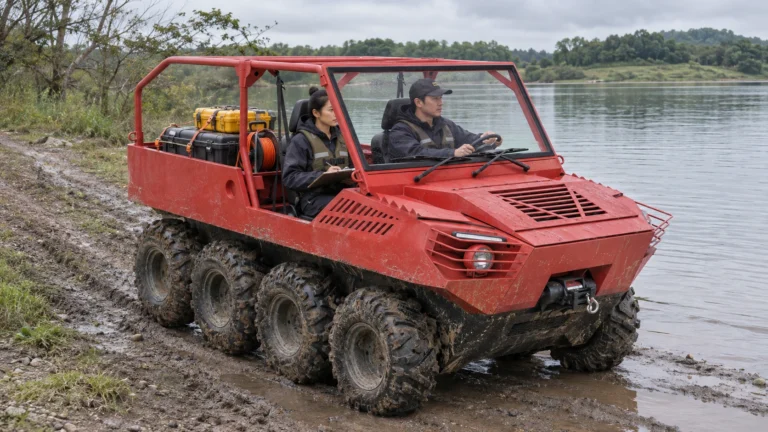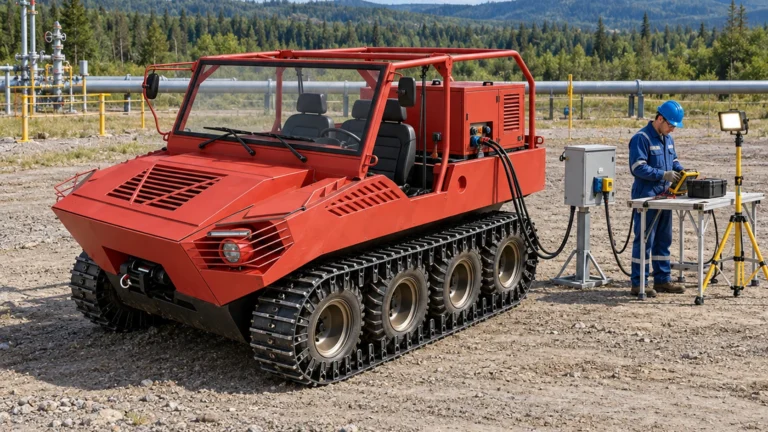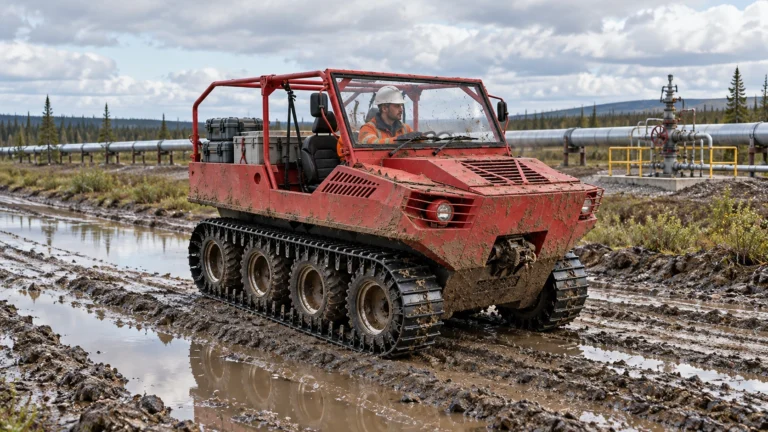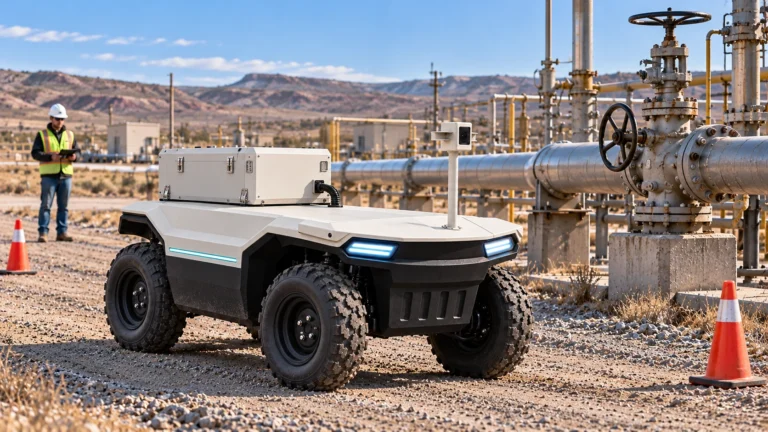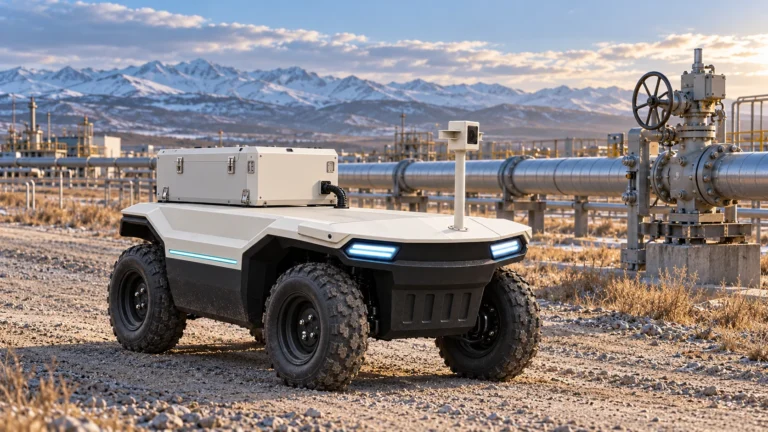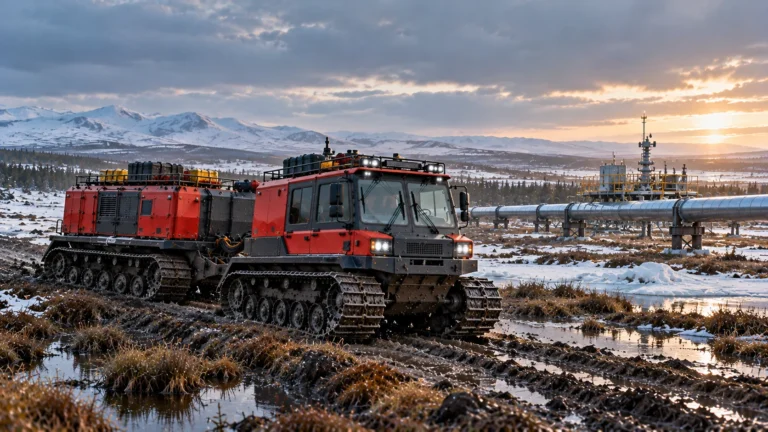


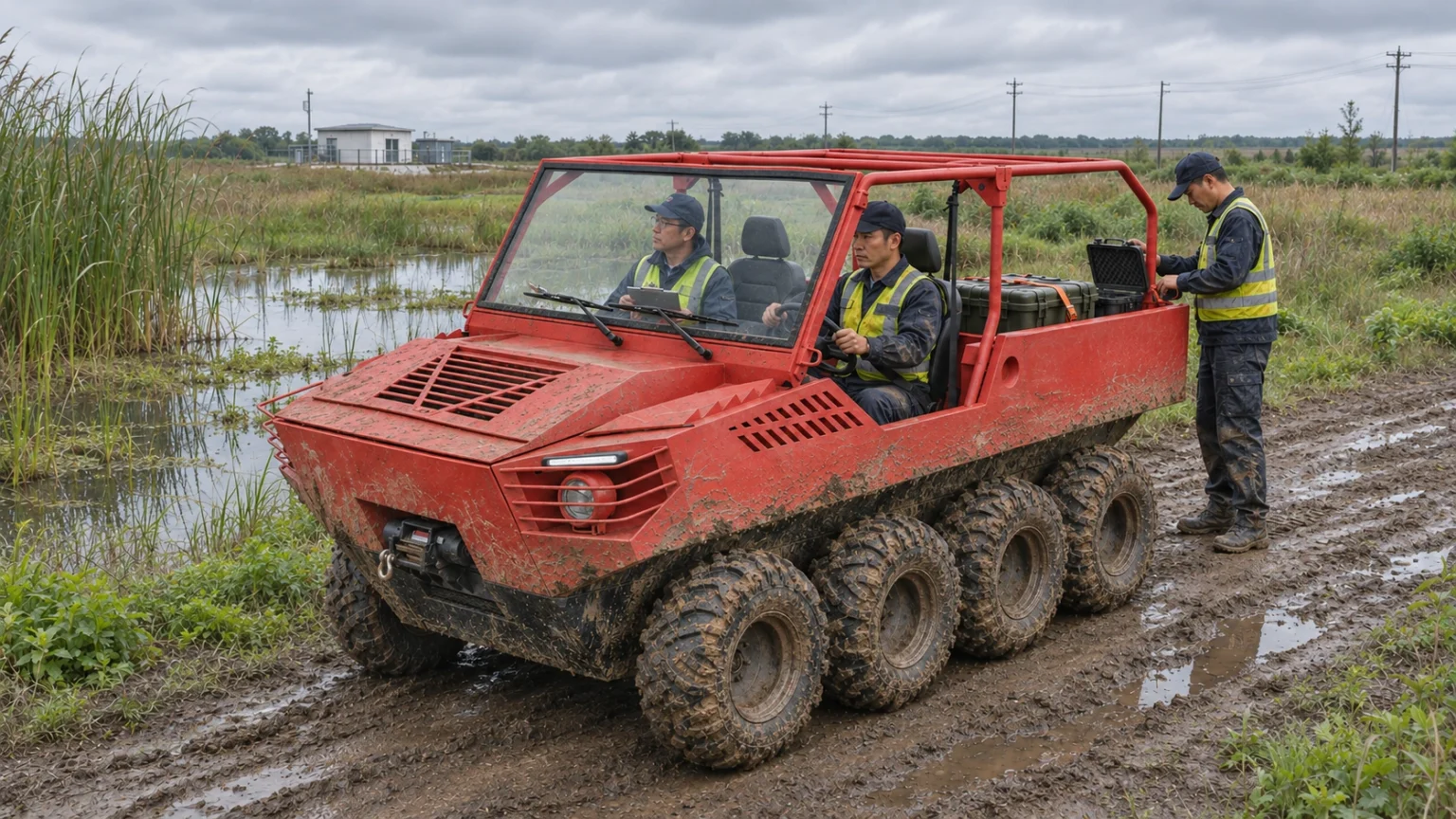
A light amphibious 8×8 is an eight-wheel-drive vehicle designed for travel on land and, within its specified operating limits, afloat. Selecting one starts with the route, the people and equipment to be carried, and the work required at the destination. Wheel count alone does not establish water payload, bank-climbing ability or suitability for a particular rescue operation.
Start with the job the vehicle must complete
Define one representative mission before comparing specifications. For a utility team, that could mean taking technicians and repair tools from a road-accessible staging point to an isolated asset. For a survey team, it could mean moving people, instruments and samples between dispersed locations. For an emergency service, it could mean supplying an access-restricted area under an approved response plan.
Describe the outbound journey, the work period and the return journey separately. A vehicle that reaches the worksite still needs enough capacity and resources to bring the team and its equipment back. Include the condition expected after rain, seasonal flooding or a change in load, rather than assessing only a convenient demonstration route.
Understand what this vehicle category includes
This guide concerns compact, low-speed mission transport of the type associated with light amphibious all-terrain vehicles. It does not describe heavy 8×8 trucks or armoured vehicles simply because they share the same wheel-drive notation. Nor does “amphibious” mean that every model is approved for every waterway.
Flotation, propulsion, steering, tires and optional tracks differ between models. Compare the documented configuration that will actually be supplied. A performance figure for another vehicle, tire package or test load is background information, not acceptance evidence for the vehicle being purchased.
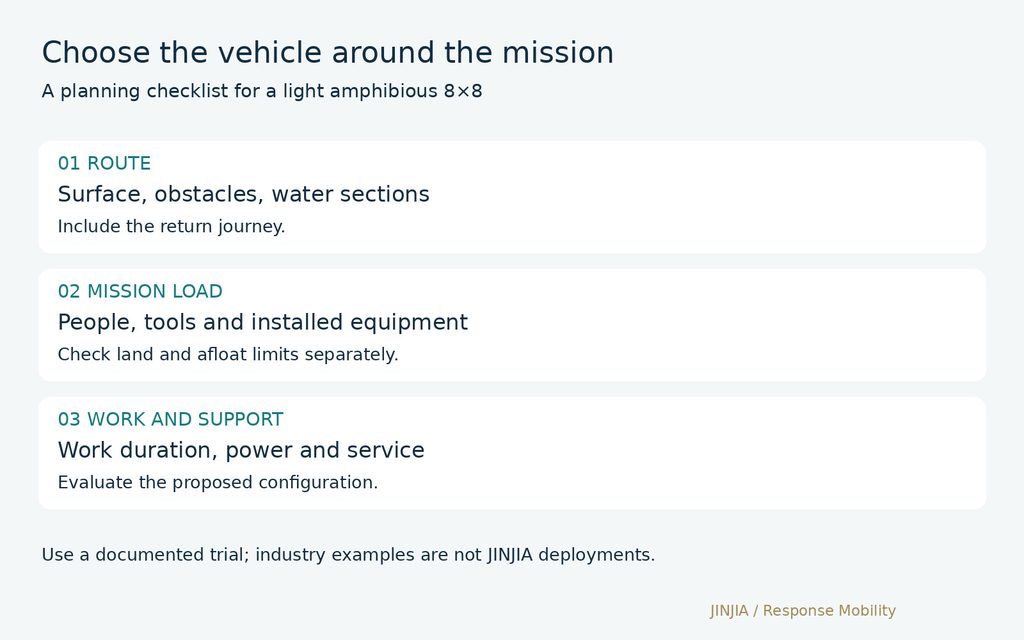
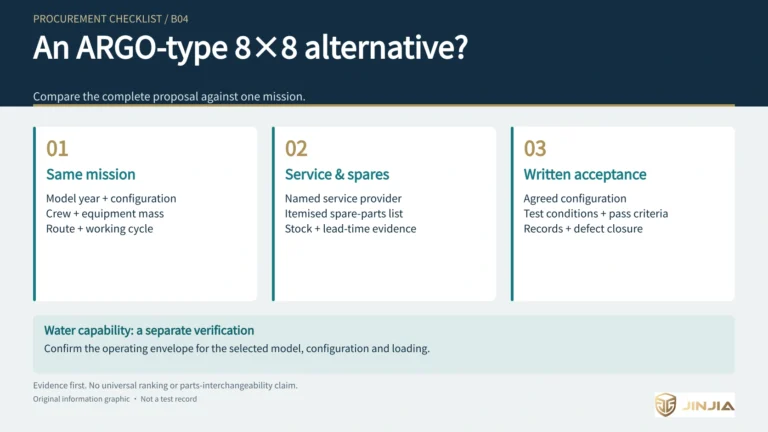
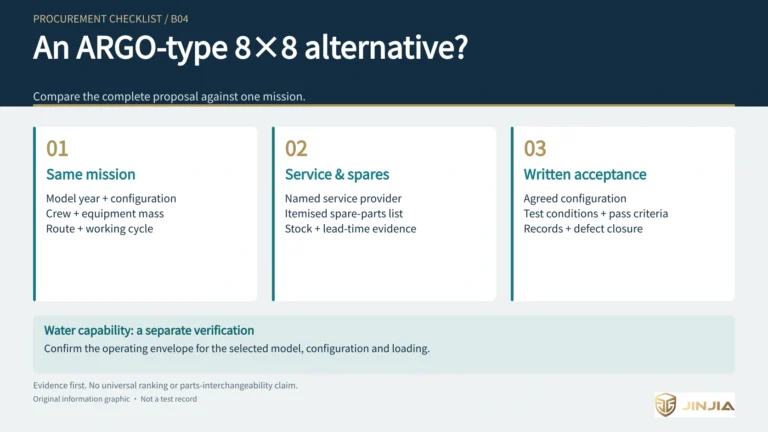
Planning information diagram; company statements and scope are shown explicitly.
Build a route-and-load brief
| Decision | Information to record | Why it changes the selection |
| Access route | Surface, slope, narrow passages, obstacles and return route | Establishes the representative trial route |
| Water section | Whether flotation is required; entry and exit points; local conditions | Separates a wading task from an afloat task |
| Mission load | Occupants, tools, supplies, installed equipment and their positions | Supports configuration-specific load assessment |
| Work at destination | Tasks, duration and external equipment | Identifies seating, cargo and power requirements |
| Support | Fuel supply, transport to site, recovery and maintenance access | Shows whether the vehicle can be supported routinely |
For purchasing discussions, provide a route sketch, photographs and a weighed equipment list. An approximate headcount without equipment mass is a weak basis for configuration advice. Ask the supplier to identify which limits apply on land and which apply afloat, and how installed options affect the approved load arrangement.
What documented applications can teach buyers
INTERVENT’s account of the 2010 Sandomierz flood response describes four ARGO Avenger 750 EFI vehicles used for evacuations, food and water delivery, and reconnaissance. The useful procurement lesson is the variety of transport tasks within one response, rather than a universal claim about flood conditions. [1]
A separate INTERVENT report records an ARGO 8×8 supporting power-grid repairs at Radzików in August 2011 by carrying a service crew and equipment through access-restricted ground. This illustrates how access and repair logistics can be connected. Both reports concern ARGO vehicles and the named participants; neither is a JINJIA deployment record. [2]
These cases help formulate questions for a trial. They do not transfer the reported vehicle’s payload or performance to a different brand or configuration. Mining, forestry, environmental monitoring and remote infrastructure work should each be assessed against their own route and working requirements.
Place 88E and 88D in the comparison
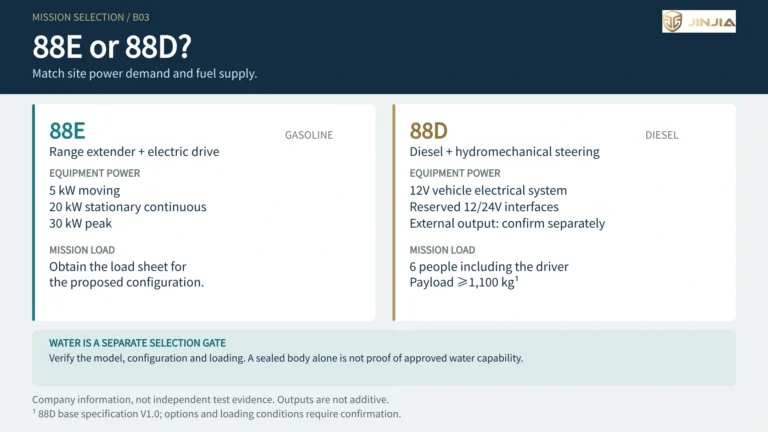
JINJIA’s 88E uses a gasoline range extender to generate electricity, with electric motors providing propulsion. Its confirmed architecture has two traction motors and a separate motor for water propulsion. The 88D is the diesel model. Treat them as separate configurations when requesting technical and service information. [3]
If the mission includes powered equipment, discuss the 88E’s stated external-power modes alongside the equipment list: 5 kW while moving, 20 kW while stationary and 30 kW peak. These describe different operating conditions and must not be added together. Equipment compatibility and the applicable operating limits need confirmation for the proposed configuration. [3]
For the propulsion explanation, read how the 88E range-extended 8×8 works. A diesel vehicle’s presence in the same product family does not give it the 88E’s electrical architecture or output ratings.
Make the trial answer the purchasing question
Agree a trial plan with the supplier and responsible operators. Use the proposed vehicle configuration, a representative load and agreed operating conditions. Record the route, elapsed time, load arrangement, energy or fuel use, and any changes needed before repeating the task. Water trials require a separately agreed plan within the vehicle’s documented limits.
Assess loading access, equipment restraint, visibility, crew communication and routine service access as well as mobility. Ask for the operator documentation, training scope, maintenance schedule, spare-parts arrangements and the division of support responsibilities. A useful result is a written record showing what was demonstrated, under which conditions, and what remains to be confirmed.
Frequently asked questions (FAQ)
Q: Does 8×8 mean the vehicle has eight motors?
A: No. It describes eight driven wheels. The number and arrangement of motors or other drivetrain components depend on the model.
Q: Can the land payload be used as the water payload?
A: No. Request the approved afloat load and loading arrangement for the exact vehicle configuration. Do not infer them from the land rating.
Q: Can an amphibious 8×8 replace a boat in every task?
A: No. The choice depends on the route, water conditions, access points, mission and documented operating limits. An amphibious vehicle and a boat can serve different parts of the same response.
Q: Should a buyer choose 88E or 88D first?
A: Start with the mission, available fuel, electrical loads and service arrangements. Then compare the documented configuration and a representative trial for each candidate.
Q: Are the ARGO examples JINJIA references?
A: No. They are attributed industry examples used to explain application patterns. JINJIA references require their own evidence and customer permission.
Q: What information should accompany an enquiry?
A: Send the country, route description, occupants and equipment mass, any flotation requirement, work duration and service expectations. Include electrical equipment requirements if external power is part of the mission.
Discuss a configuration for your route
Contact JINJIA / Response Mobility with a route sketch and mission-load list. The next step is to identify a suitable configuration and the evidence needed to evaluate it.
Sources and further information
[1] INTERVENT, “ARGO amphibious vehicles on flood rescue in Sandomierz,” 18 June 2010. https://intervent.pl/en/z-dzialan-argo-powodz-sandomierz.html
[2] INTERVENT, “ARGO 8×8 amphibious vehicle helps restore power in Radzików near Warsaw,” 13 August 2011; operation dated 8 August 2011. https://intervent.pl/en/z-dzialan-argo-radzikow.html
[3] JINJIA / Response Mobility, company-confirmed 88E and 88D product information used for this article. Configuration-specific technical documentation governs an actual supply. This is manufacturer information, not an independent test report.