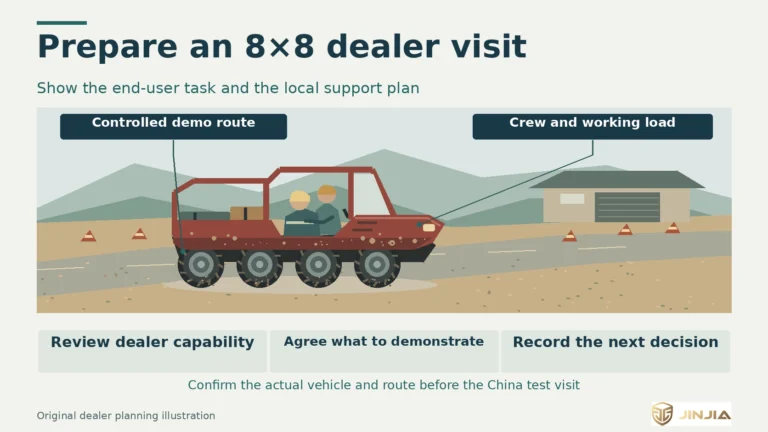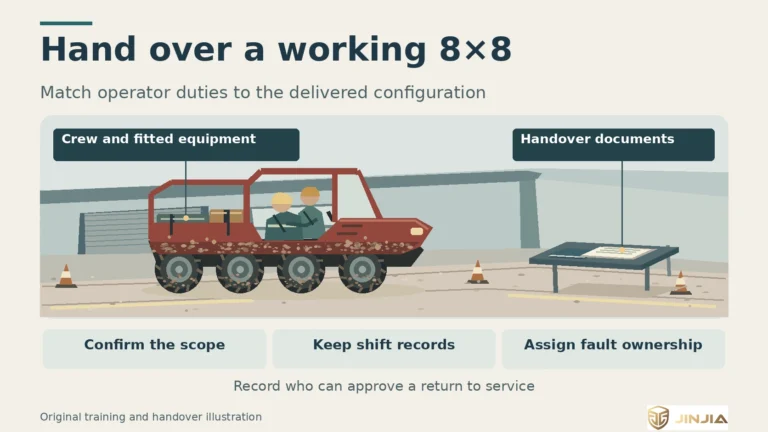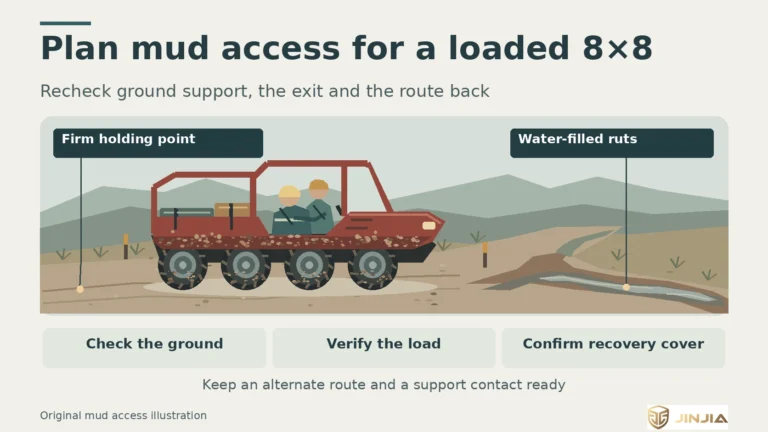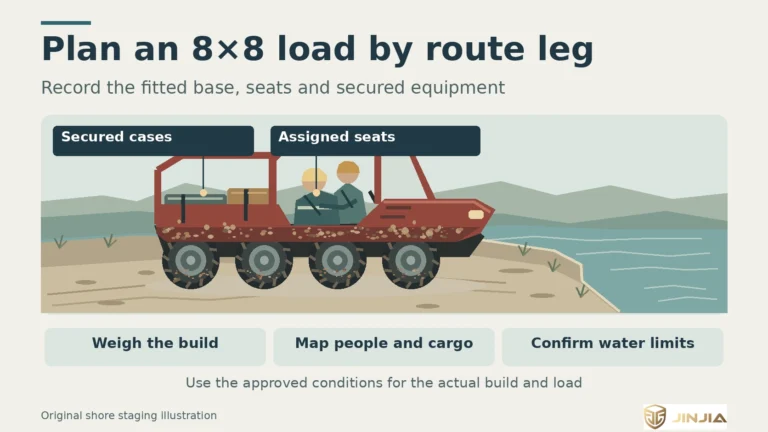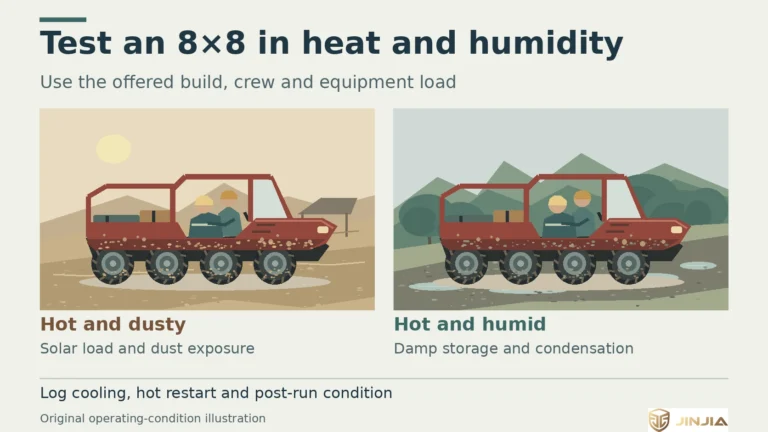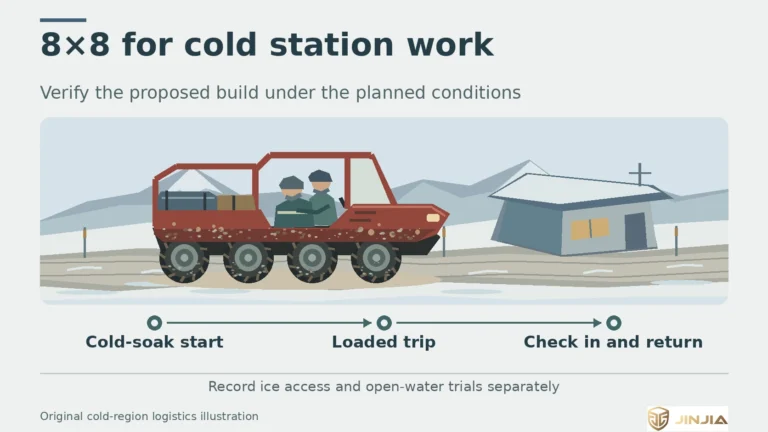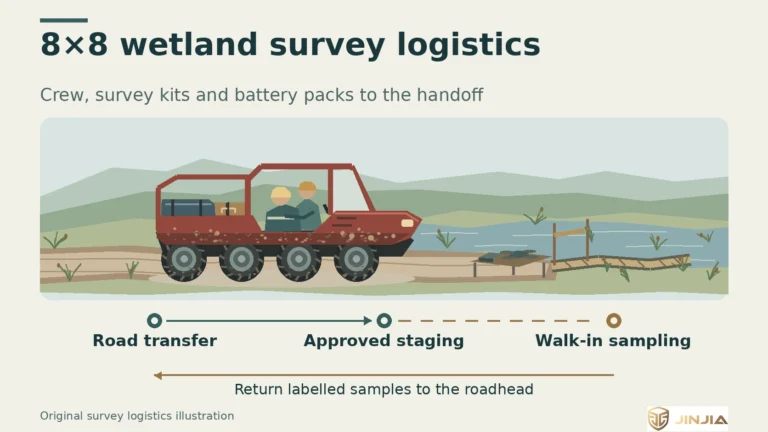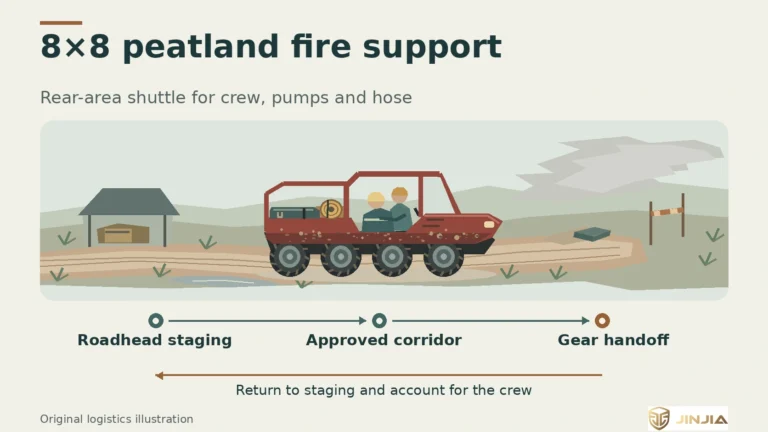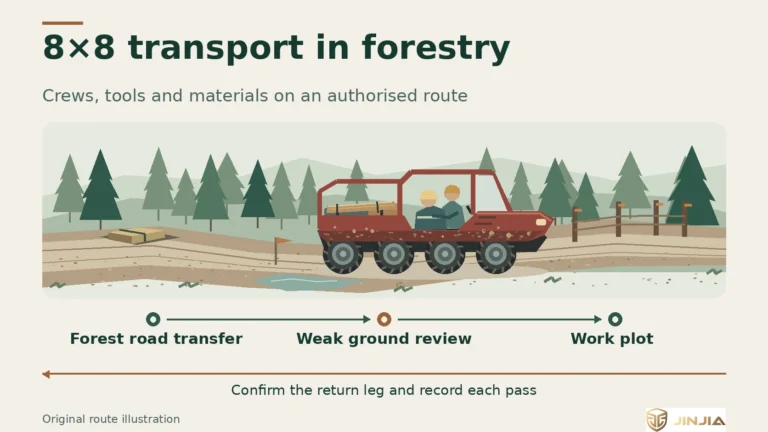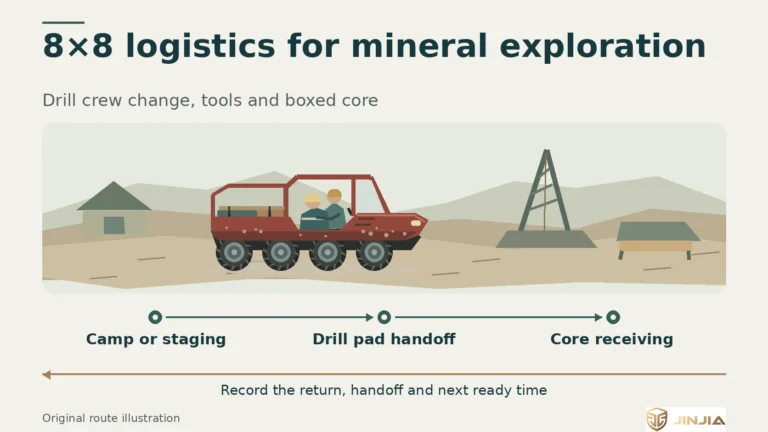


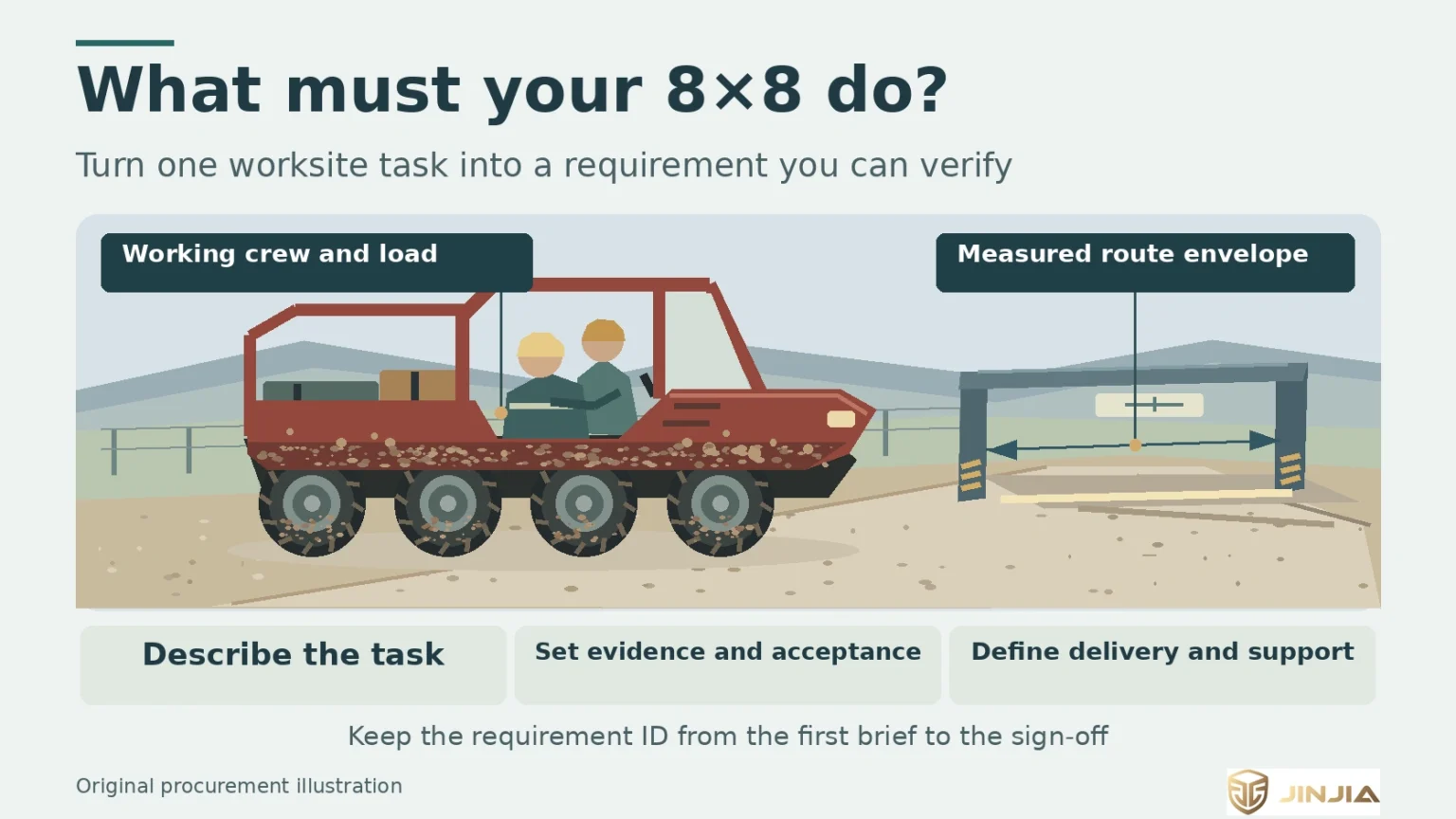
Set the clearance and working load to verify using the offered 8×8, fitted options and measured route.
Start with the work the 8×8 must deliver
An amphibious vehicle procurement specification should tell each supplier which people and equipment the vehicle must move, where it will work and what the buyer will verify on delivery. Give bidders the same route, load, working conditions and acceptance rules so they can explain how their proposed configuration meets the job.
For a worksite 8×8, define the working crew and payload, fitted options, access limits and the tasks required on land or around water. Ask each supplier to identify its offered build, supported operating conditions and any deviations. That makes the bid usable for both the evaluation team and the people who will receive the vehicle.
Use manufacturer evidence at the right level
JINJIA’s 88E uses range-extended electric drive. The 88D is diesel. The model names identify different configurations. The 88D civil and industrial technical specification lists land-side data and calls for project-specific confirmation of water payload, freeboard, stability and water speed. Request the limits for the offered configuration and its fitted equipment. [S91, S92]
Use a product page or brochure to identify options and open questions. For each mandatory requirement, request a dated drawing, specification, approved operating document or verification record tied to the offered revision. The New Zealand Government Procurement guide is a drafting reference for linking requirements to documented needs and making them verifiable. [B28-E1]
Turn the route and duty into measurable requirements
Write one requirement per row. Give it an ID, the work outcome, conditions and a measurable threshold with units. State which items are mandatory and which are evaluated as preferences. When a necessary interface or envelope has to be prescribed, record the task or site reason. Give alternatives a way to provide comparable evidence against the same outcome.
For an illustrative maintenance route, a crew and secured tools must pass an existing access gate. In the brief, record the limiting route envelope, actual dressed crew mass and the mass of the cases, mountings and fitted options. The vehicle requirement then calls for clearance against the surveyed envelope in the quoted working configuration. Request the configuration drawing when bids are submitted and confirm the delivered dimensions against the same route record at acceptance.
Where a water leg is essential, identify wheel-supported wading and operation afloat as separate requirements. Describe the load and site conditions for each. Request configuration-specific limits before allocating that part of the work. Use the surveyed route and operating plan to justify the thresholds.
Specify evidence and acceptance in the same row
Tell bidders what evidence belongs in the bid, what the receiver checks and what needs an approved site verification. Carry the requirement ID through each stage. Match the evidence to the vehicle revision, fitted equipment, configuration and applicable mass. State the required record, the reviewer and the criterion for a pass. Decide which criteria are pass/fail and which are scored before comparing offers. [B28-E2]
| Stage | Evidence to require | Record to retain |
| Bid evaluation | Matching configuration documents for the mandatory requirements, plus an explicit list of deviations or pending proof. | Evidence references and the buyer’s review by requirement ID. |
| Delivery inspection | Delivered serial number, fitted options, agreed documents and measurements where specified. | Items checked, any difference from the approved build and the person responsible. |
| Site acceptance | Results of the agreed verification against stated conditions and thresholds. | Conditions, results, reviewer, decision and any corrective action or retest. |
Agree the treatment of missing proof and failed checks before awarding the order. A report from another configuration can support a clarification. Ask the supplier to explain applicability and obtain the agreed confirmation for the supplied unit. Keep early document review, receipt of the vehicle and final acceptance as distinct records.
Define the delivery and support package
Identify the delivery location, configuration revision, required manuals, handover material, training scope and participants. Request a priced initial spares list, with compatibility, parts source and lead time for the offered vehicle and option interfaces. Add the local service and manufacturer support routes and the contact responsible for each.
Allocate responsibility for providing evidence, conducting the agreed verification and approving the result. Define how changes to tyres, seating, mission equipment or load distribution trigger a compatibility and acceptance review. Record when the warranty starts, what coverage applies and who handles service enquiries in the proposed agreement.
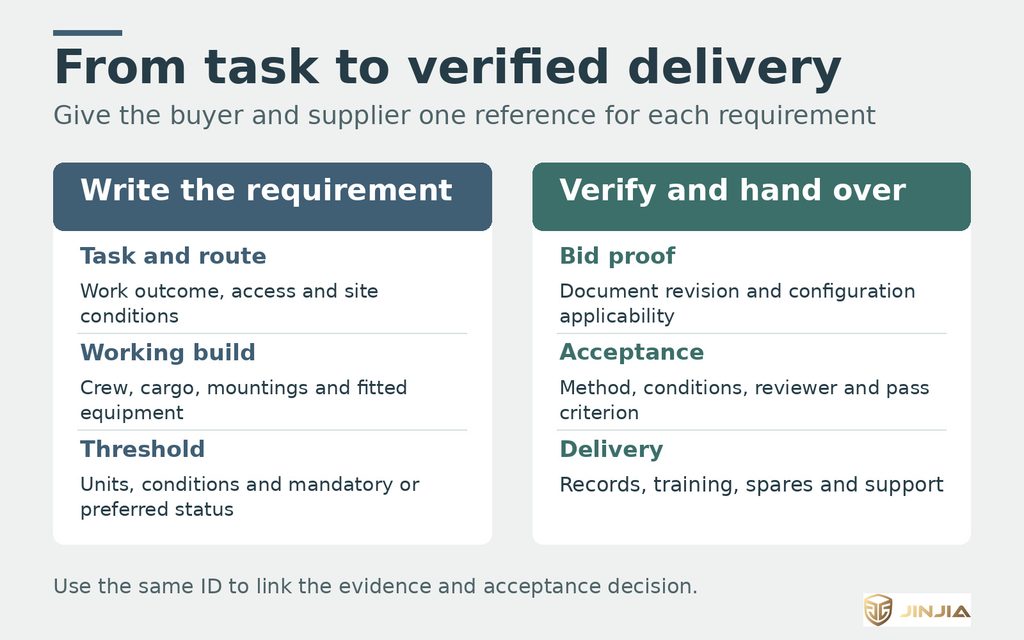
Carry the same requirement ID from the route and load to the evidence and sign-off.
Keep unknowns and alternatives visible
A standard designation, permission or registration claim needs the applicable location, vehicle category, current documents and review owner. Ask the responsible buyer or specialist to confirm what applies to the intended use. Keep an unverified statement open in the evaluation record with its required evidence and due date.
If the access or water requirement cannot be supported, compare an approved land route or a separate transfer method against the same work objective. Document what changes, which parts of the route are covered and who accepts the revised scope. Carry only verified or agreed requirements into the final delivery and acceptance documents.
Use a one-page review before requesting bids
• Task and route. State the job, route limits, site conditions, duty cycle and intended land or water operation.
• Offered configuration. Record all people, secured cargo, equipment, options and working mass.
• Requirement IDs. Write one measurable outcome per row, with units, conditions and mandatory or preferred status.
• Evidence and acceptance. Define bid proof, verification, pass threshold, witness or reviewer and retest handling.
• Delivery and support. List the required records, training, spares, service routes and warranty terms.
• Open decisions. Record deviations, local approvals, equivalent approaches and the owner of each action.
Use the vehicle comparison to identify the documents to request for the quoted 88E or 88D. 88E and 88D configuration comparison.
Send your route, mission load and working conditions for an 8×8 configuration discussion. Contact JINJIA.
Frequently asked questions (FAQ)
A: Document the worksite route, crew in work clothing, secured payload, fitted equipment, duty cycle and expected outcome. Derive limits from the real conditions.
Q: What goes in one requirement row?
A: Use an ID, task reference, outcome, units, threshold, configuration, mandatory or preferred status, evidence, verification method and responsible reviewer.
Q: Which evidence should suppliers submit with their bids?
A: Request a dated document or test record with revision, vehicle build and applicable conditions. Ask for a list of open evidence and deviations.
Q: How do delivery checks differ from final acceptance?
A: Delivery checks identify the unit, equipment and documents received. Final acceptance compares agreed evidence and verification results against the thresholds. Record the decisions separately.
Q: How should the buyer handle an equivalent solution?
A: Ask for proof of the same mission outcome under comparable conditions. Review it against the same published criteria and record any scope changes.
Q: Which support items belong in the technical attachment?
A: Include applicable manuals, handover and training, parts applicability and supply route, support contacts, and the order-specific warranty and service terms.
Sources and further information
[S91] JINJIA 88D Civil / Industrial Technical Specification · v1.0 · 8 September 2026 · pp. 7–9 · company source
[S92] JINJIA · 88E vs 88D 8×8 Platform Selection (English)
[B28-E1] New Zealand Government Procurement · Documenting your requirements
[B28-E2] New Zealand Government Procurement · Decide your evaluation criteria
[B28-E3] JINJIA amphibious utility vehicle product overview (English)