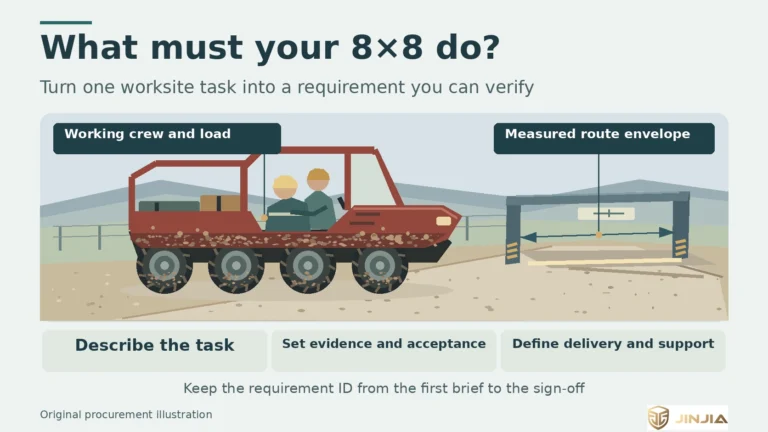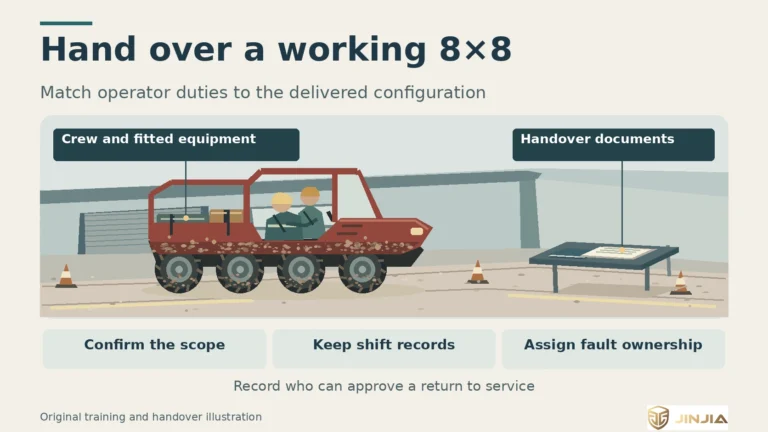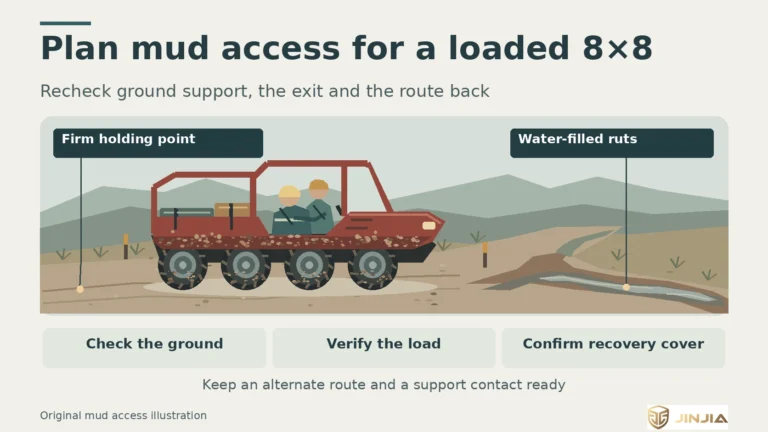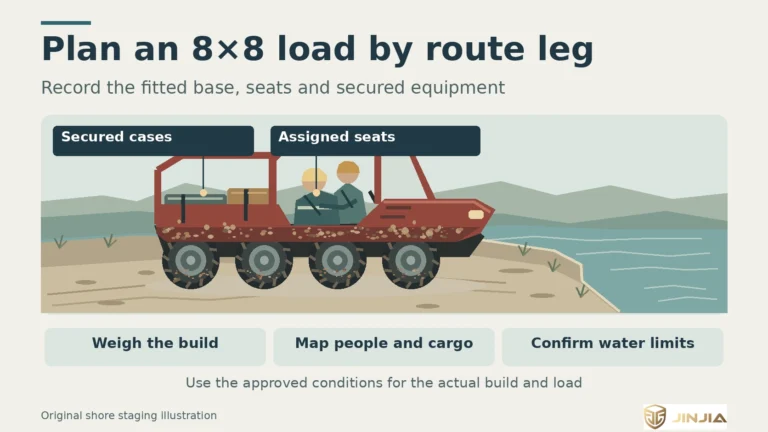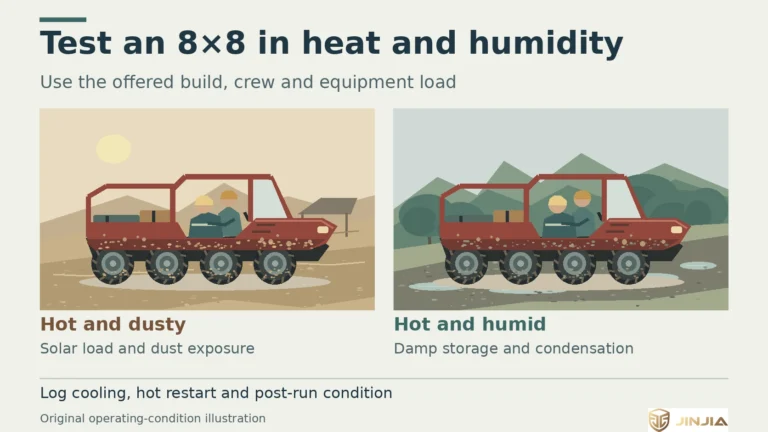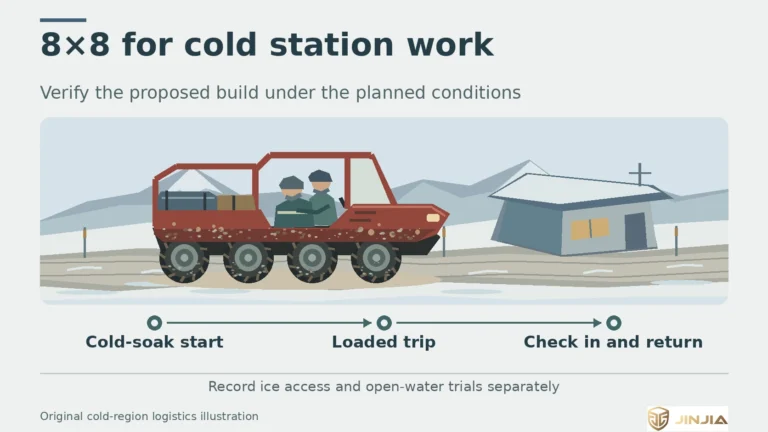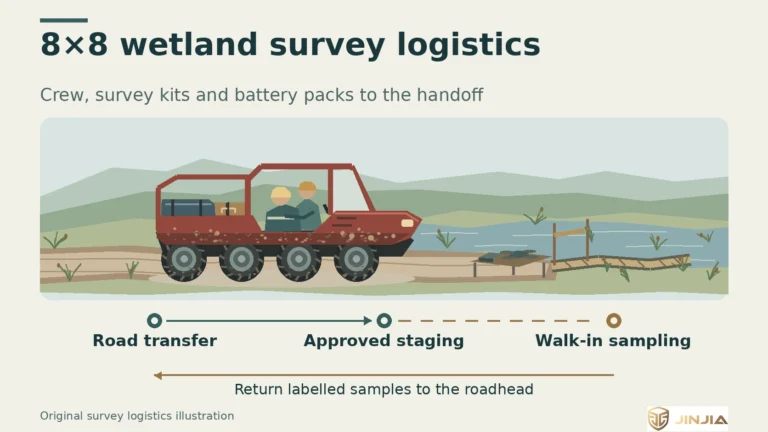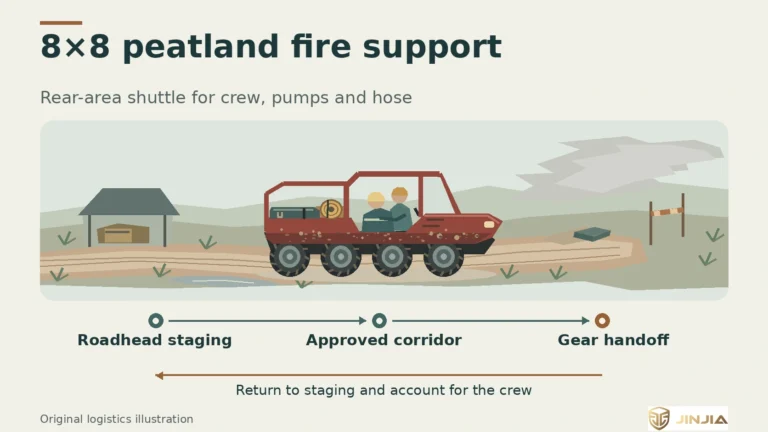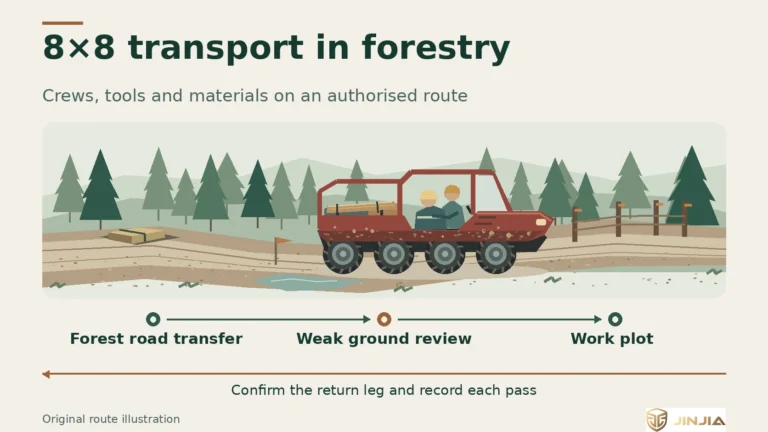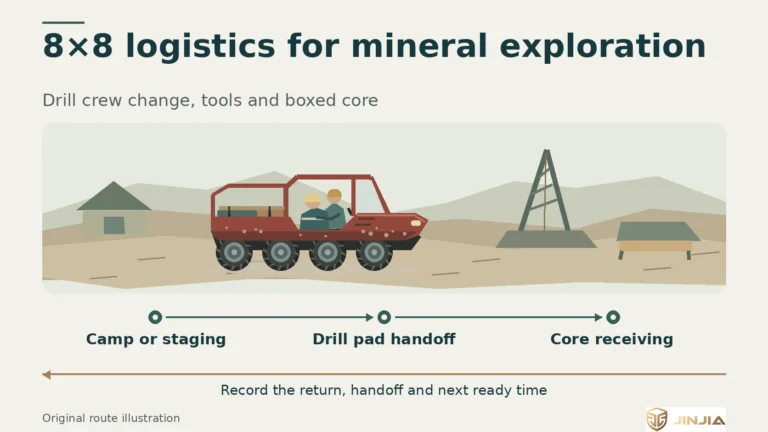


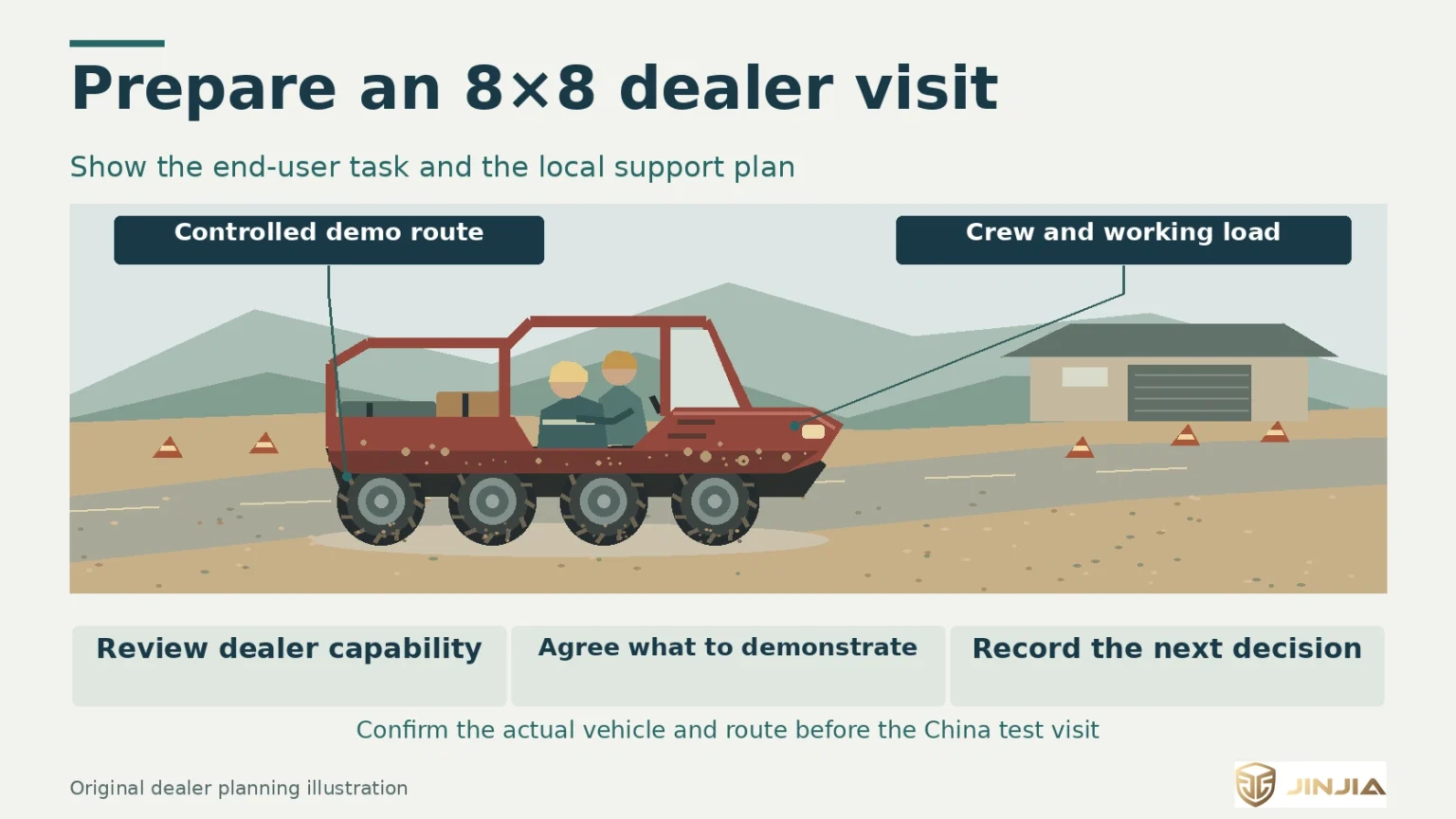
Original illustration of a controlled 8×8 demonstration. Confirm the configuration, actual load and verification route before a test visit.
1. What should an amphibious 8×8 dealer be ready to support?
A dealer should be able to sell the complete vehicle, help the user define a workable configuration and support the fleet locally after delivery. For an amphibious 8×8 dealership discussion, start with the customers you serve, the work the vehicle must do and the workshop that will support it.
Consider a dealer proposing an 8×8 for utility maintenance on wet access tracks. Who can present a credible demonstration, supply the parts that keep the vehicle working and handle the first service call? Those answers shape the cooperation discussion and the later China test visit.
2. Match the platform and the evidence
JINJIA offers the 88E range-extended electric platform and the 88D diesel platform. Ask for the exact build to be discussed and the evidence behind it. The 88D technical sheet identifies its standard six-person layout including the driver. Water payload, freeboard, stability, wading depth and water speed require separate confirmation for the proposed build and use. JINJIA 88E and 88D selection guide
The outline below is a proposed way to assess a dealer and plan a visit. A configuration sheet identifies the offered vehicle. A signed demonstration record describes what happened under its recorded conditions. A dealer should ask for both before relaying a performance claim to an end user.
3. Show whole-vehicle sales and service capability
List the civil sectors, regions and types of fleet that your team already serves. Name the person responsible for complete-vehicle sales, configuration queries and customer handover. Show where the service work will happen, who can diagnose faults and how your team will handle parts, training and escalation. An anonymized example with the workshop location and response process is enough to begin.
| Review area | What the dealer should bring | What to agree |
| Sales and handover | Customer sectors, coverage area, sales lead and handover example | What the dealer offers and who checks the requested build |
| Local service | Workshop coverage, assigned technicians and diagnostic capability | Who receives a service call, records the issue and escalates it |
| Parts and training | Starter-parts plan, contact for supply and proposed training | Available stock, replenishment route and agreed local and remote support |
The first discussion can establish capability, territory of interest and the next evidence needed. Commercial terms and quotations follow the agreed scope and configuration.
4. Identify target users and a representative demonstration route
Bring one or two credible end-user profiles and the problem each is trying to solve. For a utility crew, mark the depot, wet access track and handover point. Describe the people, gear and equipment normally carried, the route constraints and the expected shift. If the task includes flotation, document that leg separately, with the access points, load and conditions the team needs to verify.
Propose a controlled route with suitable access, an assigned operator and an agreed observer. State the outcome you want to see. A dry route can show approach, access and crew handover for the proposed build. Any water segment needs prior review of the vehicle, conditions, permissions and recovery arrangements. Use a shore-side explanation or records review when a segment remains open.
5. Prepare the China test visit and cooperation review
Once both sides have reviewed dealer capability and the use case, discuss an appointment in China. Send six items in advance: the visiting team and their roles, proposed dates and working language, local customer and task, proposed vehicle and working load, verification route and priorities, and the records and decisions the team needs from the visit. Use the accompanying visit checklist to keep those items together.
Confirm what vehicle and options are available for the visit. On the day, record the vehicle, fit-out, route, conditions, crew and load. Note checks completed, deferred or requiring a follow-up. Review the results with the sales and service leads and agree which tasks, documents and commercial discussions can advance. A later local pilot can use its own route, support plan and acceptance evidence.
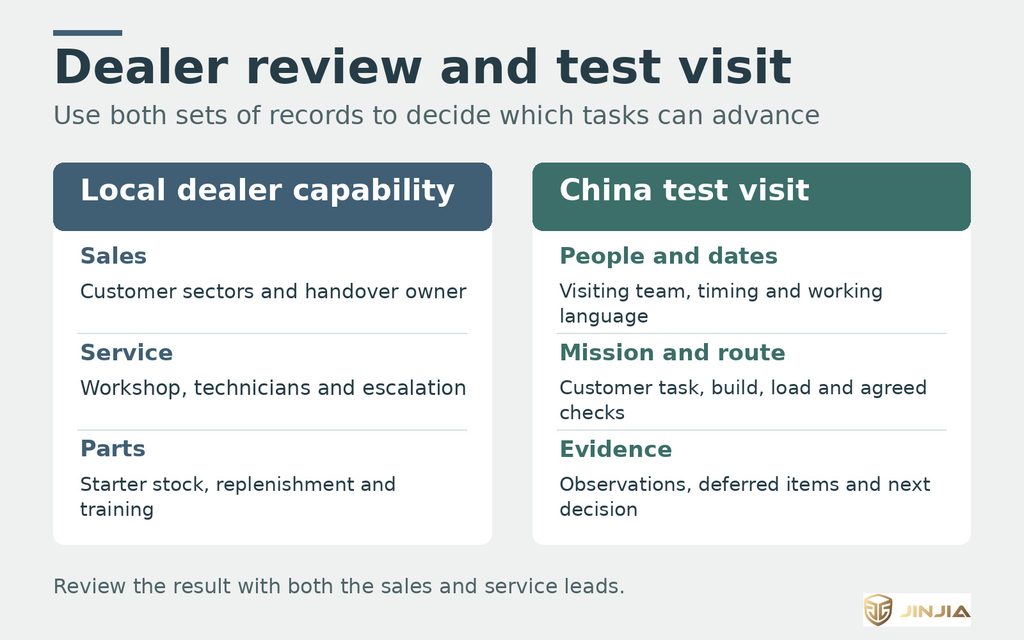
Review dealer capability and the local end-user route before agreeing the checks for a China visit.
6. Define the limits of the visit and the next step
Treat the visit record as evidence for the demonstrated configuration and conditions. Plan further reviews for locally fitted equipment, a different load, a different route or a customer-specific requirement. If the dealer’s coverage is still developing, agree a smaller area or service role and identify the unresolved responsibilities.
For any proposed local sample vehicle or pilot, discuss the written scope, support, delivery and commercial arrangements after both sides agree the next step. Hold the demonstration leg if the actual vehicle, operator, site conditions or permission remain unconfirmed. An engineering call, a workshop review or a document exchange can move the discussion forward in the meantime.
7. Use a one-page dealer and visit checklist
• Identify the end-user sector, region, task and dealer contact who will manage it.
• Describe the workshop, field coverage, service escalation and initial parts support.
• Mark the route, actual crew and equipment, operating limitations and intended 8×8 build.
• Send the six visit inputs and agree which checks the China visit will record.
• Record observed results, open items, responsible people and the next decision.
• Match any follow-up proposal to the vehicle, site, training and service arrangements.
Send JINJIA a dealer profile, one representative user task and an outline of local support. Contact JINJIA
Download the China test-visit checklist (EN/RU/CN) · B31_China_Test_Visit_Checklist_EN_RU_CN.pdf
Read the 8×8 alternative buyer checklist
Compare 8×8 purchase cost and support
Frequently asked questions (FAQ)
A: Share your active sectors and region, complete-vehicle sales responsibility, workshop capability and one practical end-user mission. Identify any capability that needs a partner.
Q: When should the parties discuss a visit to China?
A: After reviewing the proposed dealer capability and mission, agree the configuration, test priorities and the documentation to bring.
Q: What should a demonstration route represent?
A: It should reflect a defined customer task, with agreed access, conditions, crew and working load. Review flotation as a separate mode when needed.
Q: Who should handle a service case after delivery?
A: Name the local intake owner, the workshop or field team, and the remote technical escalation contact. Put parts lead time, training and response scope in the agreed terms.
Q: What should the test visit produce?
A: A record tied to the tested build and route, a list of observed and deferred items, and a decision owner and date for each follow-up.
Q: When should a commercial quote or local pilot be discussed?
A: After the parties agree which configuration, support responsibilities, evidence and delivery terms the proposal will cover.
Sources and further information
[S91] JINJIA 88D Civil / Industrial Technical Specification · V1.0 · 8 September 2026 · pp. 7–9
[S92] JINJIA · 88E and 88D 8×8 platform selection (EN)