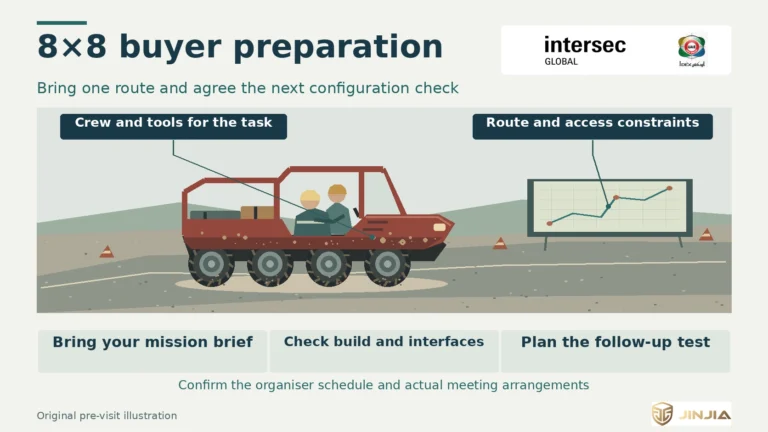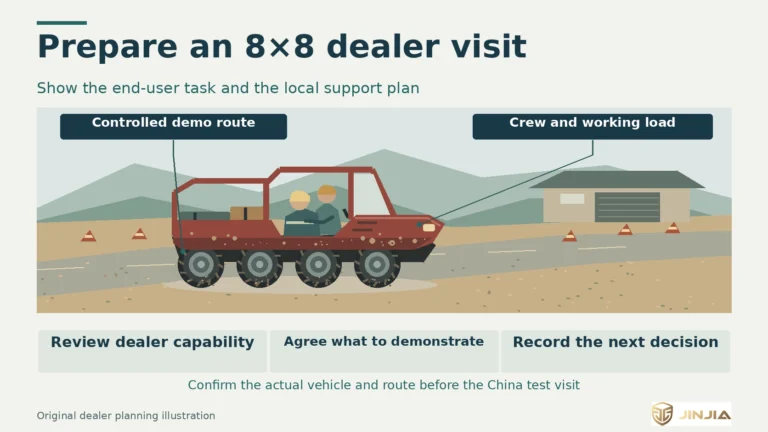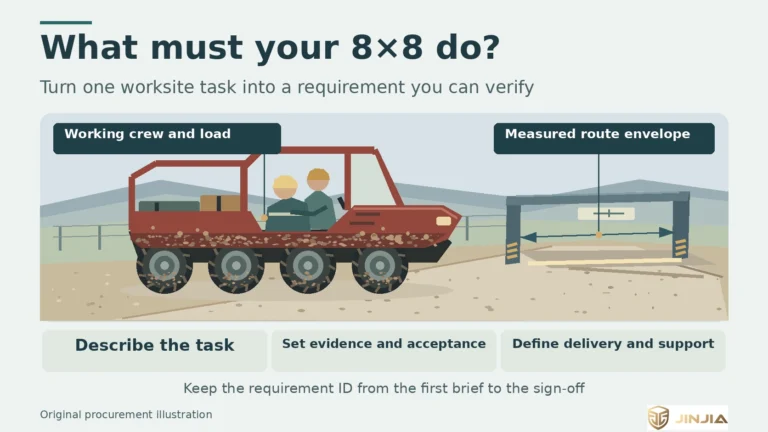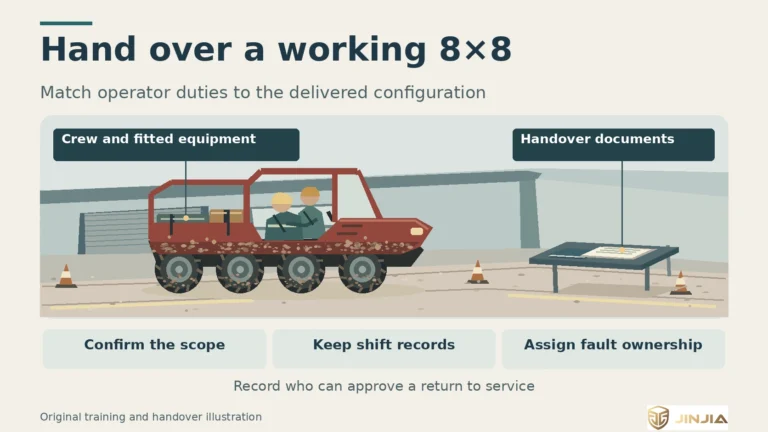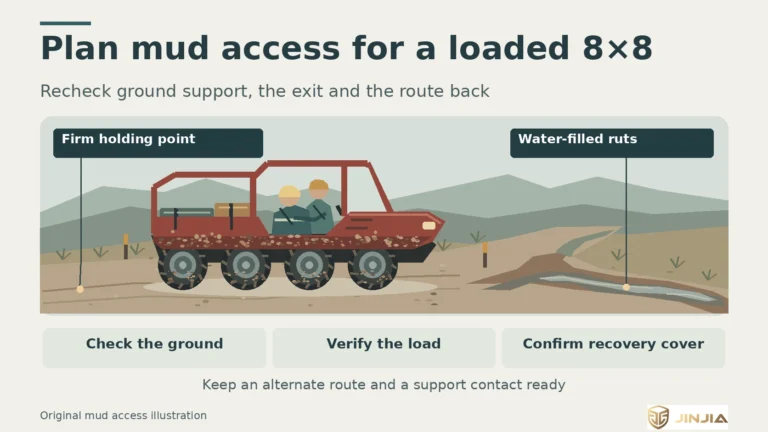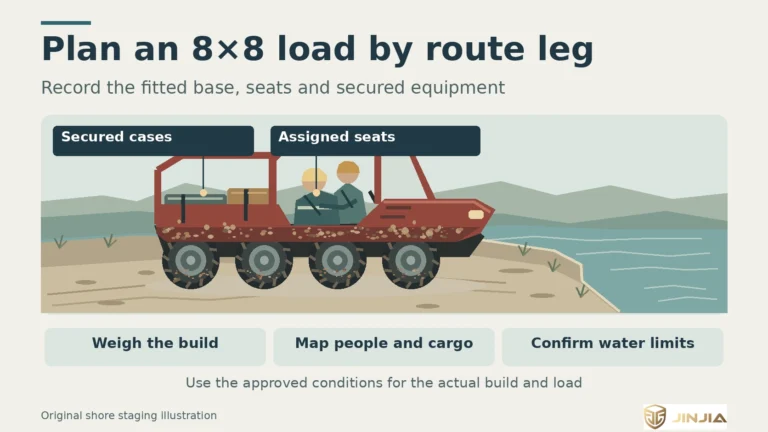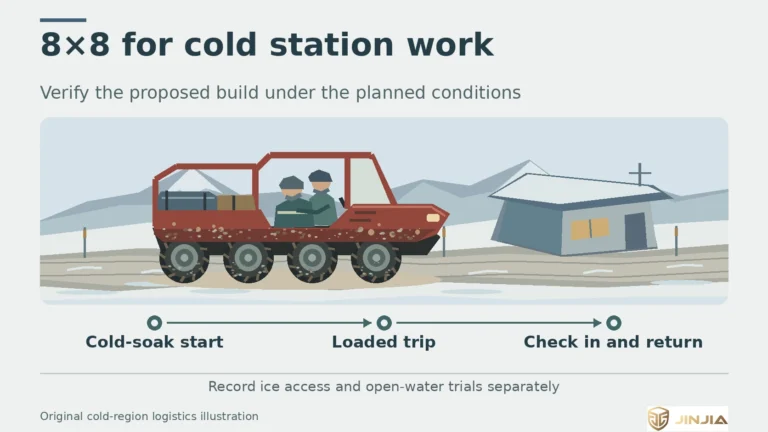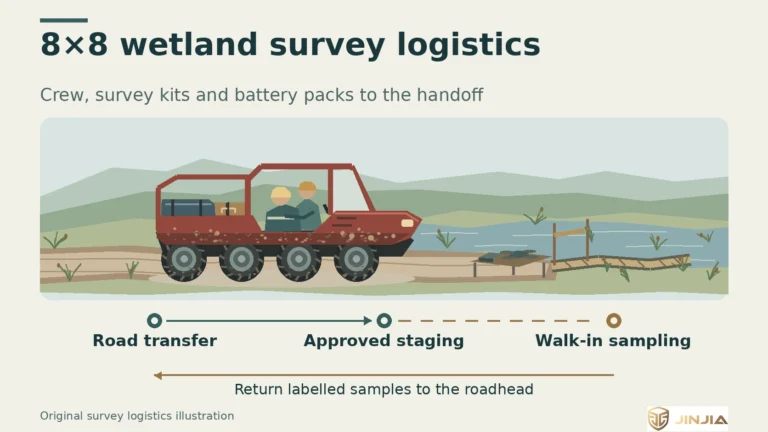


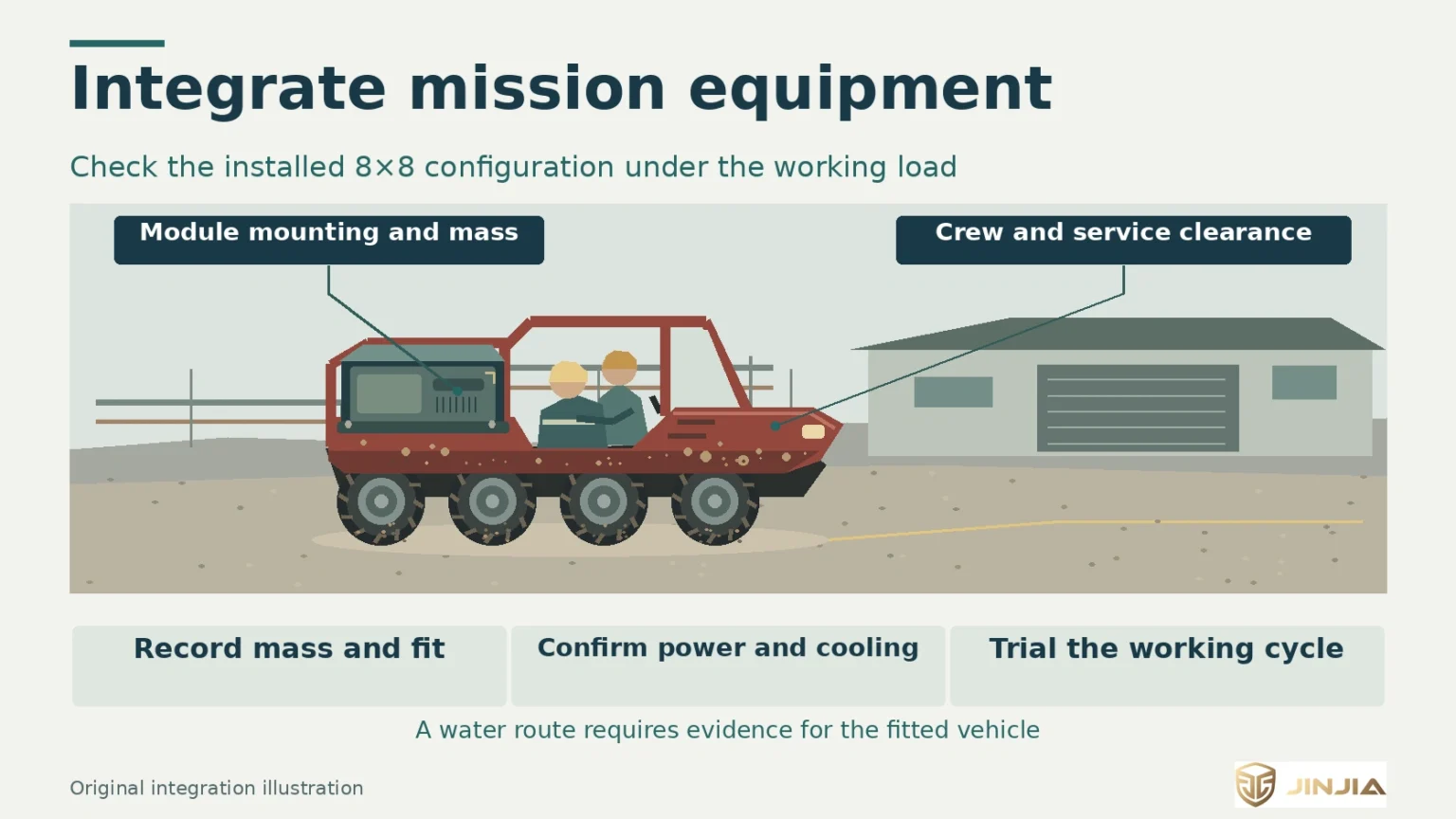
Original illustration of an installed work module. Assess loaded mass, mounting, power and cooling on the actual build.
1. Which mission equipment can an amphibious 8×8 carry?
An amphibious 8×8 can be evaluated for a secured tool pack or an integrated work module. Start with the job, the actual loaded vehicle and the routes on which that build will be used. A removable case carrying inspection instruments has different loads, interfaces and service needs from a powered pump module. Define crew seats, dry and working mass, transport position and operating position in a configuration sheet before selecting a module.
For JINJIA, identify whether the proposal is based on the range-extended electric 88E or the diesel 88D. Keep the land configuration and any proposed water configuration in separate approval records. If a module is carried to a site and deployed with the vehicle stationary, specify that sequence.
2. What the platform records and historical example establish
The JINJIA utility vehicle page describes the platform family. The 88E/88D comparison identifies the two power architectures. The civil 88D specification describes the standard six-person layout, including the driver. Use a drawing, mass statement and wiring schedule for the actual build. A brochure gives the starting platform, while a trial report identifies the tested build and conditions. [S89, S91, S92]
Ontario Drive & Gear’s 2012 history shows an 8×8 ARGO modified with a wheelchair ramp. A separate example depicts an 8×8 Magnum with transfer and wheelchair-loading aids. These examples document historical configurations. They provide a useful precedent for asking about access, mass and restraint when an adapted seat or ramp is in scope. [S57]
3. Check installed mass and centre of gravity
Build the load sheet from the actual vehicle, occupants, module, mounting hardware, cables and tools. For tanks or bins, give the mass and location with each intended fill or load state. Separate the travel position from any extended, raised or open position. The supplier or integrator should provide mounting drawings, loaded weight distribution and engineering sign-off for the proposed operating envelope.
| Check | Give the integrator | Evidence to review |
| Mass and location | Measured module mass and mounting location with the working load | Load worksheet for the proposed build |
| Space and access | Crew and tool access, stowed envelope and service clearances | Drawing and fit check on the actual vehicle |
| Transport restraint | Mounting points, latches and restraint design for the trip | Inspection of the assembled and secured module |
4. Match the power interface and cooling to the working cycle
Provide the equipment nameplate and a duty cycle. Include supply voltage and frequency as applicable, running draw, the starting demand and how long it lasts, and the loads used together. Specify whether the equipment needs power on the move or only at a stationary work point. For the quoted 88E configuration, have the supplier confirm the continuous output, transient capability and outlet arrangement under those conditions. Check separately what the proposed 88D installation would use.
Request an interface schedule that identifies connectors, protection, shutoff and the division of installation work. Keep heat rejection and airflow on the same review. Enclosures and other loads can obstruct vents or retain heat. Record the temperature and load conditions for the proposed duty cycle, including the intended stopping conditions for the test.
5. Validate the task and plan maintenance
Use a representative duty cycle after the fit check. Define observations for travel with the module secured, deployment, powered work and repacking. Have the trial team log the configuration, people, measured load, conditions, interruptions and exceptions. Review access to fasteners, wear points, filters and connectors with the service team. Identify maintenance tasks shared between the base vehicle and the module supplier and name the contact for each.
For an accessibility proposal, review boarding, transfer or seated travel, restraint and emergency egress as distinct use cases. The needs of the passenger and assistant belong in the brief. Include the ramp or lift in the mass and configuration record. Arrange specialist review of the full installed solution, and document the scope before carrying passengers in the proposed configuration.
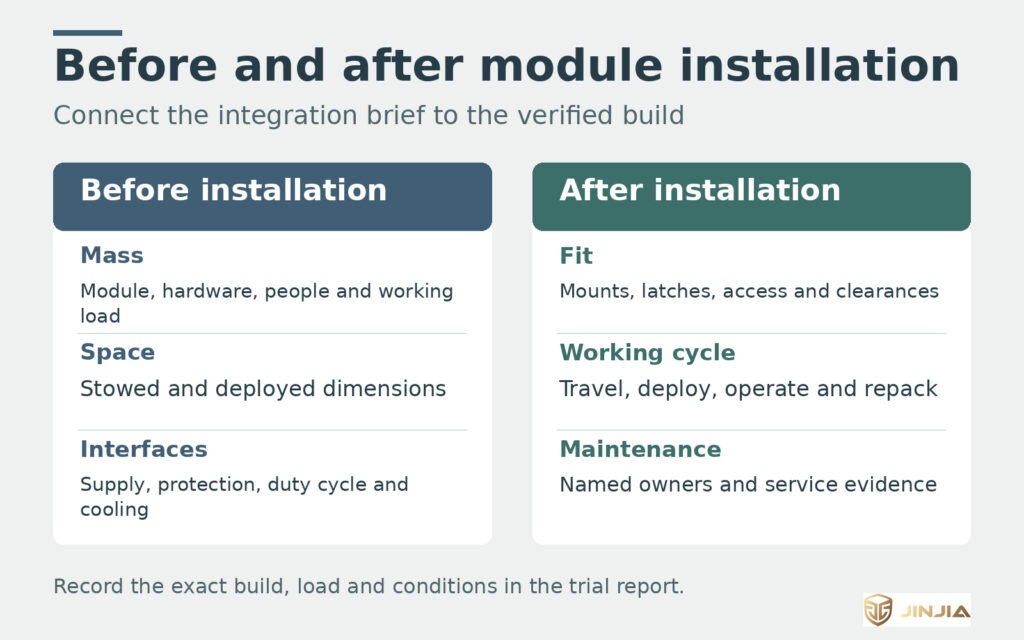
Record the mass and interfaces before installation. Verify fit, operation and maintenance on the installed build.
6. Record the limits, pending evidence and alternative
Treat wheelchair access as a special project for either platform. The historical example supplies no current JINJIA availability or certification. Enter any requested certification in the project brief with its scope and the evidence required for the destination and use.
If water operation is part of the task, request separate evidence for the exact build, including flotation load, freeboard, stability, egress and the approved conditions. Land load figures and an equipment installation drawing are insufficient for that assessment. A land-only vehicle with a separate boat, or a vehicle that transports a standalone module for use off the vehicle, may simplify the work. Compare each alternative against the same mission and route.
7. Send a one-page integration brief
• Define the task, the proposed platform and the operating locations.
• Mark the route segments, any water segment and the intended duty cycle.
• List the people, hardware, equipment and consumables with their masses and positions.
• Attach module drawings, the interface schedule and the equipment power data.
• Agree observations, acceptance evidence, limits and the person who closes each gap.
• Identify service access and allocate maintenance, spares and warranty responsibility.
Send the mission, route and module data to JINJIA for an integration review.
Read the 8×8 field-power assessment
Frequently asked questions (FAQ)
Q: What goes into installed module mass?
A: Include the module, support frame, mounting hardware, cables or hoses, equipment and consumables. Account for occupants and other carried items when calculating the working load of the vehicle.
Q: Can a supplier confirm module fit from a catalogue payload figure?
A: Ask for placement, clearances, travel and deployed states, and loaded weight distribution. Use the installation drawing and a fit check on the proposed build.
Q: What power information belongs in the brief?
A: Record voltage, any frequency requirement, running demand, starting demand and duration, concurrent loads and the operating position. Include cooling and protection in the interface review.
Q: Does the historical ramp show that a current 88E or 88D can carry a wheelchair user?
A: It shows an earlier ARGO adaptation. A current proposal needs its own boarding, restraint, egress and installed-configuration assessment.
Q: How do I check an equipped vehicle for a route with water?
A: Request evidence for the actual fitted configuration and load, including freeboard, stability and the intended water conditions. Agree the water decision before adding that segment to a trial.
Q: What records should a module trial produce?
A: Keep the actual build, load, duty cycle, result and outstanding items. Add the maintenance access findings and assign follow-up work.
Sources and further information
[S57] Ontario Drive & Gear · 50th anniversary history, December 2012, printed pp. 18 and 29 (EN)
[S89] JINJIA · Amphibious Utility Vehicle (EN)
[S91] JINJIA 88D Civil / Industrial Technical Specification · V1.0 · 8 September 2026 · pp. 7–9