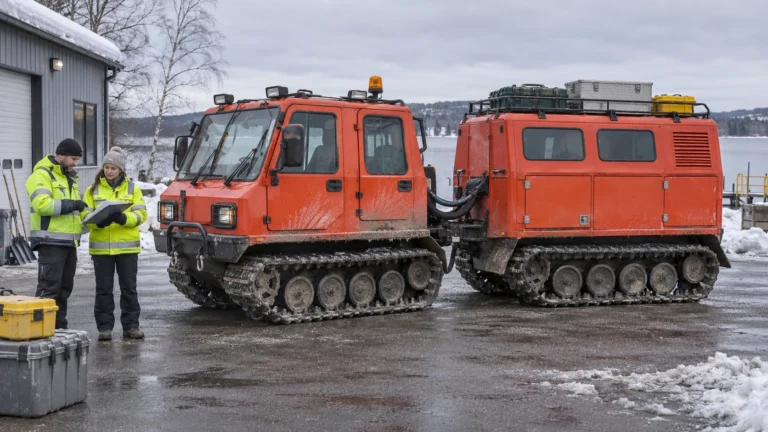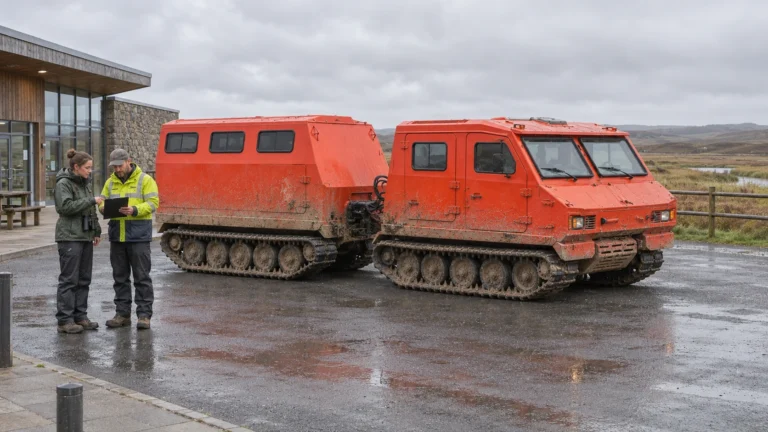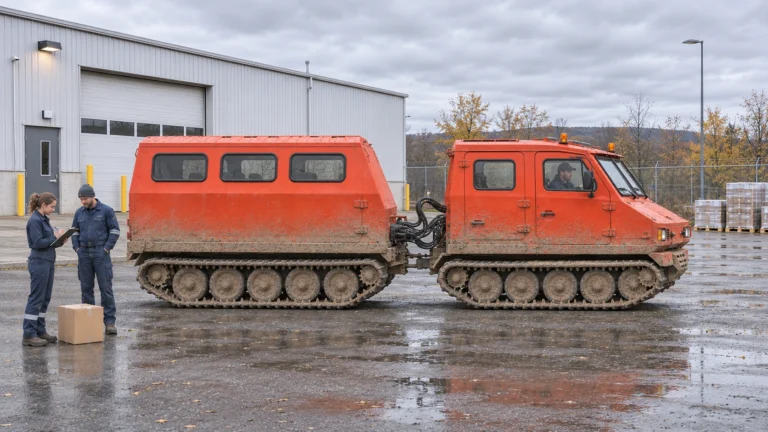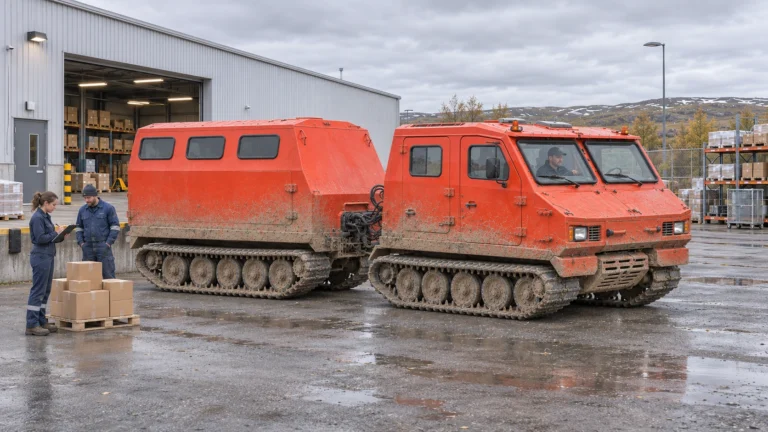











The JJ117 tracked utility vehicle is presented by JINJIA within its tracked utility vehicle family [S1]. For civilian readers, a public product page is an introduction rather than a signed description of a specific delivered machine. This guide explains how to distinguish a model name, a vehicle photograph, a document revision and an independently supported statement.
Contents
What does the product page establish?
Civilian versions: distinguish names from illustrations
How to identify the applicable file
Evidence types and their limits
Where to clarify an unresolved statement
Frequently asked questions (FAQ)
References and source boundaries
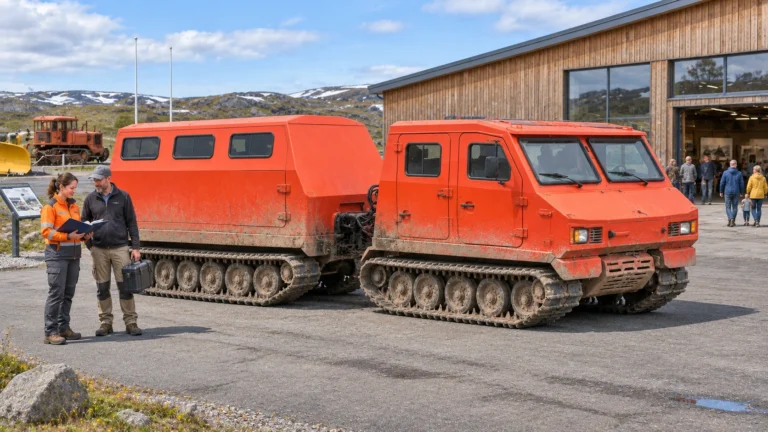
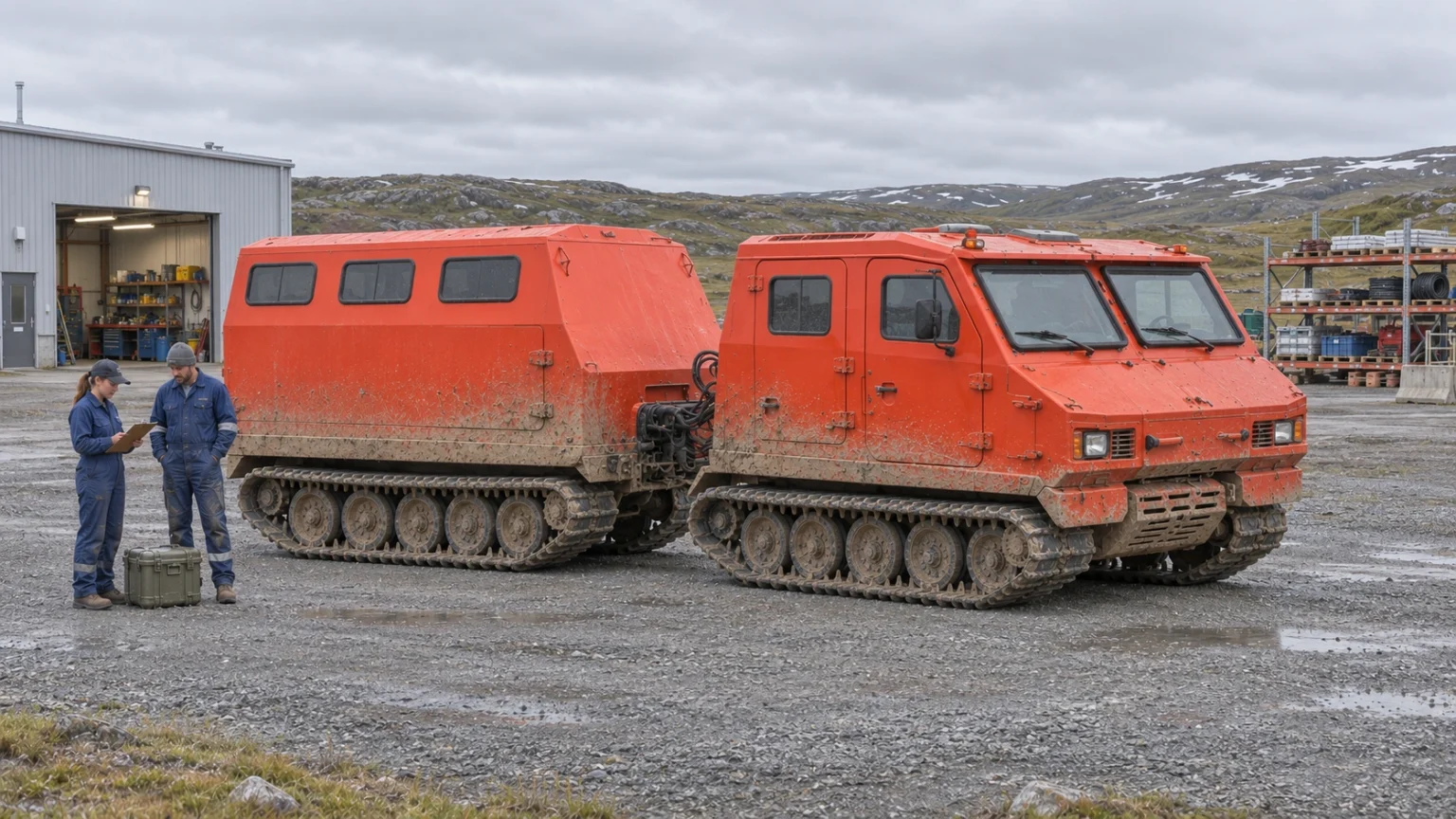
AI concept of a civilian workshop document review beside a parked two-section carrier. Not a delivered JJ117 or verified configuration.
What does the product page establish?
The JJ117 name identifies a product family in the manufacturer’s published materials. The accompanying photographs and descriptions illustrate models and applications. However, a family name alone does not determine the equipment included in an individual vehicle or establish permission for a particular use.
The general category explanation [S2] is useful for interpreting the term tracked utility vehicle. In addition, the existing light 8×8 comparison [S3] provides a separate overview of the categories. This article instead focuses on reading product information without treating an illustration as a contractual document.
Keep the original source title and publication context when recording a statement. For example, a public product description and a later written clarification should remain identifiable as two separate documents.
Civilian versions: distinguish names from illustrations
Public information may show more than one vehicle version. A description of a passenger body and a photograph of a cargo body are not interchangeable records. Instead, associate each image with its stated model and purpose, where that information is available.
In a civilian transport organisation, photographs can help colleagues recognize the equipment category at a receiving yard. Nevertheless, an image cannot establish whether a shown arrangement belongs to a particular supplied vehicle. A concept image, especially one created with AI, must retain its illustrative label.
For this reason, the accompanying fictional workshop scene illustrates document review. It does not represent a delivered JJ117, a tested machine or a verified body configuration.
How to identify the applicable file
Read the document title, issuing organisation, model designation, publication date and revision identifier. Then place the document in the project file without changing its original source description. When a revision is missing, label it unknown rather than guessing.
Separate items that are visible in the product literature from statements that need an applicable signed record. If two documents describe the same subject differently, preserve both entries and request a written clarification. Do not select the more attractive wording by default.
The editable fact record included with this article makes the distinction visible. It is a document-control aid, not a technical evaluation, approval or operating instruction.
Evidence types and their limits
A manufacturer publication explains what the company presents publicly. A dated and signed record is evidence of what the issuing party states for the documented version. Neither automatically proves an independent test result.
An independent report should be identified by its issuer, date, scope and the exact item to which it refers. Likewise, a third-party example about another product does not establish a JJ117 result. If the relevant evidence is absent, keep that question unresolved.
The table below offers a simple way to classify documentation. It deliberately does not contain performance values, vehicle qualification conclusions or operating recommendations.
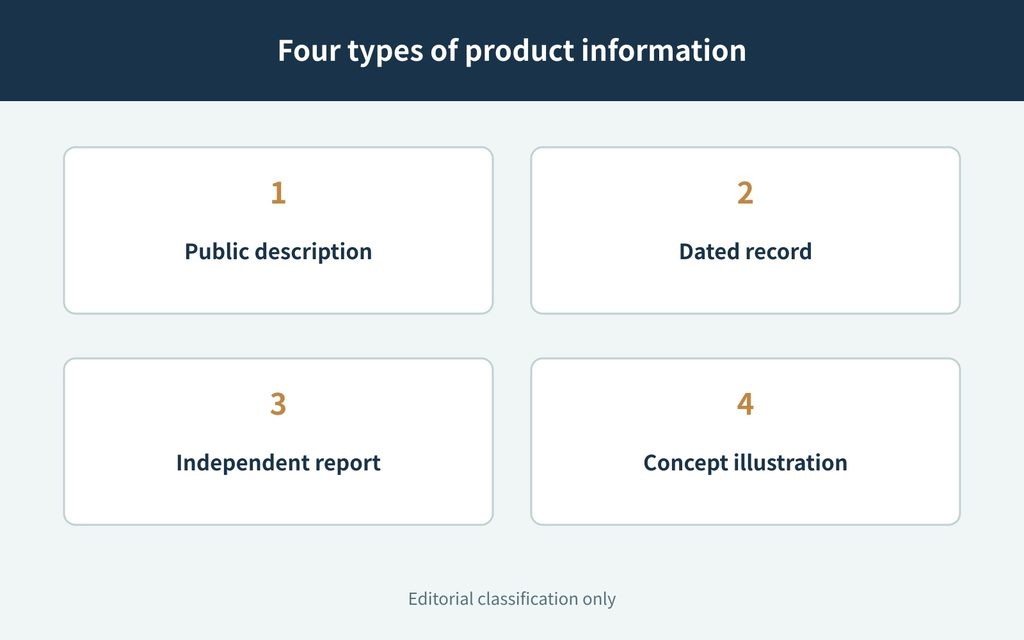
Document classification only, not a technical specification or approval.
Where to clarify an unresolved statement
First retain the document reference and the exact statement that needs clarification. Next distinguish a question about wording from a question about the applicability of the document to a particular civilian version.
Use the official product page for the published description [S1] and the published contact page for general questions about documentation [S4]. If a response changes an earlier statement, record the date and source of the response rather than silently overwriting the earlier record.
Ultimately, accurate product information depends on knowing which document makes which claim. The aim is an orderly record of statements and sources, not an implied approval of a vehicle or a particular use.
Read the published contact information for general documentation questions.
Frequently asked questions (FAQ)
A: No. It is the manufacturer’s public description. An applicable signed document is a distinct record.
Q: Does a vehicle image identify its exact supplied version?
A: Not by itself. Use the stated image context and the corresponding document, where available.
Q: How should two different revisions be handled?
A: Retain the two versions, note the conflict and obtain a clarification from the issuing party.
Q: Is a manufacturer statement an independent test?
A: No. Identify who made the statement and the source type before describing its evidence status.
Q: Can an AI concept image serve as delivery evidence?
A: No. It is an illustration and must be clearly distinguished from a photograph of a delivered item.
Q: Where can I read the current public product description?
A: The JINJIA Tracked Utility Vehicle page [S1] is the public product entry; general documentation questions may be addressed through the contact page [S4].
References and source boundaries
S1: JINJIA / Response Mobility — Tracked Utility Vehicle — Manufacturer’s public product introduction; not independent evidence or project-specific confirmation.
S2: JINJIA — What Is a Tracked Utility Vehicle? — Existing general category explanation; separate from this document-reading guide.
S3: JINJIA — Light 8×8 vs Articulated Tracked Vehicle — Existing category comparison; linked to avoid repeating the same topic.
S4: JINJIA — Contact — Published contact information; no claim of a response or approved configuration.