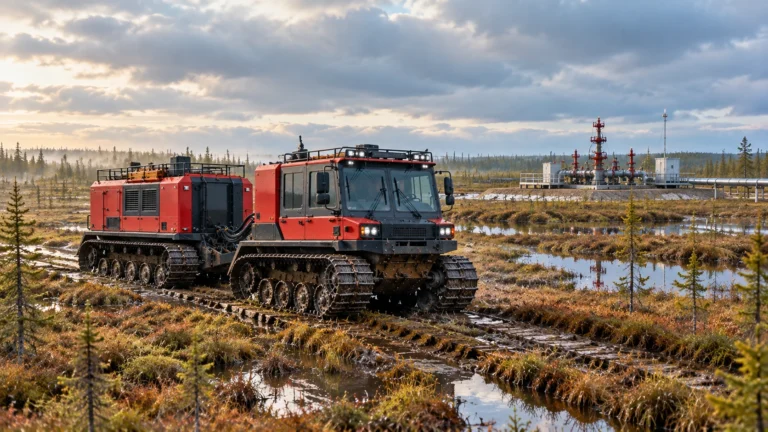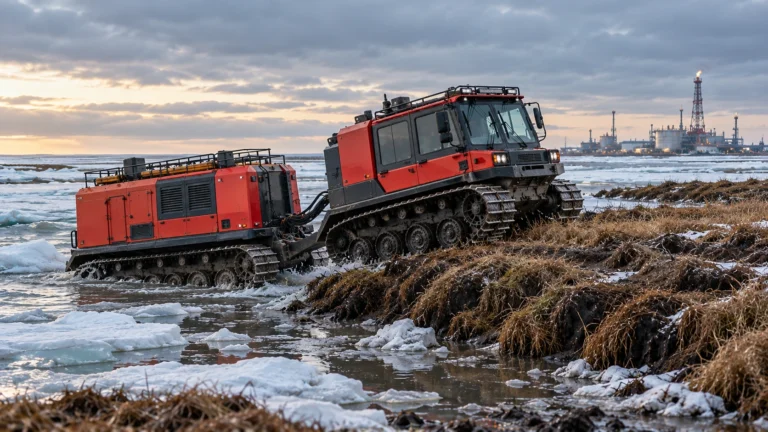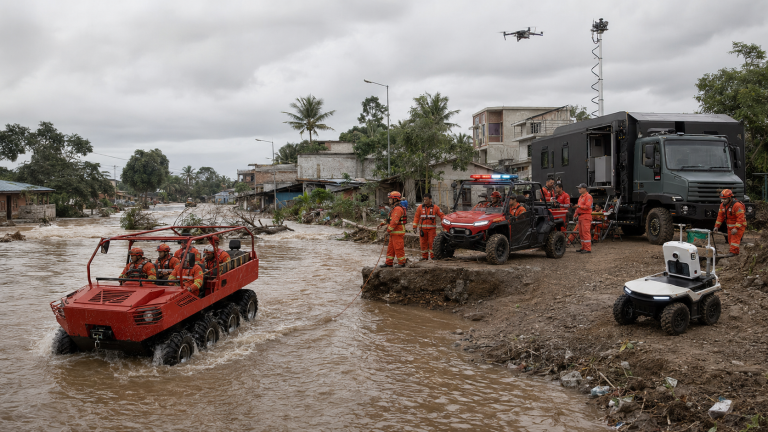


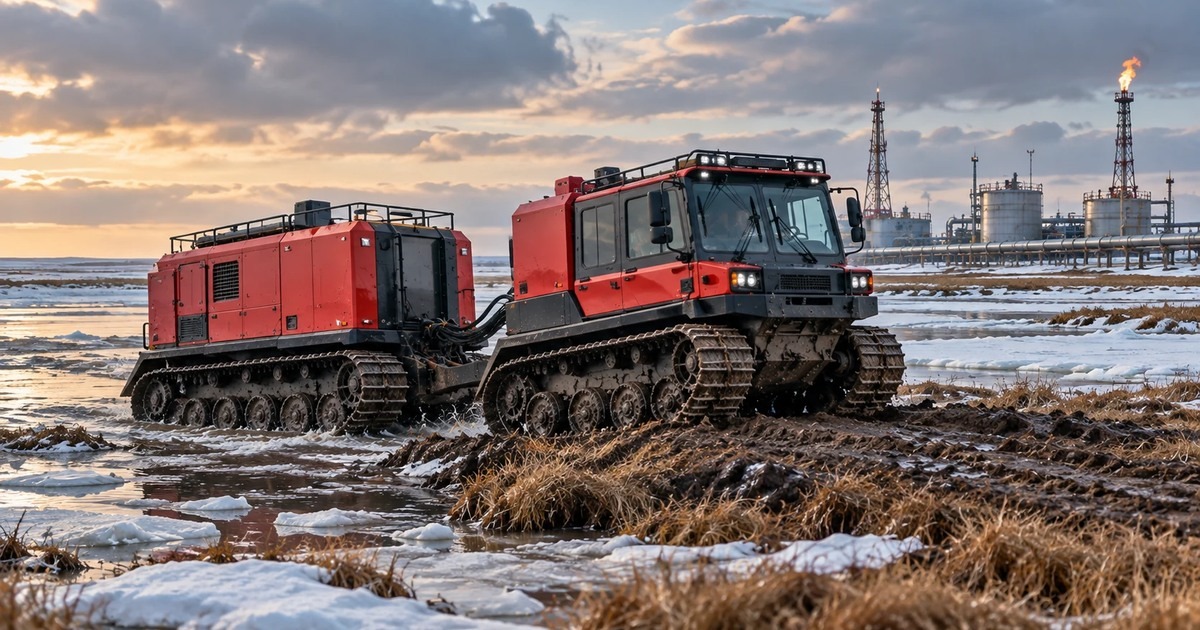
An oilfield vehicle does not fail only because a route is steep. It may fail because the ground will not carry its weight, a thawed pipeline corridor becomes impassable, or the last 100 metres to a coastal installation have no prepared bank. In such locations, the first question is not “How fast is the truck?” but “Can the mission reach the site safely?”
Articulated tracked vehicles are a candidate mobility class for selected oil and gas tasks in peatlands, swamps, snow, tundra, flood-affected ground and remote industrial corridors. Their advantage is an engineering combination: tracked ground contact, articulation between vehicle sections and the ability to configure a mission body. Suitability must be checked against the actual ground, loading and safety requirements.
Quick answer: where do articulated tracked vehicles fit in oil and gas?
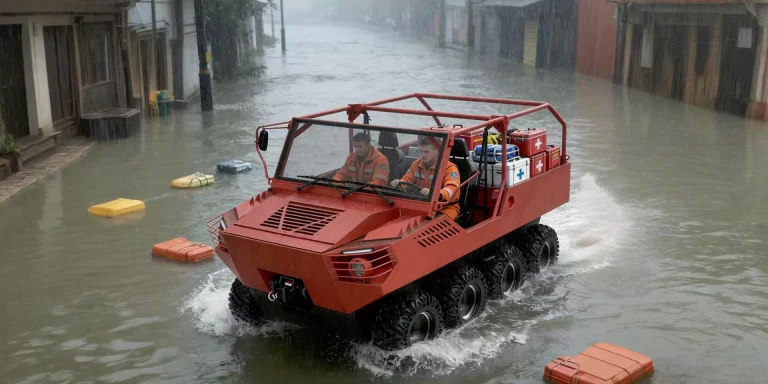
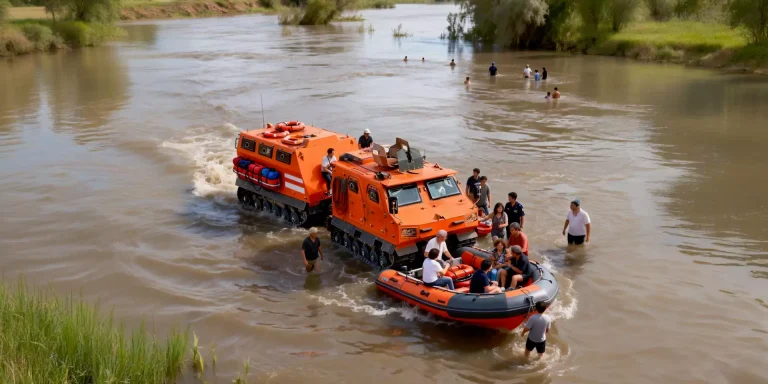
They are most relevant where road access is absent or unreliable and where personnel, tools or emergency supplies must cross low-bearing-capacity or rapidly changing terrain. Priority applications include remote wellsite support, wetland pipeline maintenance, winter access, coastal logistics and emergency equipment carriage. Amphibious travel is not automatic: it is a model- and configuration-specific capability.
Why conventional access breaks down?
Peat and waterlogged soil can lose bearing capacity under vehicle loads; visible vegetation can conceal weaker layers below. Snow and freeze–thaw cycles change traction and sinkage. An undeveloped shoreline may combine saturated mud, a steep bank and a sudden reduction in buoyant support as an amphibious vehicle leaves the water.
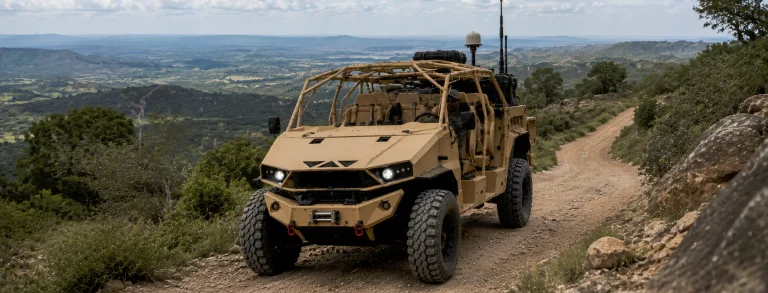
Wheeled vehicles remain efficient on suitable roads and firm ground. A tracked solution should be considered when a site study identifies a mobility bottleneck—not assumed to be superior under every condition. Low nominal ground pressure does not eliminate rutting, vegetation damage or the risk of immobilization.
What articulated tracks can contribute?
A two-section tracked layout creates separate ground-contact zones and allows a connecting joint to accommodate changes in terrain geometry. This can be useful on uneven approaches and during selected soft-ground transitions. Depending on the design, the rear section can accommodate a personnel cabin, tools, cargo or a mission module.
Engineering checks remain essential: actual contact area, loaded mass distribution, track slip, soil shear strength, articulation limits, recovery provisions and environmental permissions determine practical performance. A joint and four tracks by themselves do not prove flotation, icebreaking or safe operation in hazardous areas.
JINJIA JJ117: published product specifications, not inferred performance
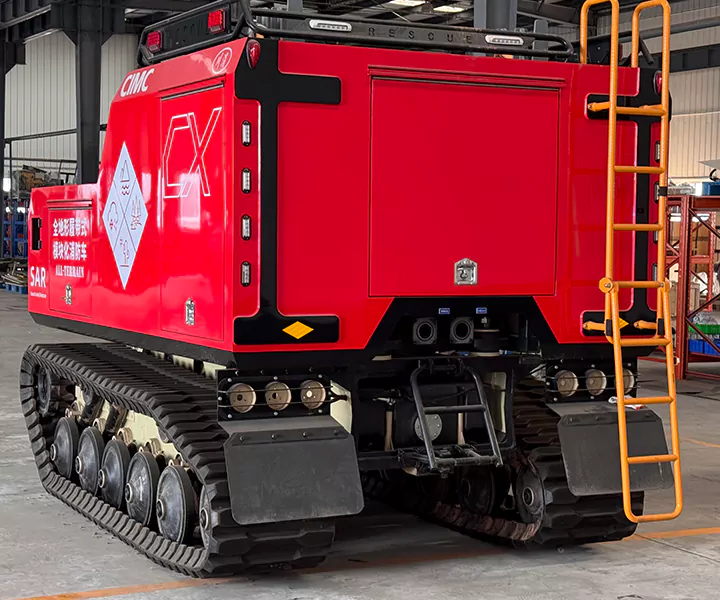
JINJIA publicly describes JJ117 as a modular tracked platform with firefighting, rescue, transport and communication configurations. The official product page and downloadable technical brochure identify two variants, JJ117-X1 and JJ117-X2. The figures below are manufacturer-published specifications; they are not independent field-test or certification results.
| Model / mission | JJ117-X1: all-terrain water-cannon configuration | JJ117-X2: multifunctional tracked transport configuration |
| Published vehicle weight | 17,000 kg (brochure wording: combat weight) | 17,000 kg (brochure wording: combat weight) |
| Length × width × height | 9.1 × 2.45 × 3.6 m | 9.1 × 2.45 × 2.6 m |
| Maximum road speed | 65 km/h | 65 km/h |
| Published temperature range | −43°C to +50°C | −43°C to +50°C |
| Selected configuration detail | 242 kW rated power; 1,500 L/min pump; 2,500 L tank | 5 km/h published water speed; 2,000 L tank; 4 + 10 seating layout listed |
Publication caution: Neither the official web page nor brochure establishes nominal ground pressure, verified payload, a water-to-unprepared-bank test result, an icebreaking rating, hazardous-area approval, or marine FiFi certification. X2 brochure entries for “turbofan water cannon range 280 m” and “fan airflow 37 m” contain questionable labels/units and are intentionally excluded pending engineering correction.
Six high-value oil and gas applications
1. Remote wellsites and exploration: move approved personnel loads, tools and field supplies between remote operating points where permanent roads are not economical.
2. Peatland and swamp operations: evaluate tracked logistics for survey work, maintenance and emergency access on low-bearing-capacity ground; route restrictions and repeated-pass damage still matter.
3. Pipeline inspection and repair support: carry crews, portable instruments, hoses, communications kits and replacement parts along inaccessible rights-of-way. Any work near live assets follows the operator’s permits and HSE procedures.
4. Arctic and sub-Arctic energy sites: study winter access over snow and frozen terrain, while separately assessing thaw-season bearing strength and safe ice operations.
5. Shallow-water and coastal infrastructure: assess specialized amphibious configurations for shore-to-site support. Water propulsion, stable flotation and exit onto an unprepared bank require separate validation.
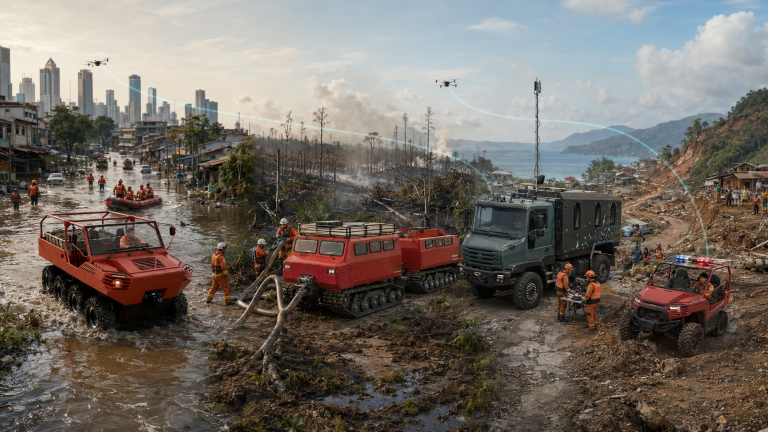
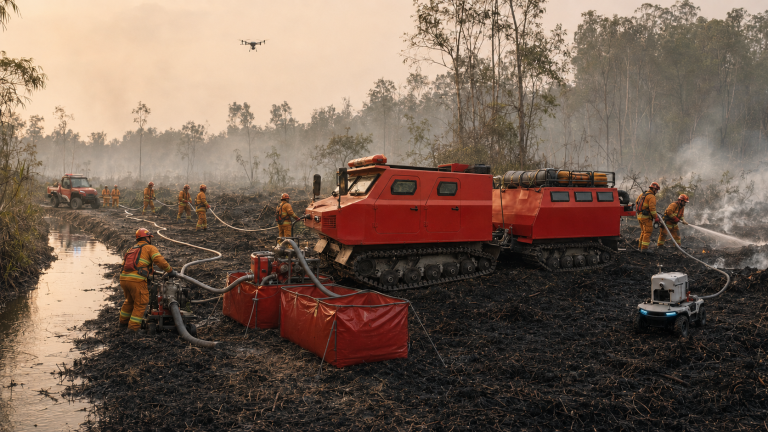
6. Emergency-response logistics: configure suitable modules for firefighting tools, rescue gear, field power or communications. A tracked carrier transporting firefighting equipment is not automatically a certified marine FiFi firefighting vessel.
What must be validated before a procurement decision?
Site and ground: terrain survey, soil bearing and shear strength, gradients, obstacles, slope transitions and environmental constraints.
Vehicle and mission: fully loaded mass, true payload, required crew/cargo layout, duty cycle, maintenance logistics and recovery equipment.
Water and ice: fording versus powered flotation, water depth, shoreline profile, current, ice quality and the applicable approval route.
Oil and gas HSE: H₂S risk, area classification, ignition-source control, crew protection, corrosion, communications and site permissions. Published vehicle temperature ranges are not substitutes for project-specific environmental qualification.
From terrain question to engineering proposal
JINJIA / Response Mobility begins with the duty cycle and ground conditions, then evaluates an appropriate platform and mission configuration. For a serious RFQ, the most useful first inputs are operating terrain, required payload, environmental conditions, intended application and estimated quantity.
The JJ117 family provides a documented starting point for technical discussion. Final platform selection, amphibious claims, certifications and delivery commitments remain subject to the approved configuration and engineering review.
Frequently asked questions
Where can articulated tracked vehicles be used in oil and gas?
Candidate uses include exploration support, remote wellsite logistics, soft-ground pipeline access, cold-region maintenance and emergency-equipment transport. Suitability depends on a site-specific mobility assessment.
Does a 17,000 kg JJ117 vehicle have a 17-ton payload?
No. The official data lists a 17,000 kg vehicle weight for the cited configurations. It does not specify an allowable cargo payload; that must be confirmed separately.
Can the JJ117 drive on water?
The official BN117-X2 brochure describes a sealed amphibious configuration and lists a water speed of 5 km/h. The figure is a published specification, not proof of performance in every water condition or proof of marine certification.
Can a tracked vehicle climb from water onto an unprepared bank?
Only if the configuration, shoreline soil, bank gradient, available traction and buoyancy-to-ground transition have been evaluated and demonstrated. Amphibious flotation alone does not prove successful bank exit.
Is it suitable for ice or peat?
These are priority application environments for study, but ice load capacity, snow/peat trafficability, ground pressure and environmental constraints need site-specific assessment. No icebreaking capability is claimed here.
Can JJ117-X1 replace an offshore FiFi 1 vessel?
No such equivalence is established by the cited documents. Offshore firefighting demands an independently defined fire-performance envelope, marine suitability and the relevant approvals.
Request an oil & gas terrain-mobility assessment
Tell JINJIA what ground your team must cross and what mission must be delivered. Send the five inputs below and our team can evaluate a suitable technical discussion path.
1. Operating terrain (peat / marsh / snow / ice / shallow water / slopes)
2. Required payload and crew
3. Environmental conditions and temperatures
4. Intended application and duty cycle
5. Estimated quantity and project location
Explore JJ117 tracked vehicle configurations: https://responsemobility.com/tracked-utility-vehicle/
Send your project requirements: https://responsemobility.com/contact/
Email: info@responsemobility.com
No certification, site performance or delivery outcome is implied until the project configuration is reviewed.
Deployment & QA
1. Publish only the article body above this page; enter the SEO fields in the CMS separately.
2. Set author/publisher as JINJIA / Response Mobility; use actual publish and update dates generated by the CMS.
3. Upload the hero as WebP, retain the supplied ALT and visible AI-concept disclaimer.
4. Add BlogPosting and BreadcrumbList structured data using the final canonical URL, hero media URL and actual publication timestamp.
5. Configure self-canonical; after both sites are live, implement reciprocal hreflang for en and ru and x-default if appropriate.
6. Existing links are verified. Do not add an uncreated /applications/oil-gas-energy/ link yet.
7. QA source limits: X2 cannon-range/fan-airflow table has questionable units; omit until corrected.
Reviewed source URLs
Official EN JJ117 product page: https://responsemobility.com/tracked-utility-vehicle/
Official JJ117 technical brochure: https://responsemobility.com/wp-content/uploads/2026/06/Tracked-Utility-Vehicle.pdf
Google BlogPosting structured-data guidance: https://developers.google.com/search/docs/appearance/structured-data/article