

Direct answer: when can an articulated tracked vehicle help an Arctic oilfield?
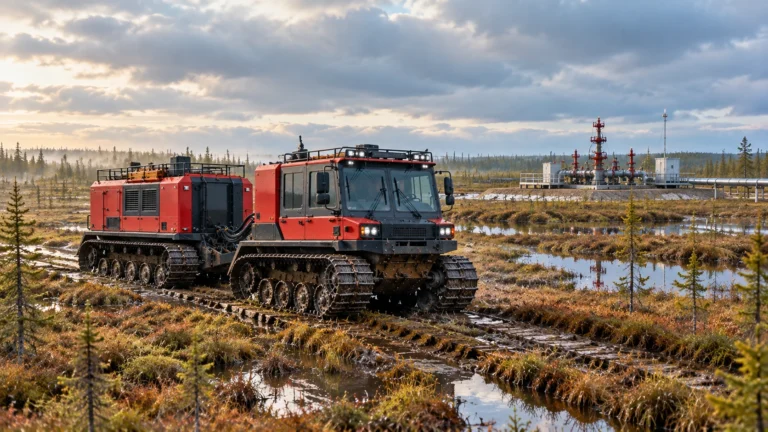
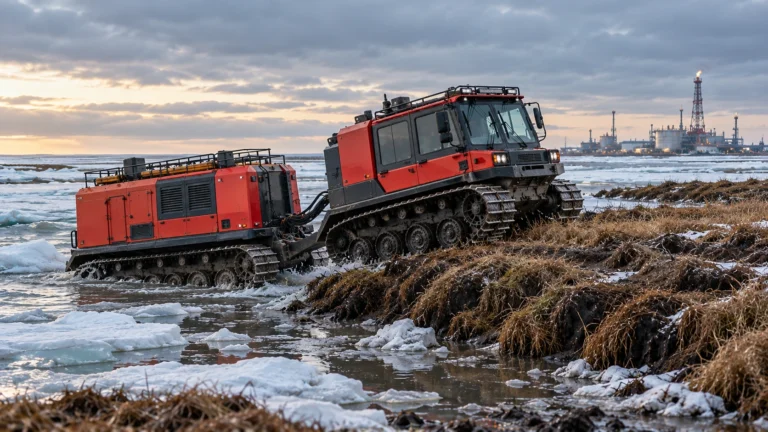
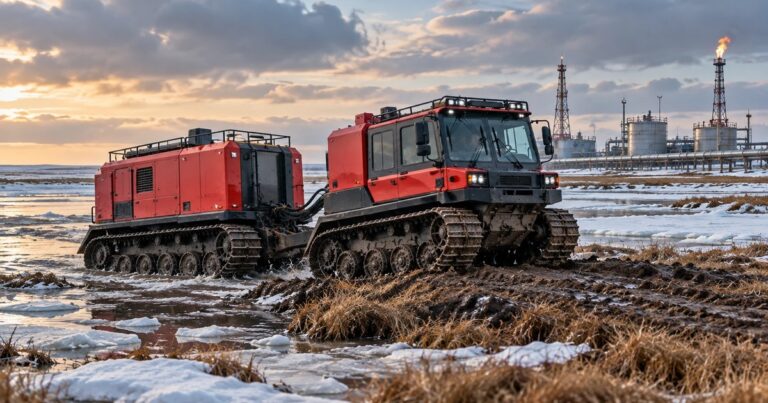
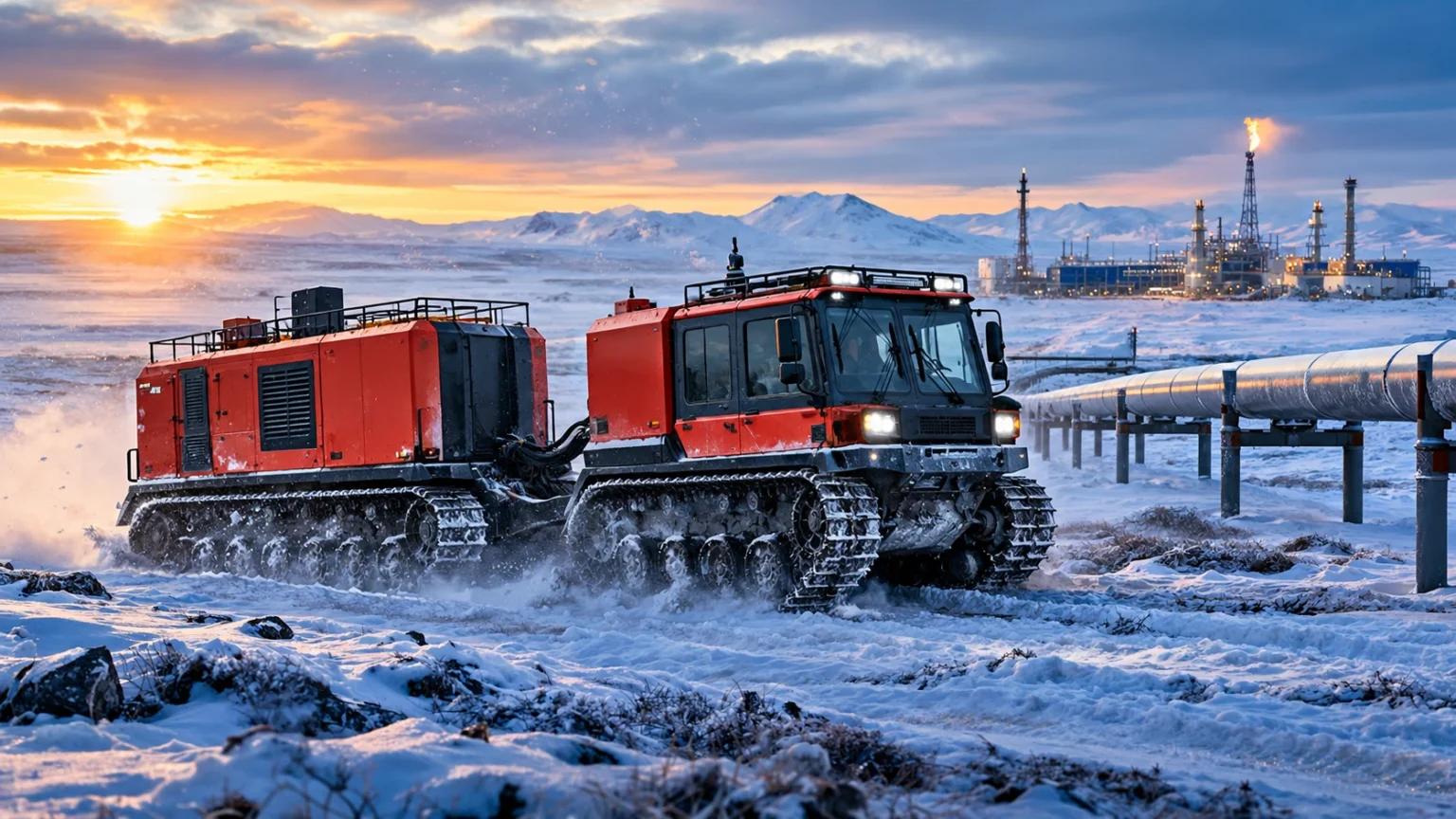
An articulated tracked carrier can be considered when an oil and gas operator must move personnel, tools or mission equipment across deep snow, irregular frozen ground or remote terrain without dependable year-round roads. Tracks spread load across a longer ground-contact area, while an articulated two-section layout can provide flexibility for terrain adaptation and separate payload modules.
This is a suitability assessment, not an unrestricted access guarantee. Deep-snow traction, safe travel on natural ice, tundra protection, cold starting and recovery must each be demonstrated for the proposed vehicle configuration and site conditions. A stated ambient-temperature range does not by itself establish certified 24/7 Arctic availability.
Why Arctic energy access is a seasonal engineering problem?
The phrase “Arctic terrain” combines several fundamentally different operating surfaces. Dry powder snow, wind-compacted drifts, lake or sea ice, frozen gravel, snow-covered boulders and summer-thaw tundra cannot be treated as one traction condition. Site access may change within days as temperature, wind, snowfall, water level and ground temperature change.
A winter road may be usable only during a defined opening period. A route over frozen ground can deteriorate when the active layer thaws, and snow may hide cracks, standing water or poorly supported ground. Oil and gas planners should use a season-specific route assessment rather than accepting a generic “all-season” claim. ISO 35101 provides a high-level reference for the Arctic working environment and operational risk management.
Deep snow: flotation, traction and vehicle geometry
Tracked propulsion can reduce average nominal ground pressure relative to certain wheel arrangements by distributing the supported mass over an extended contact patch. But snow mobility depends on density, temperature, crust layers, sinkage, track-lug engagement, drawbar pull, underbody drag and available power. Very light powder and wet heavy snow can produce opposite failure mechanisms.
For an articulated configuration, engineers should examine each section separately: front/rear mass, track contact length and width, articulation geometry, grade transition, turning resistance and loss of traction during curves. A rear module overloaded with cargo may increase sinkage even if the front module passes. Route testing should include starts, stops, slopes, turns and representative fully loaded operation—not only straight-line travel in light snow.
Natural ice is not the same as packed snow
A vehicle capable of travelling through deep snow is not automatically approved for travel on floating lake ice, river ice or sea ice. Ice load capacity depends on effective thickness, ice quality, salinity, temperature, cracks, current, snow insulation, route geometry and the duration or speed of loading. A load chart from one location or vehicle class must not be generalized to another route.
The Northwest Territories ice-road maintenance guidance stresses local ice assessment, appropriate limits, safe spacing and special attention to stationary loads. Working near shorelines, pressure ridges, open leads or unstable ice edges requires extra analysis. Travelling on supported ice, crossing mixed ice-water terrain, floating and actively breaking ice are four distinct capabilities; the published JJ117 page does not establish an approved ice-load rating or active icebreaking performance.
Tundra and permafrost: beware of the thawing active layer
Permafrost is ground that remains frozen for multiple years, but its upper active layer can thaw seasonally. In summer or shoulder seasons, a frozen-looking landscape may become saturated and weak, and surface disturbance can accelerate rutting and local drainage changes. The U.S. Geological Survey documents how thawing ice-rich permafrost affects infrastructure and the Arctic landscape.
For tundra access, a tracked carrier should not be marketed as “zero impact.” Assess permissible traffic windows, surface vegetation, soil and ground-ice conditions, turning zones, number of passes, environmental permissions, recovery equipment and rehabilitation obligations. In sensitive terrain, the correct engineering recommendation may be to avoid vehicle travel or use a temporary protected route.
Cold-weather engineering: the whole system must function
Winter reliability is not determined by the engine alone. Low temperatures affect cranking power, battery capacity, lubricants, hydraulic viscosity, elastomers, fuel systems, hoses, tracks, seals, brakes, communications and operator ergonomics. Snow ingress can obstruct cooling or exhaust components; condensation and repeated freeze–thaw cycles can damage electrical connections.
A proper verification plan should specify cold soak duration, verified starting method, preheating and auxiliary power, cabin heating and defrosting, fluid grades, emergency shutdown, lighting, rescue tools and maintenance access while wearing winter PPE. The operator also needs serviceability, spare-parts support and a plan for personnel refuge if the vehicle becomes immobilized.
Seven high-value applications for oil and gas operators
01 — Remote wellsite logistics: carry approved tools, spares, light equipment and field teams where access roads are absent or seasonally interrupted.
02 — Pipeline corridor inspection: support crews visiting remote aboveground pipelines, valve stations, instrument points and communications cabinets.
03 — Geophysical survey support: transport approved survey instruments and technicians to sites after assessing ground disturbance and route permissions.
04 — Snowstorm recovery logistics: move essential equipment and qualified responders along pre-assessed routes after severe weather.
05 — Mobile maintenance module: examine a service-tool or enclosed workshop layout within verified gross weight and centre-of-gravity limits.
06 — Temporary power and communications: carry a compact power-generation or communications module where integration, thermal management and safety permit.
07 — Cold-region emergency support: move approved personnel and supplies to designated response areas; hazardous-zone, marine and rescue duties require separate certification and operational controls.
These are application opportunities, not claims of completed JJ117 deployments at named Arctic oilfields.
What the official JINJIA JJ117 product page actually establishes?
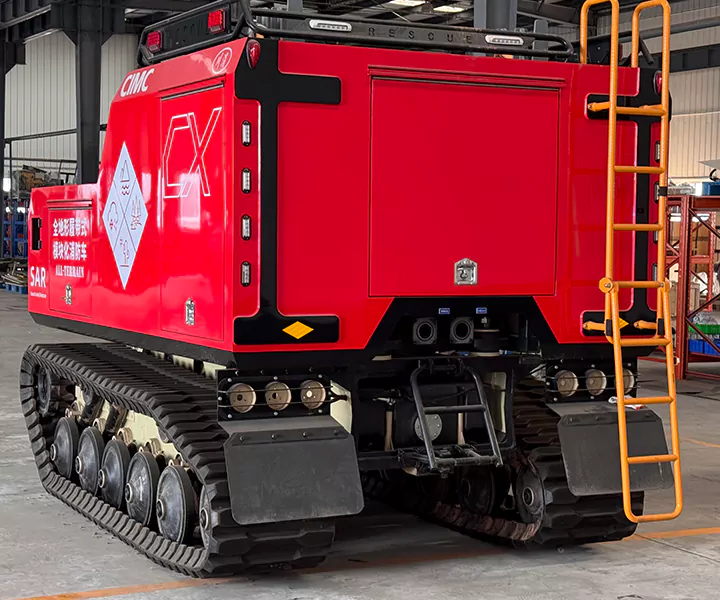
The official English Tracked Utility Vehicle page identifies JJ117-X1 and JJ117-X2 articulated tracked configurations. Both tables list a “Weight” field of 17,000 kg, a maximum road speed of 65 km/h and an operating-temperature range of −43°C to +50°C. JJ117-X1 is listed at 9.1 × 2.45 × 3.6 m; JJ117-X2 at 9.1 × 2.45 × 2.6 m. These are manufacturer-published specifications rather than independent proof of cold-soak qualification.
The 17,000 kg “Weight” field must NOT be misread as a 17-tonne payload capacity. The published page does not provide a vehicle-specific snow sinkage test, ice-load limit, cold-start cycle report, season-long Arctic fleet availability, approved icebreaking rating or permafrost impact study. Prospective energy clients should request configuration-specific test evidence. Official product information: https://responsemobility.com/tracked-utility-vehicle/
A six-stage evaluation workflow before deployment
Stage 1 — Map the mission: personnel, useful payload, operational mass, work shift, route length, recovery distance and intended season.
Stage 2 — Classify terrain: snow depth and density, ice thickness/quality, frozen ground, thaw season, slope and hidden water.
Stage 3 — Review engineering fit: tracks, articulation, powertrain, traction, weight distribution, ground clearance, modular loads and environmental protection.
Stage 4 — Verify safety: approved access route, ice-road authority where relevant, hazardous-area boundaries, HSE plan, communications and rescue.
Stage 5 — Test against acceptance criteria: cold start, full-load traction, turning and braking, repeat-pass rutting, recovery and uptime—not merely demonstration footage.
Stage 6 — Document the operating envelope: maximum allowed conditions, inspection intervals, stopping thresholds, maintenance, training and handover.
Procurement checklist: what an EPC or oilfield operator should send
Operating terrain: mapped route, snow depth and density, lake/river/sea ice versus frozen soil, thawing areas, slopes and available survey records.
Required payload: personnel, cargo, towing, mission module and total fully equipped operating mass; identify mass on each vehicle section.
Environmental conditions: minimum and maximum temperature, cold-soak duration, wind, snow, humidity, icing and hazardous-area restrictions.
Intended application: transport, pipeline inspection, mobile workshop, emergency support or another clearly bounded mission.
Estimated quantity: prototype/evaluation units, later fleet size, delivery country, planned service season and support expectations. Include any requirements for navigation, heating, recovery, communications and certification.
Frequently asked questions
Q: Are tracked vehicles suitable for Arctic oilfields?
A: They can be candidates for selected routes and payloads, but suitability depends on measured terrain, season, full vehicle mass and tested cold-weather performance.
Q: Can a tracked carrier drive on natural ice?
A: Only under an approved ice-access plan based on local ice assessment; tracked propulsion alone gives no ice-load approval.
Q: Does −43°C on a product page prove reliable cold starting at that temperature?
A: No. A declared working-temperature range is not a substitute for a documented cold-soak, start and operational verification programme.
Q: Can JJ117 break through thick ice or move across floating ice?
A: No such capacity should be claimed from the currently published JJ117 specifications. Floating, ice-edge transition and icebreaking require independent engineering and authorizations.
Q: Do tracks avoid tundra damage?
A: No. Repeated passes, turning and thaw-season traffic can still cause rutting and environmental disturbance.
Q: What information should be included in an RFQ?
A: Operating Terrain | Required Payload | Environmental Conditions | Intended Application | Estimated Quantity, plus route maps, season and safety requirements.
Discuss an Arctic oilfield mobility project with JINJIA
JINJIA / Response Mobility evaluates articulated tracked platforms and mission-specific configurations for difficult oil and gas access problems. We recommend beginning with operating-envelope definition, route and soil evidence, loaded mass and cold-region safety requirements—not with an unconditional promise of access.
Send five initial design inputs: Operating Terrain | Required Payload | Environmental Conditions | Intended Application | Estimated Quantity. Where possible, attach route coordinates, snow/ice survey data, seasonal use constraints, photographs and payload diagrams.
JJ117 product page: https://responsemobility.com/tracked-utility-vehicle/ | Project inquiry: https://responsemobility.com/contact/ | Email: info@responsemobility.com
Sources and verification references
JINJIA / Response Mobility, Tracked Utility Vehicle product page (two configurations; accessed 2026-10-24) — https://responsemobility.com/tracked-utility-vehicle/
ISO 35101:2017, Petroleum and natural gas industries—Arctic operations—Working environment — https://www.iso.org/standard/63469.html
ISO 35104:2018, Petroleum and natural gas industries—Arctic operations—Ice management — https://www.iso.org/standard/63861.html
Government of the Northwest Territories, Highway Maintenance Manual—Ice Bearing Assessment — https://www.inf.gov.nt.ca/sites/inf/files/resources/highway_maintenance_manual_1.pdf
USGS, Permafrost Change and Impacts on Infrastructure and Resources in Alaska — https://www.usgs.gov/programs/climate-adaptation-science-centers/science/permafrost-change-and-impacts-infrastructure
USGS (2025), Climate Change and Infrastructure Development Drive Ice-rich Permafrost Thaw in Point Lay — https://www.usgs.gov/publications/climate-change-and-infrastructure-development-drive-ice-rich-permafrost-thaw-point-lay
Nature Communications (2018), Degrading permafrost puts Arctic infrastructure at risk by mid-century — https://doi.org/10.1038/s41467-018-07557-4