

Direct answer: where could an amphibious tracked platform help offshore response?
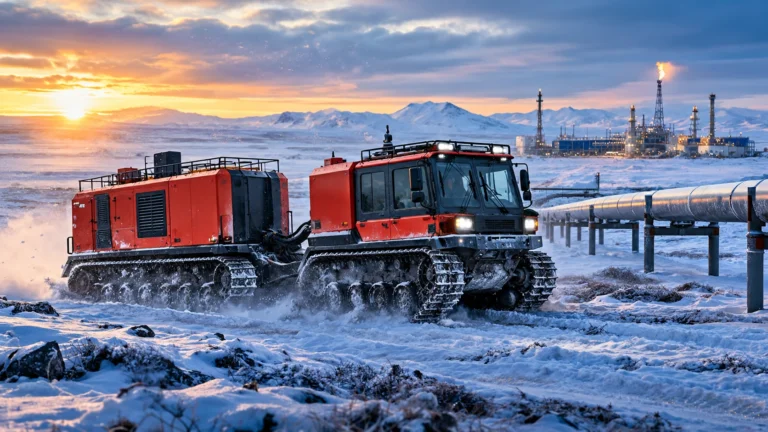
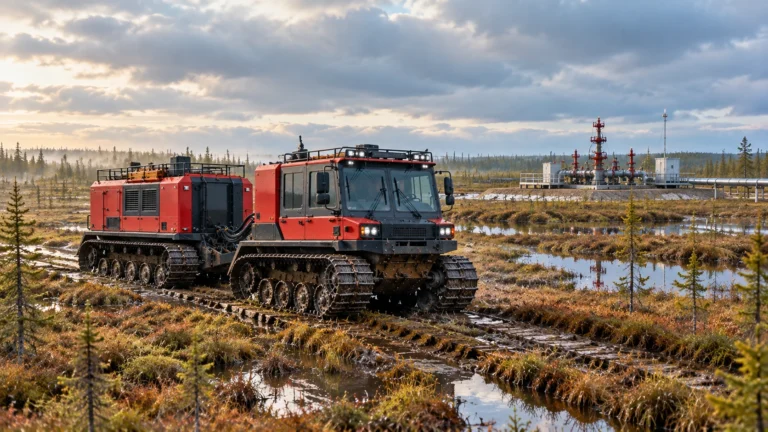
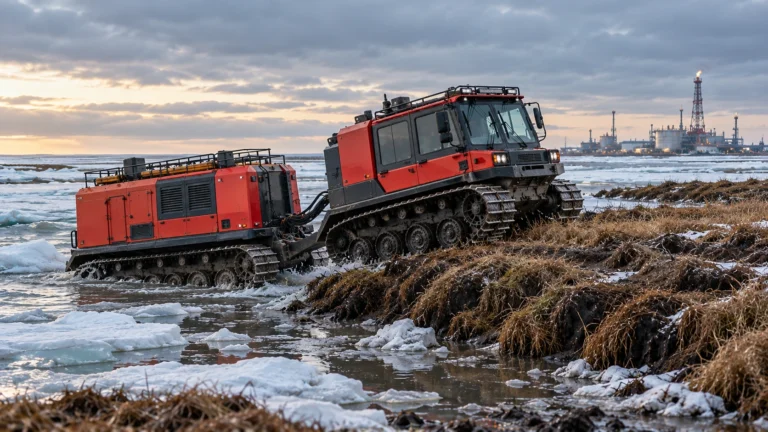
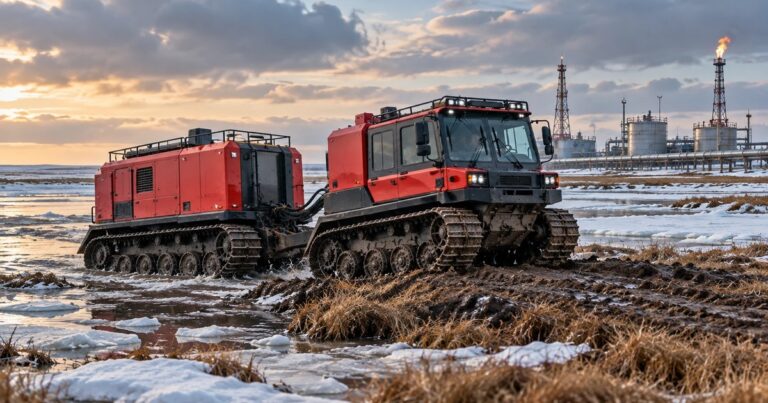
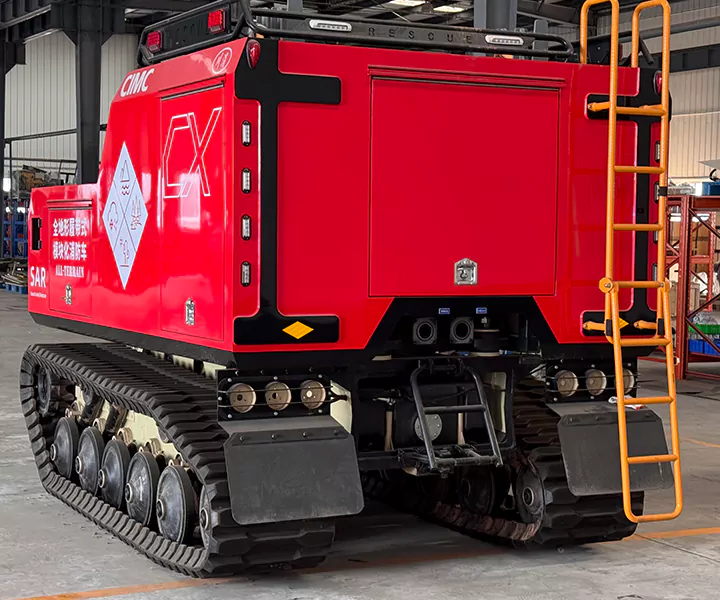
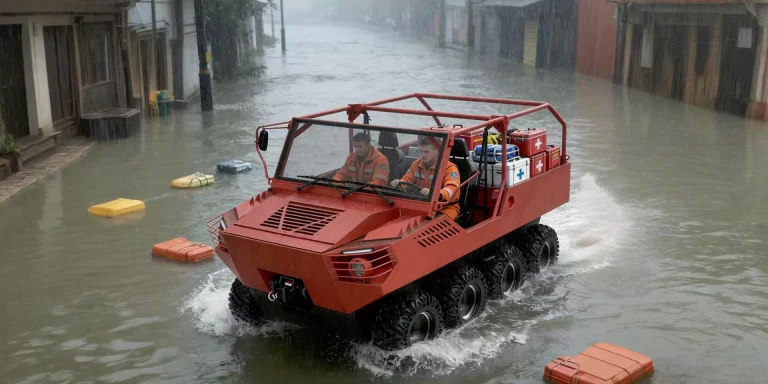
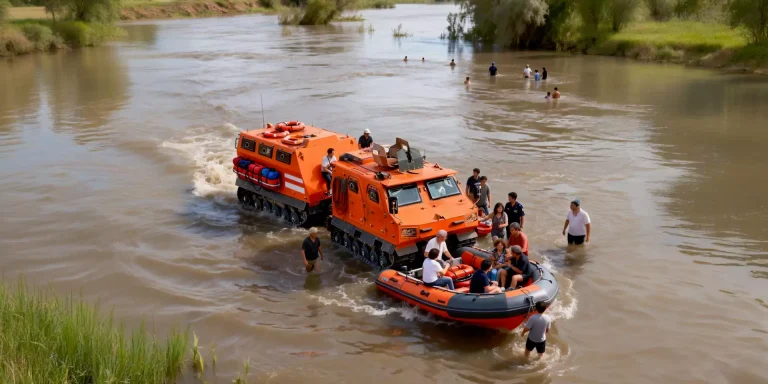
A purpose-designed amphibious tracked platform may be considered for emergency logistics where offshore energy infrastructure sits beside shallow water, marshland or undeveloped shorelines. Potential tasks include carrying authorized response personnel, pumps, hoses, spill-control materials, communications equipment and other mission loads between approved locations.
Its role must be defined carefully: a tracked carrier with a stated water speed is not automatically a certified marine craft, an icebreaker or a substitute for a FiFi 1 firefighting vessel. Every proposed offshore mission requires an engineering, regulatory and operational assessment.
Why the shallow-water transition can be the hardest part
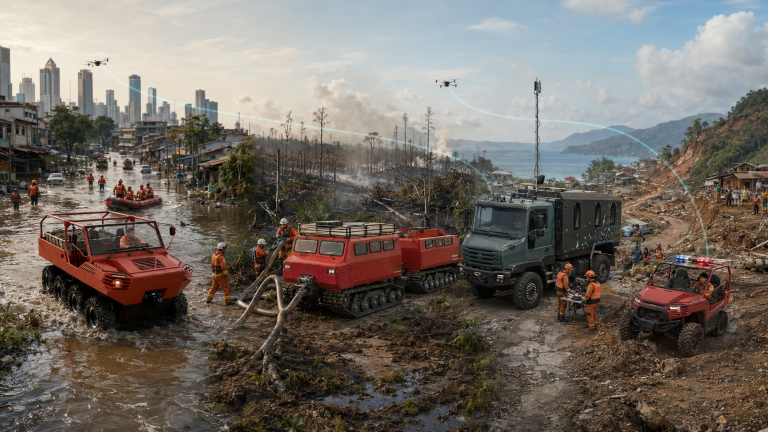
Conventional road vehicles may struggle to reach a natural bank where peat, soft silt and standing water meet. Conventional vessels may be restricted by local draft or landing arrangements. A mixed-terrain response must therefore consider both movement in water and controlled exit onto a bank or artificial island.
When an amphibious platform climbs ashore, buoyancy support diminishes while track contact forces rise. Soil shear strength, bank slope, obstacle geometry, vehicle trim, traction and rear-section loading all affect the result. The ability to float or move at a published water speed does not prove successful landing on an unprepared bank.
Six practical offshore energy missions worth evaluating
01 — Nearshore emergency equipment logistics: carry suitable portable hoses, tools, absorbents and communications equipment toward authorized shoreline staging areas.
02 — Shallow-water inspection support: convey qualified personnel and inspection gear on surveyed routes near canals, tidal approaches and artificial islands.
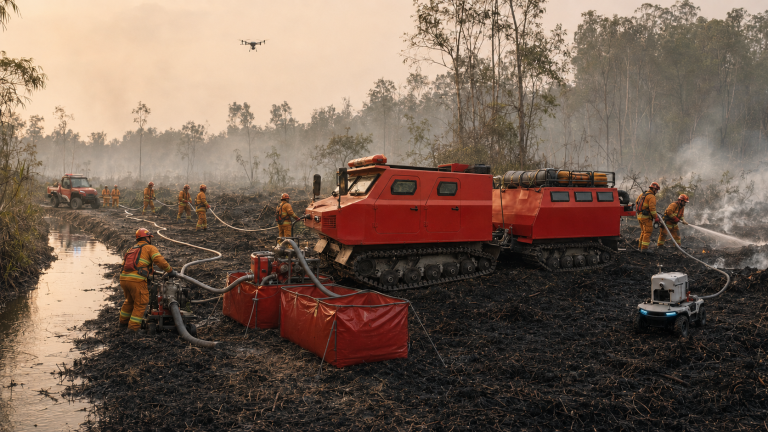
03 — Firefighting-support transport: move portable firefighting equipment and personnel; pump operation and firefighting classification are separate engineering scopes.
04 — Oil-spill response logistics: transport appropriate booms, pumps and supplies without entering restricted or environmentally sensitive areas without permission.
05 — Storm or flood recovery: support remote access between damaged onshore roads and prepared incident-control points following a site safety review.
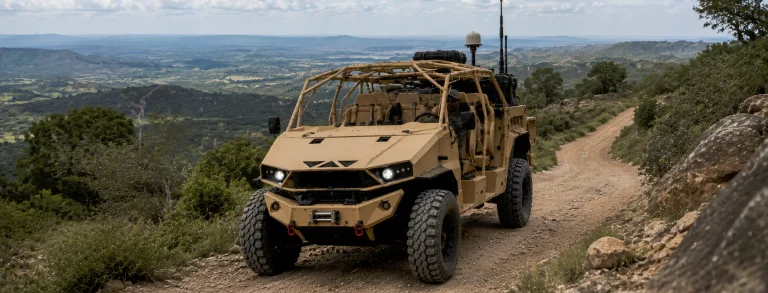
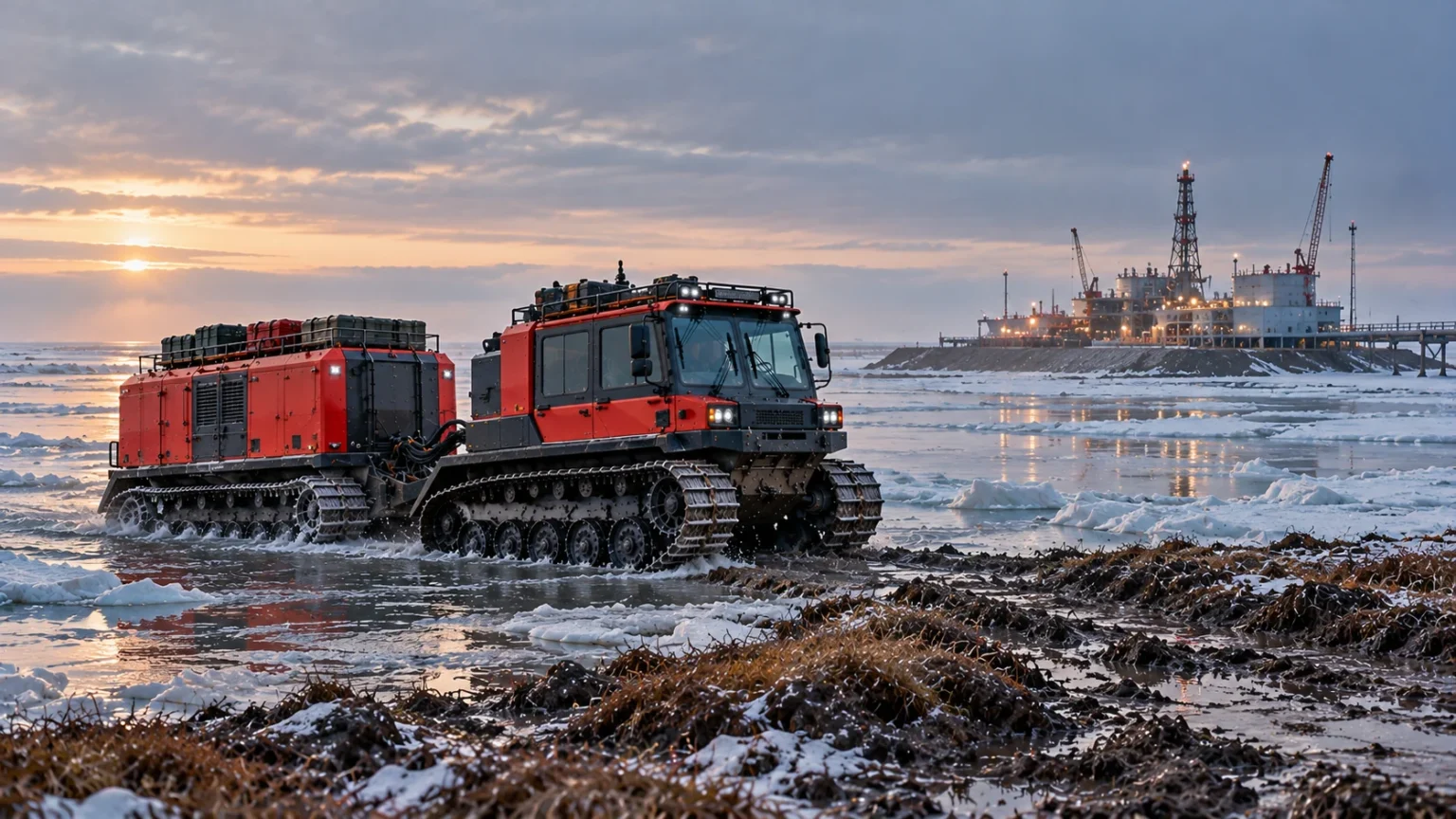
06 — Seasonal cold-region support: evaluate movement near snow, shore ice and shallow water; ice travel and icebreaking are independent capabilities.
These are proposed application categories, not reports of confirmed JJ117 projects at a named offshore installation.
Four capability levels must not be confused
Fording: a vehicle traverses water while remaining substantially supported by the ground. Flotation: the craft supports its operating mass by buoyancy. Powered water navigation: propulsion and control are adequate for defined conditions. Certified offshore service: the vehicle meets the applicable flag-state, class, crew and operational requirements for its precise role.
A design may meet one level without meeting the next. In particular, ice-surface travel, floating-ice handling and active icebreaking are further, separate tasks. A request to break 0.6 m ice requires its own design basis and cannot be inferred from tracks.
Firefighting vessel versus emergency logistics carrier: a design decision
Marine external firefighting is an integrated system. Capacity is driven by the required flow and pressure, monitor arrangement and throw, duty duration, pumping power, water-intake reliability, cooling and controls. On a floating platform, jet reaction forces can create heeling and yawing moments. Stability must be checked for credible combinations of pumping, load and environmental effects.
Industry descriptions of FiFi 1 typically refer to large external pumping and monitor systems measured in thousands of cubic metres per hour. Those references help define a possible scope but do not establish what a particular tender requires. An emergency logistics carrier, a small auxiliary water monitor and a fully classed firefighting vessel are not interchangeable products.
If a new platform must meet a formal FiFi class, its exact notation, limits and acceptance pathway should be agreed with the designated class society and flag administration at concept stage. No FiFi 1 classification is stated for JJ117 on the official product page.
Marine safety, classification and ice-area limits
Marine approval is not determined by appearance or propulsion alone. The relevant administration and classification body may review intact stability, reserve buoyancy, watertight subdivision, downflooding, propulsion, navigation, life saving, fire and machinery systems, crew competency and construction drawings. Novel or small craft may need a specific equivalent-approval approach.
IMO stability materials provide international context but the exact rules depend on vessel type and size. SOLAS Chapter XV applies to defined ships carrying industrial personnel, not automatically to every small tracked amphibious craft. The IMO Polar Code has defined geographical applicability and should not be presented as a universal rule for the Caspian Sea or every cold-water site.
Operational permission may also depend on the place of registration, the local operator and the intended year-round response duty. Certification must be verified before commitments on availability or service commencement.
Oil-and-gas HSE: H₂S detection is only one protective measure
Offshore oil and gas incidents may involve hydrogen sulfide, flammable vapours, high radiant heat and contaminated water. A gas detector on board is useful only as part of a larger assessment; it does not make an ordinary engine, electrical system or passenger compartment explosion-proof or suitable for entry into a toxic-gas plume.
Risk assessment should cover exclusion zones, gas detection and alarms, respiratory protection, ignition-source controls, personnel protection, emergency withdrawal, remote communications and recovery. The platform should be staged outside hazardous zones unless a specific approved configuration and operating procedure permits otherwise.
JJ117 manufacturer-published facts: X1 and X2 are distinct variants
JINJIA / Response Mobility publicly lists JJ117-X1 and JJ117-X2 as Tracked Utility Vehicle configurations. Both have a manufacturer-published “Weight” field of 17,000 kg, maximum road speed of 65 km/h and operating-temperature range of −43°C to +50°C. Dimensions: X1, 9.1 × 2.45 × 3.6 m; X2, 9.1 × 2.45 × 2.6 m. The 17,000 kg entry is NOT a 17-tonne rated payload.
The JJ117-X2 page states “Floating Speed (Water)” of 5 km/h. The JJ117-X1 page lists a 1,500 L/min pump and a 500 L/min water-cannon flow, but this does not prove that a single JJ117 configuration combines the X2 water performance with the X1 firefighting equipment. It also does not demonstrate offshore seaworthiness or FiFi 1 approval.
Published numbers are manufacturer specifications, not independent evidence of open-water endurance, reserve buoyancy, unprepared-bank recovery, icebreaking, corrosion resistance or approved crew carrying. Some X2 firefighting data have inconsistent units and are deliberately excluded pending clarification. Official source: https://responsemobility.com/tracked-utility-vehicle/
Ten questions to settle before a concept or quotation
01 — What exact duty is required: emergency logistics, auxiliary firefighting or classed offshore fire suppression?
02 — What fire performance is required: pump flow, pressure, monitor throw, extinguishing agent and duration?
03 — What is the operating location, water depth, current, wind, wave state and transit distance?
04 — Must the craft self-propel across open water or only cross surveyed shallow routes?
05 — What shoreline and island interfaces, bank slopes, soils and landing obstacles are expected?
06 — What ice conditions apply, and is active icebreaking a mandatory acceptance test?
07 — What crew, passenger, payload, duty cycle, night-operation and response-time requirements apply?
08 — Which flag state, class society and local authority will approve the vehicle and its operating role?
09 — Are H₂S monitoring, hazardous-area approval, winterisation and rescue/recovery specified?
10 — Is the procurement for equipment supply, or for a chartered 24/7 manned service—with separate responsibilities?
Frequently asked questions (FAQ)
Q: Can a tracked vehicle replace a FiFi 1 vessel?
A: Not by default. Equivalent fire performance, marine stability and an accepted class/flag-state pathway must be demonstrated for a defined mission.
Q: Does the JJ117-X2 water speed prove offshore suitability?
A: No. A published 5 km/h floating speed is not evidence of wave limits, reserve buoyancy, sea trials, or marine certification.
Q: Can an amphibious tracked platform climb onto an unprepared bank?
A: That is a separate traction and shoreline-transition requirement needing bank geometry, soil and loaded testing.
Q: Can the same platform break thick ice?
A: Active icebreaking is a distinct structural and propulsion capability; no verified JJ117 icebreaking rating is published.
Q: Does an H₂S sensor make the craft safe for a sour-gas incident?
A: No. Exposure, hazardous-area electrical design, procedures, PPE and exclusion zones must be evaluated.
Q: What should a buyer send to JINJIA?
A: Operating Terrain | Required Payload | Environmental Conditions | Intended Application | Estimated Quantity, plus water/ice, firefighting, classification and crew requirements.
Discuss a purpose-built offshore emergency mobility concept
JINJIA / Response Mobility evaluates modular tracked mobility platforms for difficult industrial terrain. We recommend first defining the emergency mission and approved operating envelope, then checking whether an existing transport variant, a modified amphibious platform or a new marine-class concept is appropriate.
Please send: Operating Terrain | Required Payload | Environmental Conditions | Intended Application | Estimated Quantity. For offshore proposals, add water depth, landing details, waves/current, firefighting targets, flag/class expectations and operator role.
Review JJ117: https://responsemobility.com/tracked-utility-vehicle/ | Engineering enquiry: https://responsemobility.com/contact/ | Email: info@responsemobility.com
Sources and verification references
JINJIA — official Tracked Utility Vehicle JJ117-X1 / JJ117-X2 page (checked 2026-10-15) — https://responsemobility.com/tracked-utility-vehicle/
IMO — Ship Design and Stability — https://www.imo.org/en/ourwork/safety/pages/shipdesignandstability-default.aspx
IMO — International Code on Intact Stability 2008 / ships and novel designs — https://wwwcdn.imo.org/localresources/en/KnowledgeCentre/IndexofIMOResolutions/MSCResolutions/MSC.267%2885%29.pdf
IMO — SOLAS Chapter XV / industrial personnel, applicability must be assessed — https://www.imo.org/en/about/conventions/pages/international-convention-for-the-safety-of-life-at-sea-%28solas%29%2C-1974.aspx
IMO — Polar Code (for operations within its defined geographical applicability) — https://www.imo.org/en/ourwork/safety/pages/polar-code.aspx
OSHA — Hydrogen sulfide in oil and gas workplaces — https://www.osha.gov/hydrogen-sulfide/hydrogen-sulfide-workplaces
Marine Firefighting Resource Assessment (Port of London study, class context) — https://www.readkong.com/page/2021-marine-firefighting-resource-assessment-study-8813961