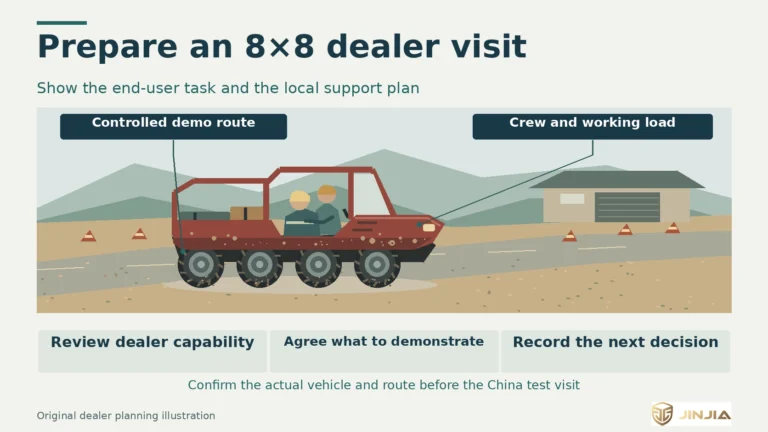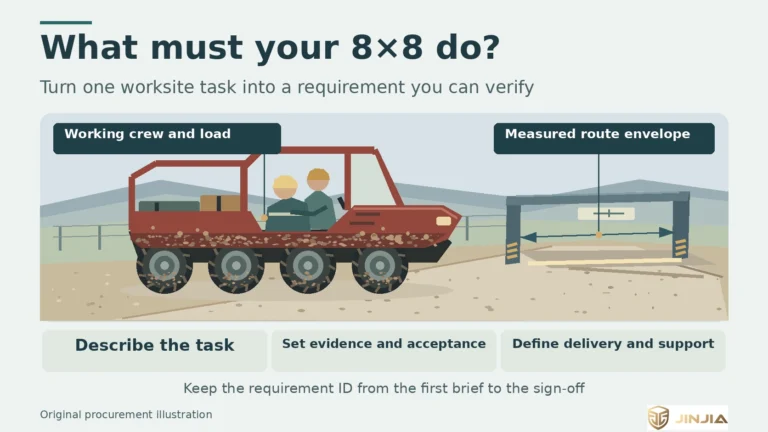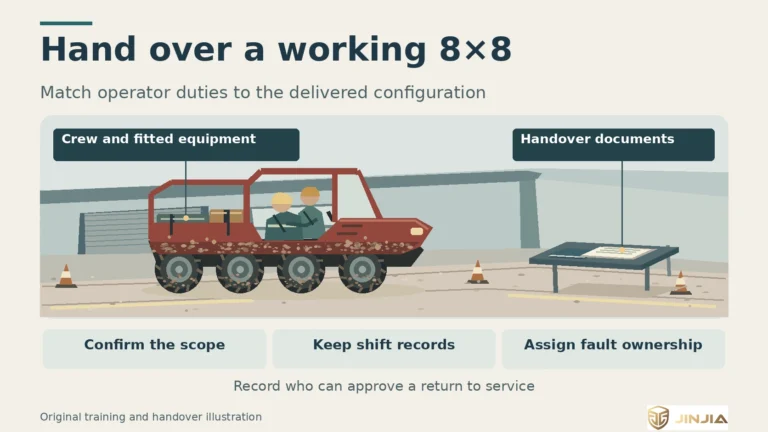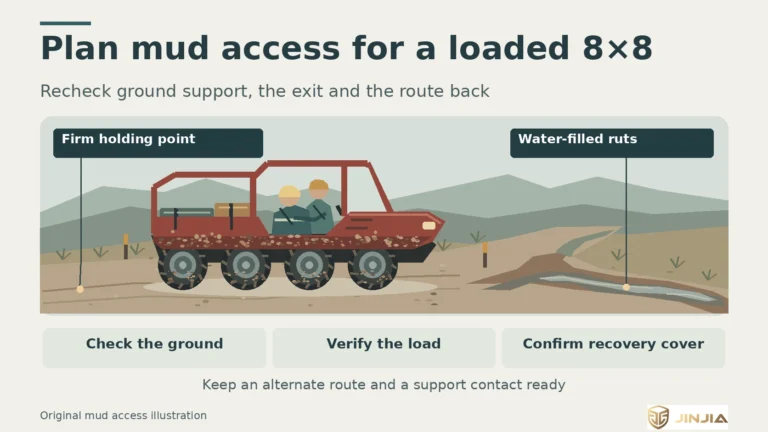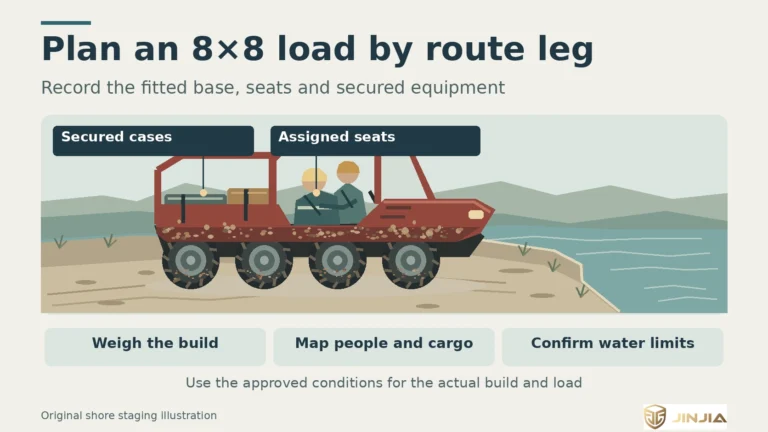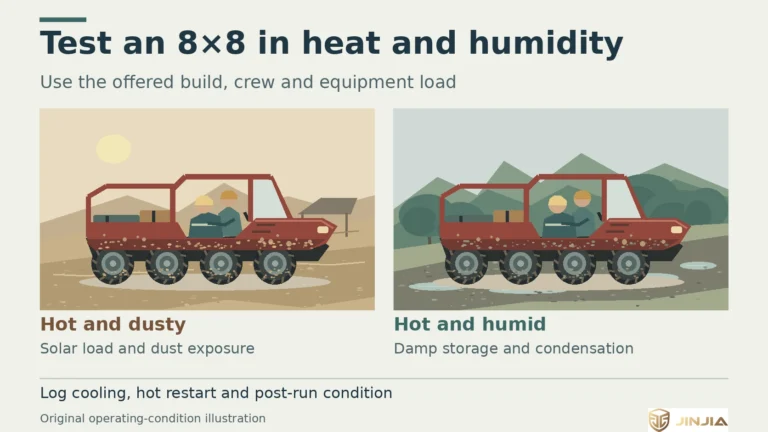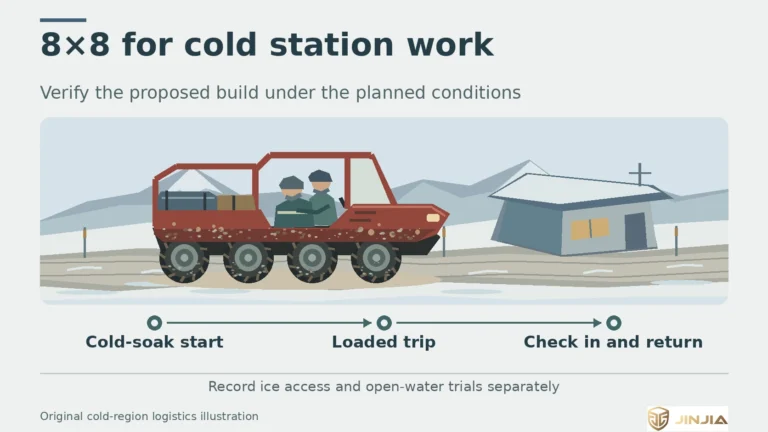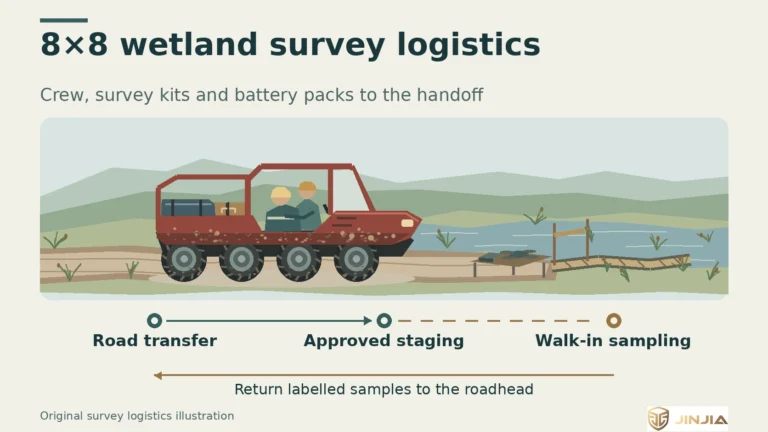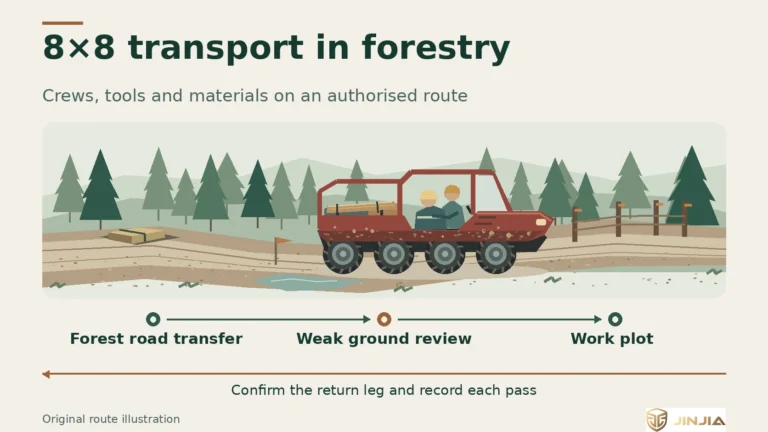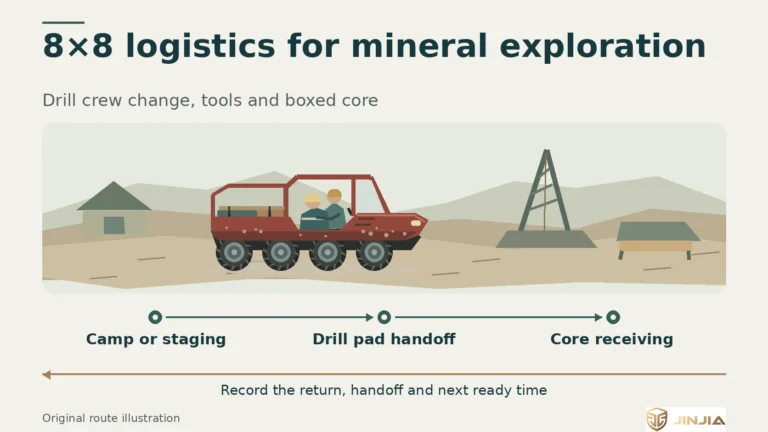


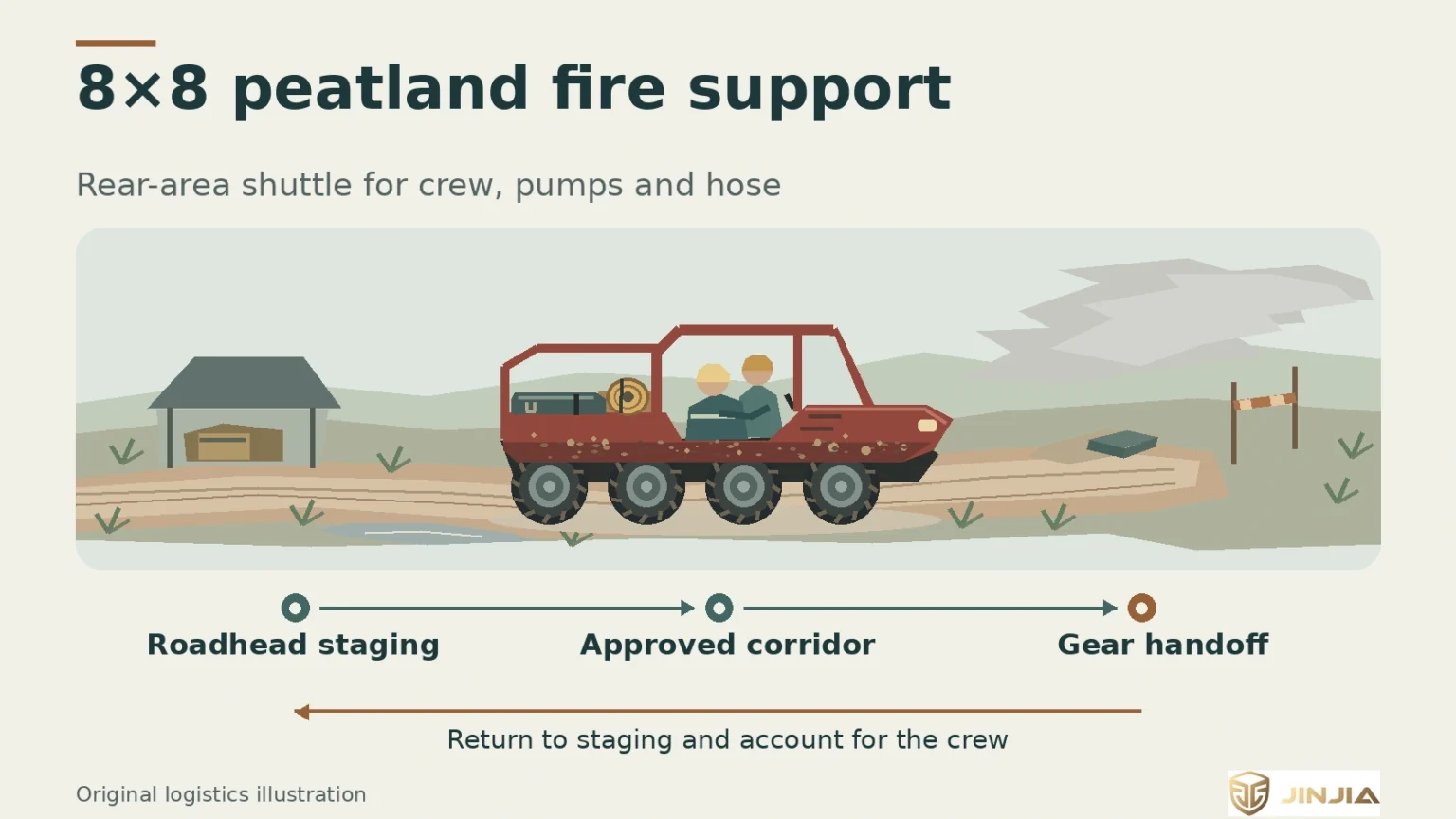
Move personnel, a packed pump and hose between roadhead staging and the approved handoff. Confirm the return and headcount.
Define the 8×8 support mission
A peatland firefighting support vehicle can shuttle authorised personnel, packed pumps, hose, tools and limited water between a roadhead and a designated handoff. Define the trip, load and return before selecting the vehicle. The incident team sets the transport corridor, work boundary and latest return requirement.
JINJIA 88E uses range-extended electric drive and 88D is diesel. Evaluate each proposed build for the seats, packed load and approved route. Write the purchase requirement around rear-area transport, with any fitted equipment reviewed as part of the delivered build.
What the West Yorkshire records establish
Annex 1 of West Yorkshire Fire and Rescue Service’s January 2020 Wildfire Review describes an ARGO 8×8 700HD used for moorland incidents, with its own water supply and a removable fire fog unit. The review describes a specific service vehicle and configuration. (S03)
The service’s report for the Castle Hill grass fire in Huddersfield on 3 July 2025 records Argocats among the equipment used. An update on 4 July describes water relay operations by the responding crews. The report leaves the Argocat model and its individual role in that relay unspecified. Procurement evidence for a proposed 8×8 configuration comes from its own vehicle and integration records. (S04)
Arrange access for people and equipment
Mark the roadhead transfer, authorised travel corridor, handoff, turning point and return route on the incident map. Assign a dispatch lead and a named receiver. Confirm the driver, approved seats and restraints, headcount in each direction and loading space for secured equipment. Leave enough usable access at the handoff for unloading and an unobstructed return.
Record staffing, communication checks and the return or check-in window before releasing the trip. Survey the intended surface and turns with the route owner, including any bridges or drainage crossings. If access depends on a water crossing, assess that segment, water loading and both banks separately with the incident and vehicle teams. The NWCG operational briefing structure is a useful reference for transport, communications and contingency planning. (B18-E2)
Plan water and tool resupply
Give the transport team an itemised load for each leg. Record packed pump mass, hose bundles, couplings, tools and any filled containers. Include occupants, installed racks and the usable capacity of the selected build. Confirm low, secure stowage and a clear unloading method. Specify the receiving point, quantities and next delivery window, plus the return of wet hose, empty containers or tools.
For sustained firefighting water, agree who provides the bulk supply and where it transfers to the crew. Evaluate a water tender or a separate relay for the main supply. Use a light 8×8 for the replenishment loads it can carry under the approved trip plan. For an electric pump or lighting at the handoff, evaluate the 88E’s stationary output with the actual equipment. Confirm interface and protection, start-up demand, sustained load and duty cycle. Verify any power requirements for the 88D separately.
Set heat-exposure and withdrawal conditions
Peat can continue smouldering below the surface after visible flames subside. A route assessment therefore needs the incident lead’s current view of heat, smoke, visibility, ground condition and escape access. Agree the vehicle and personnel limits, reporting channel, turnaround and rally point during the briefing. Use limits approved for the actual incident and build. (B18-E1 · B18-E2)
Write down who can call a hold or withdrawal and who will account for the people on return. Changes in smoke, communications, terrain or return access call for reassessment under the incident plan. Keep the support leg within the authorised corridor. Exercise a hold, return and headcount in an approved drill using a representative load and a designated fallback.
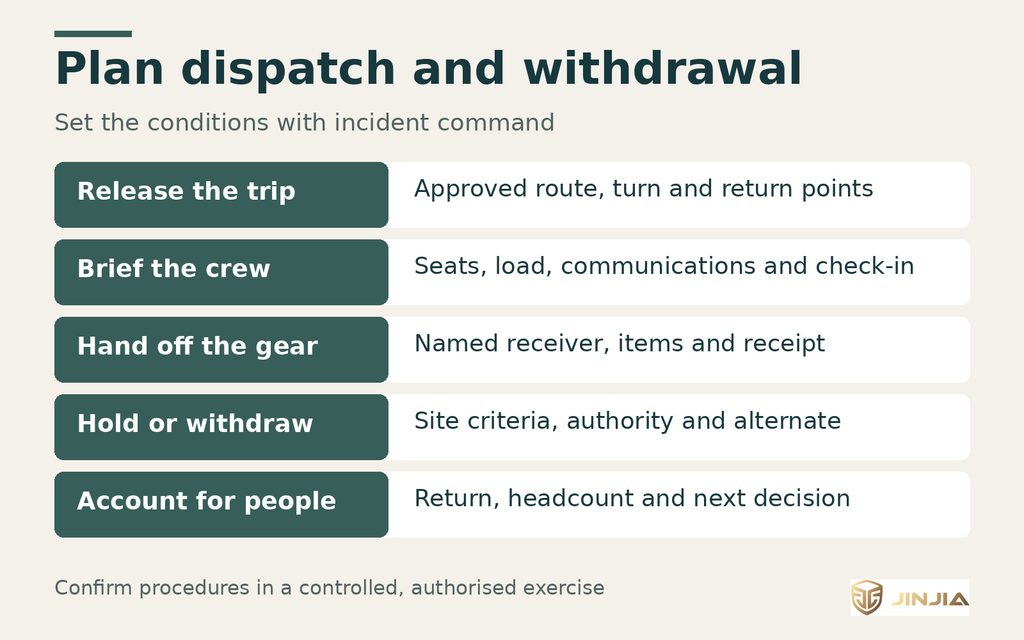
Record the approved corridor and escalation conditions. Confirm the return and account for personnel before another trip.
Verify the boundary and compare alternatives
Use the 8×8 for the shortest approved leg that still solves a transport problem. A road vehicle may reach the transfer point with more water or crew space. A suitable carrier may be preferable for a heavy pump assembly. A separate relay may sustain water delivery when repeated transport runs consume the available route window.
If the specification requires a mounted pump, tank, thermal protection or a certified firefighting appliance, ask the bidder for vehicle-specific integration and applicable approval records. Compare handoff time, payload, access, communications and the ability to withdraw during a controlled trial. Keep the existing Indonesian peatland fire article as the reference for the broader response system.
Give procurement a one-page support brief
• Route. Attach the approved corridor, handoff and return points, the alternate and any separate water leg.
• People. List crew counts by direction, seats, restraints, dispatch lead, receiver and return headcount owner.
• Cargo. Record loaded masses, restraints, delivery windows, unloaded gear and the bulk water supply arrangement.
• Power. Supply the intended pump or lighting input requirements and confirm the 88E’s offered interface if needed.
• Release and withdrawal. State the operating boundary, briefing conditions, hold authority, communications, fallback and evidence required from the drill.
Send the route, load list and operating conditions to JINJIA for an 8×8 configuration review. Refer to the broader Indonesian response framework and the field power and flood vehicle guides when those topics apply. Contact · Karhutla response framework · Field power · Flood response vehicle selection
Frequently asked questions (FAQ)
A: Confirm the roadhead, authorised route and handoff, seats and load by direction, named receiver, communications and return point.
Q: How should water and tool resupply be recorded?
A: Record the packed or filled load by leg, quantities, restraints, delivery window and receipt. Identify the separate source and transfer point for bulk water.
Q: What evidence is needed for heat exposure and withdrawal?
A: Obtain the offered vehicle’s operating limits and the incident team’s access, hold and withdrawal criteria. Use a loaded exercise to check communications, the fallback and accountability.
Q: Can the 88E supply an electric pump at staging?
A: Assess the stationary output and the actual pump together. Verify connector, protection, start-up demand, sustained load and duty cycle on the supplied configuration.
Q: What do the two West Yorkshire records prove?
A: The 2020 review identifies a specific ARGO 700HD configuration for moorland use. The 2025 grass-fire account records Argocats, with the model and each vehicle’s role left unspecified.
Q: When is a separate water carrier or relay preferable?
A: Evaluate it when water demand, route access or delivery windows exceed the validated replenishment role of the light 8×8.
Sources and further information
[S03] West Yorkshire Fire and Rescue Service | Wildfire Review, Annex 1
[S04] West Yorkshire Fire and Rescue Service | Castle Hill, Huddersfield wildfire
[B18-E1] Indonesia BRIN | Peatland fire risks and groundwater monitoring, 1 September 2026
[B18-E2] NWCG | Incident Response Pocket Guide, PMS 461, briefing checklist