

In this Delta series, AGV means Autonomous Ground Vehicle: a ground vehicle that can carry out specified driving functions without a person continuously directing each movement, within defined operating conditions. UGV means Unmanned Ground Vehicle and describes a vehicle operating without an onboard driver. A remotely driven UGV is not automatically autonomous. In industrial logistics, AGV also commonly means Automated Guided Vehicle, so the full term and intended task belong in every requirement.
For an outdoor patrol buyer, the useful question is what the machine must do on a particular route and when a person must intervene. This article explains the terminology and how to turn it into a clear Delta 150 enquiry.
At a glance
– Here AGV means Autonomous Ground Vehicle; industrial AGV can mean Automated Guided Vehicle.
– UGV describes unmanned operation; the term does not establish the supplied autonomous functions.
– For Delta 150, agree the driving task, route conditions, human intervention and acceptance evidence.
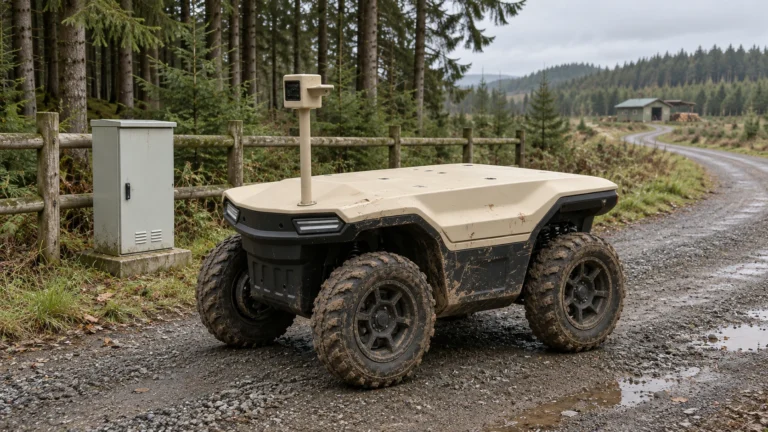
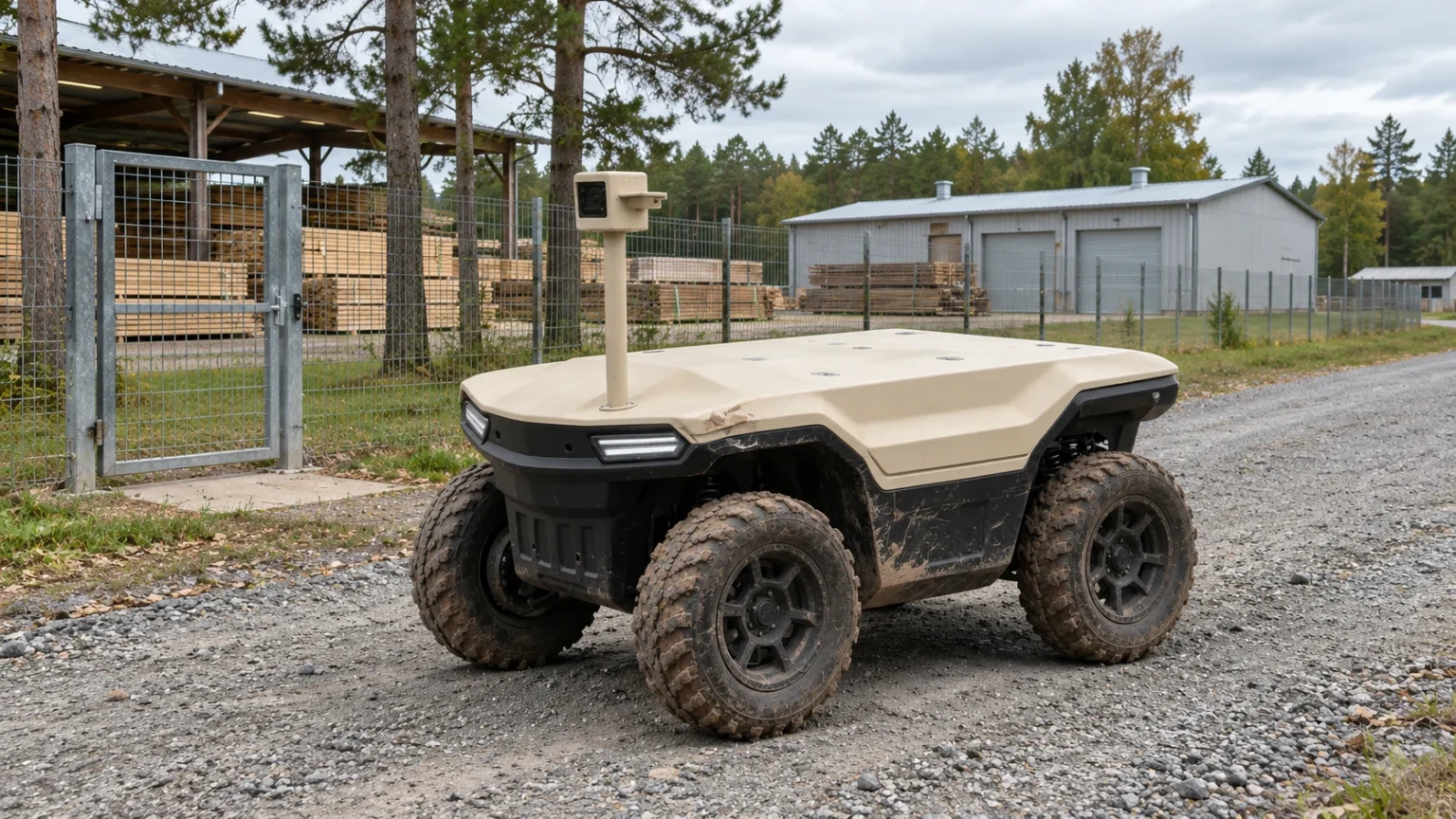
AI concept visualisation of Delta 150 with observation equipment on a controlled service lane outside a timber facility. Equipment and operating mode require confirmation.
What Autonomous Ground Vehicle means
An Autonomous Ground Vehicle uses its configured sensing, localisation and control functions to perform agreed driving actions. A specification might require the vehicle to follow an approved route, reach an observation point and stop there. The word autonomous does not tell you which of those functions is supplied, where it works or how exceptions are handled.
The term is used outside warehouse logistics. A Umeå University forestry navigation pre-study used Autonomous Ground Vehicle for a proposed forest machine path-tracking system. That 2002 research is a terminology example, not evidence of present Delta performance or an industry-wide definition.
Write the required behaviour in plain language. “Follow this surveyed service lane and stop for operator review when the route is blocked” is more useful than “supply a fully autonomous AGV”. The exact stopping behaviour, detection conditions and method of recovery still need agreement and testing.
Why AGV also means Automated Guided Vehicle
In manufacturing and distribution, AGV commonly expands to Automated Guided Vehicle. A NIST paper on industrial AGV obstacle detection uses that meaning in a material-handling context and examines navigation methods. It also shows why the acronym alone cannot determine how sophisticated a vehicle is.
Do not infer that every industrial AGV needs a painted line or magnetic tape, or that every outdoor AGV can freely choose a route. Navigation methods vary. Check the full product description, its intended environment and demonstrated functions.
| Term in a requirement | Meaning to make explicit |
| AGV as Autonomous Ground Vehicle | Which driving functions are autonomous, under which route and operating conditions, and with what human supervision? |
| AGV as Automated Guided Vehicle | What guided transport task and navigation method are intended, and what site preparation is required? |
| UGV as Unmanned Ground Vehicle | There is no onboard driver during the unmanned operation; the control mode must be specified separately. |
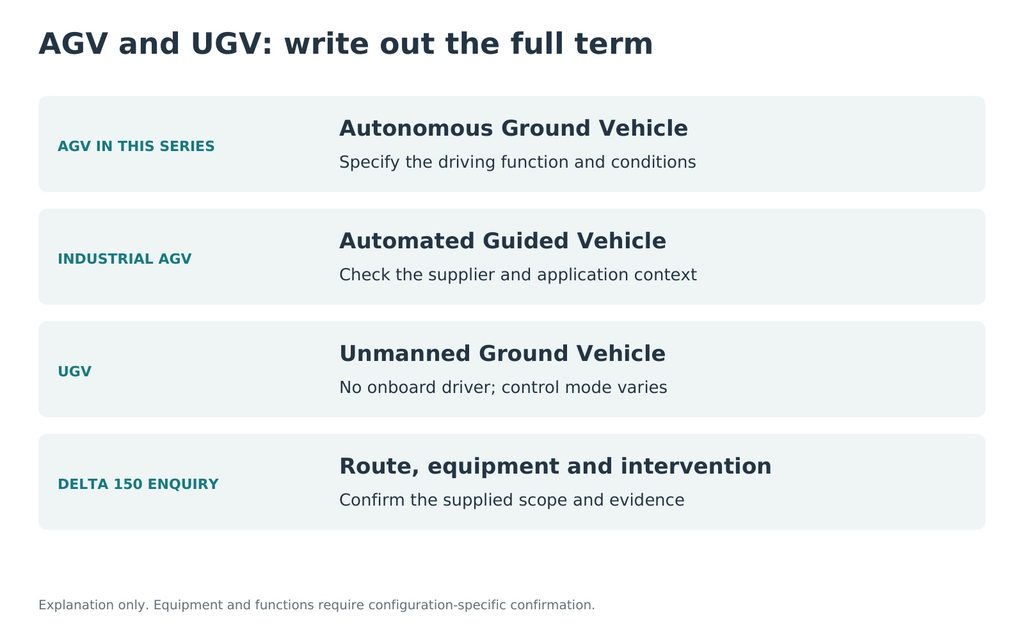
AGV has two common expansions in different contexts. UGV and autonomy describe different aspects of a system.
Keep one definition throughout the enquiry, quotation and acceptance documents. If a supplier uses AGV differently, retain its full term and compare the actual operating requirement. Changing an acronym does not resolve a configuration mismatch.
How UGV and autonomous operation relate
UGV and autonomous describe different aspects of the system. The first concerns the onboard driver; the second concerns the functions performed by the machine. A UGV may be remotely driven, assist an operator or perform defined autonomous actions. The same configured platform may support more than one mode, but each supplied mode needs its own description.
An early NIST autonomy framework relates autonomy to the mission, environment and human involvement. For procurement, that suggests a practical habit: describe those three together instead of assigning a universal autonomy label. This is an engineering approach, not a certification of Delta.
For example, route following on a controlled gravel lane does not establish permission or capability to enter a busy loading area. Automatic driving does not establish automatic interpretation of camera images. Someone must still review uncertain events and arrange any on-site response. For the broader platform definition, see what a UGV is.
Outdoor patrol and indoor transport ask different questions
An indoor transport task may focus on repeatable delivery between defined stations. An outdoor patrol task may focus on obtaining a useful view of a fence, gate or accessible asset. Both need traffic rules and exception handling; neither task can be selected from the acronym alone.
| Task question | What to compare before choosing equipment |
| What is a successful task? | For transport, the agreed load reaches its destination. For patrol, the agreed observation or inspection record is usable. |
| What does the route expose? | Check the actual surface, slope, clearance, lighting, weather and traffic. “Indoor” or “outdoor” is too broad on its own. |
| What must the payload do? | A cargo fixture and a patrol camera need different mounting, power and data arrangements. Navigation sensors do not automatically provide the required inspection view. |
| What happens when access changes? | Define restricted areas, closed gates, temporary obstacles and the person authorised to release or recover the vehicle. |
| What keeps the service available? | Agree communications, charging opportunities, cleaning and local support against the duty cycle. |
Consider a hypothetical timber facility perimeter. The initial task is to visit agreed observation points on a separated service lane and return usable gate and fence images. It does not include timber handling, entering truck loading lanes or independently identifying every incident. The route, camera view and review process should be tested as separate requirements.
This is an illustrative task, not a customer deployment. More outdoor mobility categories are covered in types of UGVs. A warehouse navigation demonstration is not evidence that the same configuration will work on that perimeter route.
What to confirm for a Delta 150 patrol configuration
The Delta family page positions Delta 150 as a compact electric 4×4 platform in the 150 kg payload class for patrol, inspection and remote observation. The task sensor package and operating mode are configuration decisions. A concept image cannot establish what comes with the supplied vehicle.
Before using autonomous in a purchase requirement, agree the route and permitted operating conditions, the supplied driving functions and software version, and the required operator role. Specify what must happen after loss of localisation or communications, when the route is blocked, and when the observation cannot be completed. Confirm emergency stopping, operator takeover and local recovery arrangements in the technical review.
For the mission equipment, identify the observation target, required view, mounting mass, power draw and data output. Include brackets, enclosures and communications equipment in the payload and power assessment. Confirm charging and supervision against the actual work schedule. None of these checks is replaced by the AGV label or by a headline payload figure.
Send JINJIA a route map or short video, the observation task and the required remote or autonomous operating mode through the contact page. Include traffic, operating hours and the expected image or record. Those inputs support a configuration discussion and a site-specific validation plan.
Frequently asked questions (FAQ)
A: Not exactly. Here AGV means Autonomous Ground Vehicle and describes configured driving functions. UGV describes unmanned ground operation. The terms can apply to the same vehicle but do not replace its specification.
Q: Does AGV always mean Autonomous Ground Vehicle?
A: No. Automated Guided Vehicle is a common industrial meaning. State the full term at first use and check the supplier’s intended application.
Q: Is an outdoor AGV automatically more capable than a factory AGV?
A: No. Compare the demonstrated task, environment and human involvement. Indoor and outdoor systems can each have demanding requirements.
Q: Does autonomous patrol mean no personnel are needed?
A: No. Supervision, event review, charging, maintenance and recovery responsibilities remain part of the operating plan. The required staffing depends on the task and supplied system.
Q: Is every Delta 150 supplied with the illustrated camera and autonomous functions?
A: No such assumption should be made. Confirm the sensor package, software functions, interfaces and operating conditions in the agreed supply scope and acceptance plan.
Q: Where do Delta 500 and Delta 1000 fit?
A: They provide other payload-class options in the Delta family. Start with Delta 150 for the compact patrol and observation task discussed here; evaluate the other models separately when equipment or supply loads require them. Do not transfer Delta 150 functions or operating limits to another model without verification.