

A UGV, or unmanned ground vehicle, is a vehicle that works on the ground without carrying a human driver. It may be remotely operated, perform defined tasks autonomously, or combine those modes. For outdoor inspection, the useful question is what the complete system can observe, record and hand over on a particular route.
JINJIA Delta 150 is a compact electric 4×4 platform in the 150 kg payload class, positioned for patrol, inspection and remote observation. Its task equipment and operating mode must be specified for the site. The platform provides mobility; a usable inspection service also needs suitable sensors, communications, energy and a clear response process.
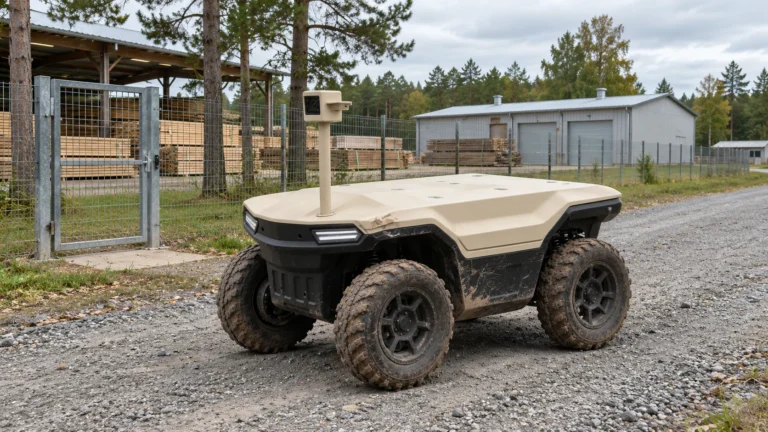
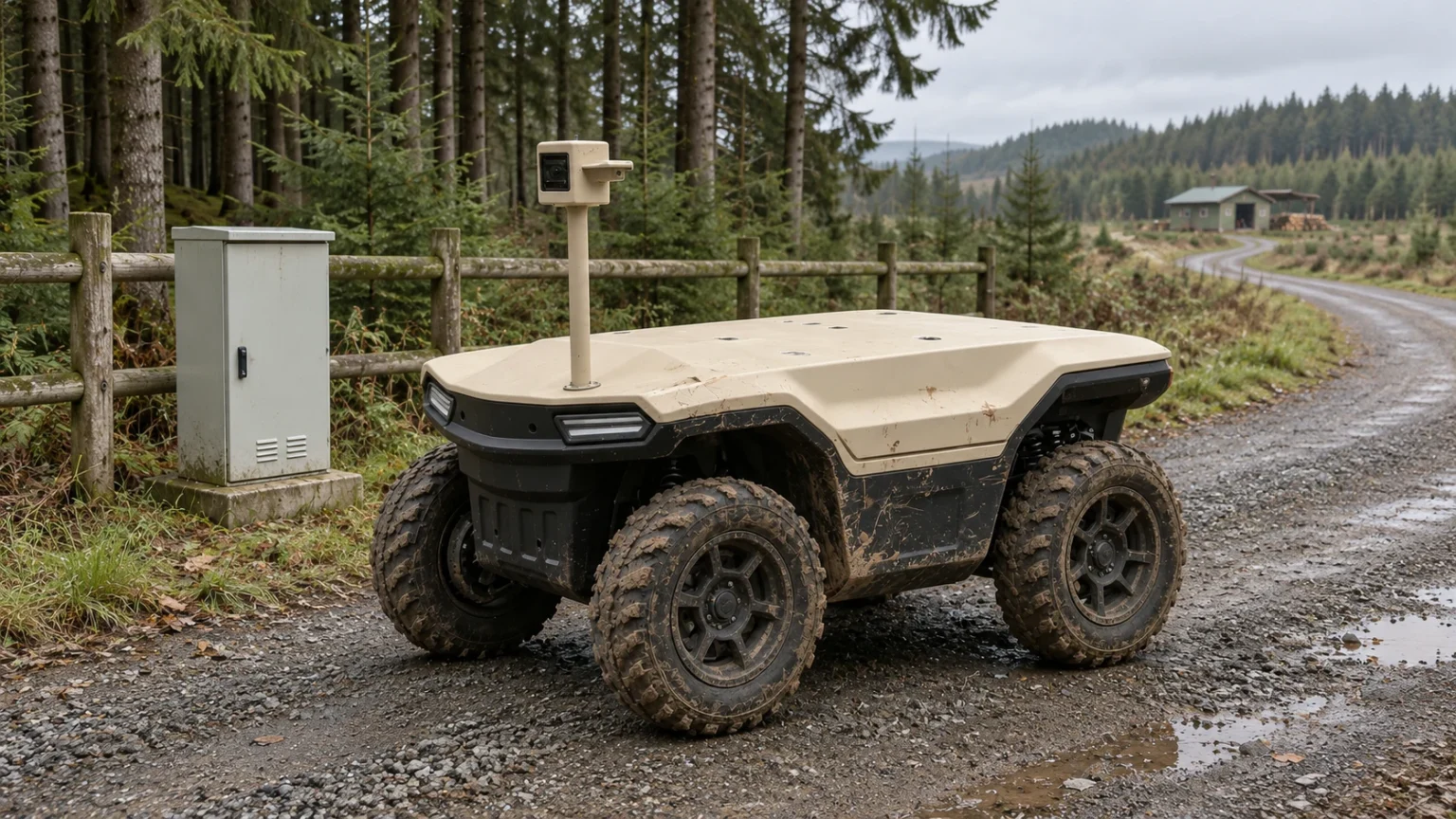
AI concept visualisation of Delta 150 carrying an observation camera on a gravel access road. Configuration and site suitability require confirmation.
UGV and AGV terminology
UGV describes a ground vehicle with no onboard driver. It does not, by itself, establish how independently the vehicle can work. A remotely driven inspection robot is still a UGV.
In this series, AGV means Autonomous Ground Vehicle when discussing autonomous outdoor ground operations. In industrial material handling, AGV also commonly means Automated Guided Vehicle, as illustrated by NIST research on industrial AGVs. Buyers should state the full term and the intended task when comparing proposals.
An outdoor inspection UGV may carry cameras to record a fence or a pump enclosure. A factory vehicle may move materials between workstations. Their route conditions, payloads and operating procedures can differ substantially. Compare the actual system specification rather than treating a shared acronym as proof of equivalent capability.
The vehicle and its mission equipment
The vehicle platform includes the chassis, drive system, power supply and control hardware. Mission equipment is what lets it perform a useful job: for example, a camera on a mast for observing an asset from an agreed stopping point.
Navigation sensors and inspection sensors can have different purposes. A camera that helps the vehicle move does not automatically produce the image detail, viewing angle or measurement quality required by a maintenance team. A thermal camera selected for navigation also should not be assumed to provide calibrated temperature measurements.
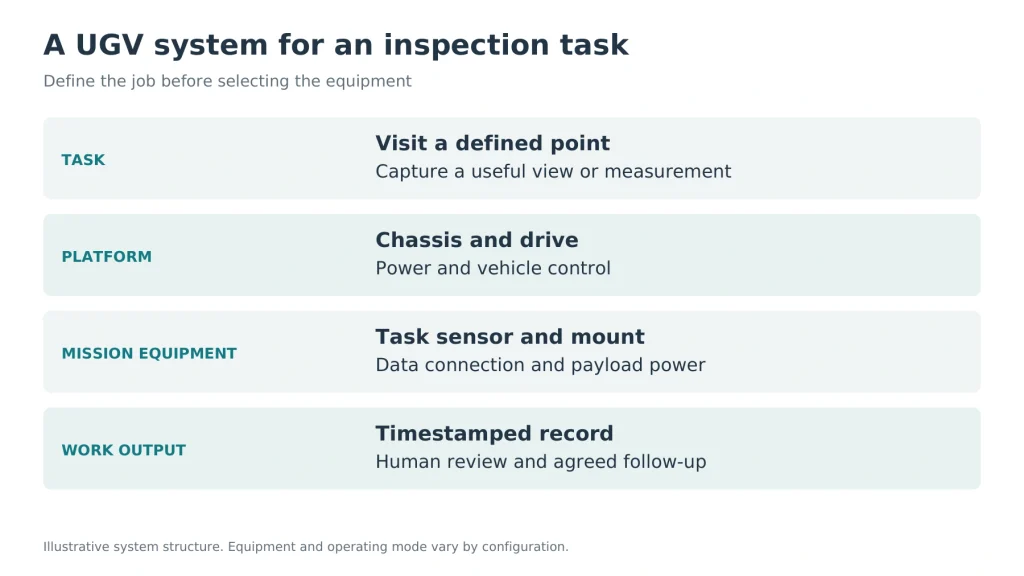
Illustrative relationship between the task, platform, mission equipment and usable inspection record.
Consider a proposed forest-road task: visit a utility cabinet, stop where the equipment is visible, capture an image, and send a timestamped record for review. The route must be accessible to the vehicle; the camera must see the target; the record must reach someone who can act on it. This is an illustrative workflow, not a report of a completed deployment.
Payload planning includes the camera, mast, mounts, protective enclosure, communications hardware and any added power equipment. Total mass is only one check. Mounting strength, centre of gravity, viewing clearance and electrical demand also affect the configuration. Adding equipment can change the duty cycle and route suitability.
Remote control and autonomous route operation
Remote operation means a person directs the vehicle through an appropriate control link. Assisted operation can automate selected functions while leaving other decisions to the operator. Autonomous route operation can execute an agreed route or task within defined conditions, with supervision and recovery arrangements specified for the system.
These descriptions are not interchangeable. Waypoint navigation does not establish that a vehicle can travel through any forest, cross public roads or negotiate uncontrolled truck traffic. Positioning, obstacle detection, communications and braking must be considered together on the intended route.
NIST’s autonomy framework relates autonomy to task complexity, environmental difficulty and human involvement. That is a useful way to frame a buyer’s questions; it does not assign a certification or autonomy level to Delta 150.
Before deployment, agree what happens if the control link is lost, positioning becomes unreliable, the route is blocked or a sensor fails. Define who can stop or take control of the vehicle and how it will be recovered. Cellular or satellite connectivity is a configuration decision requiring coverage and performance checks.
Where Delta 150 fits
Delta 150 is an option to evaluate when the intended task is moving a suitable observation payload along an assessed ground route. Candidate tasks include forest-road patrol, industrial perimeter observation and visual inspection of accessible external assets.
A good starting task has a clear target and an output that the site team can use. For example, a time-stamped image from a repeatable viewpoint may help a reviewer compare an external asset between visits. Whether the selected configuration provides sufficient detail must be tested at the actual distance and under relevant lighting.
An inspection robot still depends on people for task planning, reviewing uncertain events, maintenance and recovery. Continuous site coverage requires a workable operating plan, including charging and staffing. It should not be inferred from a battery range figure or an autonomy label.
The Delta UGV/AGV family also includes Delta 500 and Delta 1000 for different payload requirements. Those models merit a separate assessment when the task involves equipment, supplies or larger loads. This article focuses on Delta 150; operating performance and autonomy features should be confirmed for each model and configuration.
For broader selection, see types of unmanned ground vehicles and UGV applications. These explain the category and application choices without replacing a site assessment.
What to prepare before choosing an inspection UGV
Start with one repeatable job and collect the information below. This gives an engineering discussion more substance than a request for an “all-terrain autonomous robot”.
| Input | What the buyer should provide |
| Task and output | Target assets, observation points and an example of a useful record. |
| Route | A map or video showing surface, width, gradients, obstacles and turning space. |
| Traffic | People, trucks, crossings, available separation and permitted operating windows. |
| Sensor payload | Required view or measurement, equipment mass, mounts and power demand. |
| Duty cycle | Distance per round, stops, daily frequency and charging opportunities. |
| Communications | Coverage gaps, control-room access and permitted network connections. |
| Human responsibility | Supervisor, event reviewer, maintenance staff and recovery arrangements. |
| Acceptance evidence | Agreed task records, completion criteria and intervention logs. |
Use the first trial to measure useful work. Record whether the target was reached, whether the image or measurement was usable, how much human intervention was needed and what interrupted the task. Counting completed journeys alone can miss poor data quality or an impractical support burden.
Discuss a Delta 150 task with JINJIA. Send a route map or short video, the assets to inspect, payload needs, operating schedule and interface requirements through our contact page. We can use those inputs to scope the configuration and the checks needed before a field trial.
Frequently asked questions
A: No. UGV refers to the absence of an onboard driver. The vehicle may use remote control, assisted functions or autonomous operation under specified conditions.
Q: What does AGV mean in this series?
A: Here it means Autonomous Ground Vehicle. Industrial suppliers also use AGV for Automated Guided Vehicle, so compare the full term, application and operating specification.
Q: Does Delta 150 include every camera and software feature shown in a concept image?
A: No. Concept imagery illustrates a possible task. The supplied sensor package, software functions, interfaces and operating conditions must be confirmed in the configuration and scope of supply.
Q: Does 150 kg describe the vehicle’s own weight?
A: No. It identifies the platform’s payload class. The allowable installed equipment and its distribution need configuration-specific confirmation; the vehicle’s own mass is a separate specification.
Q: Can an inspection UGV replace all human patrol work?
A: Suitability depends on the job and site. A vehicle may support repeated observation, while people remain responsible for reviewing events, responding, maintaining equipment and recovering the system.
Q: How should a first project be scoped?
A: Choose a defined route, a limited set of observable targets and a useful output. Agree the operating conditions, human responsibilities and acceptance evidence before expanding the task.