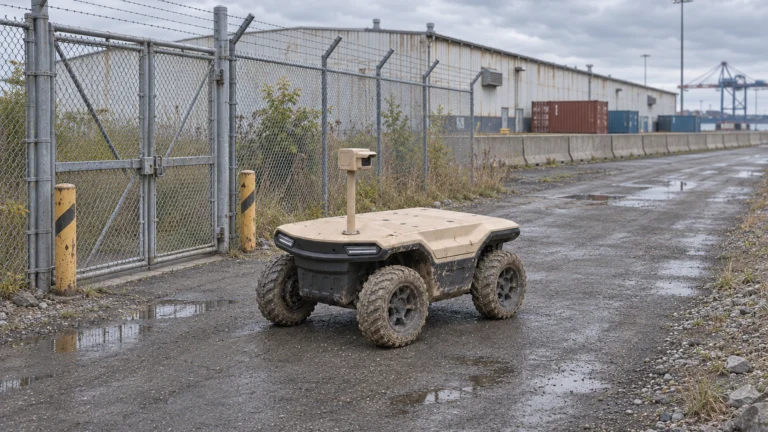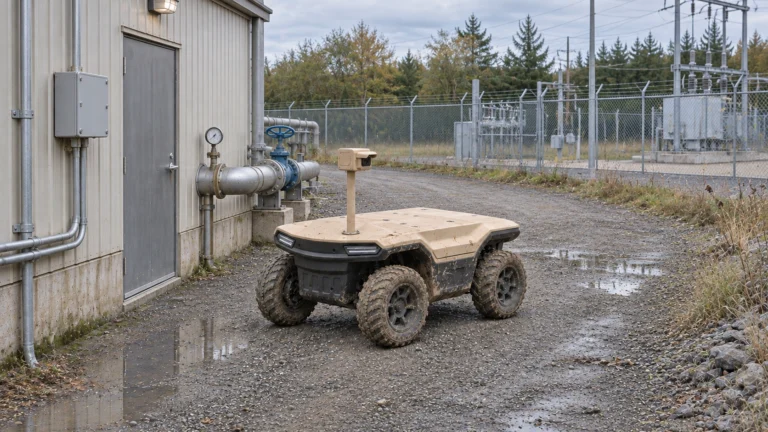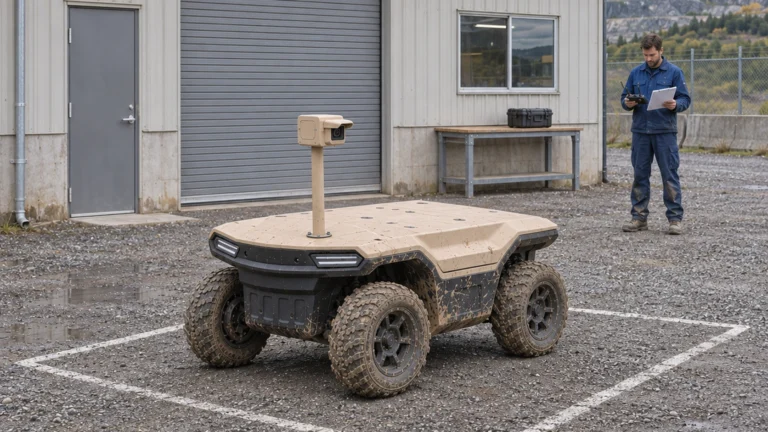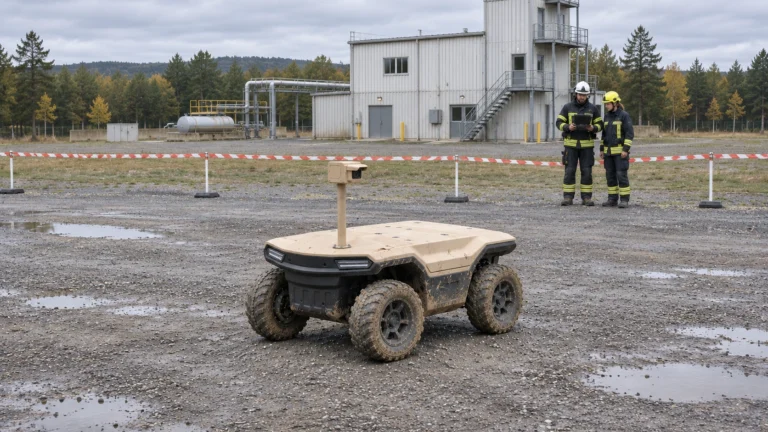


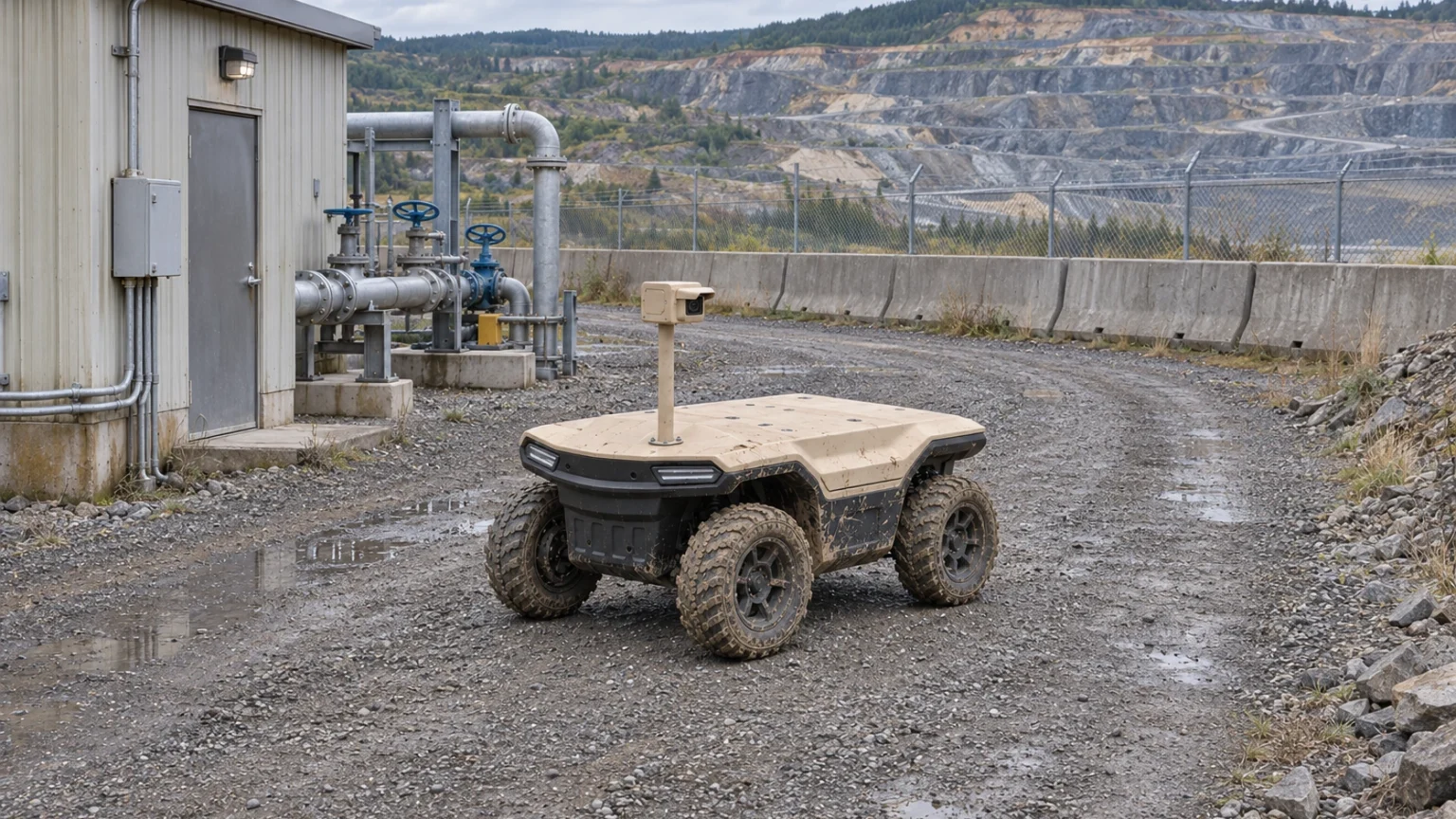
A surface mine inspection robot trial needs a small, useful inspection question before it needs a long route. An approved view of a pump building, fence or external equipment enclosure can be a better first task than travelling beside production vehicles. Define what the operator must learn, where the robot may go and who acts on the result.
Delta 150 is JINJIA’s four-wheel UGV in the 150 kg payload class. A camera-equipped inspection AGV is a proposed configuration for agreed ground routes. Here AGV means Autonomous Ground Vehicle; in some industrial contexts it means Automated Guided Vehicle. This article describes trial planning, not a proven mine deployment or autonomous haulage capability.
At a glance
• Start with accessible auxiliary assets and a controlled observation question.
• Separate the trial route from production traffic and define suspension conditions.
• Accept the evidence and support workload, not a successful drive alone.
Contents
Select accessible auxiliary facilities
Address mixed traffic and dust
Specify sensor viewpoints and records
Verify the route and communications together
Plan human support before the first run
Collect evidence against the task boundary
Frequently asked questions (FAQ)
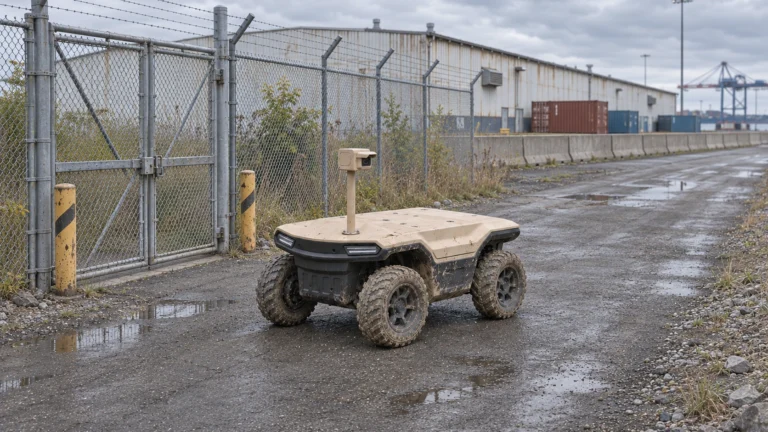
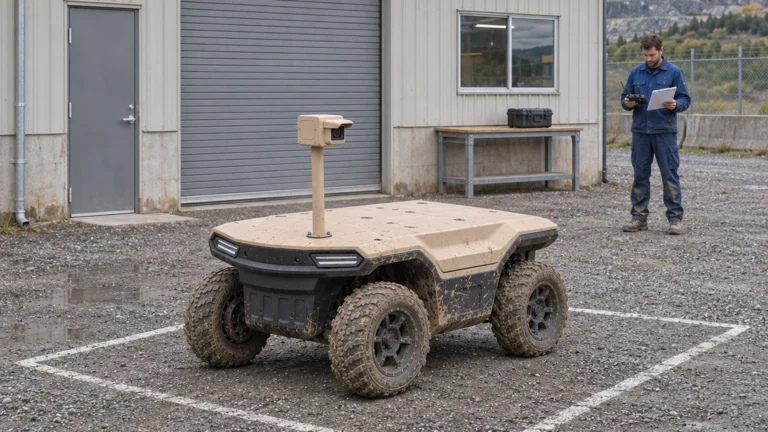
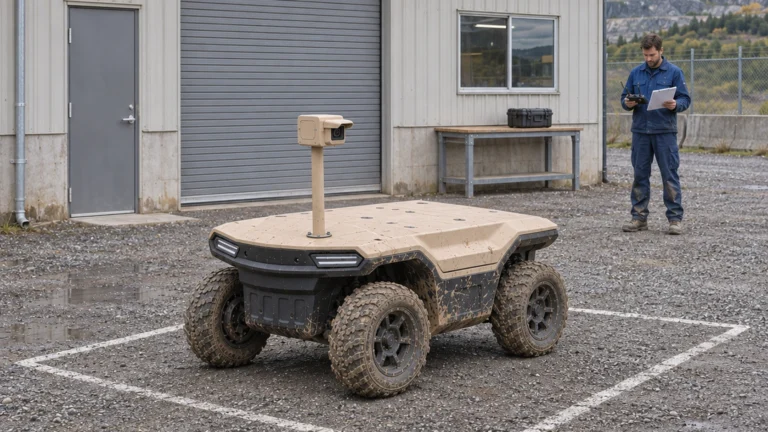
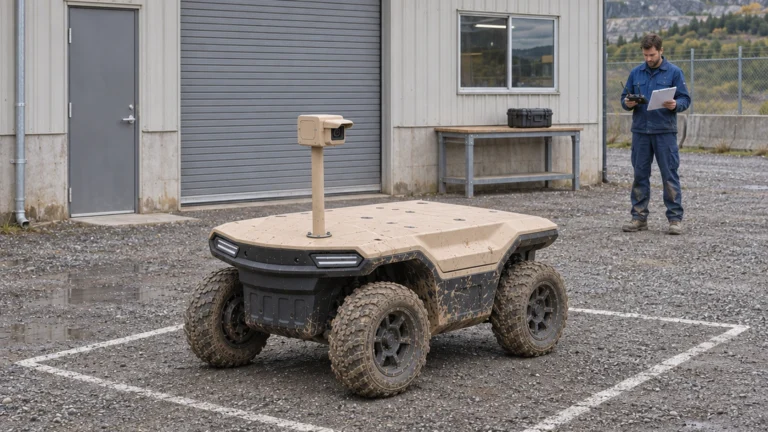
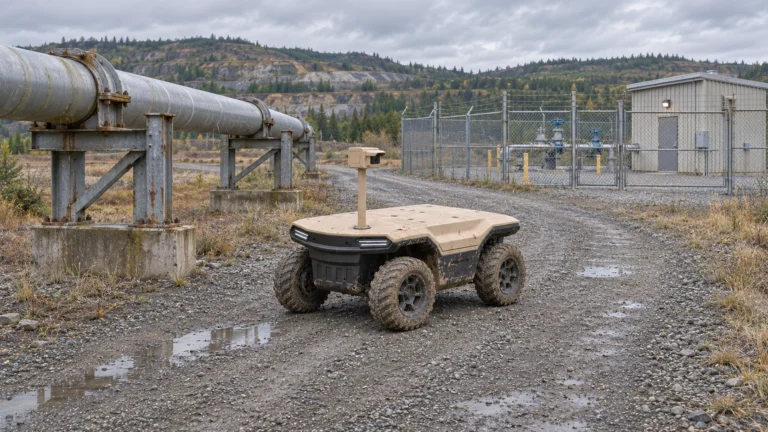
AI concept: proposed task-equipped Delta 150; configuration subject to confirmation.
Select accessible auxiliary facilities
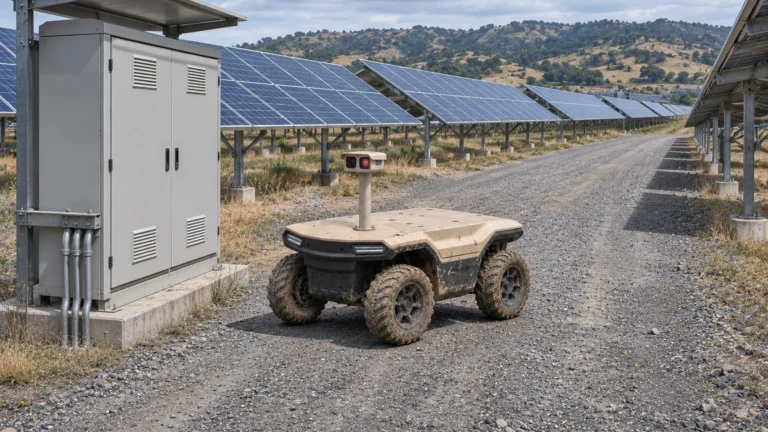
Ask operations for a short list of repeated checks that can be made from an authorised ground position. Potential subjects include the outside of a pump house, a service-area fence or the visible state of an equipment enclosure. Record the asset ID, expected view and decision needed. An image of an enclosure does not establish the condition of its hidden components.
Walk each candidate point with its owner. Check access width, drainage, turning space, loose stone and the loaded vehicle’s clearance. Exclude locations that require climbing, crossing an edge or entering an unapproved process area. Keep the first task narrow enough that a reviewer can distinguish a missed inspection from a merely incomplete journey.
Address mixed traffic and dust
The 2026 WorkSafe WA road and traffic code discusses separating vehicle classes and managing dust and road defects. Those are useful planning principles; local mine rules govern the project. For a compact inspection vehicle, prefer a physically controlled service route and an agreed operating window. A navigation sensor is not permission to enter a haul-road network.
Document any unavoidable crossing, its release authority and the waiting point. Separately record dust-related image loss, obscured navigation sensing and poor visibility for other road users. A clean-weather demonstration does not cover these cases. Set site-approved suspension and restart conditions, including changes after road watering, grading or production activity. Do not enter an active working envelope to obtain a better photograph.
Specify sensor viewpoints and records
Define what detail the selected camera must show at each observation point. Test angle, distance, target size, vibration and dwell using the actual payload and mount. For example, a hypothetical enclosure-door check needs a repeatable view of the door state; it does not need an unsupported claim to diagnose everything inside. Keep the original image and its observation time.
Use a thermal payload only for a defined thermal question. Surface contrast can direct a specialist’s attention, while quantitative temperature work needs suitable radiometric equipment and a measurement procedure. Lens contamination and reflective surfaces can invalidate a view. Record cleaning and repeat visits rather than silently replacing a failed sample with a better one. Navigation sensing and inspection payloads have different jobs.
Verify the route and communications together
Survey positioning and communications along the actual route, at stops and near buildings or stockpiles. A signal at the control room does not prove a continuous robot link. Note operating mode, delay, video quality and location confidence. Evaluate the payload’s power and the intended shift alongside route access; a distance specification alone cannot establish inspection endurance.
Treat loss of command link, loss of positioning and failure of an inspection sensor as separate events. Confirm each configured response in a controlled test. Show stale data clearly and retain the original time when records arrive late. If a segment depends on relay equipment or a staff escort, include it in the trial scope and workload. Do not count an unobserved checkpoint as covered.
Plan human support before the first run
Assign the mine sponsor, route-release owner, remote operator, evidence reviewer and local recovery team. Confirm their working hours and how a request reaches them. The trial still needs people to assess findings, keep the route available and manage exceptions. A robot that repeatedly waits for a gate or lens cleaning may consume more support than a short demonstration reveals.
Define permitted recovery methods with the site team and the supplier for the configured machine. Record access equipment, response time and downtime; never assume someone can walk into a production zone. Reassess permissions after route, payload or software changes. Separate safety-related stop conditions from ordinary observation failures so a useful photo cannot override a site restriction.
Collect evidence against the task boundary
The supplied trial sheet connects one asset and inspection question to its route, view, conditions, receiver and pass rule. In a hypothetical pump-house check, arrival only counts when the agreed usable view reaches the reviewer within the required window. A blocked route, unreadable image or missing record has its own result and reason. No mine trial results are claimed here.
Compare accepted observations with all scheduled attempts. Track exclusions, intervention minutes, cleaning, recovery, energy use and maintenance alongside the findings. Decide whether to retain the task, revise the viewpoint or stop because another method serves it better. Send JINJIA a route sketch, asset list and sample record to scope a Delta 150 configuration and trial. Expansion to other facilities requires new evidence.
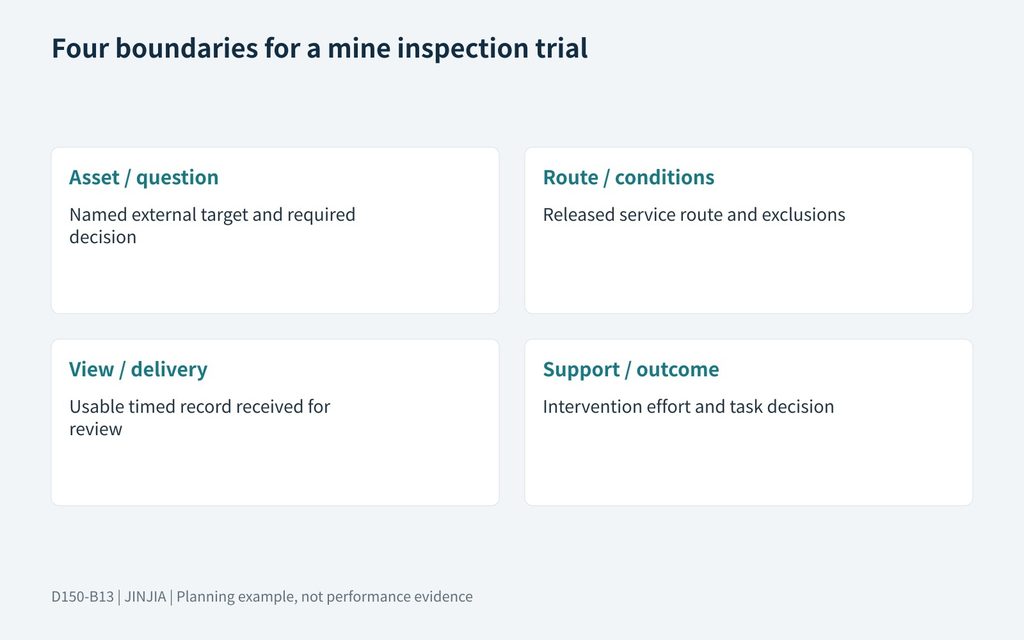
JINJIA planning framework; example inputs are not test results.
| Trial boundary | Required evidence |
| Asset / question | Named external target and required decision |
| Route / conditions | Released service route and exclusions |
| View / delivery | Usable timed record received for review |
| Support / outcome | Intervention effort and task decision |
Frequently asked questions (FAQ)
A: A repeated external observation at an accessible auxiliary asset on a site-approved controlled route.
Q: Can Delta 150 share a haul road by default?
A: No. Route access, interactions and any crossing need the mine operator’s assessment and authorisation.
Q: Does reaching the asset prove an inspection passed?
A: No. The required view, timing, delivery and review must also meet the agreed rule.
Q: Does a thermal image prove equipment failure?
A: Not by itself. Define the observation or measurement method and have an appropriate person assess the finding.
Q: How should dust-related failures be counted?
A: Record failed views, navigation limitations, cleaning and repeated attempts with their conditions.
Q: Does this trial establish production autonomy?
A: No. A bounded auxiliary inspection trial does not validate haulage, drilling or unrestricted mine operation.
Sources and further reading
Platform context; integration scope requires project confirmation.
WorkSafe WA — Road and traffic management at Western Australian mines (2026)
Sections 2.2.8, 2.4 and 3.1 inform traffic separation and road-condition review. Regional guidance; not Delta approval or a global legal rule. The trial worksheet is JINJIA planning.