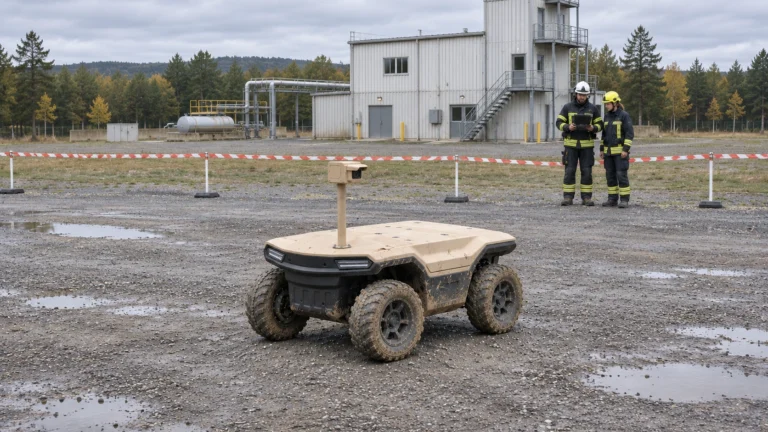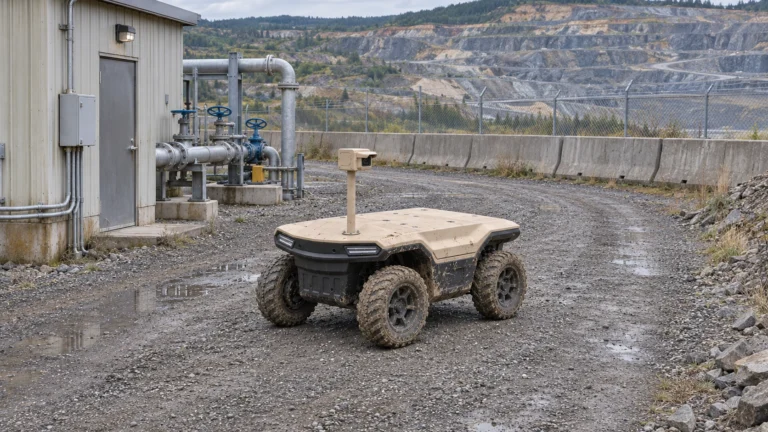


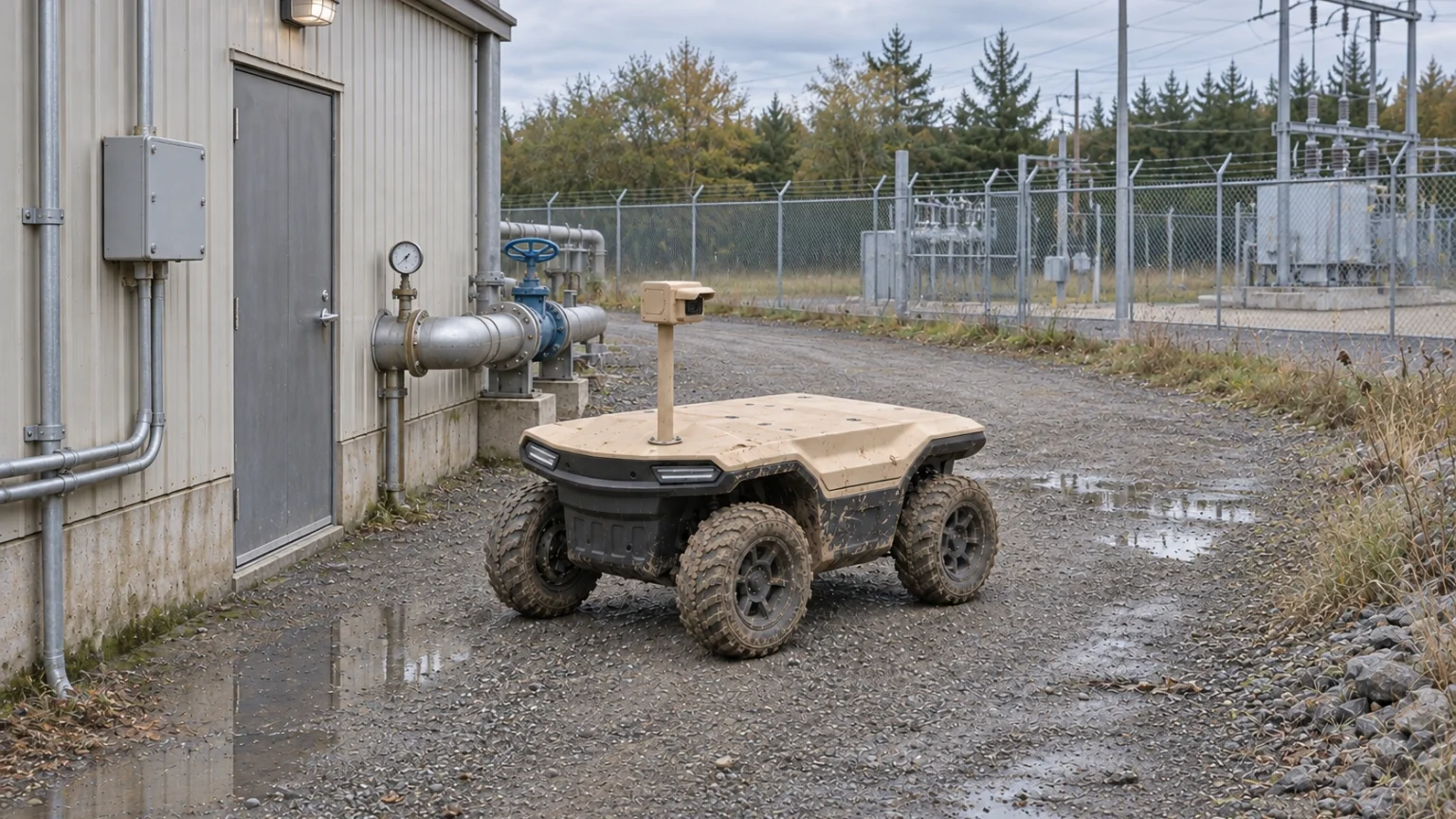
A utility inspection ground robot should give the maintenance team a record it can locate, judge and use. Start with a permitted view of an external asset, then connect the image to its asset ID and work-order process. A remote video feed can help observation, but a useful inspection record also needs context and a responsible reviewer.
Delta 150 is JINJIA’s four-wheel UGV in the 150 kg payload class. Utility or substation AGV inspection describes a potential task with a confirmed observation payload. Here AGV means Autonomous Ground Vehicle; Automated Guided Vehicle is another industrial usage. This guide does not claim electrical-site certification, immunity to interference or an installed customer project.
At a glance
• Use controlled ground routes and targets visible from approved positions.
• Keep readings, thermal indications and confirmed defects distinct.
• Accept individual records before assessing full-route repeatability.
Contents
Define controlled ground routes and visible targets
Separate meter readings, thermal images and anomaly clues
Control viewpoint, calibration and record quality
Assess clearance and the electromagnetic environment
Connect the record to work orders and archives
Move from point acceptance to route acceptance
Frequently asked questions (FAQ)
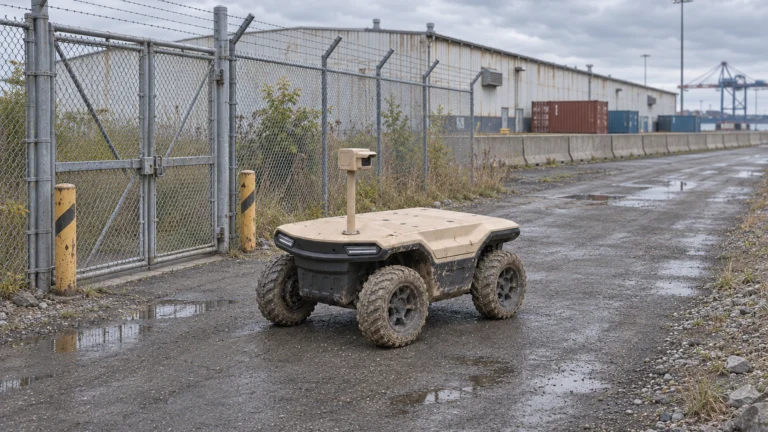
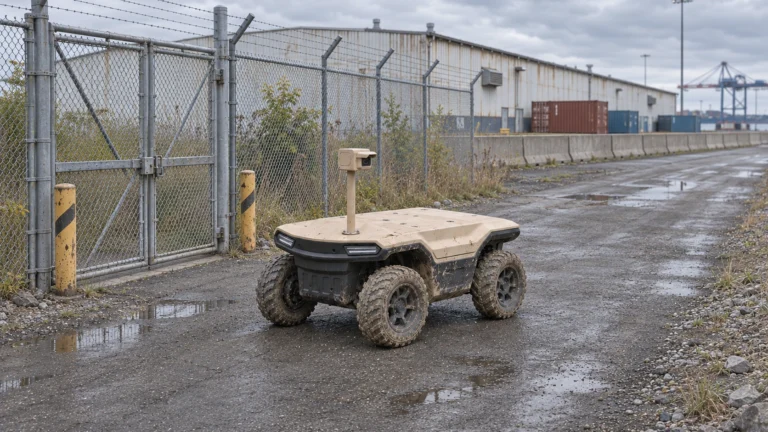
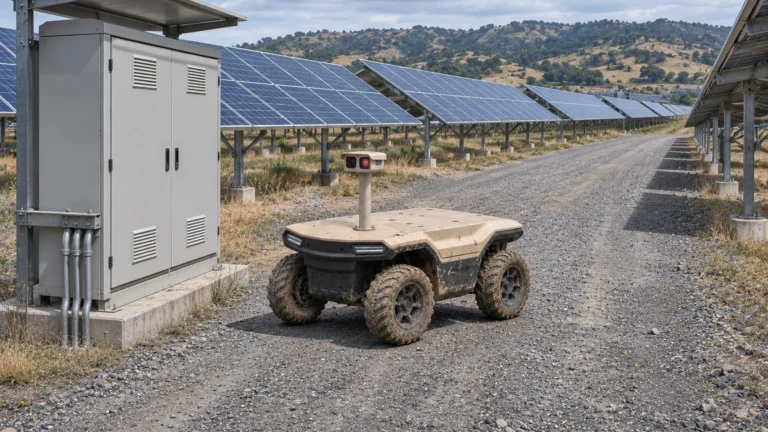
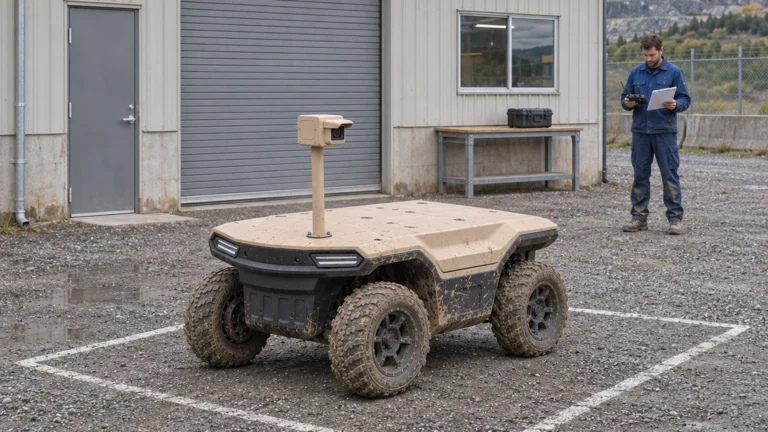
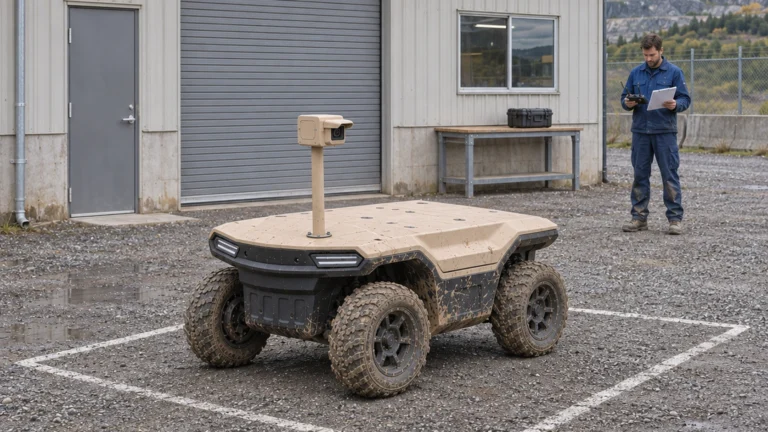
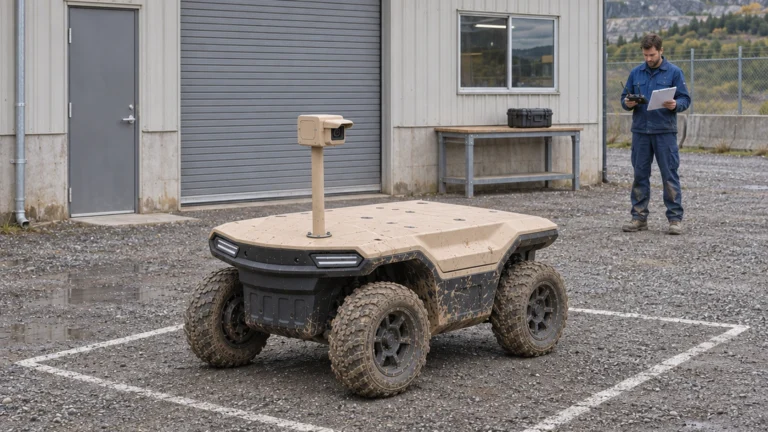
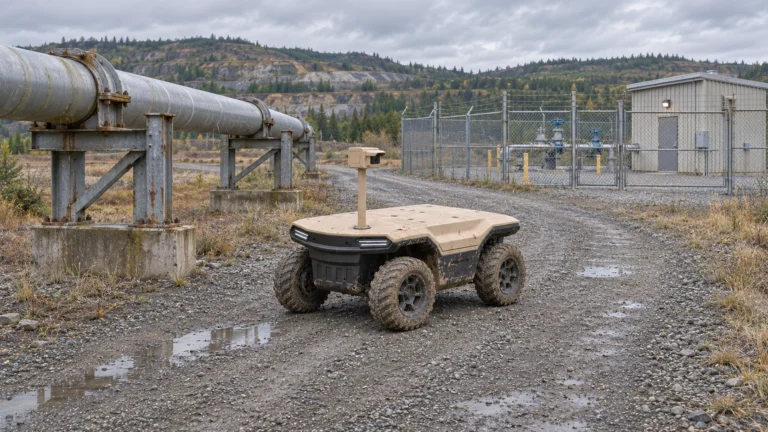
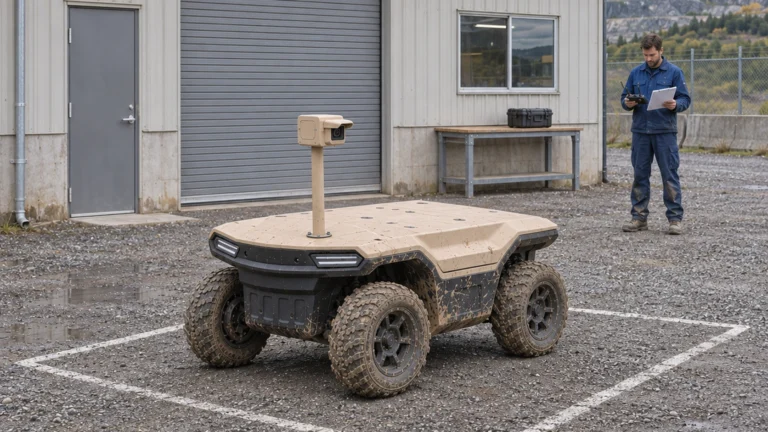
AI concept: proposed task-equipped Delta 150; configuration subject to confirmation.
Define controlled ground routes and visible targets
Ask the utility operator for the authorised inspection path and asset list. Suitable candidate questions might concern an external gauge, enclosure-door state, visible pipe condition or an approved thermal target. Record the exact surface or indicator to be observed. A photograph of the cabinet cannot show hidden contacts, and a ground route does not grant access to restricted equipment.
Walk the route with operations and maintenance. Include the complete payload height and width when reviewing clearance, turns, drains and gates. For example, a hypothetical pump-station inspection can start at one approved exterior point. State the no-entry boundary, observation position and local recovery access before assessing whether the machine can repeat the task.
Separate meter readings, thermal images and anomaly clues
For an external gauge, define the required scale, unit, needle or digit detail and viewing angle. First test whether a human can reliably read the received image. If automated reading is proposed, validate it separately using representative instruments, conditions and exceptions. An unreadable or uncertain value should remain flagged instead of becoming a plausible-looking number.
Likewise, decide whether a thermal task seeks a qualitative change or a quantitative temperature. A bright patch is a clue for review, not automatically a component defect. FLIR’s imaging documentation discusses resolution, distance and reflected radiation as interpretation limits. Select a suitable instrument and method for the question; do not infer diagnostic performance from the presence of a camera.
Control viewpoint, calibration and record quality
Make observations comparable by recording point ID, pose, target distance, direction, dwell and camera settings. Pair a thermal record with an identifying visible view where useful. Retain the original file and timestamp, not just a screen capture that loses context. For measurement tasks, document instrument identity, applicable calibration information and the settings needed to interpret the data.
Test the received image under representative light, weather, vibration and equipment operating states. Reflections, obstructions and lens contamination can change the result. Therefore, agree a usable-record rule with the maintenance team and a process for uncertain samples. The observation position must remain within the approved route even when a closer view would improve the picture.
Assess clearance and the electromagnetic environment
The utility operator must set site-specific access restrictions and approach boundaries for the actual installation. Review the entire robot and mast envelope, recovery activity and any charging location. This article supplies no universal approach distance. Electrical work permissions and qualified inspection procedures remain with the site; the proposed robot does not open cabinets or touch live parts.
Also assess positioning, communications and electronics in the intended electromagnetic environment. Do not assume that IP protection establishes electrical compatibility or interference immunity. Request configuration evidence and plan site tests with the operator. Define separate responses to stale data, lost position, lost command link and sensor failure, then verify the configured response without entering a prohibited area.
Connect the record to work orders and archives
Use the existing asset hierarchy and maintenance record format. Fluke’s inspection-process guidance starts with asset lists and baseline route records. For this proposed workflow, link the source file to asset ID, observation time, point, conditions, quality status and review question. Keep the original observation time if network recovery delivers the file later.
Assign the reviewer, decision, action owner and closure record. Start with an agreed manual handover if a system interface is not yet validated; do not present a file export as a ready-made CMMS integration. Where software integration is required, confirm field mapping, identity, permissions, errors, retention and retrieval with the system owner. Preserve rejected and uncertain observations as well as accepted ones.
Move from point acceptance to route acceptance
First demonstrate one point’s usable observation, delivery and maintenance decision. Then repeat it under the agreed conditions before adding points and route sections. A successful single snapshot does not validate the whole route. The supplied worksheet separates point quality, route availability, link status and work-order closure so each failure has a visible cause.
Finally, compare all scheduled checks with accepted records and overdue observations. Include lens cleaning, remote review, gate assistance, recovery, charging and maintenance effort. Decide whether to keep, revise or stop the task before expanding to another site. Send JINJIA the external inspection list, permitted paths and maintenance record format to discuss a bounded Delta 150 configuration and trial.
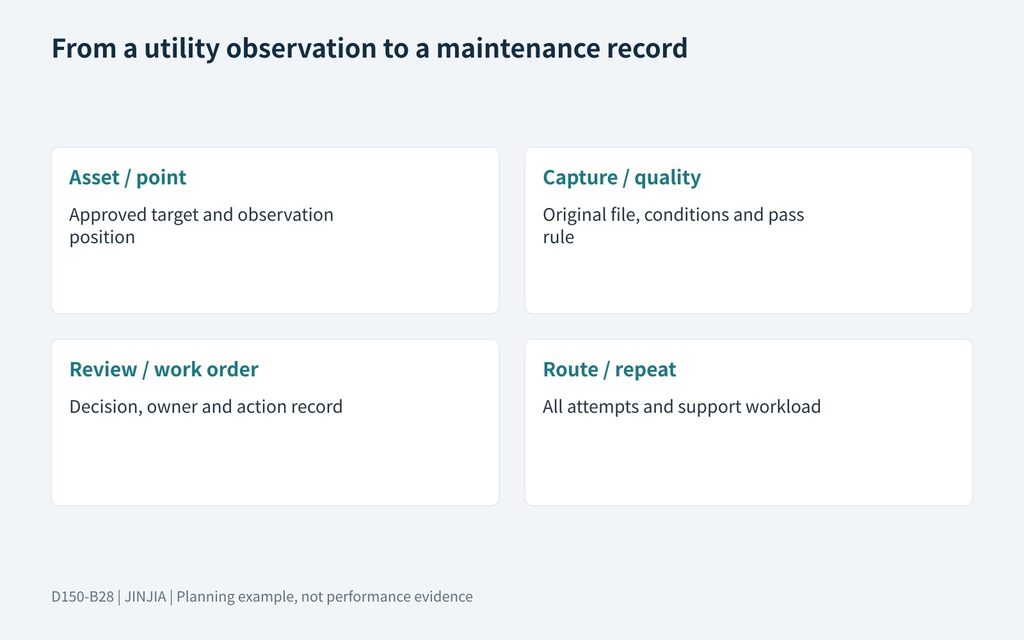
JINJIA planning framework; example inputs are not test results.
| Record stage | Required link |
| Asset / point | Approved target and observation position |
| Capture / quality | Original file, conditions and pass rule |
| Review / work order | Decision, owner and action record |
| Route / repeat | All attempts and support workload |
Frequently asked questions (FAQ)
A: An identifiable asset, original time, sufficient view, relevant conditions, quality status and a named reviewer.
Q: Can an image reading be treated as confirmed automatically?
A: No. Validate image legibility and any automated reading method; retain uncertainty explicitly.
Q: Does a thermal contrast prove a defect?
A: Not alone. A competent reviewer needs the observation context and any required measurement or follow-up test.
Q: Does this guide approve substation entry?
A: No. The site operator must assess and authorise the exact machine, payload, route and recovery process.
Q: Is CMMS integration included by default?
A: No. Agree and verify the interface or use an approved manual handover first.
Q: What should happen before full-route acceptance?
A: Accept individual observation points, repeatability, delivery and workflow before evaluating the combined route.
Sources and further reading
Platform context; integration scope requires project confirmation.
FLIR documentation — Achieving a good thermal image
Resolution, distance, reflections and interpretation context. General imaging principles; not a Delta payload specification or endorsement.
Fluke — Thermal imaging in preventive maintenance
Inspection-process section: existing asset lists, baseline images and route records. No claimed savings or fixed interval transferred to Delta.