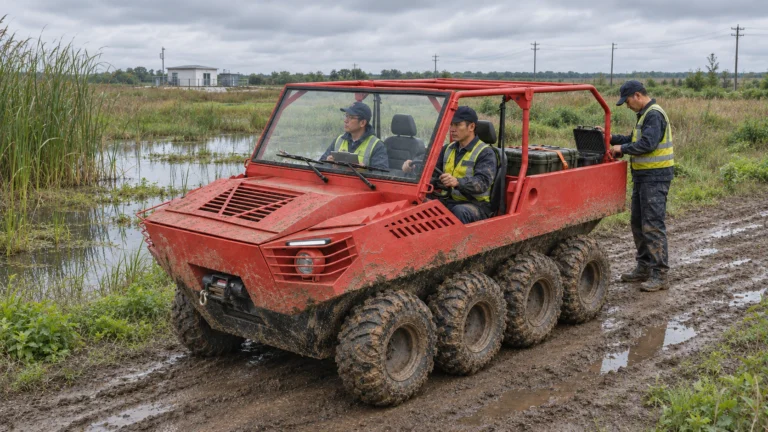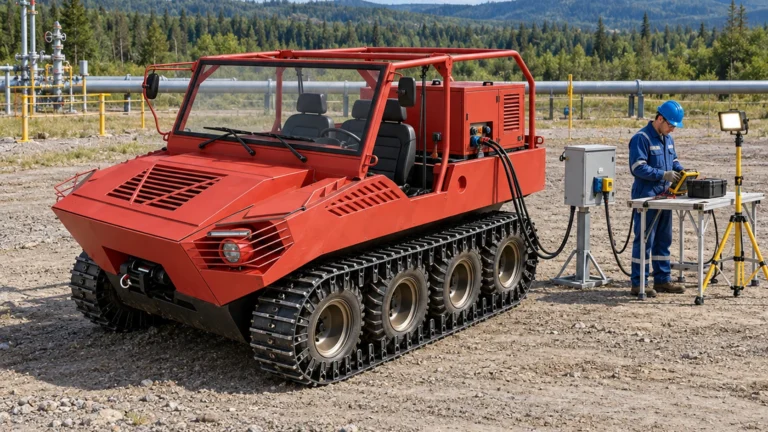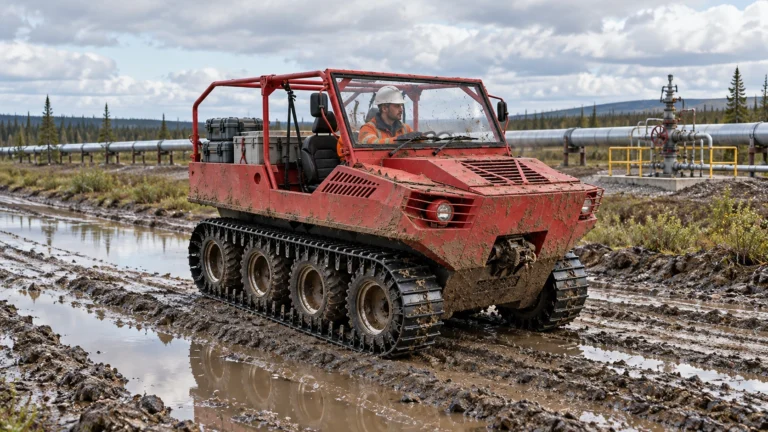


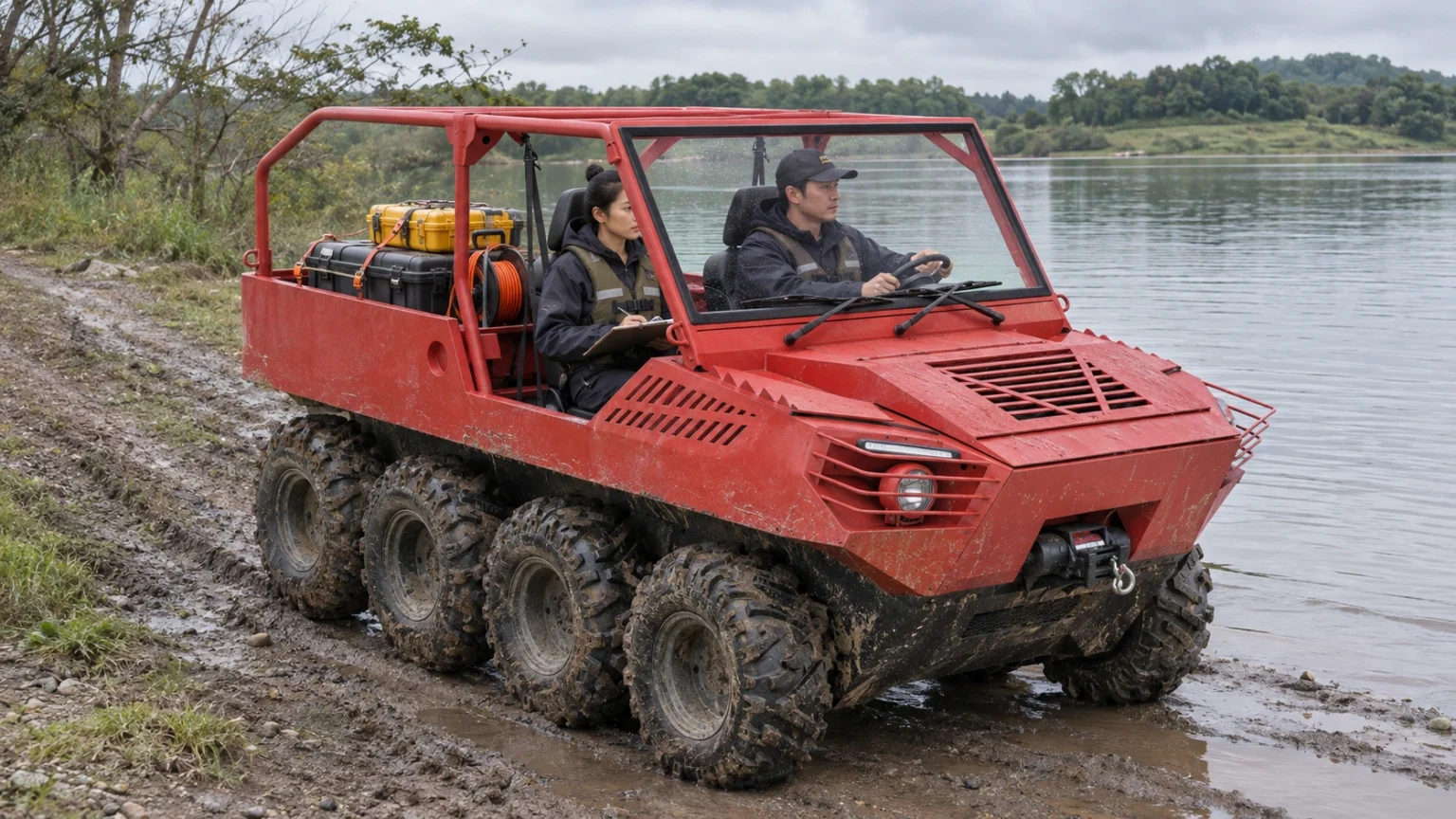
JINJIA 88E land-and-water mission preparation: two crew members and secured tools at a muddy shoreline. AI-generated application concept, not a customer deployment or performance-test photograph; the supplied configuration and load arrangement require confirmation.
The JINJIA 88E is a gasoline-fuelled, electrically driven amphibious 8×8. Its range extender generates electricity, two traction motors drive the vehicle on land, and a third motor serves water propulsion. These separate roles are the starting point for planning a mission that combines land travel, an afloat segment and work at the destination. [1]
1. What is the buyer choosing?
A buyer is assessing a range extended amphibious 8×8 whose primary operating concept is refuelling a gasoline range extender and using electric motors for propulsion. The 88E is not a battery-only vehicle. Its charging connection does not change that distinction, and the 88D diesel model has its own specifications. [1]
Start with the task: who and what must reach the worksite, what route is involved, and how long must the vehicle work before returning? Understanding which component generates electricity and which components propel the vehicle helps turn those requirements into a configuration review. It does not yet establish how far or how fast the vehicle can travel.
2. What evidence supports this explanation?
The three-motor arrangement, gasoline range extender and approximately 2 kWh battery are company-confirmed 88E information. They describe the intended functions; they are not independent performance-test results. Request the approved technical documents for the offered configuration before making a purchase decision. [1]
The U.S. Department of Energy’s Alternative Fuels Data Center explains the general series-hybrid principle: electric motors provide propulsion while an engine generates electricity. This supports the distinction between generation and propulsion, but the guidance does not test or certify the 88E. Other PHEV capabilities described on that page must not be transferred to this vehicle. [2]
The accompanying diagram shows functional relationships, not an electrical wiring diagram. The muddy-shore image illustrates a crew with secured tools preparing for a land-and-water task; it is AI-generated and does not document a customer deployment, water trial or approved load arrangement.
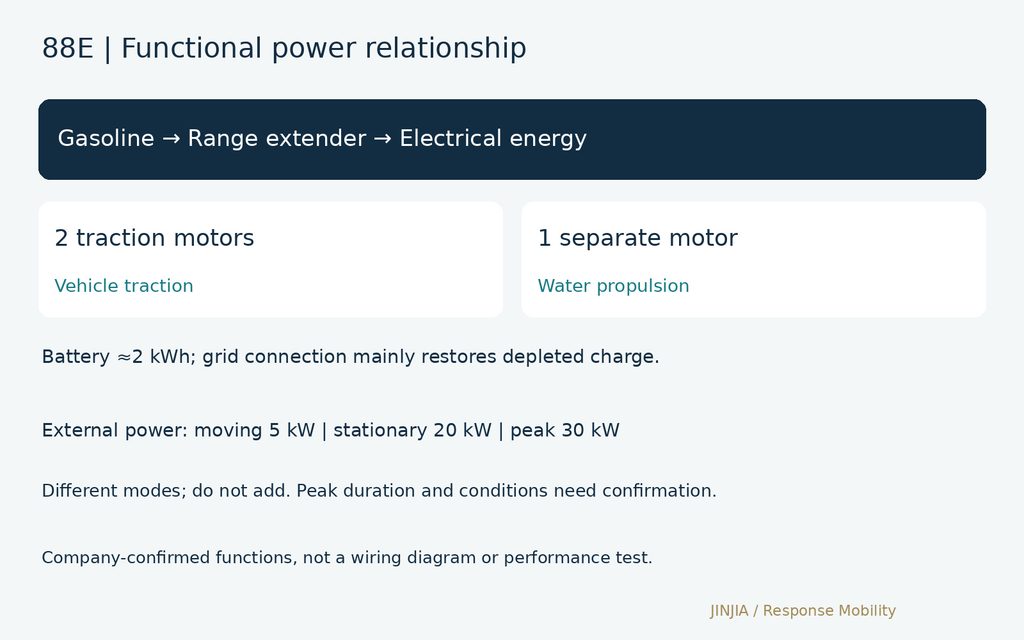
Planning information diagram; company statements and scope are shown explicitly.
3. Gasoline supplies the range extender
Gasoline is the fuel input. The range extender converts that fuel into electrical energy for the vehicle’s electric-drive system. This is the relationship a buyer needs to distinguish from a conventional description in which an engine’s output is discussed directly as wheel propulsion. The confirmed 88E description is gasoline generation with electric propulsion. [1]
For a remote task, plan fuel availability, the permitted refuelling procedure and service support. Ask for the generator’s operating conditions, maintenance schedule and the controls applicable to the supplied vehicle. Do not infer generator output, fuel consumption or operating hours from the name “range extender.”
The precise electrical bus, power electronics, battery-management strategy and start/stop thresholds require configuration documentation. A functional illustration should not invent those details. Performance comparisons need a representative duty cycle and measured results.
4. Two motors drive travel on land
Two traction motors perform the land-propulsion role. “8×8” identifies eight driven wheels; it does not mean that the vehicle contains eight independent wheel motors. The detailed transmission of torque to the wheels and the steering arrangement must be confirmed in the supplied configuration documents. [1]
Ask for a land trial with the intended crew, tools and installed equipment. Record the route, surface, gradients, load, tyre or optional-track configuration and travel time. A motor count alone establishes neither payload capacity nor climbing, obstacle-crossing or braking capability.
Keep the travel segment separate from stationary work in the mission plan. If electrical equipment must operate during movement, state its demand and operating sequence so the available supply can be assessed under that condition.
5. The third motor serves water propulsion
The third motor has a separate water-propulsion function. Distinguishing it from the two traction motors explains the confirmed division of propulsion duties between land and water. It does not identify every mechanical detail of the water-propulsion unit or its control sequence. [1]
An afloat task also depends on the hull, sealing, load distribution, permitted water load, water conditions and entry and exit points. A separate propulsion motor does not establish water speed, current limits or suitability for a particular crossing. Land payload cannot simply be treated as allowable afloat payload.
Provide the proposed water route and access points, and request the operating limits and transition procedure for the offered configuration. Where validation is needed, agree a controlled representative trial with the supplier. The shoreline scene in this article is an illustration, not evidence that those conditions have been validated.
6. Boundaries, unverified points and alternatives
The company-confirmed battery capacity is approximately 2 kWh. The grid connection is mainly intended to restore charge when the traction battery is depleted. The core operating concept remains gasoline generation and electric propulsion. Capacity in kWh describes stored energy; power in kW describes a rate. Capacity alone cannot establish battery-only range, charging time or stationary working duration. [1]
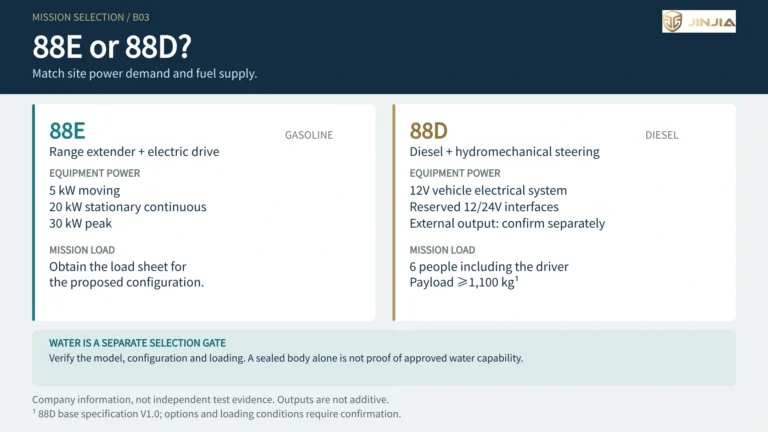
External supply is stated separately by operating mode: 5 kW while moving, 20 kW when stationary and 30 kW peak. These figures are not additive. Peak output is not a continuous rating; its duration and conditions require confirmation. Check the actual voltage, frequency, connections, starting demand and simultaneous loads before matching equipment. [1, 3]
Fuel savings, silent operation, emissions and total operating cost require defined conditions and evidence. They should not be promised from the architecture name. Record starting battery condition, load, route, work duration, external electrical demand and fuel use in a representative evaluation.
Compare the 88D diesel model using its own configuration and service requirements. A battery-only alternative requires an assessment of charging access and usable energy; a boat-based approach may suit tasks dominated by water access. Select between these options using the actual mission and verified limits, rather than treating one drivetrain as universally preferable.
7. A one-page brief for the buyer
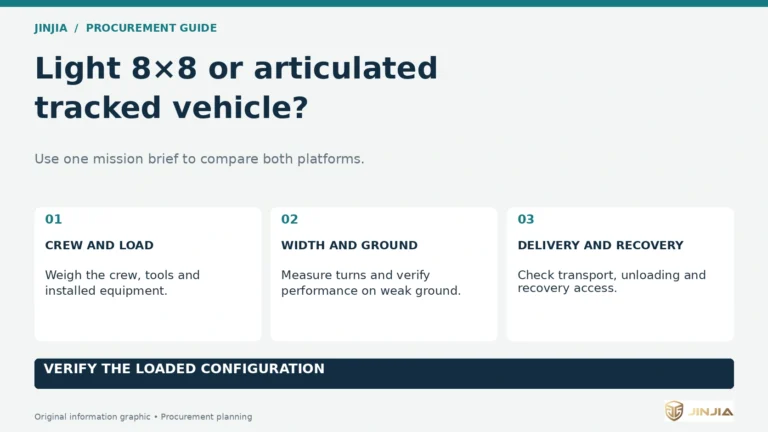
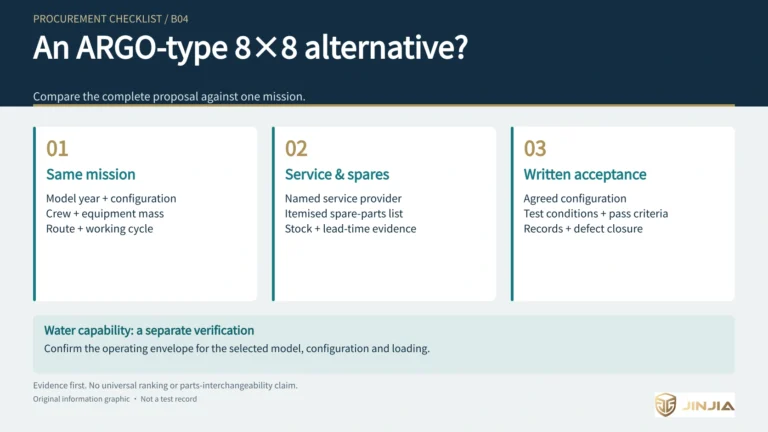
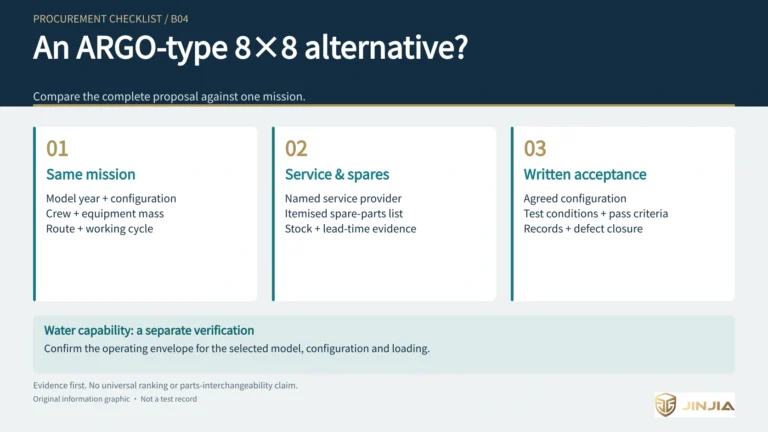
Send the following six inputs together so that the travel, work and return stages can be assessed as one duty cycle.
| Mission input | What to provide | What to confirm |
| Land route | Distance, surface, gradients and obstacles | Trial route and travel configuration |
| Water segment | Afloat distance, conditions, entry and exit points | Water load, limits and transition procedure |
| Crew and load | People, tools, supplies and installed equipment | Total mass, restraint and distribution |
| Work cycle | Travel, stationary work and return durations | Fuel plan, starting charge and reserve |
| Electrical loads | Nameplates, starting demand and simultaneous use | Voltage, frequency, connectors and peak duration |
| Acceptance evidence | Proposed task and pass criteria | Configuration record, measured results and open items |
Contact JINJIA / Response Mobility with your route, mission load and working conditions to discuss the appropriate configuration and validation plan.
Related topics: Choosing a Light Amphibious 8×8 by Mission; Planning 88E Field Power Around Real Loads; How Amphibious Vehicles Work on Land and Water.
Frequently asked questions (FAQ)
A: No. Its main operating concept uses gasoline in the range extender to generate electricity, with electric motors providing propulsion. The charging connection does not change that architecture.
Q: How many propulsion motors does the 88E have?
A: The confirmed arrangement is three: two traction motors and one separate motor for water propulsion. Eight driven wheels do not mean eight wheel motors.
Q: Does approximately 2 kWh establish an electric-only range?
A: No. Capacity alone cannot establish driving distance or operating duration. A configuration-specific operating test and the relevant technical limits are needed.
Q: Can 30 kW be used continuously?
A: It is stated as peak output. Request the applicable duration and conditions. The stated stationary output is 20 kW; the moving output is 5 kW.
Q: Does range-extended drive guarantee lower fuel use?
A: No. A comparison needs equivalent tasks, loads, conditions and measured results. The architecture alone does not prove a percentage saving or lower ownership cost.
Q: What should be sent for a power-equipment assessment?
A: Provide equipment nameplates, operating and starting power requirements, required voltage and frequency, intended simultaneous use, work duration and site conditions, alongside the vehicle mission-load list.
Sources and further information
[1] JINJIA / Response Mobility, company-confirmed 88E architecture and operating concept: gasoline range extender, two traction motors, one water-propulsion motor, approximately 2 kWh battery and replenishment charging connection. Manufacturer information, not independent test results.
[2] U.S. Department of Energy, Alternative Fuels Data Center, Plug-In Hybrid Electric Vehicles, “Fuel-Efficient System Design.” Used only for the general series-hybrid principle; checked 9 November 2026.
[3] JINJIA / Response Mobility, Amphibious Utility Vehicle, external-power modes, cross-checked with company information. Other unresolved page specifications are not adopted here.