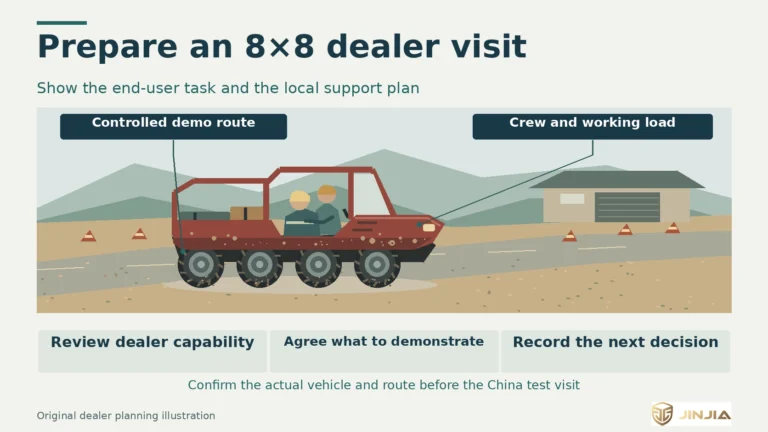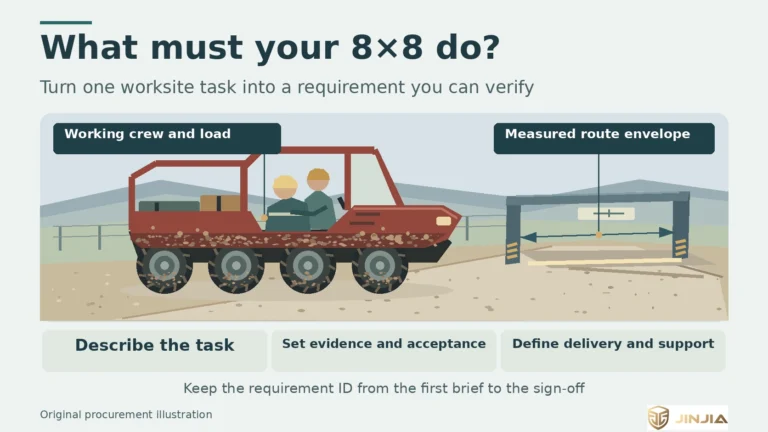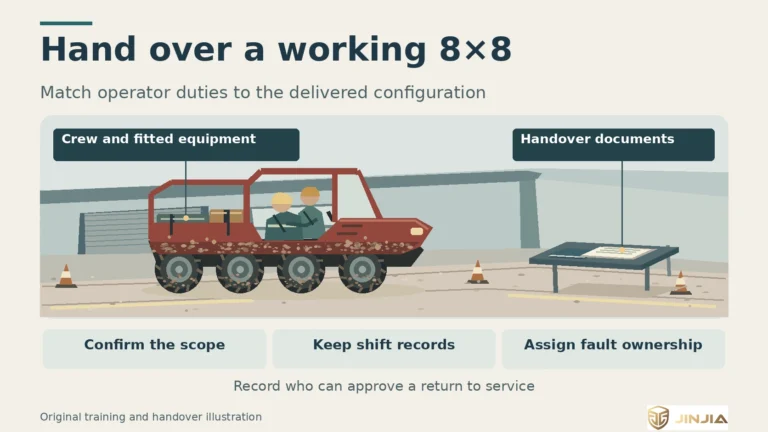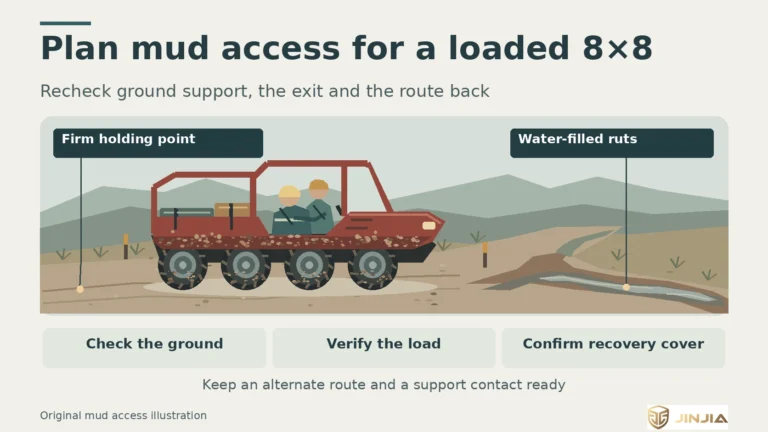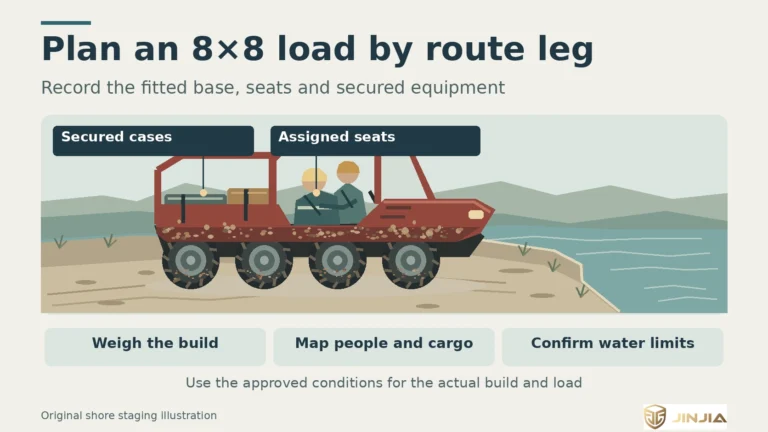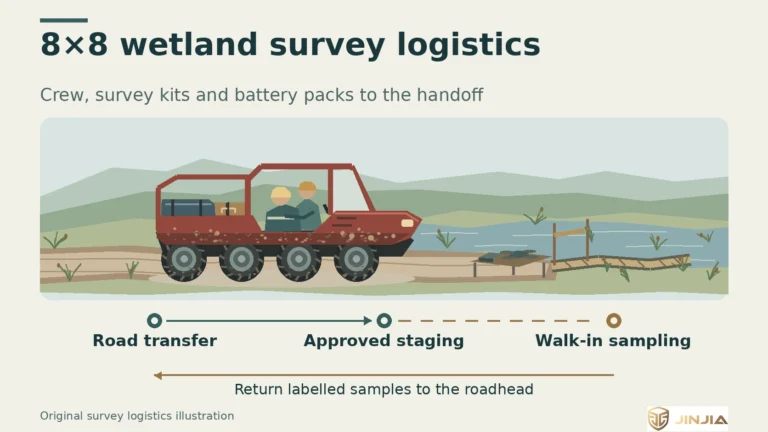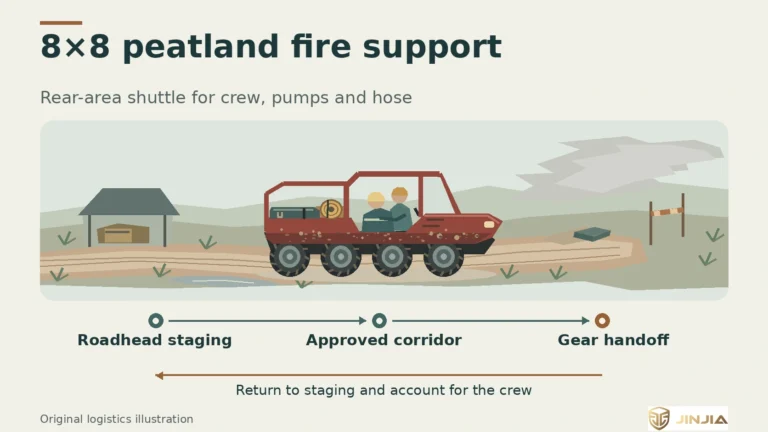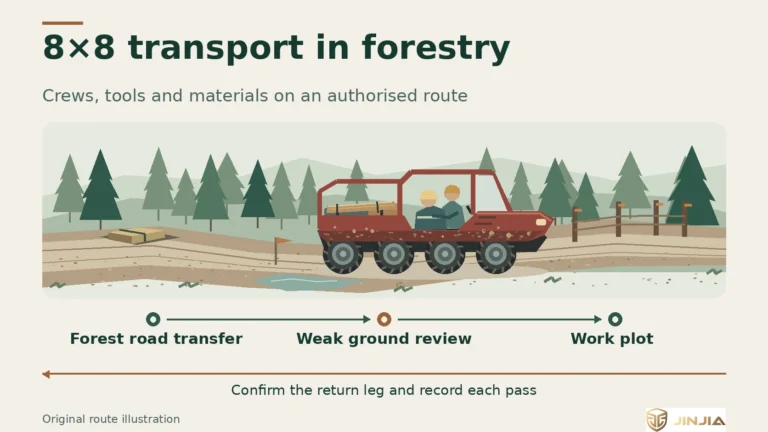


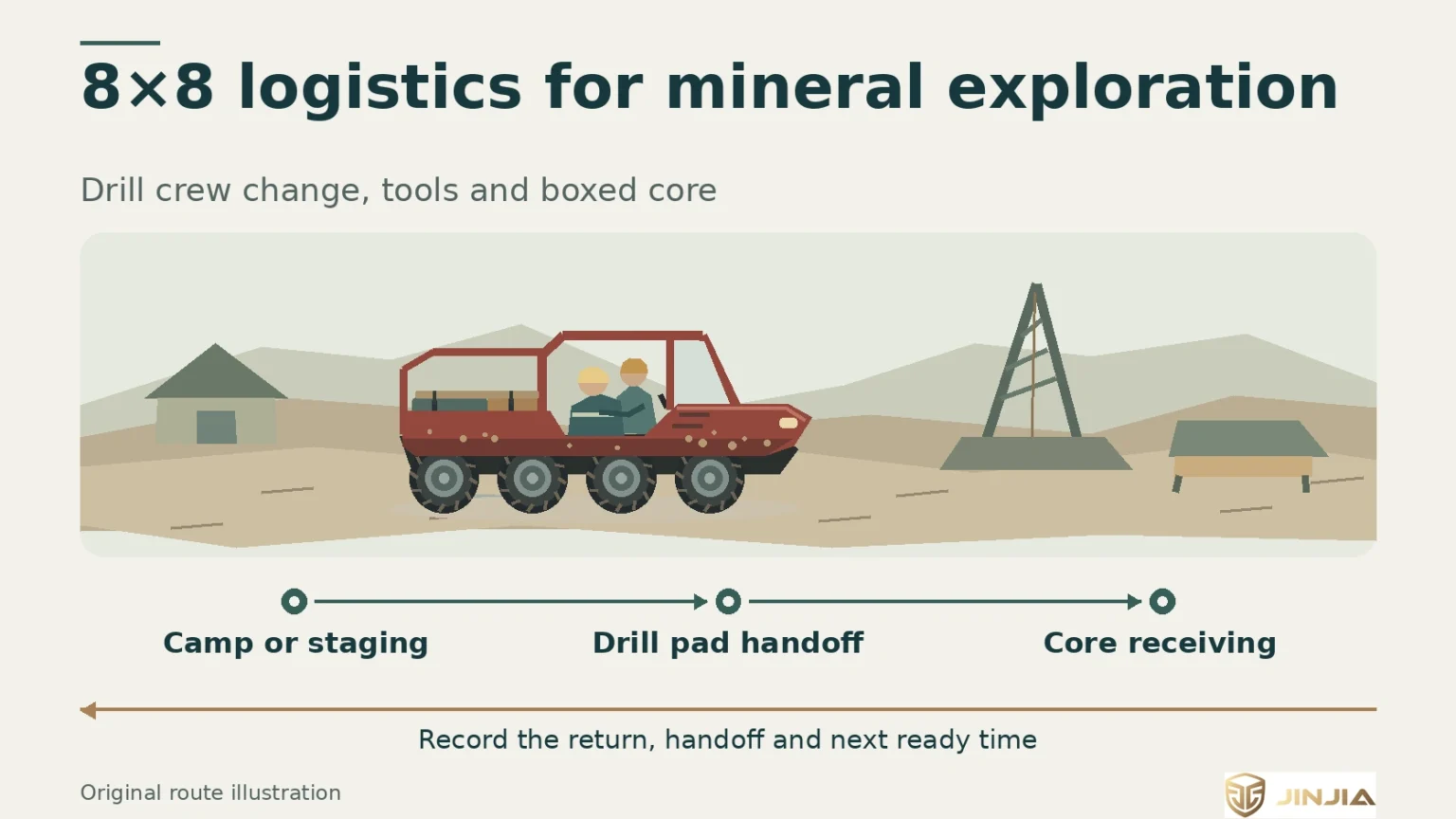
Plan the crew shuttle from staging to the drill pad and the return of boxed core to the receiving point.
Put the 8×8 on a defined exploration route
A mining exploration amphibious vehicle can be evaluated for the short haul between a camp or roadhead and a surface drill pad. Define the job as a crew change, a delivery of small tools, or a transfer of boxed drill core to a receiving point. JINJIA 88E uses range-extended electric drive and 88D uses diesel. Ask which build, seating arrangement and load limits apply to the planned trip.
Start at the transfer point where ordinary road transport can unload. Map the last leg to the drill pad and the way back. Decide at which point the crew, tools and core boxes change hands. If the route includes a permitted water leg, ask for separate water limits and check the entry, exit and return for the proposed configuration.
What the Timmins accounts establish
In the Timmins Rent All feature, Bradley Drilling assistant superintendent Gerry Chartier describes using ARGO vehicles for shift changes and small equipment and supplies. A 2012 Canadian Mining & Energy article identifies the ARGO 750 HDi in that account. Both publications carry the same operator account. They give the transport task and the model context, without a recorded route trial or turnaround time.
The same Timmins feature separately attributes carrying core boxes and rods on a Centaur to Mallette Drilling. It gives no manifest of sample contents. The ARGO XT exploration brochure lists core sample transport as an application, and ARGO’s 2013 commercial brochure lists geological survey and resource exploration. Mudd-Ox describes certain setups fitted with remote drilling equipment. These are separate application references. Route, load and integration evidence for the offered JINJIA build comes from its own evaluation.
Schedule drilling crew changes
Work back from the pad handover time. List the people travelling in and the people waiting to return. Confirm the driver, approved seats and restraints for each leg. Pick a marked waiting area and name the person who confirms that each group has boarded or arrived. If both groups overlap or the equipment takes up usable space, schedule enough separate trips for the actual seating arrangement.
At the pad, hand the incoming crew to the drilling supervisor at the agreed location. Record arrival and clearance to return. Allow for delays if the working area is occupied or rain changes a route segment. Agree who holds or reroutes the trip with the site team. Ontario’s mine traffic guide is a reference for managing routes, vehicles and people where its requirements apply.
Protect tools and drill core during transport
Use an outward and a return manifest. On the outward leg record tool cases, spares, packed dimensions, mass and the receiving person. Include occupants and their equipment in the vehicle loading review. Confirm restraint points and access for unloading with the selected build. Heavy rods, drums or mounted drills need a separate equipment and handling review.
Agree the core box list with the project geologist. Use the project’s numbering for each box, hole and interval. Record condition at loading and receipt, the sender and receiver, and exceptions such as a damaged lid or a mismatched label. Follow the project’s packaging and security requirements and count the boxes again at handoff. The CIM exploration guidelines call for a recorded chain of custody under geoscience supervision.
Measure routes and vehicle turnaround
Use one cycle from ready for dispatch to ready for the next trip. Record loading and boarding, outward travel, waiting, shift handover, return travel, unloading and core receipt, then the inspection and reset required before dispatch. If there is a shared receiving crew or more than one drill pad, record queues rather than treating them as driving time. Log surface, weather, vehicle and actual load beside each measured cycle.
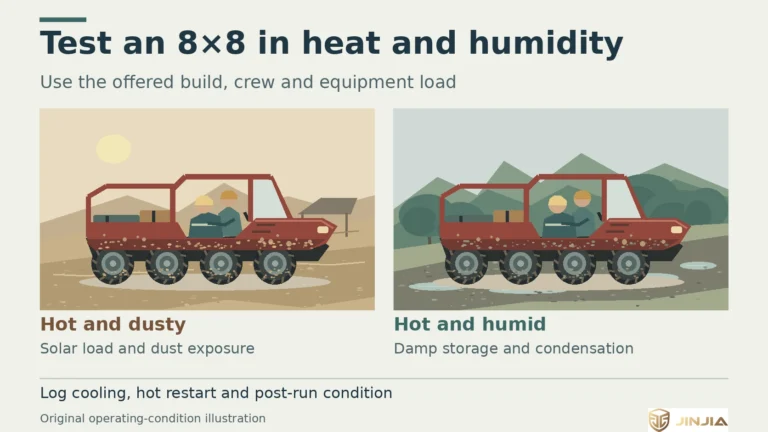
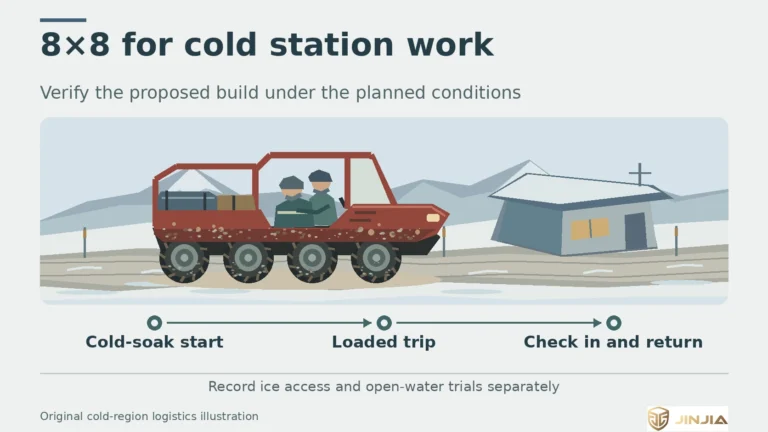
Run both directions with a representative crew and load under approved conditions. Check where turns, parking, unloading and a call for recovery are possible. Use the observed whole cycle to compare capacity with the shift window and the core shipping deadline. Plan for downtime and nominate a backup route or carrier. Repeat the review when the route, load or weather changes enough to affect the original trial.
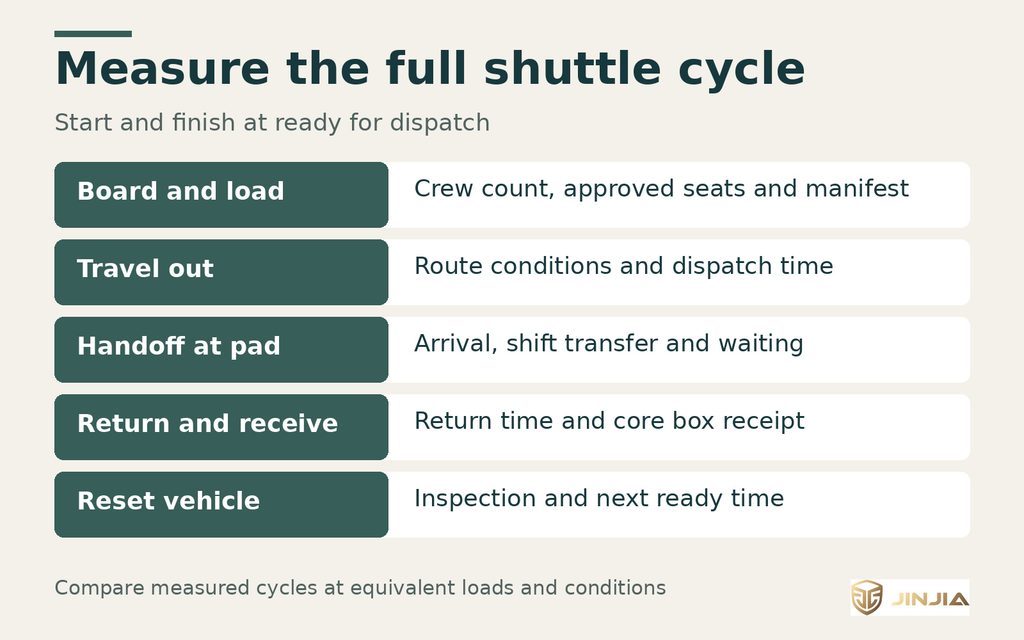
Measure turnaround between ready-to-dispatch checks. Include loading, the crew handover, core receipt and reset.
Set operating boundaries and compare alternatives
The proposed role is light surface logistics on a route confirmed by the site. Where the road can carry a utility vehicle, compare it on the same shift schedule. For a bulk load or a rig move, compare a dedicated carrier and the site’s loading method. The 8×8 and articulated tracked vehicle guide explains the different transport roles.
Use site-approved limits and hold the trip if the route, turnaround space or receiving point becomes unavailable. Keep proposed rig mounts and cranes in a separate engineering scope. Check over-tyre tracks as an option on the specific build. A closed, ground-supported vehicle and a light amphibious vehicle require different water evidence. If a water leg is approved, verify load, entry, exit and return specifically for the offered build.
Give procurement a one-page task brief
• People. Record shift window, crew counts by leg, seating, driver and the drill-pad receiving lead.
• Cargo. List packed tools and core boxes by direction, their weights and sizes, restraints and the person responsible for receipt.
• Route. Include a sketch and photos of both legs, handoff and turnaround points, ground and water conditions, permissions and the alternate.
• Cycle. Record the representative load, dispatch and return timestamps, queuing, receipt and the next ready time. Name the hold and recovery leads.
• Decision. Compare the same shift and cargo task with a conventional utility vehicle or a heavier dedicated carrier. Record the work the supplier must demonstrate.
Send the task brief to JINJIA for a discussion of the 8×8 platform. For a route that includes water, use the land-and-water operating guide to structure the configuration review.
Frequently asked questions (FAQ)
A: Record the shift window, the incoming and outgoing crew counts, the driver and approved seats on each leg. Confirm where people wait and who checks the handover at the drill pad.
Q: How should tools and core transport be documented?
A: List packed sizes, masses, restraint points and recipients by direction. Use the geologist’s box, hole and interval identification and record each receipt and condition exception.
Q: What records are needed for route and vehicle turnaround?
A: Provide both route legs and the alternate, test conditions and load, and actual timestamps from ready for dispatch to next ready. Record queues, handoffs, core receipt and reset separately.
Q: Can the land loading limit apply to a water leg?
A: Ask for a configuration-specific water limit as well as the land limit. Confirm the approved water leg, entry, exit and return for that load.
Q: Can one 8×8 also move a drill or heavy rods?
A: Define the weight, handling and mounting requirements separately. Select a suitable dedicated carrier or validated integration for a rig move or heavy materials.
Q: What if the crew window conflicts with the core shipment?
A: Prioritise the shift handover and sample acceptance with the site leads. Use actual turnaround records to schedule a separate trip or a backup vehicle as required.
Sources and further information
[S22] ARGO Australia archive · Timmins Rent All feature, pp. 50–51
[S37] Mudd-Ox · Exploration and drilling support applications
[S39] ARGO · Commercial vehicles brochure (2013)
[S41] ARGO XT · Exploration brochure hosted by Gigra
[B16-E1] Canadian Mining & Energy · Deeper, sturdier and lower impact
[B16-E2] CIM · Mineral Exploration Best Practice Guidelines, section 7