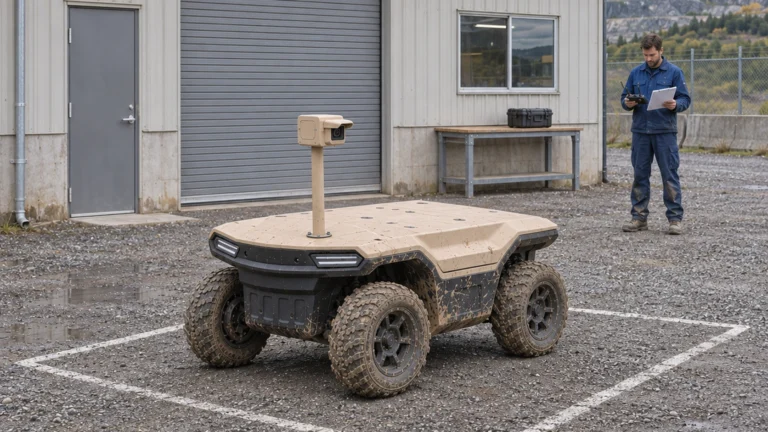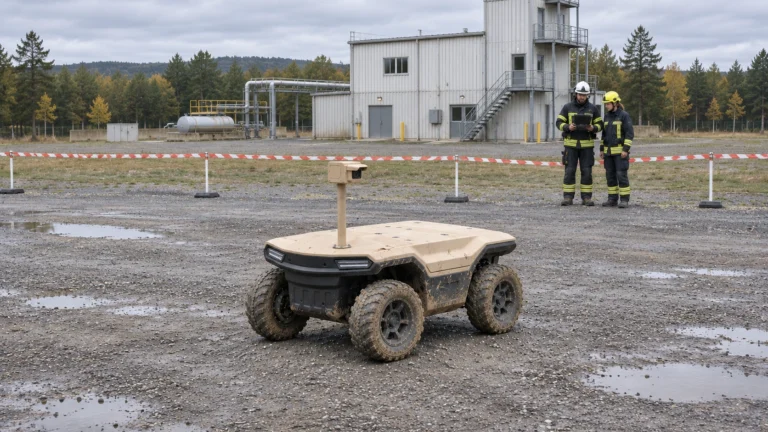


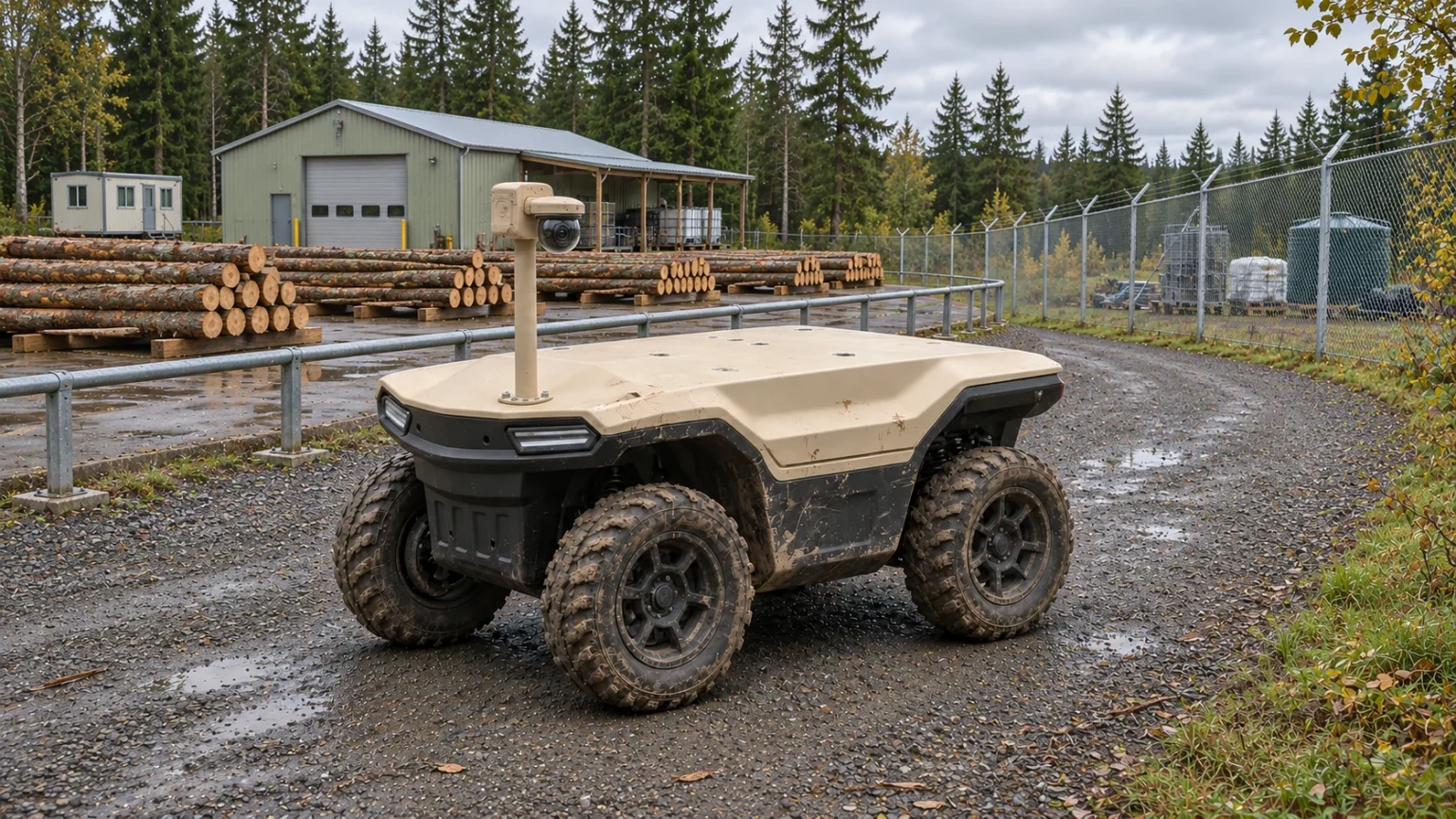
A log yard security robot should return observations that the yard team can compare and act on. Begin with the blind spots around a boundary, camp entrance or parked asset, then select accessible camera positions outside loading movements. The useful output is a reviewed record tied to a place and time, not simply a video stream from a moving vehicle.
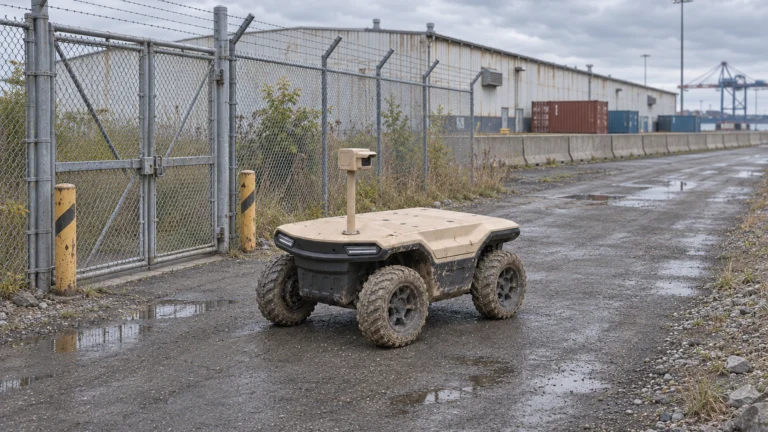
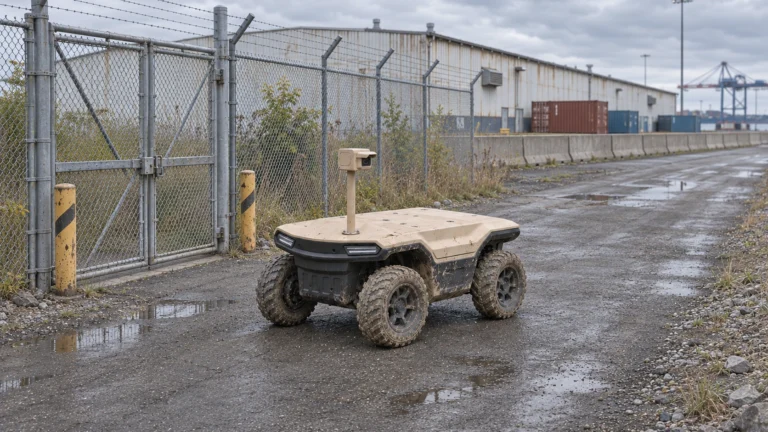
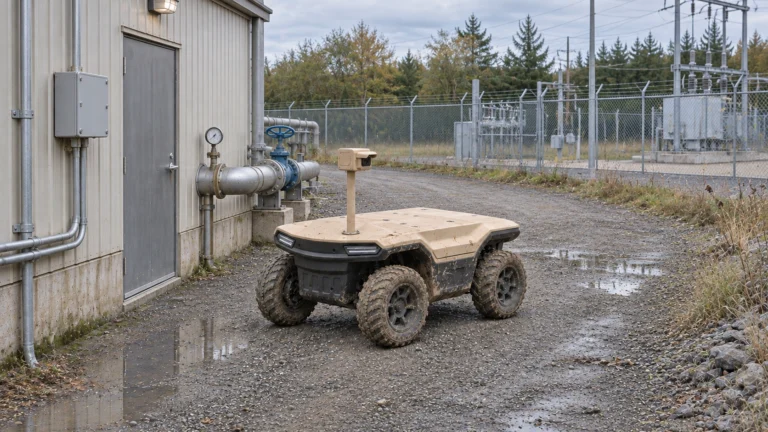
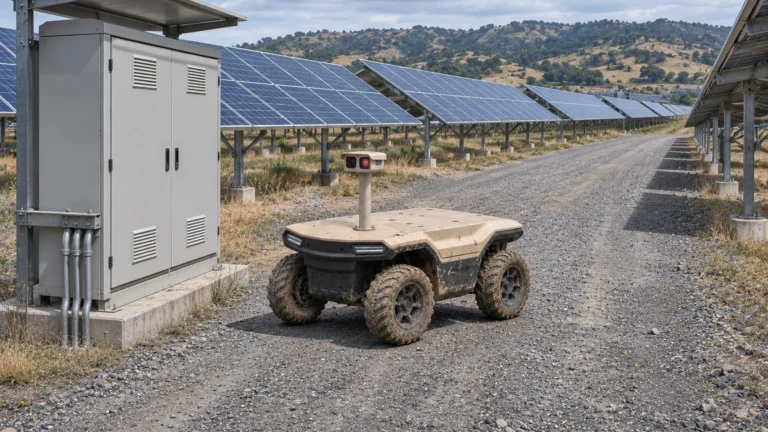
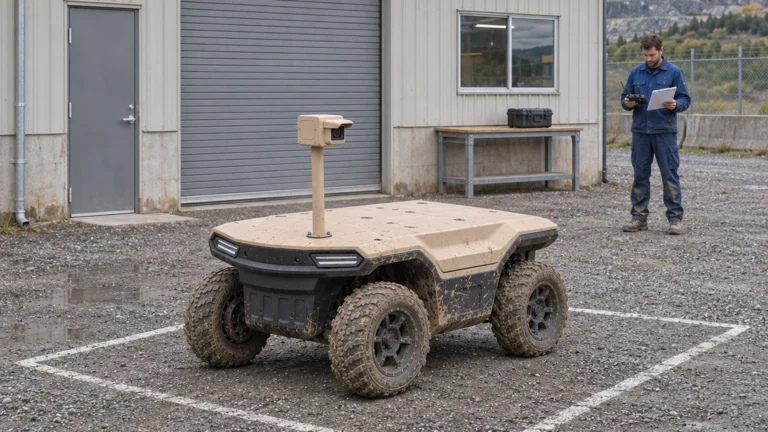
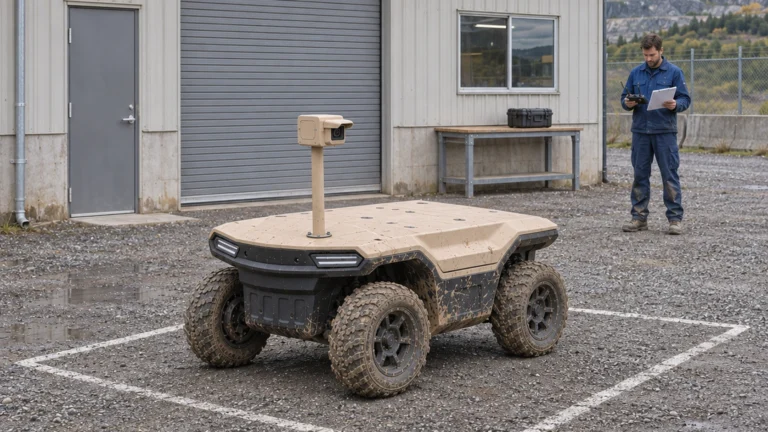
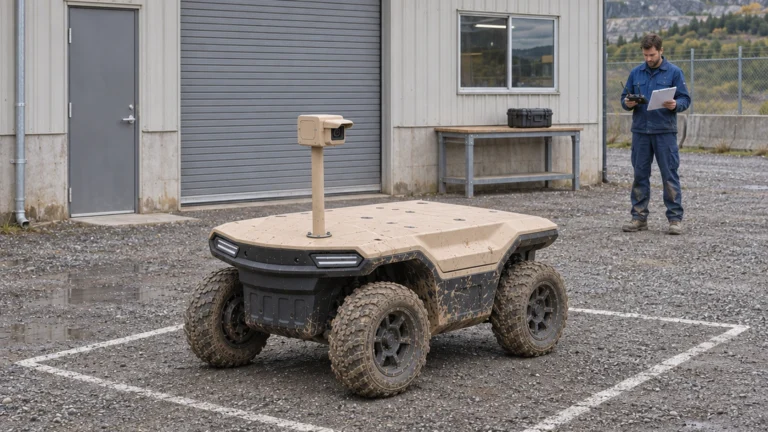
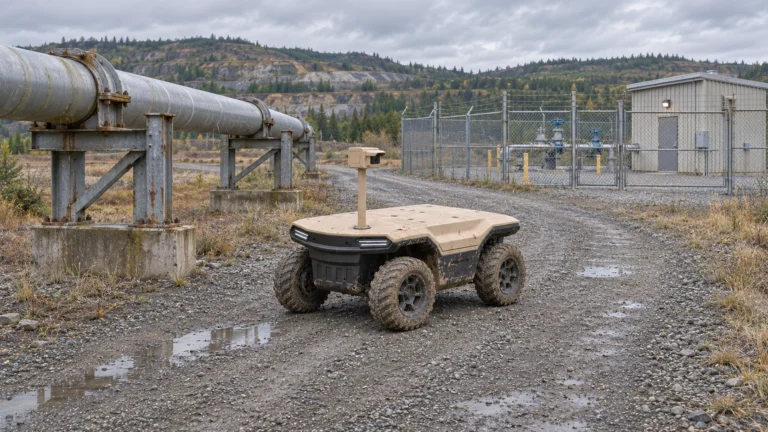
This guide considers Delta 150 with a proposed PTZ observation camera. AGV means Autonomous Ground Vehicle here; industrial AGV can also mean Automated Guided Vehicle. The term does not establish autonomous functions or the supplied camera. The illustration is a proposed forestry camp patrol AGV configuration, not a completed customer deployment.
At a glance
– Map blind spots outside loading movements.
– Record repeatable camera views with a review owner.
– Keep patrol images separate from stock measurement.
Contents
1. Map tasks around yards, camps and parked equipment
2. Observe boundaries, people and vehicles
3. Use repeatable views and test night patrol separately
4. Distinguish timber images from inventory measurement
5. Connect shift handover to work orders
6. Use a site acceptance checklist
7. Frequently asked questions (FAQ)
8. Sources and further reading
AI concept: proposed task-equipped Delta 150; configuration subject to confirmation.
Map tasks around yards, camps and parked equipment
Prepare a task map that separates a log-yard boundary, camp entrance, workshop exterior and parked equipment. For each target, specify the current camera view, missing detail and person who needs the additional observation. A boundary gap and a maintenance check may share a route but require different records and reviewers.
Mark active unloading, loader travel, log storage, truck turning and pedestrian access as distinct areas. The proposed patrol lane should remain outside those activities. Include seasonal layout changes, bark debris and temporary storage in the survey. If a stockpile blocks the view, approve a new viewpoint rather than sending the robot between unstable stacks.
Observe boundaries, people and vehicles
Define what the observation should establish: the visible condition of a fence section, a gate position or an event at an approved entrance. Record viewpoint and coverage exclusions. An image of a person or vehicle does not establish identity, permission or intent; any classification needs its own agreed process and evidence.
Confirm the site’s permissions and data workflow before collecting operational images. Avoid unrelated living areas at a camp. When a view is blocked or unsuitable, return an explicit incomplete result. Do not convert missing video into a statement that the perimeter is clear. The duty operator remains responsible for reviewing and escalating events.
Use repeatable views and test night patrol separately
Repeatable images need a recorded stop position, camera height, direction and framing. If a PTZ camera is proposed, confirm the mount, preset repeatability, power and interfaces. Include all fitted equipment in the configuration. A wide scene view and a close equipment view are separate requirements; one does not prove the other.
Test low-light work separately from daylight. Agree the detail required in darkness, then assess the actual camera and any proposed illumination under representative conditions. Thermal imagery, if requested, requires its own equipment and acceptance evidence. Neither a daytime illustration nor a camera-shaped component proves night detection or automatic diagnosis.
Distinguish timber images from inventory measurement
Patrol images can preserve the appearance of a timber stack at a known time and viewpoint. They may help a supervisor notice a change for review. They do not, by themselves, establish measured timber volume, ownership, count accuracy or the reason for a change.
| Record | What to agree |
| Patrol view | Point ID, time, framing and visible area |
| Reported change | Comparison record and reviewer conclusion |
| Inventory measurement | Separate instrument, method and validation |
If inventory is the buying objective, define a separate measurement task. Specify the reference method and acceptable error before selecting equipment. A patrol configuration should not acquire a stock-measurement claim through its marketing caption.
Connect shift handover to work orders
An exception should enter the existing shift and maintenance process with an event ID, original file, target asset and review status. Name the receiver and the next action. Keep routine observations separate from work that needs repair, access checks or another view.
At handover, show unresolved events, blocked points, equipment faults and camera-cleaning needs. A new shift should be able to locate the original file without asking the previous operator. Closing a work order requires the authorised process and evidence of its outcome; a robot’s arrival at an asset is not proof that maintenance was completed.
Use a site acceptance checklist
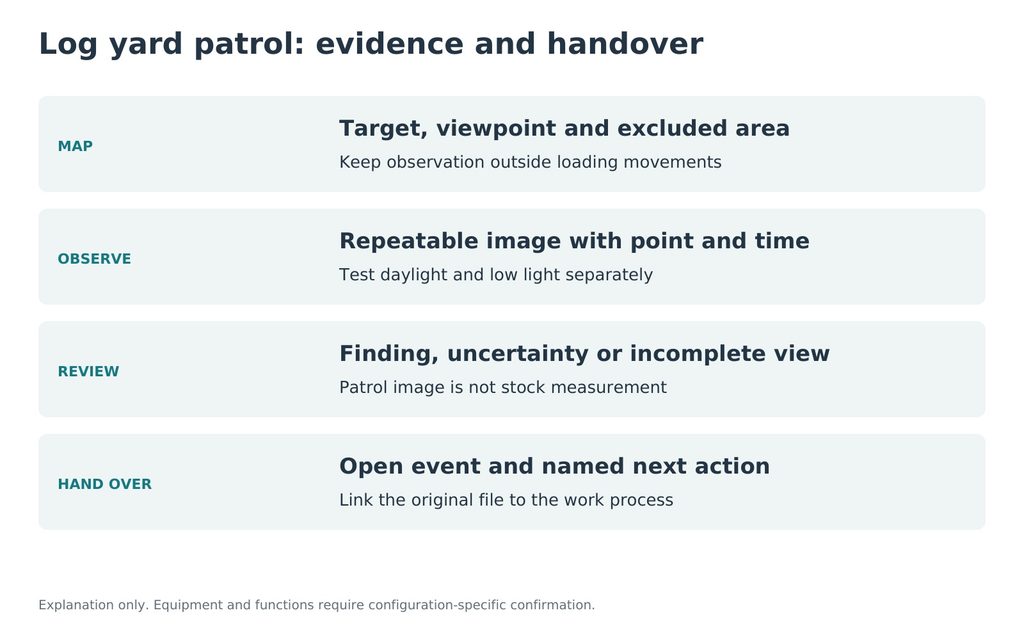
JINJIA planning framework; site-specific evidence is required.
Use an acceptance list that tests the whole task, including unavailable views. Confirm the map, safe access, repeatable framing, image usefulness, review handover and replenishment routine. Record interventions and support time. Set the required output with the yard supervisor before the trial rather than selecting only successful images afterwards.
| Trial item | Record |
| Access and stopping | Route version and excluded loading areas |
| Useful observation | Original image and reviewer finding |
| Incomplete work | Missed point, cause and follow-up |
| Shift operation | Cleaning, energy, support and open events |
Start configuration discussions at the Delta UGV/AGV family page. Delta 500 and Delta 1000 remain separate equipment or logistics options with their own evidence. Send a yard plan, fixed-camera coverage and three priority event types for a Delta 150 assessment.
Frequently asked questions (FAQ)
A: Do not assume access. Survey movements and use a separated observation lane or an approved time window; exclude an unresolved loading conflict.
Q: Is PTZ equipment standard?
A: The camera in this illustration is proposed. Confirm the delivered sensor, mount, interfaces and task evidence.
Q: Does daytime performance establish night patrol?
A: No. Assess the required detail with the actual low-light configuration and representative conditions.
Q: Can patrol images measure timber inventory?
A: Ordinary views record appearance. Measurement requires a separate method, reference and validated equipment.
Q: What belongs in shift handover?
A: Open events, original file links, missing points, equipment faults, cleaning needs and named next actions.
Q: What should a yard operator provide?
A: A site plan, current fixed-camera coverage, loading movements and three high-priority event types.
Sources and further reading
1. JINJIA — Delta UGV/AGV product family
Product-family context. The proposed task equipment and operating functions require confirmation for the supplied configuration.