

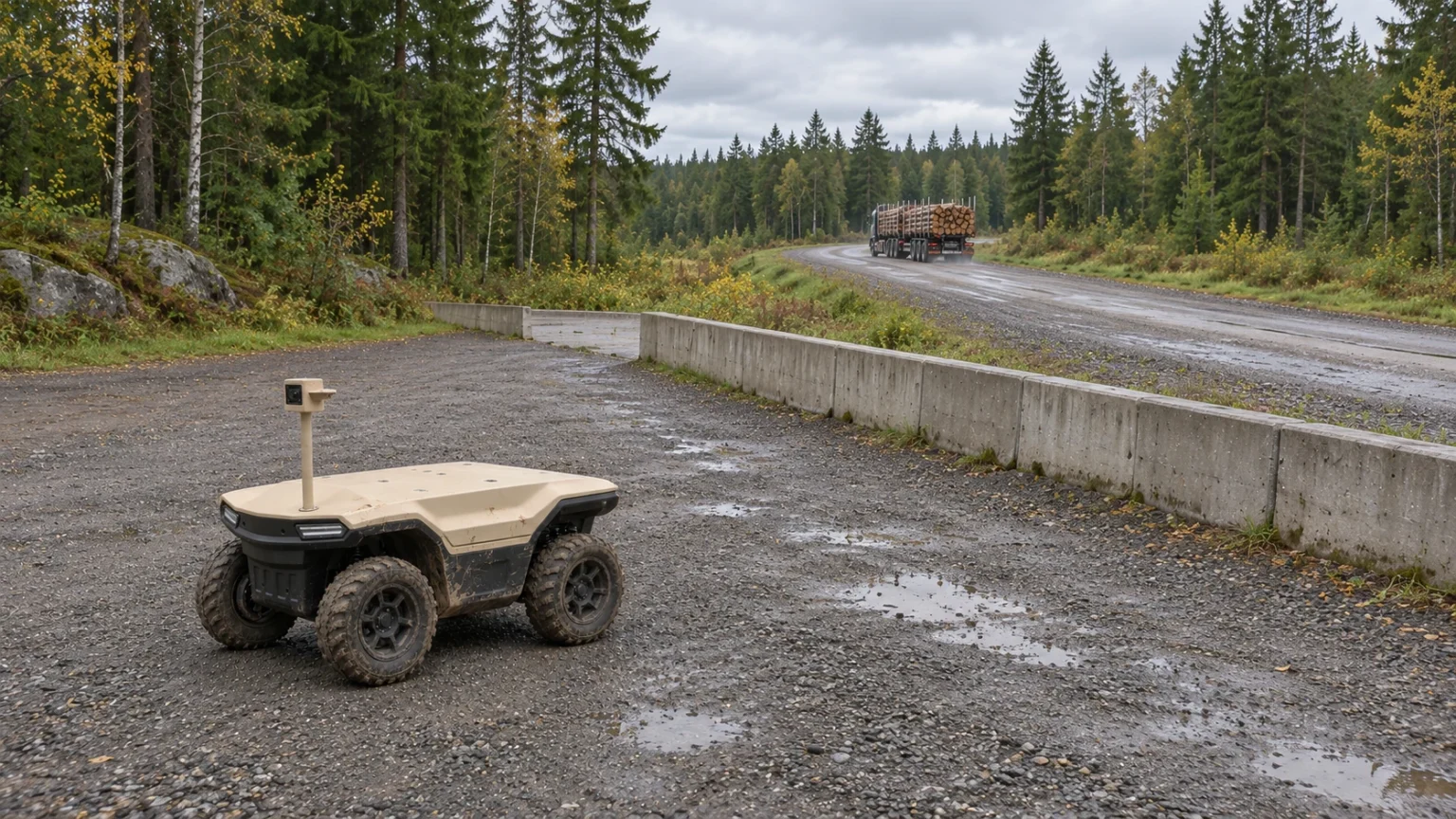
Forestry patrol robot mixed traffic planning starts with the haul-road operation. A small robot may be hard for a truck driver to see, and a stopped robot can still obstruct a vehicle’s swept path. The first question is whether the task can use a separate route or controlled time window, before discussing obstacle avoidance.
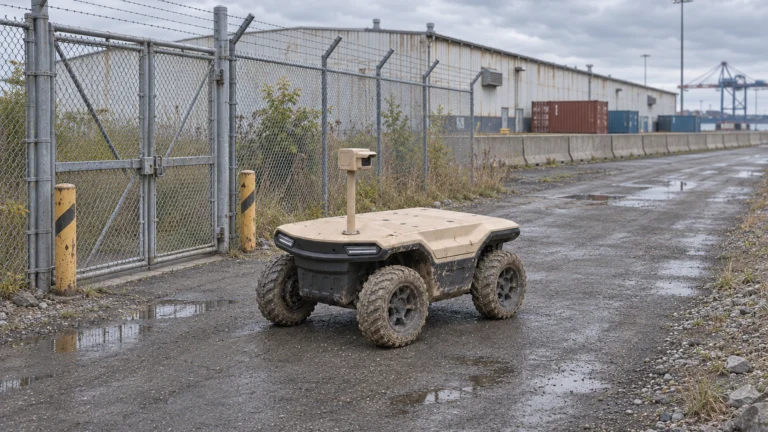
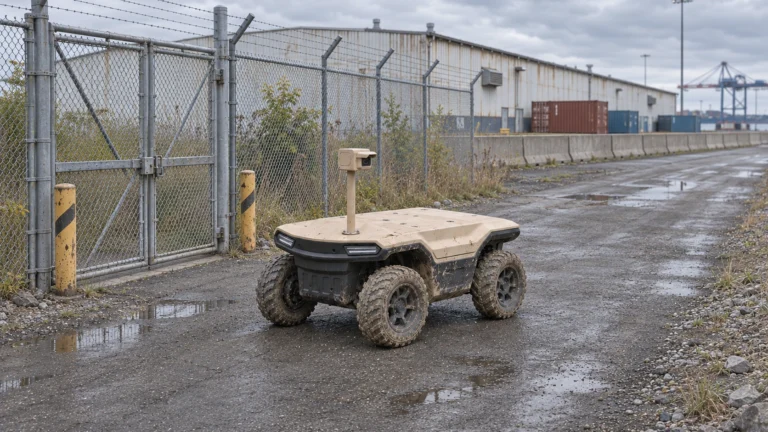
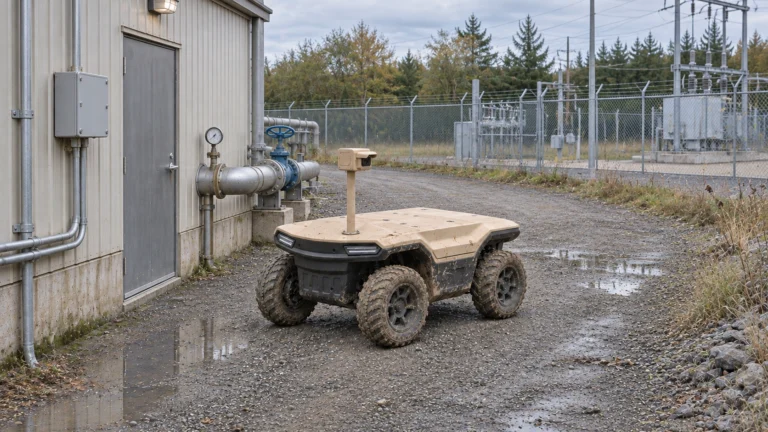
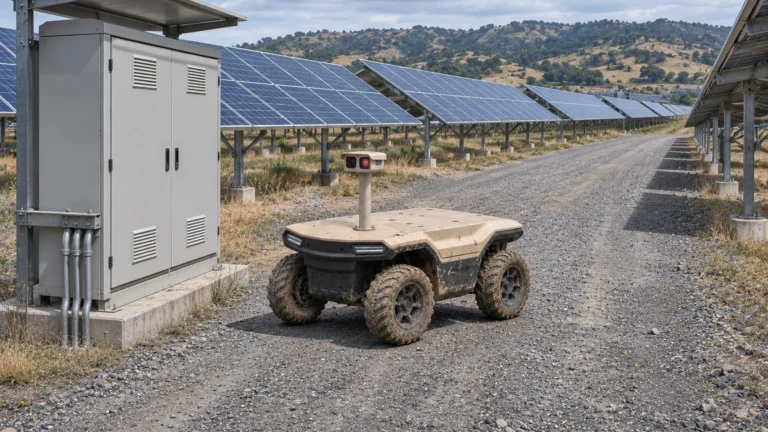
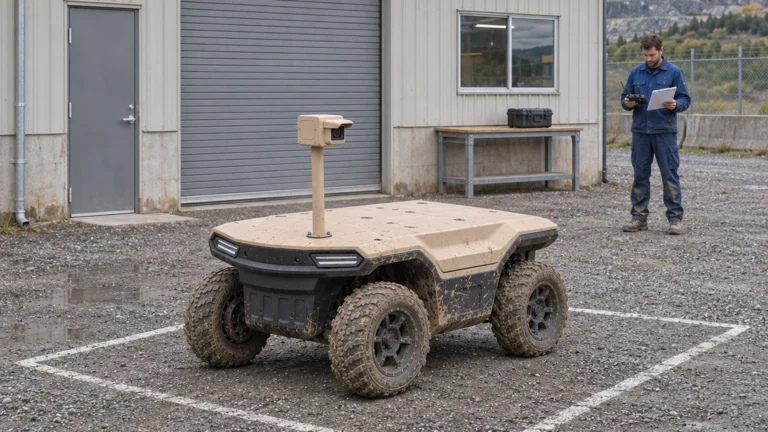
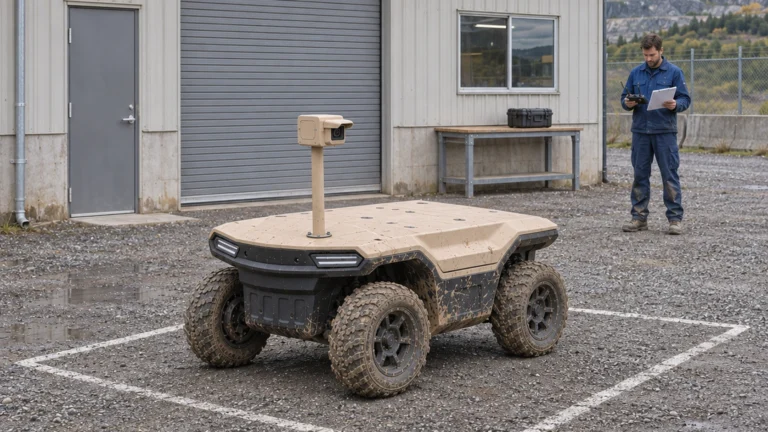
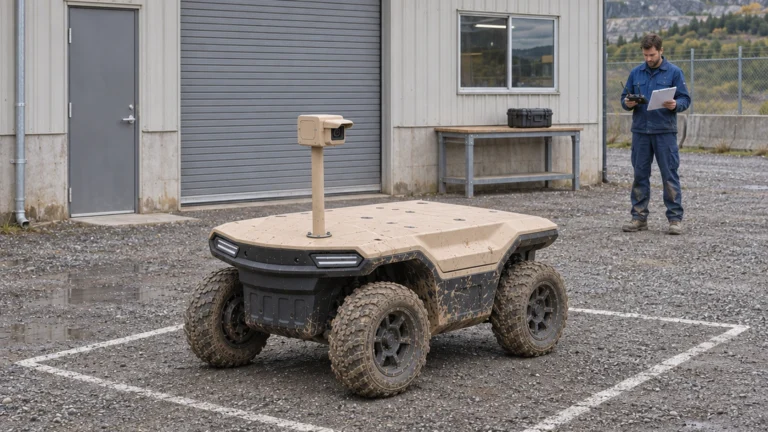
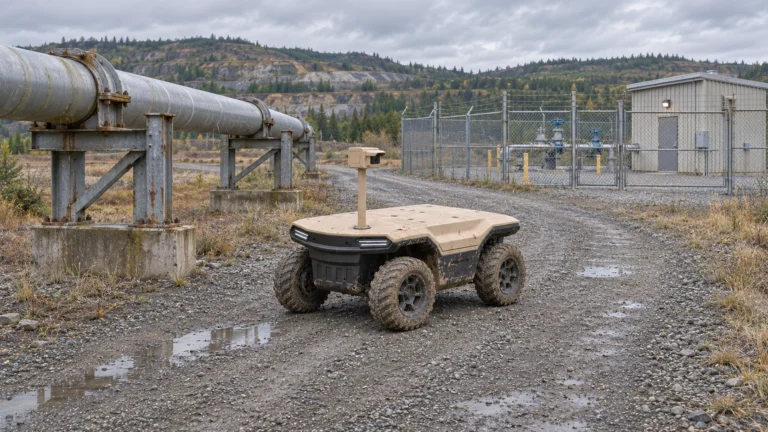
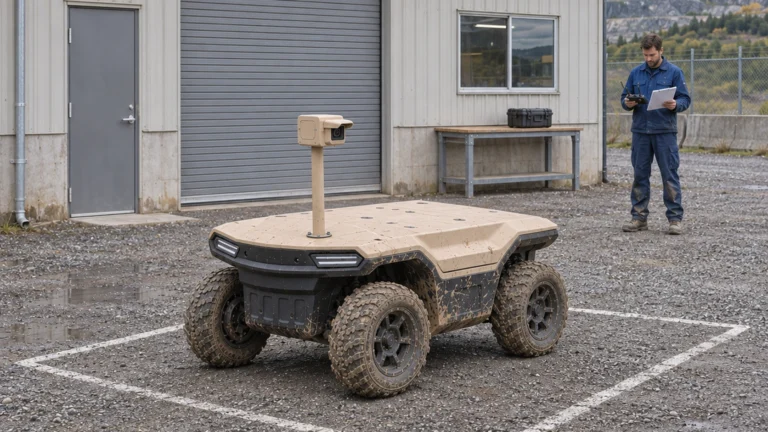
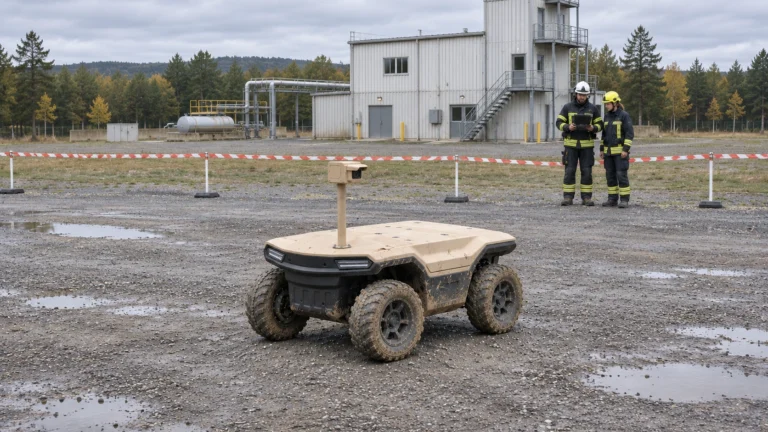
This guide considers Delta 150 with a proposed observation camera. AGV means Autonomous Ground Vehicle in this series; industrial AGV can also mean Automated Guided Vehicle. Outdoor AGV route safety depends on site controls and the verified configuration. The images show a conceptual separated holding bay, not an approved installation or a completed autonomous traffic trial.
At a glance
– Prefer separation or controlled time windows.
– A stopped robot must remain clear of truck work and swept paths.
– Verify takeover and exception handling before shared-route evaluation.
Contents
1. Survey road width, blind bends and passing places
2. Separate right of way and holding areas
3. Account for people, trucks and working machinery
4. Define speed reduction, stopping and human takeover
5. Plan for lost connection and localisation
6. Set time windows and route rejection criteria
7. Frequently asked questions (FAQ)
8. Sources and further reading
AI concept: proposed task-equipped Delta 150; configuration subject to confirmation.
Survey road width, blind bends and passing places
Walk the candidate route with the site’s traffic owner before introducing a robot. Record usable width, edge strength, drainage, visibility and passing places. Review the actual loaded trucks and trailers, including their turning and reversing movements. A wide-looking verge may be soft ground rather than a usable refuge.
For each blind bend or crest, identify who can see whom and when. Photograph both directions and mark conflict points on the route record. Assess the complete robot envelope with its camera mast. Do not invent a universal clearance or following distance; the site’s competent assessment must set conditions for the actual vehicles, ground and operating speeds.
Separate right of way and holding areas
Seek separation before accepting shared access. A dedicated patrol path, a physically protected holding bay or an enforceable time window may reduce the number of interactions that must be managed. The UK HSE guidance on separating pedestrians and vehicles is a general workplace-transport reference for separation and crossing planning, not a Delta certification or a universal forestry rule.
A holding area needs a clear entrance, room for the equipped robot and a route back into permitted operation. It must remain outside truck swept paths, loading areas and falling-material exposure. Painted markings alone should not be described as a protective barrier. Name the person who grants access and the process that prevents conflicting permissions.
Account for people, trucks and working machinery
Map the operation by activity and shift, not just by vehicle count. Include truck arrival, reversing, loading, excavator movement, pedestrian access and contractor visits. A road that is quiet between deliveries can become an active machine work zone when a loader starts.
List every conflict location with its owner and control. Camera observation should be possible from an approved position outside machine work areas; do not send the robot under a loader arm to obtain a closer view. Include the people who operate and recover the robot in the traffic plan. A robot-only map that omits its support team is incomplete.
Define speed reduction, stopping and human takeover
Define the permitted operating mode for each segment and who can request a stop, take control and authorise restart. Confirm the actual stop controls, control-link behaviour and mode indication with the integrator. A software pause, a protective stop and an emergency-stop function must not be treated as interchangeable without evidence for that configuration.
Reduced speed can be one control, but it does not remove a blind approach or create a protected waiting space. Validate detection, stopping and takeover in controlled conditions before any shared-route evaluation. Record conditions and interventions rather than promising that an operator can always react in time. If stopping would leave the robot in an exposed lane, change the route or traffic arrangement.
Plan for lost connection and localisation
Treat lost connection and inadequate localisation as distinct events. Specify how each is detected, how the vehicle responds, how the duty team is notified and who controls the affected area. Verify the configured behaviour on a controlled route. Do not assume that loss of the control link always leaves another communication channel available.
Do not improvise automatic return through active haul traffic. A recovery plan needs last usable position, traffic isolation, access for staff and suitable handling arrangements. If the robot cannot move clear, the site must have an agreed traffic response before people approach. Record the event and review the route before resuming the task.
Set time windows and route rejection criteria
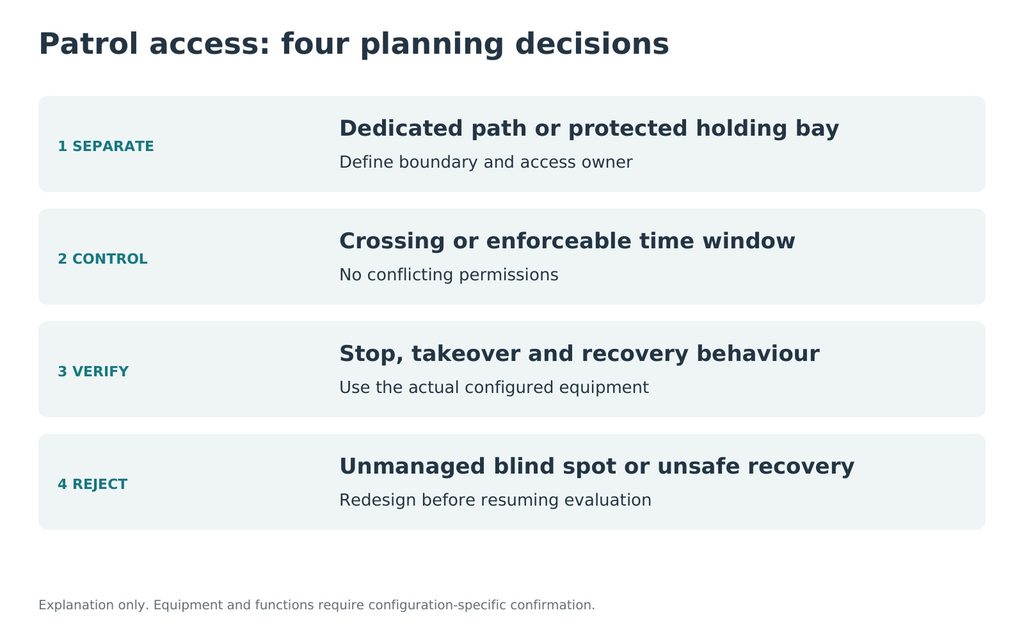
JINJIA planning framework; site-specific evidence is required.
A time window works only when its start, end, access authority and enforcement are clear. Link the patrol schedule to actual haul operations and unplanned work. Record who confirms the route is clear and who releases it back to truck traffic. A calendar entry without control of access is not effective separation.
| Decision | Evidence needed before evaluation |
| Separate path or bay | Defined boundary, access and responsible owner |
| Controlled crossing | Visibility, permissions and conflict control |
| Time-separated use | Enforceable window and release process |
| Exclude or redesign | Unmanaged blind spot, unsafe recovery or repeated conflict |
Agree stop-review triggers: changes to truck type, route works, failed separation, communication or location exceptions, and repeated intervention. Keep an excluded route excluded until its revised controls are reviewed. Discuss a Delta UGV/AGV configuration against the site task; Delta 500 and Delta 1000 need their own evaluation. Submit route video, heavy-vehicle flow, passing places and isolatable time windows to scope Delta 150 patrol access.
Frequently asked questions (FAQ)
A: No. Define route access, separation, traffic responsibilities and configuration-specific verification first.
Q: Is every road shoulder a safe holding area?
A: No. Check ground support, truck swept paths, work zones, visibility and permitted access.
Q: Does reduced speed solve a blind bend?
A: No. Visibility and conflict control still need an acceptable site-specific arrangement.
Q: Can a remote operator always rescue a conflict?
A: No. Link availability, view, delay and takeover behaviour require verification; route design must not depend on an unproven reaction.
Q: Should the robot return automatically after connection loss?
A: Do not assume that response. Agree and test the configured behaviour and recovery process before operation.
Q: What should the site provide for an initial review?
A: Route video, loaded vehicle types and flow, blind bends, passing and holding places, available isolation windows and the traffic owner.
Sources and further reading
1. UK HSE — Separating pedestrians and vehicles
General workplace-transport guidance on separation and crossings; not a Delta approval or a universal forestry traffic rule.
2. JINJIA — Delta UGV/AGV product family
Product-family context. The proposed task equipment and operating functions require confirmation for the supplied configuration.